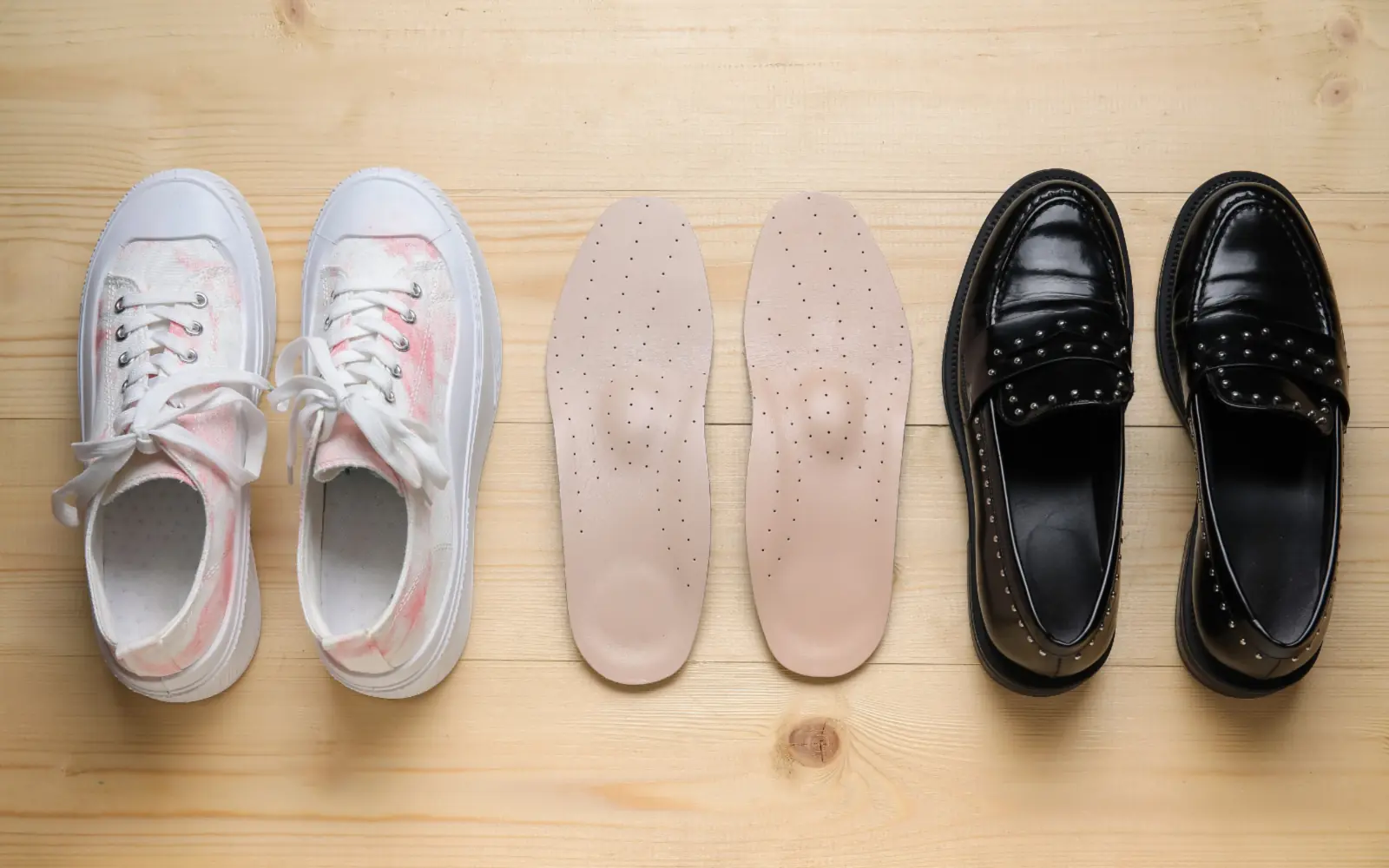
Shoes, inserts and equipment
What to Look For: Shoes, Inserts and Kit for Heel Pain
Judging a product for yourself beats memorising somebody’s top ten. Here is what actually matters in each category, and who each one is wrong for.
How this page and our review site divide the work. Heel Guide explains what each kind of product has to do for each kind of heel pain, and who it is wrong for. Specific models are named, measured and compared on our sister site, Podiatrist Tested, written by the same surgeon. Learn the criteria here and you can judge any product, including the ones that launch next year.
Guides by heel problem
- Shoe and insole picks, by problem
- Shoes for heel pain, matched to the cause
- Best shoes for plantar fasciitis
- Shoes for Achilles tendonitis
- Insoles for heel pain: which insert for which heel
- Insoles for plantar fasciitis: prefab vs custom
- Heel cups: who they help, and which type
- Heel lifts for Achilles tendonitis
- Plantar fasciitis socks and compression sleeves
- Night splints and braces
On this page
Shoe and insole picks, by problem
Named, current models assessed against the features below by Dr. Biernacki, with who each one suits and who should skip it.
Running shoes for plantar fasciitis
Neutral, stability and maximal-cushion picks, and when to stop running.
Walking shoes for plantar fasciitis
Walking-specific and running-derived shoes for long days on foot, in wide fittings.
Shoes for Achilles tendonitis
Higher-drop shoes and heel collars that leave the insertion alone.
Shoes for heel pain, by where it hurts
Underneath, at the back, or a thin heel pad: different shoes for each.
Shoes for heel spurs
What helps a heel with a spur, given the spur is rarely what hurts.
Sandals for plantar fasciitis
Contoured footbeds and recovery sandals, and why flip-flops struggle.
Slippers and house shoes
The change most people skip: support from the first step out of bed.
By brand, and head to head
- Best Hoka for plantar fasciitis
- Best Brooks for plantar fasciitis
- Hoka vs Brooks for plantar fasciitis
- Hoka vs On Cloud for plantar fasciitis
- Hoka Bondi vs Clifton
- Brooks Ghost vs Glycerin
- Are Birkenstocks good for plantar fasciitis?
- Are Crocs good for plantar fasciitis?
Shoes
Four features carry almost all of the benefit, and none of them is the brand on the side.
| Feature | How to test it in the shop | Why it matters |
|---|---|---|
| A firm heel counter | Squeeze the back of the shoe between finger and thumb. It should resist, not fold flat. | Controls the heel and stops it rolling. A collapsing counter lets the fascia take more load. |
| Torsional stiffness | Hold heel and forefoot and try to wring the shoe like a towel. A little give, not a spiral. | A shoe that twists freely offers the arch no help at all. |
| Bends at the toes, not the middle | Push the toe up. It should hinge where your toes hinge, not fold in half at the arch. | A shoe that folds at the arch is a shoe with no midfoot support. |
| Some heel-to-toe drop | Look at it side on: heel sitting a little higher than the forefoot. | A raised heel reduces load through the calf and Achilles. Completely flat shoes are a common aggravator, especially for insertional Achilles problems. |
Wrong for: a tall, stiff heel counter pressing directly on an insertional Achilles problem or a Haglund’s bump will keep that going indefinitely — there, a softer or open back is the better answer. And a maximally cushioned shoe can feel wonderful in the shop while providing no support at all. Soft is not the same as supportive.
The thing most people get wrong is what they wear indoors. A supportive shoe for the commute plus barefoot on a hard kitchen floor all evening is a plan that largely cancels itself out.
Full guides: shoes for heel pain, by cause, plantar fasciitis and Achilles tendonitis.
Inserts and orthoses
Start with an off-the-shelf insert. Trials comparing prefabricated inserts against custom orthoses for ordinary plantar heel pain have often found similar results, so the sensible order is the cheap one first.
- Real arch contour, not a flat foam sheet with a gel dot under the heel.
- Supportive, not painful. An insert that digs into the arch will not get worn, and an unworn insert has no effect.
- A deep heel cup helps hold the heel’s fat pad where it belongs under the bone — particularly relevant if your pain is central and bruise-like.
- Check it fits the shoe. A good insert crammed into a shoe with no room lifts your heel out of the counter and undoes the point.
- Break it in over a week or two rather than wearing it for a twelve-hour shift on day one.
Move to custom when an off-the-shelf insert helped but not enough, when the foot is an unusual shape, or when there is a specific structural problem to correct.
Full guides: insoles for heel pain, insoles for plantar fasciitis, and heel lifts for pain at the back of the heel.
Night splints
These hold the ankle near a right angle overnight so the fascia does not spend eight hours shortened — which is why the first step in the morning is the worst one. They have supporting evidence, particularly for first-step pain and for problems that have been going on for months.
The deciding factor is tolerance. The rigid boot style gives a more definite stretch and a fair number of people cannot sleep in one. The soft sock-style version is easier to sleep in and stretches less. The best splint is the one still on your leg at 3am. Wrong for: anyone with fragile skin, neuropathy or circulation problems — a device strapped on for eight unsupervised hours needs a clinician’s say-so first.
Full guides: night splints, and plantar fasciitis socks, sleeves and braces — including the sock-style splint.
Heel cups and pads
Most useful for fat pad problems — that deep, bruise-like central heel pain that is much worse barefoot on hard floors — where the goal is cushioning and containing the pad rather than supporting the arch. A silicone cup with a deep wall does more than a flat gel pad. For classic plantar fasciitis they are a comfort measure rather than a treatment.
Full guide: heel cups — who they help, and gel, silicone or firm.
Taping
Low-Dye arch taping supports the arch mechanically and can give useful relief for a few days at a time. It doubles as a cheap diagnostic: if taping the arch helps noticeably, arch support in a shoe or insert is likely to help too. It is not a long-term solution, and repeatedly taping the same skin needs care.
Step-by-step low-Dye and KT tape methods are on how to tape your foot for plantar fasciitis, and the Achilles version on KT tape for Achilles tendonitis.
Massage balls, rollers and massage guns
Rolling the arch over a ball or a frozen bottle relieves symptoms for a while and is harmless for most people. Treat it as symptom relief, not treatment — it does not replace the stretching and loading that changes the tissue. Percussion devices are the same story with a motor. Wrong for: anyone with reduced sensation, fragile skin or circulation problems, where aggressive self-massage is a real risk.
How to do it well, in order of usefulness, is on plantar fasciitis massage.
Walking boots
Occasionally the right call for a very irritable heel or a suspected bone stress injury, and always a clinician’s decision rather than a purchase. Boots weaken the calf quickly and stiffen the ankle, so they need an end date and a plan for coming out of them.
When one is worth it, for how long, and how to come out of it: walking boots for plantar fasciitis.
Before buying anything that straps to the foot — splints, braces, compression, rigid inserts — if you have diabetes, neuropathy, poor circulation, fragile skin or an open wound, ask the clinician who knows your feet first. A device that rubs on a foot which cannot feel it is how small problems become serious ones.
Reviews of specific shoes and insoles
Our own picks and comparisons are listed above. For more models, sizes and retailer prices, see Podiatrist Tested. Its retailer links are affiliate links, so we may earn a commission at no extra cost to you.
- Best shoes for plantar fasciitis →
- Walking shoes for plantar fasciitis →
- Shoes for Achilles tendonitis →
- Shoes for heel fat pad atrophy →
- Insoles for plantar fasciitis →
- Sandals for plantar fasciitis →
- Slippers for plantar fasciitis →
- All individual shoe reviews →
- Koc TA, et al. Heel Pain – Plantar Fasciitis: Revision 2023. Clinical Practice Guidelines, Journal of Orthopaedic & Sports Physical Therapy.
- American Academy of Orthopaedic Surgeons, OrthoInfo. Plantar Fasciitis and Bone Spurs.
Heel Guide earns commission on some product links — see the affiliate disclosure. A commission never decides what appears here, and no product is named until it clears the bar set out in our editorial policy.
Related heel pain guides
- Best shoes for plantar fasciitis
- Insoles and orthotics for plantar fasciitis
- Plantar fasciitis treatment
- Plantar fasciitis exercises and stretches
- Heel pain: how to work out what you have
- Taping for plantar fasciitis — how to apply it, and why the response tells you whether an insert will help.