Heel pain treatment
Walking boot for plantar fasciitis: when it helps, and how long to wear it
A walking boot is not a first-line treatment for plantar fasciitis. For a heel so irritable that every step keeps it inflamed, a short, planned spell in one can break the cycle, as long as it comes with an end date and a way out.
Boots get prescribed, bought online and borrowed from relatives for heel pain all the time. Sometimes that is exactly right. Often it is a month of calf weakness that leaves the heel no better. This page covers who a boot is for, how long to wear it, how to wear it without creating new problems, and how to come out of it.
On this page
Does a walking boot help plantar fasciitis?
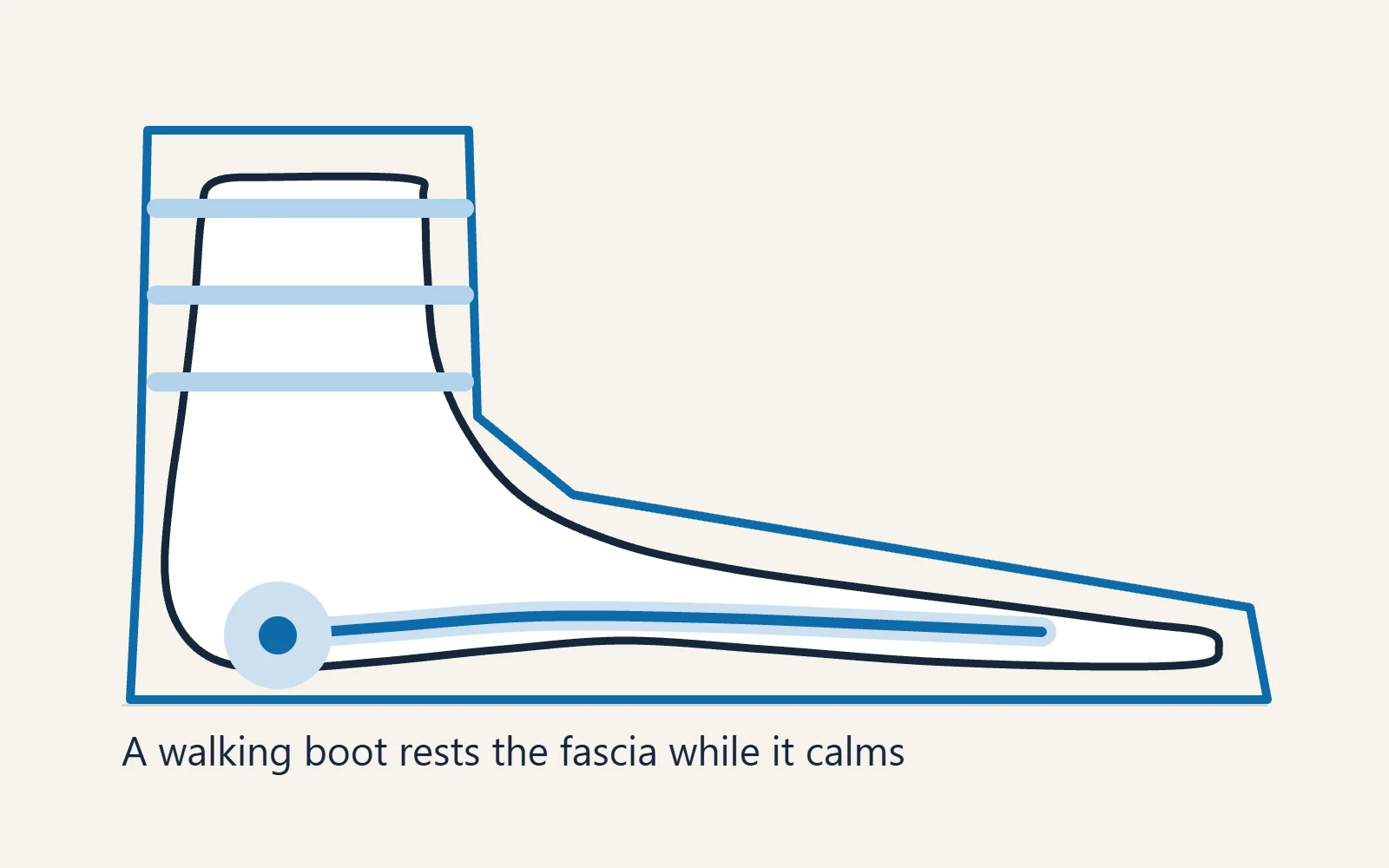
It can, for the right heel. A walking boot holds the ankle still and takes much of the stretch out of the plantar fascia with every step, which lets a heel that is being re-irritated all day finally settle. The evidence is modest and old. In a study of people whose heel pain had lasted about a year and failed other treatment, a below-knee walking cast gave complete relief in a quarter of the heels followed up and improvement in most of the rest, though almost half of the patients were not satisfied with it. The authors’ conclusion was that casting is a reasonable thing to try before anyone considers surgery.
That is the right way to think about a boot: a short-term reset for a stubborn or severe case, not a treatment in its own right. It does not strengthen anything, and every week in it weakens the calf.
Who a boot is for, and who it is not
| A boot is reasonable when | A boot is the wrong tool when |
|---|---|
| Pain is severe enough to limit ordinary daily walking | Pain is mild, mainly the first steps of the day (a night splint targets that) |
| A sensible programme of stretching, supportive shoes and inserts has not calmed it | The first-line basics have not been tried properly yet |
| The heel is re-flaring every day at work and needs a break from load | It has lasted a year or more and nothing else has helped; the problem by then is usually not load |
| A stress fracture has not been ruled out and needs protecting while that is checked | You have diabetes, neuropathy or poor circulation and nobody is supervising the boot |
If there is any chance the heel bone itself is injured, that changes the plan: a heel stress fracture is usually protected in a boot for longer and with a stricter weight-bearing plan, which is a clinician’s decision.
How long to wear a walking boot for plantar fasciitis
For plantar fasciitis, usually two to four weeks, and rarely longer. A boot for this problem should have its end date set the day it goes on. The common mistake is the open-ended boot: the pain is manageable while you are in it, so you stay in it for three or four months, and come out with a tight, weak calf, weak foot muscles and the same heel.
Wear it when you are up and about, especially on long days on your feet. Most people take it off to sleep and for the stretches; a night splint is the purpose-built tool for overnight.
How to wear it
- Level the other side. A boot sole is thick, and walking for weeks with one leg longer than the other is a common cause of new hip, knee and back pain. Wear a shoe with a thicker sole on the other foot, or add a shoe leveller to it.
- A long, thin sock under the liner, higher than the boot, to stop rubbing.
- Snug, not tight. Straps firm enough that the heel does not lift inside the boot, loose enough that the toes stay warm, pink and feeling normal. If the boot has air cells, inflate them until snug, not hard.
- Keep the stretches going. Take it off two or three times a day for the plantar fascia and calf stretches. This is what stops the calf stiffening.
- Driving. Driving with a boot on the right foot is generally not advised, because it changes how you brake. Ask your clinician before you drive, and check with your insurer.
Take the boot off and get checked if the calf becomes swollen, warm, red or painful, if the toes go numb, pale or blue, or if the skin breaks down anywhere under the boot. People with diabetes, neuropathy or poor circulation should only use a boot under supervision.
Coming out of the boot
How you come out matters as much as going in. Going straight from the boot back to your old shoes and your old workload is the usual reason the pain returns within a week or two. A gradual exit works better:
- Week one out: half the day in the boot, half in a supportive shoe with an arch-supporting insert.
- Week two: shoe most of the day, boot only for the longest or hardest stretches on your feet.
- Then boot off, supportive shoes indoors and out. No barefoot walking on hard floors for at least the next month.
- Keep the stretches daily and start the strengthening, including the heel raise with a towel under the toes, to rebuild the calf and the fascia.
- If the pain climbs back during the change-over, slow the transition down rather than going back to full-time boot.
Boot, night splint or cast?
| Device | What it does | Best for |
|---|---|---|
| Walking boot | Protects the heel and fascia while you are on your feet | Severe, daily flares that are not settling with first-line care |
| Night splint | Stops the fascia shortening overnight | First-step pain in the morning |
| Below-knee cast | Holds the foot completely still, cannot be removed | Occasionally used when a removable boot is not being worn, or before surgery is considered |
For specific boots and what to look for in one, Dr. Biernacki’s practice site has a longer guide to walking boots for plantar fasciitis.

Most heels settle without a boot. Dr. Tom’s free 14-day plan from The Heel Pain Playbook sets out what he tries first, day by day, with photos of each move and a tracker to bring to your visit if you still need one. Get the free 14-day plan.
Common questions
Does a walking boot help plantar fasciitis?
For a severe or stubborn case, it can break the cycle by protecting the fascia from being stretched with every step for a few weeks. It does not heal the tissue or strengthen anything, so it works best as a short reset inside a plan that includes stretching, supportive shoes and strengthening.
How long should I wear a walking boot for plantar fasciitis?
Usually two to four weeks, rarely longer, with the end date agreed at the start. Longer spells weaken the calf and foot muscles and often leave people worse off when they come out.
Should I sleep in a walking boot for plantar fasciitis?
Usually not, unless your clinician has asked you to. The boot is for walking. If first-step pain in the morning is the problem, a night splint is designed for that and is far easier to sleep in.
Can I buy a walking boot myself for heel pain?
You can, but it is worth a diagnosis first. A heel that turns out to be a stress fracture needs a stricter plan than a boot bought online provides, and a boot on a foot with poor feeling or circulation needs supervision.
Why does my hip or back hurt in a walking boot?
Because the boot makes that leg longer. Wear a thicker-soled shoe on the other foot, or a shoe leveller, for as long as you are in the boot.
What happens after the walking boot?
Two weeks of gradually swapping boot time for a supportive shoe with an insert, daily stretching, strengthening to rebuild the calf, and no barefoot walking on hard floors for at least a month. Stopping the boot abruptly and going back to full activity is the usual reason pain returns.
Related heel pain guides
- Plantar fasciitis treatment — where a boot sits on the treatment ladder.
- Night splints — the device for first-step morning pain.
- Plantar fasciitis stretches and exercises — what to keep doing in the boot, and after it.
- Heel stress fracture — when a boot is protecting bone rather than fascia.
- How long plantar fasciitis lasts — the realistic timeline, with or without a boot.
- When plantar fasciitis hurts too much to walk
- Tisdel CL, Harper MC. Chronic plantar heel pain: treatment with a short leg walking cast. Foot & Ankle International, 1996.
- Buchanan BK, Sina RE, Kushner D. Plantar Fasciitis. StatPearls, NCBI Bookshelf.
- Allam AE, Chang KV. Plantar Heel Pain. StatPearls, NCBI Bookshelf.
- Koc TA, et al. Heel Pain – Plantar Fasciitis: Revision 2023. Clinical Practice Guidelines, Journal of Orthopaedic & Sports Physical Therapy.
Heel pain in Michigan?
If your heel is bad enough that a boot is on the table, it is worth an examination first to confirm what is being protected. Dr. Biernacki sees heel pain in Howell and Bloomfield Township.
This page is education, not a diagnosis. Use a walking boot under a clinician’s guidance, particularly if you have diabetes, neuropathy or circulation problems. Read our editorial policy for how it was written and what it will not claim.