Heel pain causes
Achilles Tendonitis: Why Where It Hurts Changes the Treatment
Pain at the back of the heel has two versions, and the exercise that fixes one can aggravate the other. Getting that distinction right is most of the battle.
If your heel pain is at the back rather than underneath, the Achilles is the usual suspect. Achilles heel pain comes in two versions, and they are treated differently. And the first question is not how bad it is or how long you have had it. It is: how far up from the heel bone is the sore spot?
On this page
Two conditions with one name
| Midportion | Insertional | |
|---|---|---|
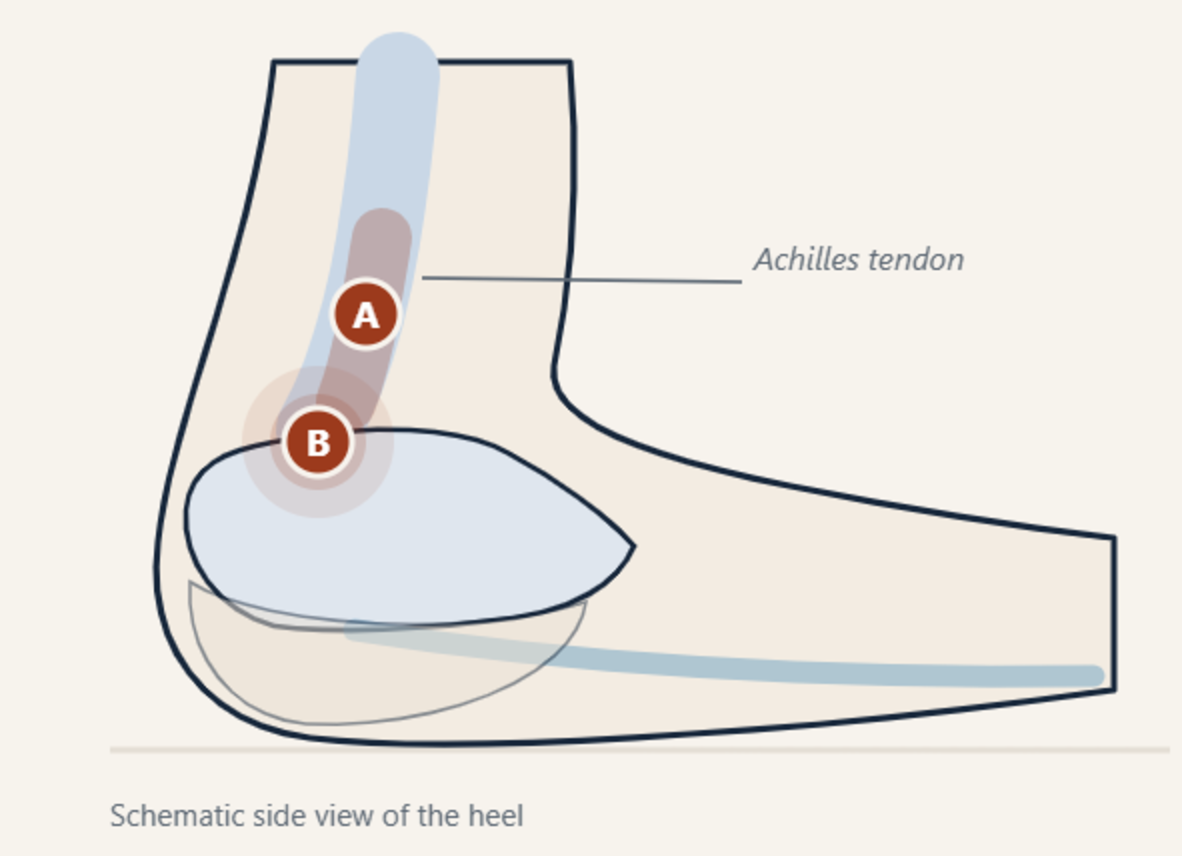
| Where it hurts | Roughly 2–6 cm above the heel bone, in the cord of the tendon itself | Right at the back of the heel bone, where the tendon anchors |
| What you feel | A thickened, tender segment you can pinch between finger and thumb | Tenderness on the bone itself, often with a bump; shoes rub it |
| Typical person | Runners and people who increased activity | Wider range, including people who are not athletes; often middle-aged and over |
| Response to stretching into dorsiflexion | Usually tolerated | Often makes it worse — it compresses the tendon against the bone |
This is the single most useful thing on this page. Deep calf stretching and full-range heel drops off a step are standard advice for midportion problems and are frequently the wrong advice for insertional ones, because at the bottom of that movement the tendon is squeezed against the back of the heel bone. Plenty of people spend months diligently making an insertional tendon angrier.
What is actually going on in the tendon
As with the plantar fascia, the name oversells the inflammation. What is generally found in a long-standing painful Achilles is tendinopathy — disorganised collagen, increased ground substance, new blood vessels and nerve ingrowth — rather than a classically inflamed tendon. That matters for the same reason: the treatments that change the tissue are loading programmes, not anti-inflammatories, and it explains why steroid injection into or around the Achilles is approached with real caution given the risk of rupture.
Recognising it
- Pain and stiffness at the back of the heel or lower calf, worst first thing in the morning and when starting activity.
- It often warms up during exercise and then hurts more afterwards and the next morning.
- Local tenderness — you can put a finger on it — and sometimes a palpable thickening or a firm bump on the bone.
- A gradual onset over weeks. Sudden onset is different: see the warning below.
A sudden pop or snap at the back of the ankle, a feeling of being kicked or shot in the calf, sudden weakness pushing off, or inability to rise onto tiptoes on that leg, is an Achilles rupture until proven otherwise. That needs same-day assessment, not a stretching programme. Also seek prompt review if the area is hot, red and swollen with fever, or if you have recently taken a fluoroquinolone antibiotic — that class carries a recognised association with tendon injury and rupture.
Midportion Achilles tendonitis: treatment
The mainstay is a progressive loading programme. The classic protocol uses slow heel raises — including the lowering phase, done off a step so the heel drops below the level of the toes — performed with the knee straight and again with the knee bent, in high volume, daily, over about twelve weeks. It is normal for the tendon to be uncomfortable during the exercise; what should not happen is pain climbing week on week or lingering badly into the next day.
Alongside it: reduce the spiking load for a few weeks without stopping altogether, look at what changed before the pain started, and be patient. Twelve weeks is the honest timescale, and the programme has to be done nearly every day to work.
Insertional Achilles tendonitis: treatment
Same principle, different range. The loading work is done without letting the heel drop below level — heel raises from the floor rather than off a step — so the tendon is not compressed against the bone at the bottom of the movement. Isometric holds are often the gentlest place to start when it is very irritable.
Add to that:
- A small heel lift in both shoes. Raising the heel a little reduces the tension and the compression at the insertion, and often makes an immediate difference. Both shoes, so you do not create a leg-length problem.
- Shoes that do not press on the sore spot. A stiff, high heel counter rubbing directly on an insertional problem or a Haglund’s bump will keep it going indefinitely. Open-backed shoes for a while are genuinely useful advice here.
- Patience. Insertional problems are generally slower to settle than midportion ones. Six months is not unusual.
Step-by-step instructions for both programmes, with a printable sheet, are on the Achilles tendonitis exercises page. If you want to try tape for comfort while you do them, see KT tape for Achilles tendonitis.
When the basics have not worked
- Shockwave therapy has supporting evidence in Achilles tendinopathy that has resisted a proper loading programme, and is often used alongside the exercises rather than instead of them.
- Formal physical therapy, for the same reason as with the fascia: the programmes work when they are done properly, and most people do them approximately.
- Imaging — ultrasound or MRI — when the diagnosis is uncertain, when there is a question of a partial tear, or before considering surgery.
- Surgery for a minority: debridement of degenerate tendon, removal of a Haglund’s prominence, sometimes tendon transfer where a lot of tendon is diseased. Recovery is months, not weeks.
Corticosteroid injection into the Achilles is generally avoided because of the rupture risk. That is a meaningful difference from plantar fasciitis, where injection has a defined place.
One more distinction worth making before you treat this: if the tenderness is greater when you squeeze the soft hollows either side of the tendon than along the tendon itself, or the sore spot is where the shoe counter presses rather than in the tendon, read heel bursitis and which of the two bursae is inflamed. They sit millimetres apart, they frequently occur together, and the standard heel-drop stretch is wrong for one of them.
Shoes and inserts for this heel. Heel-to-toe drop and the back of the shoe matter more than arch support for an Achilles. See shoes for Achilles tendonitis, and heel lifts, which outperformed eccentric exercise in one trial of mid-portion tendinopathy.
Common questions
How long does Achilles tendonitis take to heal?
For a midportion problem treated with a proper loading programme, about twelve weeks is the usual timescale, and the programme has to be done almost daily to get there. Insertional problems are typically slower — three to six months, sometimes longer. Cases that have been going on for a year before anyone started treating them properly take longer again. The single biggest predictor of a slow recovery is a programme done sporadically.
Should I stretch my Achilles?
If the pain is in the cord of the tendon a few centimetres above the heel, generally yes. If it is right at the bone where the tendon attaches, deep stretching into dorsiflexion often makes it worse, because it compresses the tendon against the heel bone. That is the whole midportion-versus-insertional distinction, and it is why “stretch it” is such unreliable advice for the back of the heel. If you are not sure which you have, work within a comfortable range and get it examined.
Can I keep running?
Often, at reduced volume, provided pain during the run stays modest, settles within 24 hours, and is not increasing week on week. Those three tests are the ones to apply after each session. Flat, even surfaces and avoiding hills and speed work help, since both load the tendon hard. Complete rest is rarely the answer — tendons respond to graded load, and a deconditioned tendon fails again on return.
What is the bump on the back of my heel?
Commonly a Haglund’s deformity — a bony prominence at the upper back corner of the heel bone. On its own it is just a shape. It becomes a problem when a stiff heel counter presses on it, irritating the bursa and the tendon insertion between shoe and bone. Footwear changes and taking the pressure off do most of the work; surgery to reduce the bump is reserved for cases that do not settle.
Is it tendonitis or a tear?
A gradual onset over weeks with morning stiffness that warms up points to tendinopathy. A sudden pop, a sensation of being struck in the back of the leg, difficulty pushing off and inability to do a single-leg heel raise point to a rupture, and that is an urgent assessment rather than something to manage at home. Partial tears sit in between and are one of the situations where imaging genuinely changes the plan.
Is heel tendonitis the same as Achilles tendonitis?
Usually, yes. When people say heel tendonitis they mostly mean insertional Achilles tendonitis: pain and stiffness where the tendon attaches to the back of the heel bone, often with a tender bump there. Pain under the heel is a different problem, usually plantar fasciitis, and the plantar fascia is not a tendon. Pain on the inner side of the heel and ankle can come from the posterior tibial tendon, and on the outer side from the peroneal tendons. Where it hurts tells you which one it is, and the heel pain map sorts them by location.
Related heel pain guides
- Best shoes for Achilles tendonitis
- Heel bursitis
- Haglund’s deformity (bump at the back of the heel)
- Sever’s disease (heel pain in children)
- Calcaneal stress fracture
- Best shoes for plantar fasciitis
- Heel pain in the morning
- Heel pain: how to work out what you have
- Heel pain in runners
- Achilles tendonitis exercises and stretches
- KT tape for Achilles tendonitis
- Back of heel pain
- Insertional Achilles tendonitis
- Achilles tendon rupture: signs and the squeeze test
Back-of-heel pain in Michigan?
Insertional Achilles problems are the ones most often treated with exactly the wrong exercise for months. If yours is not moving, getting the type confirmed is worth an appointment. Dr. Tom Biernacki sees these at Balance Foot & Ankle.
Howell — 4330 E Grand River Ave, Howell, MI 48843
Bloomfield Township — 43494 Woodward Ave #208, Bloomfield Township, MI 48302
Monday to Thursday, 9:00am–4:30pm; Friday, 9:00am–2:30pm · (810) 206-1402
Further reading
- Alfredson H, Pietilä T, Jonsson P, Lorentzon R. Heavy-load eccentric calf muscle training for the treatment of chronic Achilles tendinosis. American Journal of Sports Medicine, 1998 — the origin of the heel-drop protocol.
- Martin RL, Chimenti R, Cuddeford T, et al. Achilles pain, stiffness, and muscle power deficits: midportion Achilles tendinopathy revision 2018. Journal of Orthopaedic & Sports Physical Therapy, 2018.
- U.S. Food and Drug Administration safety communications on fluoroquinolone antibiotics and tendon injury.
This page is education, not a diagnosis. See our editorial policy, and if you are unsure which type you have, get it examined rather than guessing — the treatments diverge.