Heel pain causes
Heel fat pad atrophy: the deep bruise in the middle of the heel
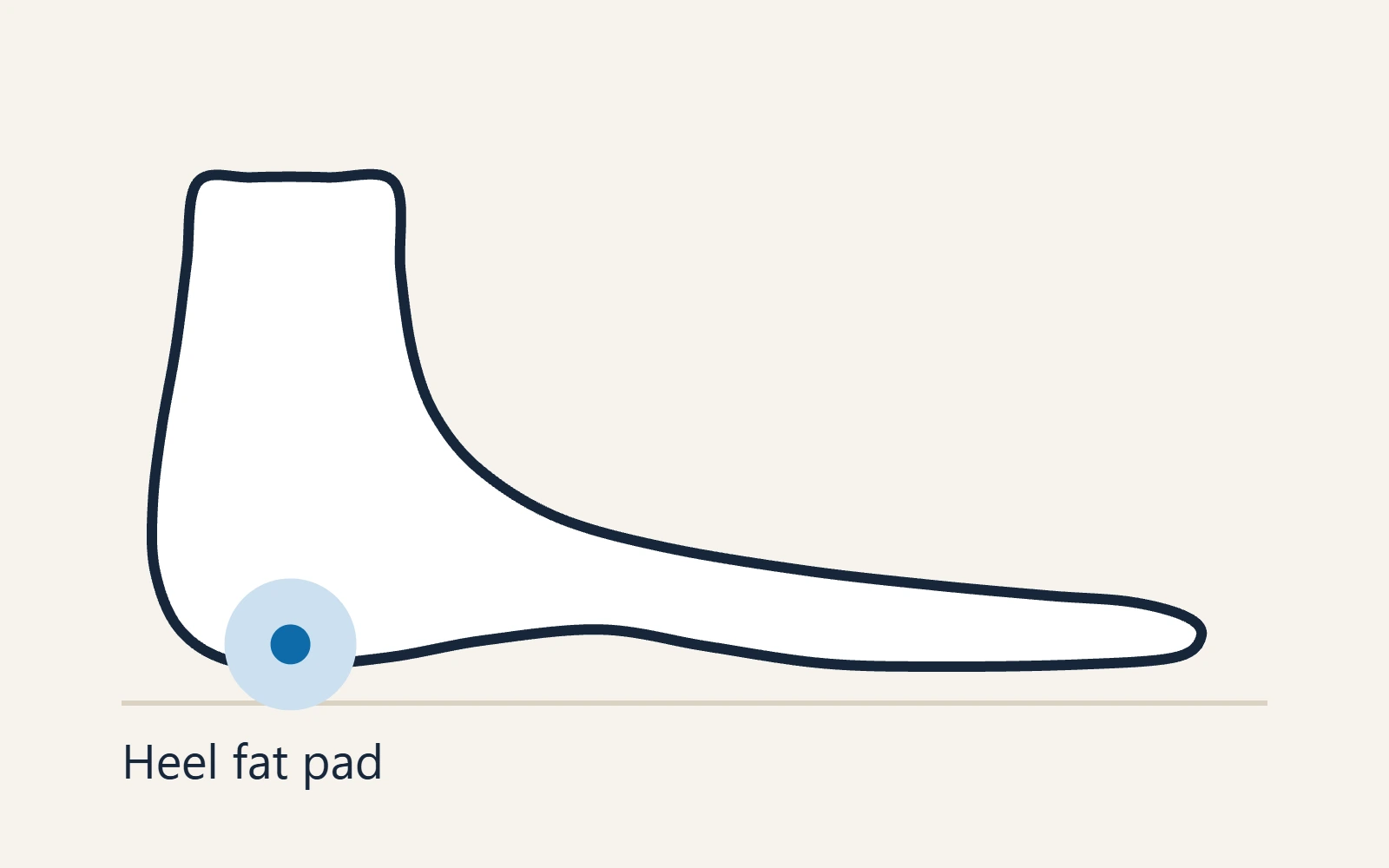
A bruise-like ache in the centre of the heel that is at its worst barefoot on a hard floor is usually not plantar fasciitis. It is the heel’s shock absorber wearing thin — and almost everything that helps fasciitis is aimed at the wrong place.
This is one of the most commonly mislabelled problems in the foot. The heel hurts, so it gets called plantar fasciitis, and the patient is sent away with a stretching programme and a firm arch support. Some months later the heel is no better, and the conclusion drawn is that this must be a stubborn case of fasciitis. Frequently it was never fasciitis at all.
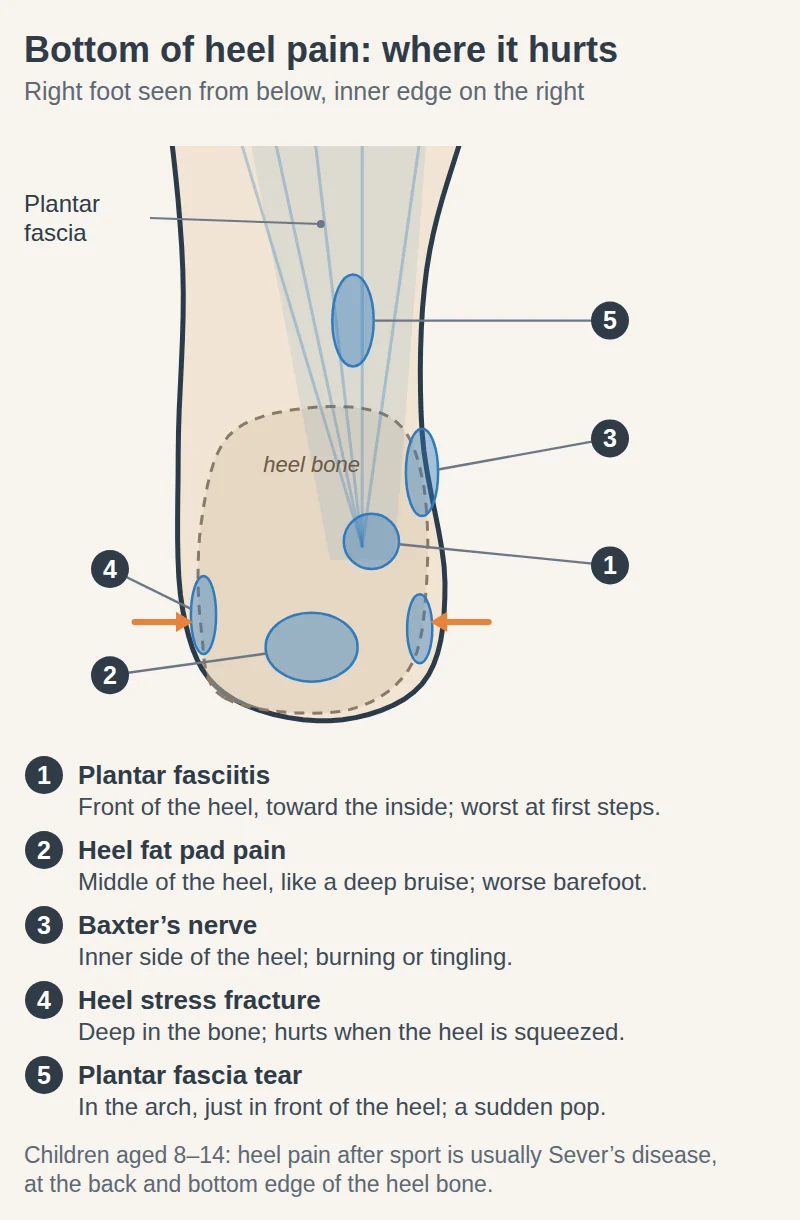
The tell is in two details: where exactly it hurts, and what happens when you stand on a tiled floor with bare feet.
On this page
What the heel fat pad actually is
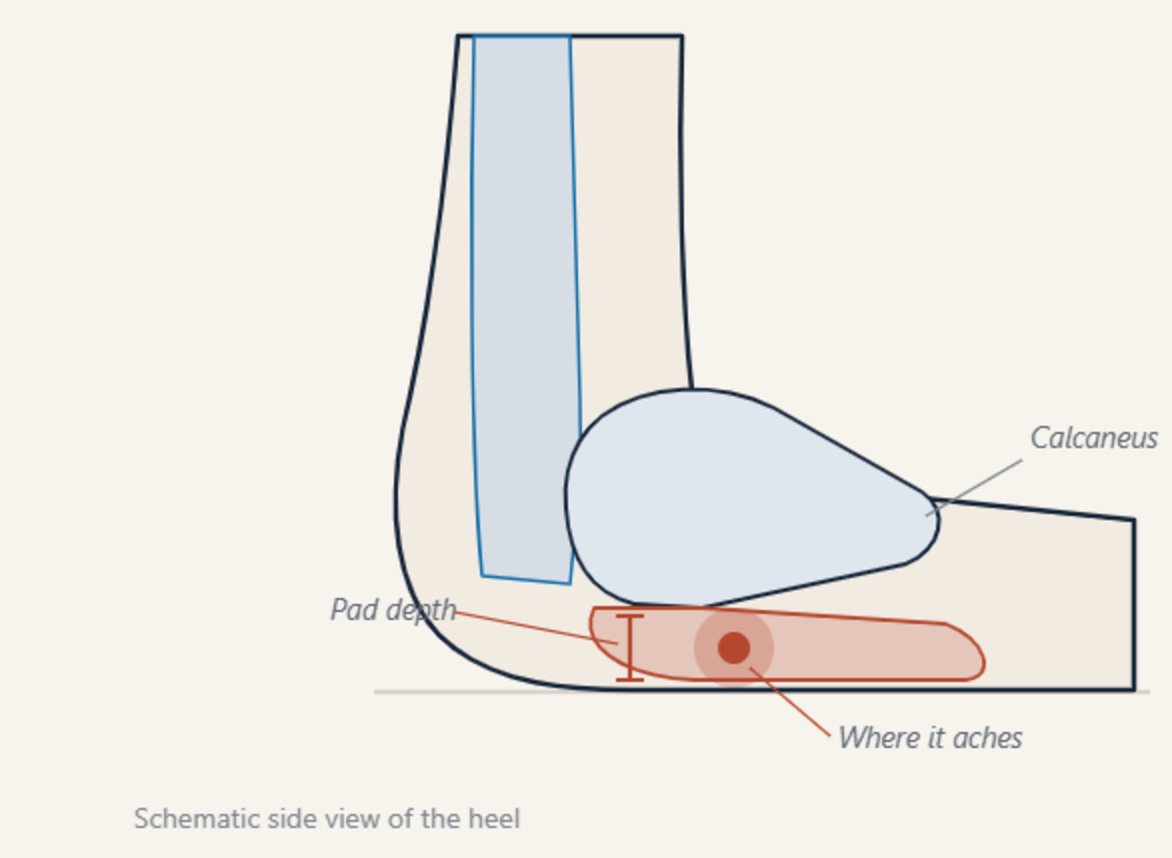
The tissue under your heel is not ordinary body fat. It is a purpose-built shock absorber: closely packed chambers of fat held inside a lattice of tough fibrous walls, anchored to the skin below and the heel bone above. Those walls stop the fat squirting out sideways when you land on it, so the pad behaves like a sealed hydraulic cushion rather than a soft pillow.
It is remarkably good at its job. It takes the force of every step you have ever taken. But the walls stiffen and the chambers lose height with time and mileage, and once that structure degrades the pad stops containing pressure properly. The heel bone then sits closer to the ground than it was designed to, and the deep ache begins.
The key idea for treatment: the pad works by being confined, not simply by being soft. That is why a heel cup that cups and holds the tissue often outperforms a squashy gel pad that lets it spread out sideways.
How it differs from plantar fasciitis
| Fat pad problem | Plantar fasciitis | |
|---|---|---|
| Where it is tender | The middle of the weight-bearing heel, dead centre | The inner front corner of the heel, where the fascia attaches |
| First steps of the morning | No dramatic spike; the heel is often at its best first thing | The classic sharp pain that eases over the first few minutes |
| Through the day | Steadily worse the longer you are upright | Eases with early movement, returns after prolonged standing |
| Barefoot on tile or hardwood | Markedly worse, and often the single clearest clue | Uncomfortable, but not the defining feature |
| Quality of the pain | Deep, dull, like a stone bruise | Sharp, localised, sometimes described as tearing |
| Response to stretching | Little or none | Usually part of what helps |
| Response to a firm arch support | Often no better, sometimes worse | Frequently helpful |
The two can coexist, and in long-standing heels they often do. But when the stretching and the arch support have been done properly for three months and the heel is unchanged, the centre of the heel is the place to re-examine.
Why the pad thins
- Age. The fibrous walls stiffen and the pad loses height and elasticity from middle age onward. This is the commonest reason by a distance.
- Mileage and impact. Long-term running, jobs spent standing on concrete, and repeated heavy landings all accelerate it.
- Body weight. More load through the same pad compresses it harder and for longer.
- Previous steroid injections into the heel. Corticosteroid causes fat to atrophy. Repeated injections into a painful heel can thin the very cushion that is needed, which is one reason a heel that has been injected several times and is still sore deserves a fresh look rather than another injection.
- A previous heel fracture. Trauma disrupts the chamber walls, and the pad rarely recovers its original structure.
- Some inflammatory and metabolic conditions, which alter the quality of the tissue itself.
How it is diagnosed
Clinically, and mostly by pressing. The tender spot sits in the centre of the heel’s weight-bearing surface rather than at the front-inner corner. Pressing firmly gives a deep bruised discomfort, and in a thinned pad you can feel how little cushion sits between fingertip and bone compared with the other heel or with an expected normal.
Ultrasound can measure the thickness of the pad, loaded and unloaded, and is occasionally useful when the picture is muddled. X-rays contribute nothing here except to exclude other things — and note that a heel spur on the film is not an explanation for central heel pain.
What actually works
- Stop going barefoot on hard floors. This single change does more than anything else on the list, and it is the one people skip. Tile, laminate and hardwood at home are where an atrophic pad is punished most. A supportive, cushioned house shoe or a cushioned clog worn indoors is treatment, not comfort.
- Use a heel cup that contains the pad. A deep, firm-walled cup holds the tissue under the heel where it belongs so it can pressurise properly. This generally beats a soft flat gel insert, which lets the pad spread out under load.
- Get cushioning under the whole foot. Shoes with a genuinely thick, resilient midsole. Maximal-cushion running shoes suit this problem well even for people who do not run. Thin, flat, hard-soled shoes are the enemy.
- Change the surface where you can. Anti-fatigue matting at a standing workstation, at the sink, and wherever you stand for long stretches.
- Reduce the load going through it. Where body weight is a factor, reducing it lowers peak pressure on every step. Swapping some impact exercise for cycling or swimming during a flare does the same thing.
- Give it time and keep the measures in place. The pad does not regenerate. What improves is the pressure it has to handle, which is why the people who do well are the ones who treat the footwear change as permanent.
Heel fat pad taping and exercises
Taping can do what a heel cup does, by holding the pad together under the bone for a day of standing or walking. With the foot relaxed and the heel over the edge of a chair:
- Anchor a strip of rigid sports tape around the back of the heel, from one side of the sole to the other, just above the base of the heel.
- Cup the pad. Lay three or four strips across the underside of the heel from side to side, each one drawing the soft tissue gently in towards the centre, overlapping by half.
- Close it with one more strip around the back of the heel over the ends.
- Stand and check. The heel should feel more cushioned, not tight. Take it off at the end of the day, or sooner if the skin objects.
Exercises will not rebuild the pad; nothing does. What they can do is share the load. Calf raises and single-leg balance work build the muscles that absorb impact above the heel, and swapping some walking or running for cycling or swimming during a flare takes pressure off it. A softer landing matters more than any exercise: cushioned shoes, no barefoot walking on hard floors, and matting where you stand.
The same skin cautions apply as for any taping: not on fragile or broken skin, and not without advice if you have diabetes, neuropathy or poor circulation.
What makes it worse
Steroid injection into the heel. It may relieve pain briefly, and it thins fat. In a heel whose problem is already a thinning fat pad, that is working against yourself. This is the most important thing on this page.
A rigid, high arch support with no heel cushioning. It addresses a mechanism that is not the one causing the pain, and a hard shell under a thin pad can add a pressure point.
Aggressive massage or rolling a hard ball under the heel. Useful for a tight fascia; unhelpful against a bruised cushion, and it frequently aggravates it.
What about fat grafting and fillers
Injecting filler or transplanted fat to rebuild the pad has been tried, and it is an appealing idea because it aims directly at the missing structure. The evidence remains limited and the effect tends to fade as the material is absorbed, because what is injected does not reproduce the chambered architecture that made the original tissue work. It is reasonable to discuss in a severely atrophic heel that has failed everything else. It is not a first step, and it is not yet a routine solution.
When to have it looked at
Book an examination if the heel pain follows a fall from height or a hard landing, if there is swelling, redness or warmth, if the pain is present at rest or at night, if the skin over the heel has broken down, or if you have diabetes or reduced sensation in the feet.
Also worth an opinion: heel pain that has had three months of proper fasciitis treatment without improvement. That is exactly the pattern in which the diagnosis, rather than the treatment, is what needs revisiting.
Shoes and inserts for this heel. Cushioning inside a firm heel cup is what a thinned pad needs. Heel cups explains which type to choose, and shoes for heel pain covers the shoe to put it in.
Common questions
Can the fat pad grow back?
Not in any meaningful sense. The chambered structure that makes it work does not regenerate once it has broken down. That sounds bleak and in practice it is not, because most people become comfortable by changing what the pad has to cope with — footwear, surfaces, containment and load — rather than by restoring the tissue.
Why does my heel feel fine in trainers and terrible at home?
Because the trainer is doing the job the pad used to do, and your kitchen floor is not. That contrast is close to diagnostic. It is also the reason indoor footwear matters more in this condition than in almost any other heel problem.
Is this the same as a bruised heel?
A bruised heel usually means a single heavy landing that inflames the pad, and that recovers over weeks. Atrophy is the slow loss of pad structure over years, and it does not recover in the same way. They feel similar, which is why the story — sudden event versus gradual onset — does much of the sorting.
Should I use a soft gel heel pad?
Try it, but if it disappoints, that is expected rather than a failure. A flat gel pad adds softness without confining the tissue. A deep cup with firm walls, worn inside a well-cushioned shoe, tends to work better because it restores containment as well as cushioning.
Can I still run?
Often yes, with a highly cushioned shoe, softer surfaces, and a volume your heel tolerates without a flare the following day. Concrete and thin racing shoes are the combination to avoid. If every run leaves the heel sore for two days, the volume is too high regardless of the shoe.
How is this different from a heel spur?
Entirely different. A spur is bone at the front-inner attachment of the fascia and usually is not the source of pain at all. Fat pad atrophy is loss of the cushion under the centre of the heel. A film showing a spur in someone with central heel pain is a coincidence more often than an explanation.
- Yi TI, et al. Clinical Characteristics of the Causes of Plantar Heel Pain. Annals of Rehabilitation Medicine.
- Lesions of the heel fat pad. PMC, National Library of Medicine.
- Heel fat pad syndrome beyond acute plantar fasciitis. PubMed.
- Allam AE, Chang KV. Plantar Heel Pain. StatPearls, NCBI Bookshelf.
Related heel pain guides
- Best heel cups
- Shoes for a thin heel pad
- Heel spurs
- Plantar fasciitis
- Burning and nerve pain in the heel
- Insoles and orthotics for plantar fasciitis
- Best shoes for plantar fasciitis
- Heel pain in the morning
- Heel pain: how to work out what you have
- Heel pain in pregnancy
- Sudden heel pain
- Heel spur treatment
- Bruised heel: stone bruise or bone bruise
Heel pain in Michigan?
Dr. Biernacki sees heel pain at Balance Foot & Ankle in Howell and Bloomfield Township. Telling a thinning fat pad from plantar fasciitis takes a minute of examination, and it changes the entire plan — including whether an injection is a good idea or a bad one.
Not sure this is your problem? Start with working out what you have, or compare it against plantar fasciitis. This page is general education, not medical advice, and it cannot diagnose your heel.
This page is education, not a diagnosis. Read our editorial policy for how it was written and what it will not claim.