Heel pain causes
Sever’s disease: why your child’s heel hurts, and why it always ends
Heel pain in an active child between roughly eight and fourteen is almost never an injury to the heel. It is a growth plate that has not closed yet, complaining about load — and it resolves completely once that plate fuses.
A child walks off the pitch holding the back of the heel. It is sore after sport, better by the next morning, and back again after the next match. Nothing happened to it — no twist, no fall, no bruise anyone can point to. That story, in that age group, is calcaneal apophysitis, which almost everyone calls Sever’s disease.
The name is unhelpful. It is not a disease, nothing is being damaged, and it leaves nothing behind. Understanding what it actually is changes how parents handle it, because the instinct — stop all sport until it stops hurting — is usually the wrong plan.
On this page
What is actually happening
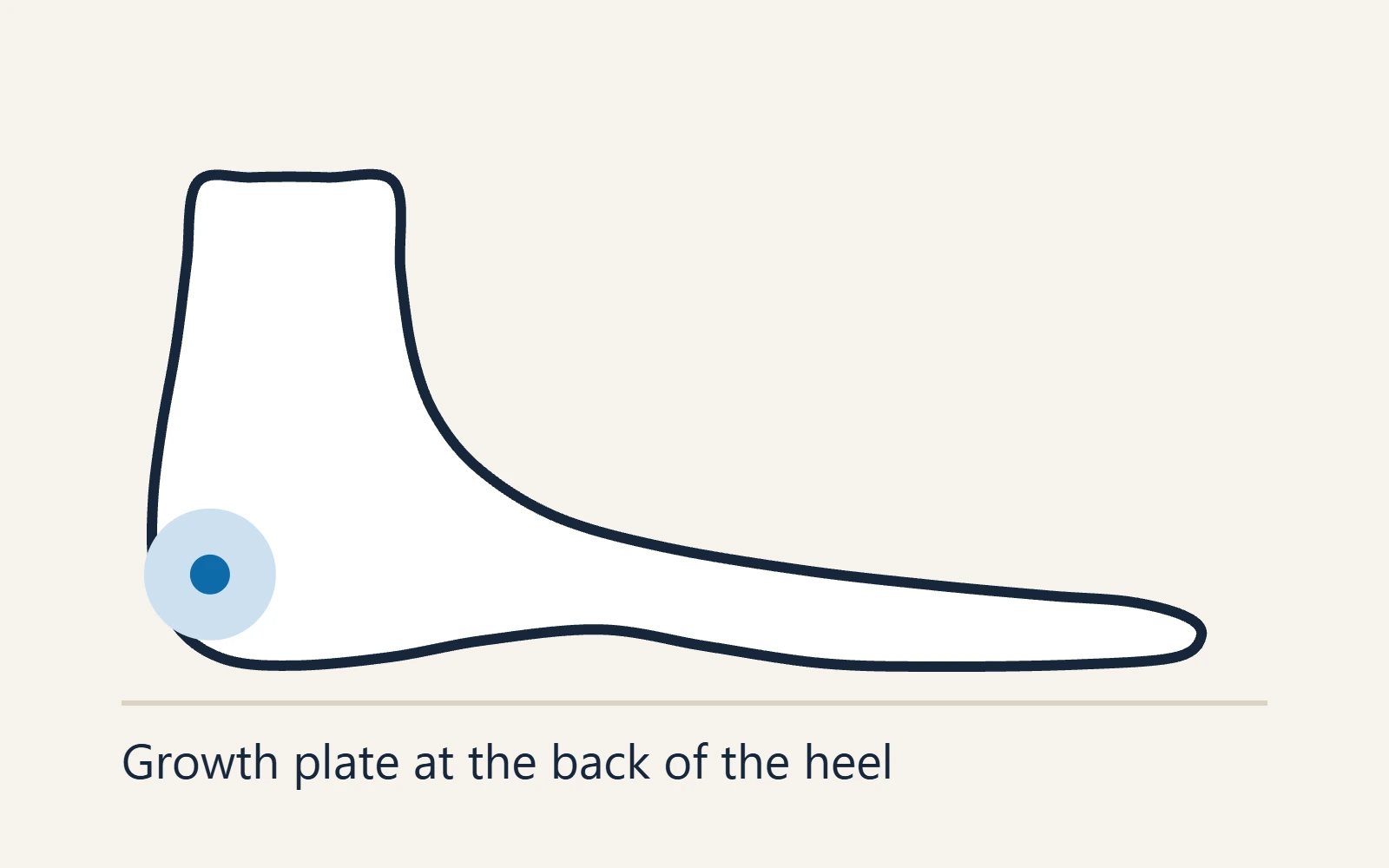
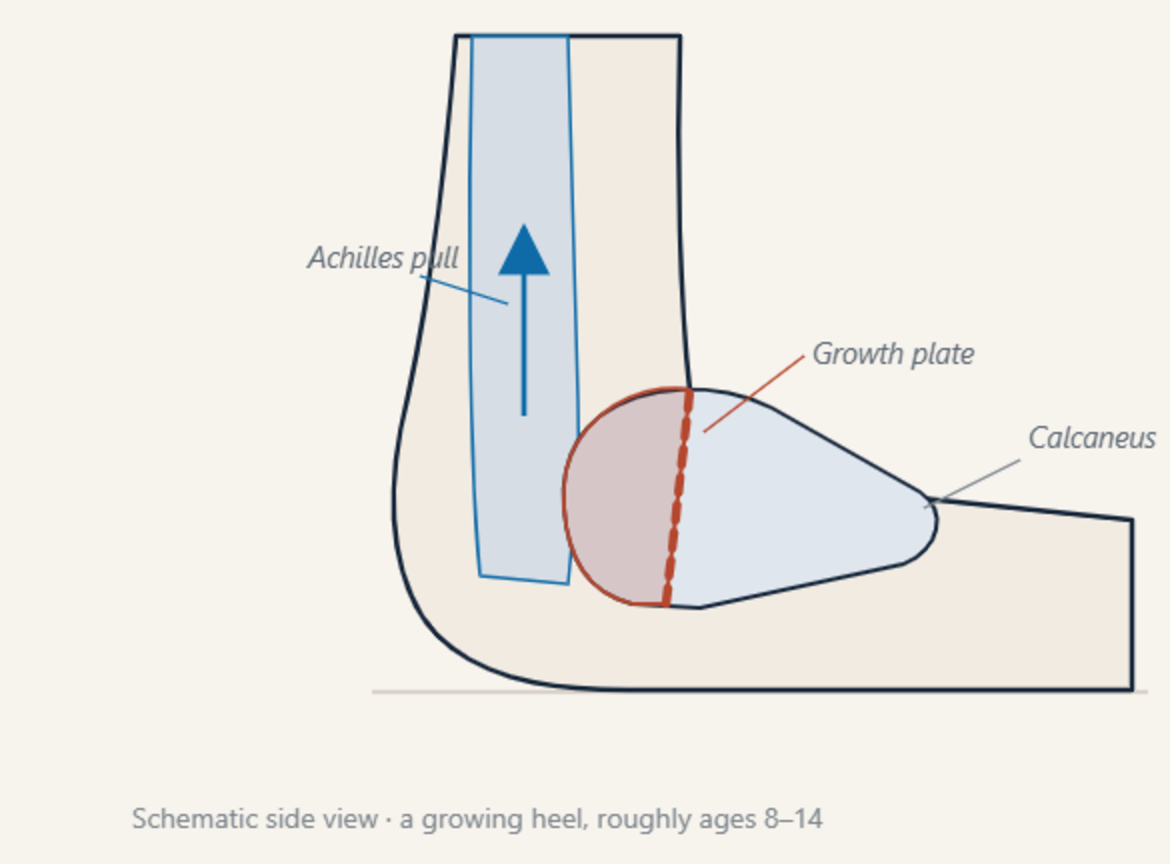
An adult heel bone is one solid piece. A child’s is not. Until the mid-teens the back of the heel bone is a separate centre of bone called the apophysis, joined to the main body by a plate of cartilage. The Achilles tendon attaches onto that apophysis.
During a growth spurt the bones of the leg lengthen faster than the calf muscle and Achilles tendon adapt. The tendon is effectively drawn tight, and it pulls on a growth plate made of cartilage rather than bone. Add repeated impact — running, jumping, landing, sprinting on hard ground — and that plate becomes irritated. That irritation is the pain.
The single most useful fact for a worried parent: the growth plate cannot be permanently damaged by this, and the condition disappears on its own when the plate closes. There is no version of Sever’s that causes lasting harm to the heel.
The pattern that gives it away
| Feature | What you typically see |
|---|---|
| Age | Roughly 8 to 14. Girls tend to present a little earlier than boys, tracking their earlier growth spurt. |
| Where | The back and the sides of the heel — not underneath it, and not in the cord above it. |
| Timing | Worse during and after activity, settled by the next morning. The opposite of the first-step morning pain of plantar fasciitis. |
| Both sides | Commonly both heels, though often one is worse. Bilateral pain in an adult is unusual; in this age group it is ordinary. |
| Trigger | A jump in training load, a new season, a growth spurt, or a switch to flat studded boots on hard ground. |
| Appearance | Normal. No swelling, no redness, no bruising, no lump. |
The squeeze test
The examination that matters takes about five seconds. Squeeze the heel gently from side to side, pressing the two flat surfaces just in front of the back corner of the heel bone. In calcaneal apophysitis this reproduces the pain almost every time.
Pain when you squeeze side to side points at the growth plate. Pain when you pinch the Achilles front to back, higher up, points at the tendon instead. Pain underneath the heel is a different problem again.
What else it could be
| If instead you see… | Think about |
|---|---|
| Pain underneath the heel, worst on the first steps of the morning | Plantar fasciitis — uncommon in children, but it happens in adolescent athletes |
| Pain in the cord above the heel bone, which warms up with activity | Achilles tendinopathy |
| Pain that wakes the child at night, or aches at complete rest | Needs assessment. Night pain is not part of this condition. |
| Swelling, warmth, redness, fever, or a child who is generally unwell | Needs assessment the same day |
| A limp that persists for weeks even on rest days | Needs assessment |
The X-ray trap
Sever’s is diagnosed from the age, the story and the squeeze test. An X-ray is not needed to make the diagnosis, and it is frequently misleading when one is taken.
A growing apophysis often looks dense, irregular or fragmented on film. That appearance is a normal stage of development and it is found just as readily in the heel that does not hurt. Parents are sometimes shown a fragmented-looking growth plate and told the heel is breaking up. It is not. X-rays earn their place when the story does not fit — night pain, a single sudden injury, swelling, or symptoms that are not improving — where the job is to rule other things out.
What actually works
- Manage the load rather than stopping everything. Complete rest works, and the pain returns within a fortnight of going back because nothing about the tendon or the surface changed. Cutting training volume to the level the heel tolerates, and keeping it there, works better and keeps the child in their sport.
- Put a heel lift in both shoes. A lift of roughly six to twelve millimetres reduces how far the ankle bends upward and takes tension off the attachment. It is the single most effective thing available, it costs very little, and it goes in both shoes even when only one heel hurts — otherwise you tilt the pelvis.
- Cushion the impact. A soft heel cup or a cushioned insert absorbs some of the landing force. Flat, thin-soled studded boots on dry hard ground are a common aggravator; a training shoe on non-match days helps.
- Stretch the calf daily, both parts of it. Straight-knee stretching for the gastrocnemius and bent-knee stretching for the soleus, held long enough to matter, on most days. The tightness is the mechanism, so this is not optional.
- Strengthen slowly once it settles. Gentle, controlled calf raises build tolerance so that the next growth spurt is less eventful.
- Ice after sport, not instead of the rest of this. Ten to fifteen minutes takes the edge off a flare. It is symptom relief and it changes nothing about the cause.
What does not help
Steroid injections have no role here. This is an irritated growth plate in a child, not an inflamed adult tendon, and injecting around a growth plate is not something to do for a condition that resolves by itself.
Surgery has no role here either. If anyone raises operating on a child’s heel for Sever’s, get a second opinion.
A rigid arch-control orthotic is usually beside the point. The problem is tension and impact at the back of the heel, not the arch. Height under the heel helps; arch control on its own often does not.
When to have it looked at quickly
Get it assessed promptly if there is pain at night or at complete rest, visible swelling, redness or warmth, a fever or a generally unwell child, a heel that hurts after a single identifiable injury, a limp that persists on rest days, or pain that is steadily worsening over weeks despite sensible load management.
None of those belong to calcaneal apophysitis. They are the reasons a clinician examines the heel rather than assuming.
When does it end
It ends when the apophysis fuses to the body of the heel bone, which is generally somewhere around fourteen to sixteen and a little earlier in girls. Once that happens the condition cannot recur, because the structure that was being irritated no longer exists.
Between now and then, expect a pattern rather than a straight line: quiet spells, then a flare when training load jumps or the child grows. The families who do best treat the heel lift and the calf stretching as permanent equipment for a couple of years rather than a two-week course of treatment.
Common questions
Does my child need to stop sport completely?
Usually not, and complete rest tends to disappoint. Because the condition is driven by load against a tight tendon, total rest relieves the pain and changes nothing underneath, so symptoms return when play resumes. Reducing volume to a level the heel tolerates, adding the heel lift and stretching, and building back up works better. A short break is reasonable during a bad flare.
Why are both heels sore when nothing happened to either?
Because the cause is growth and load rather than injury, and both legs are growing. Involvement of both heels is common in this age group and is reassuring rather than worrying. Two sore heels in an adult, by contrast, is a pattern that deserves a medical opinion.
Will this damage the growth plate or affect how tall my child gets?
No. This is irritation at the attachment rather than an injury to the growing plate itself, and it does not alter growth or leave the heel weaker. It resolves when the plate closes and leaves nothing behind.
Should we get an X-ray?
Not to confirm Sever’s, which is a clinical diagnosis. A growing growth plate often looks fragmented on film in heels that feel perfectly fine, so the picture frequently alarms people for no reason. Imaging is worth doing when the story does not fit — night pain, swelling, a single injury, or a heel that is not improving — and then the purpose is ruling out something else.
How long before it settles?
Most flares quieten within a few weeks of getting the heel lift, the load and the calf work right. The tendency to flare persists as long as the growth plate is open, so think in terms of managing it across a season or two rather than curing it in a fortnight.
Is it the same thing as a heel spur?
No. A heel spur is a mature bony outgrowth found in adults, and in most cases it is not the source of pain either. Sever’s is irritation of an open growth plate and only occurs while that plate is still open.
- American Academy of Orthopaedic Surgeons, OrthoInfo. Sever’s Disease (Heel Pain).
- American Academy of Orthopaedic Surgeons, OrthoInfo. Overuse Injuries in Children.
- Schwartz R, et al. Plantar Heel Pain. StatPearls, NCBI Bookshelf.
Related heel pain guides
- Achilles tendonitis
- Calcaneal stress fracture
- Plantar fasciitis
- Best shoes for plantar fasciitis
- Heel pain: how to work out what you have
- Heel pain in runners
Heel pain in Michigan?
Dr. Biernacki sees children with heel pain at Balance Foot & Ankle in Howell and Bloomfield Township. The examination is quick, it does not usually need an X-ray, and most families leave with a heel lift, a stretching plan and a way to keep the child playing.
Not sure this is the right page? Start with working out what you have. This page is general education, not medical advice, and it cannot diagnose your child’s heel.
This page is education, not a diagnosis. Read our editorial policy for how it was written and what it will not claim.