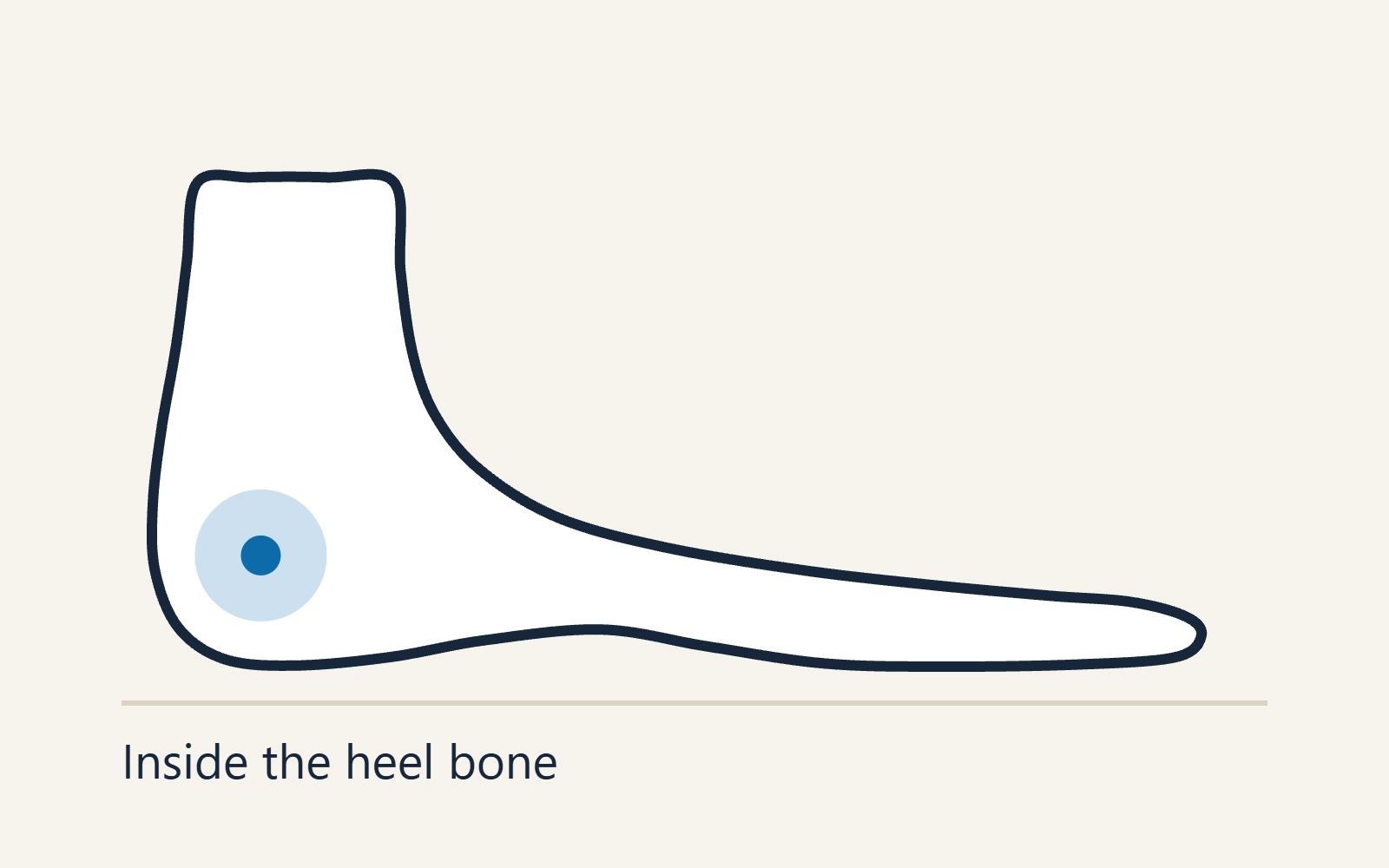
Heel pain causes
Calcaneal stress fracture: the heel pain that gets worse the more you do
Most heel problems warm up. This one does not. Deep heel pain that builds through activity, hurts when the heel is squeezed from side to side, and does not ease as you get going is the pattern that should make everyone stop and check the bone.
Almost every common cause of heel pain shares a reassuring habit: it hurts, then it loosens off. Plantar fasciitis is worst on the first few steps and eases. Achilles tendinopathy is stiff first thing and warms up. Patients learn this rhythm and plan around it.
A bone stress injury does the opposite. It is tolerable at the start and worse at the end — worse at mile three than mile one, worse at hour six of a shift than hour one. That reversal is the most important signal in this whole subject, because this is the one heel condition where continuing to push through carries a real cost.
On this page
What is actually happening
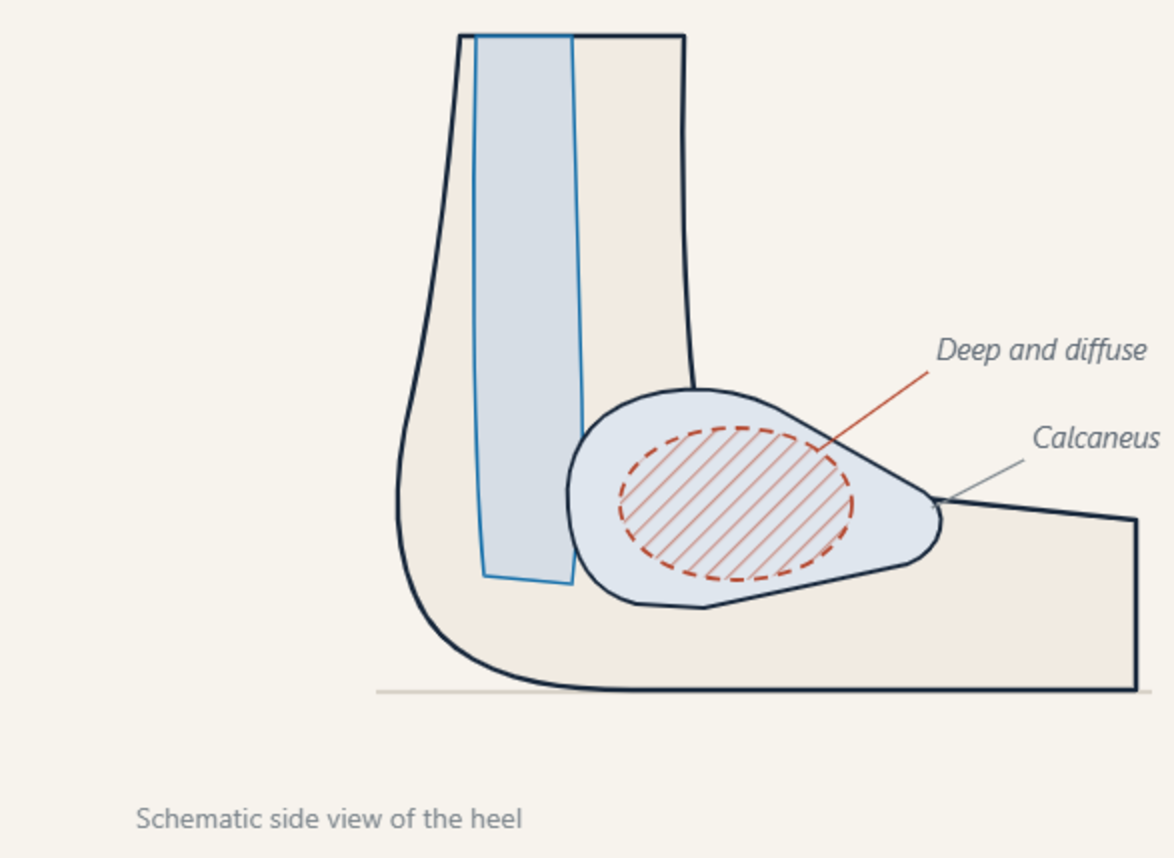
Bone is living tissue, constantly being broken down and rebuilt. Loading it hard stimulates it to get stronger, which is why running builds bone. The trouble starts when the breaking-down outpaces the rebuilding — when load rises faster than bone can adapt, or when the raw materials for rebuilding are short.
What follows is a spectrum rather than a single event. First the bone becomes irritated and swollen inside, a stress reaction. Left under the same load, microscopic cracks coalesce into a true stress fracture. Left under load beyond that, a stress fracture can progress to a complete one. Catching it at the early end is a matter of weeks in a boot. Catching it at the far end is a different conversation entirely.
Symptoms, and how they differ from plantar fasciitis
| Stress fracture | Fasciitis or tendinopathy | |
|---|---|---|
| Through a session or a shift | Gets progressively worse | Eases after the first few minutes |
| First steps of the morning | No characteristic spike | The classic sharp first-step pain |
| Where it hurts | Deep and spread through the body of the heel bone, hard to point to precisely | A specific point you can put a fingertip on |
| Squeezing the heel side to side | Reproduces the pain | Usually does not |
| At rest and at night | Can ache once it is established | Typically quiet when off your feet |
| How it started | Weeks after a clear jump in training, mileage, hours on feet, or new footwear | Often more gradual and less clearly tied to a change |
The calcaneal squeeze test
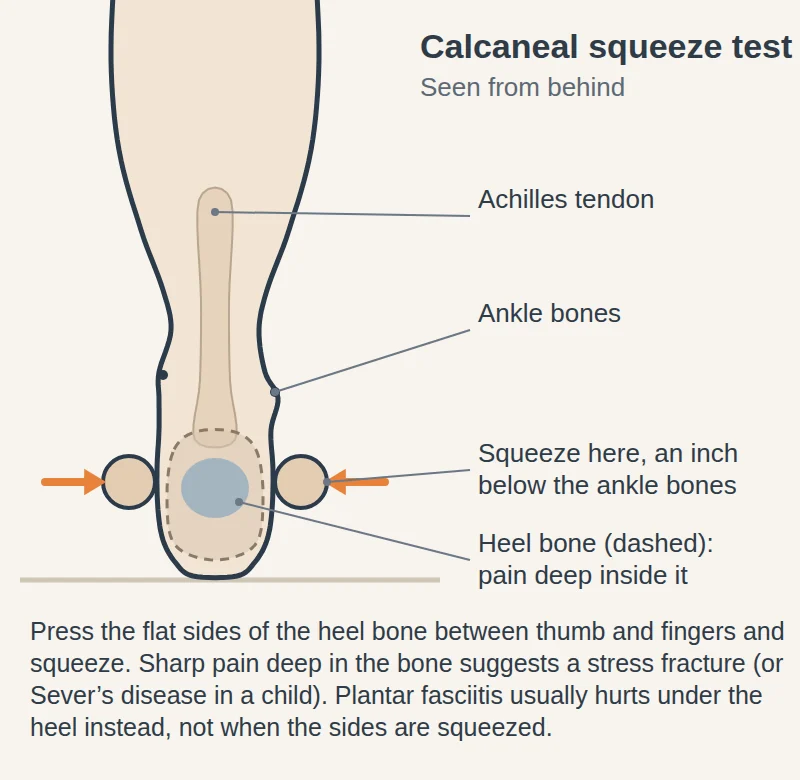
Press the flat sides of the heel bone firmly between thumb and fingers, an inch or so below the ankle, and compress. In a calcaneal stress injury this is usually distinctly painful. In plantar fasciitis it is generally not, because fascia pain sits underneath at the attachment rather than within the bone.
It is a useful test rather than a perfect one. The same manoeuvre is positive in Sever’s disease in a child, where the growth plate rather than a fracture is the cause — which is why age matters as much as the test.
Where it hurts. The tenderness sits in the body of the heel bone itself — across the sides and towards the back, behind and below the level of the ankle — rather than in the single spot under the heel where plantar fasciitis lives. Some swelling around the heel can come with it, though often there is little to see.
What an examination adds. A clinician combines the squeeze with pressure over the other usual sources of heel pain — the fascia attachment, the Achilles insertion and the fat pad — to find which one reproduces your pain, alongside the story of what changed in the weeks before. Imaging then confirms it. Hopping or running on the heel to see whether it hurts only adds load to an injured bone.
Who gets one
- Anyone whose load rose faster than their bone adapted. New runners, a sudden increase in weekly mileage, a return to training after a layoff, military basic training, a new job on concrete, or long walking holidays. Roughly a few weeks between the change and the symptoms is typical.
- People with lower bone density. Older adults, particularly postmenopausal women, can sustain one on far less load. In that setting the term used is an insufficiency fracture, and it can follow ordinary walking rather than training.
- Athletes not eating enough for their training load. Bone rebuilding needs energy and nutrients; when intake does not match output over months, bone density suffers and stress injuries follow. Disrupted or absent periods alongside heavy training is a significant warning sign and is worth raising with a doctor.
- People low in vitamin D or calcium, which limits the raw material for repair.
- People on certain long-term medications, including oral corticosteroids, which reduce bone density over time.
One stress fracture is usually about training load. A second, or one that follows a minor load with no obvious cause, is about bone health and deserves investigation in its own right — blood tests and, in the right patient, a bone density scan.
X-ray and MRI: why the X-ray is often normal
A stress fracture is not a clean break across a bone. It is a region of overloaded, microscopically damaged bone, and for the first few weeks there is frequently nothing visible on a plain X-ray. Healing eventually produces a dense line or a patch of new bone that shows up — which is why a film repeated a fortnight later sometimes reveals what the first one missed.
MRI detects the injury early, before any structural change, and it is the test of choice when the story fits and the X-ray is clear. A normal X-ray in a heel behaving like this is not reassurance; it is an expected result that has not answered the question.
Treatment and healing time
- Take the load off, now rather than later. This is the treatment. A walking boot for several weeks is common, sometimes with crutches early on if walking is painful. The guiding rule is straightforward: if it hurts while you are doing it, it is too much.
- Get the diagnosis confirmed. MRI when the pattern fits and the X-ray is unhelpful, because the management is genuinely different from every other cause of heel pain and guessing is not good enough here.
- Keep fitness with something that does not load the heel. Cycling, swimming, pool running and upper-body work maintain condition without asking anything of the bone. Deconditioning is not a required part of recovery.
- Fix the supply side. Vitamin D and calcium checked and corrected, and enough overall nutrition to match training. Bone cannot rebuild from nothing.
- Return gradually, guided by symptoms. Walking comfortably without pain comes first, then a structured build back into impact over weeks. Most recover in something like six to twelve weeks, though a slower-healing region can take longer.
- Correct what caused it. Going back to the same weekly mileage, the same worn-out shoes and the same rate of progression reliably produces the same injury. The build-back plan is as important as the boot.
Recovery usually runs in three phases. The timing depends on how early it was caught and how completely the load came off, so read the weeks as a guide rather than a schedule.
| Phase | Typical timing | What it involves |
|---|---|---|
| 1. Offload | Usually 2 to 6 weeks | A walking boot or reduced weight-bearing, crutches if walking hurts, and no running or jumping. Cycling or swimming if they are pain-free. |
| 2. Walk normally | Once walking is pain-free | Out of the boot into supportive shoes and back to full daily walking. By now the heel should no longer hurt when squeezed. |
| 3. Return to impact | Over the following weeks | Short, easy runs on alternate days, building distance before speed. A useful rule is to give the build-back about as long as the pain took to settle, and to step back if heel pain returns. |
Why this one is different
Training through a stress fracture can turn it into a complete fracture. With plantar fasciitis or Achilles tendinopathy, pushing through is mostly a matter of prolonging the misery. Here it risks converting a problem measured in weeks into one measured in months, occasionally involving surgery.
If your heel hurts more at the end of every run than it did at the start, stop running until it has been assessed. That single sentence is the most useful advice on this page.
When to be seen
Arrange an assessment promptly for heel pain that worsens through activity rather than warming up, pain when the heel is squeezed from side to side, deep heel pain that aches at rest or at night, heel pain following a clear jump in training or hours on your feet, any heel pain in someone with osteoporosis or after a fall from height, or a second stress fracture at any site.
Common questions
Can I walk on a calcaneal stress fracture?
Often you can, and that is exactly what makes this injury easy to underestimate. Being able to walk is not evidence that it is safe to keep loading. The useful measure is whether walking hurts and whether it is getting worse week by week rather than better.
How long does it take to heal?
Typically six to twelve weeks to comfortable walking, with a graded return to impact after that. The variables that matter most are how early it was caught, how completely the load came off, and whether vitamin D, calcium and overall nutrition were adequate for rebuilding.
My X-ray was normal, so is it definitely not a stress fracture?
No. Plain X-rays commonly miss these in the early weeks because there is nothing structural to see yet. If the history and the examination fit, a normal X-ray does not close the question — MRI, or repeating the film after a couple of weeks, is the next step.
Could it be plantar fasciitis instead?
Possibly, and fasciitis is far more common. The separators are the morning pattern, the location, and the squeeze. Sharp pain on the first steps that eases, at a pinpoint spot at the inner front of the heel, is fasciitis. Deep pain spread through the heel that intensifies with use and hurts on side-to-side compression is bone until proven otherwise.
Do I need a cast?
Usually not. A removable walking boot is the normal approach, which protects the heel while allowing it to come off for washing and for non-weight-bearing exercise. Casting and a period of not putting weight through the leg are reserved for more advanced injuries.
Why did this happen when I was not doing anything extreme?
Because the injury reflects load relative to what your bone could tolerate, not load in absolute terms. A modest increase can be too much where bone density is reduced, vitamin D is low, or nutrition has not kept pace with training. That is why an unexplained stress fracture is a reason to look at bone health rather than simply to rest.
Does a heel stress fracture cause swelling or bruising?
It can. Some swelling around the heel and, less often, bruising can appear, but frequently there is little to see because the injury is inside the bone — a heel that looks normal can still have a stress fracture. A heel that is badly swollen or bruised after a fall or a hard landing needs an X-ray to check for an ordinary fracture.
What is the difference between a stress reaction and a stress fracture?
They are stages of the same injury. A stress reaction shows on MRI as swelling inside the bone without a fracture line; a stress fracture is the same process once a line has formed. Both are treated by taking the load off, and catching it at the stress reaction stage usually means a quicker return.
Can a heel stress fracture heal on its own?
Yes, once the load comes off. The heel bone is not one of the high-risk stress fracture sites that often need surgery, and most heal with a boot or reduced walking followed by a gradual return. What it will not do is heal while you keep running on it — that is how a stress fracture becomes a complete one.
- Bergman R, Kaiser K. Stress Reaction and Fractures. StatPearls, NCBI Bookshelf.
- Sormaala MJ, et al. Stress injuries of the calcaneus detected with magnetic resonance imaging in military recruits. PubMed.
- American Academy of Orthopaedic Surgeons, OrthoInfo. Heel Pain.
- American Academy of Orthopaedic Surgeons, OrthoInfo. Calcaneus (Heel Bone) Fractures.
- American Academy of Orthopaedic Surgeons, OrthoInfo. Stress Fractures of the Foot and Ankle.
Related heel pain guides
- Plantar fasciitis
- Achilles tendonitis
- Sever’s disease (heel pain in children)
- Heel fat pad atrophy
- Heel pain in the morning
- Heel pain: how to work out what you have
- Heel pain in runners
- When to worry about heel pain
- Sudden heel pain without injury
- Back of heel pain
- Walking boots
- Bruised heel: stone bruise or bone bruise
- When plantar fasciitis hurts too much to walk
Heel pain in Michigan?
Dr. Biernacki sees heel pain at Balance Foot & Ankle in Howell and Bloomfield Township. A heel that is getting worse through activity rather than warming up is the one worth having examined sooner rather than later, because the treatment depends on catching it early.
Not sure this is your problem? Start with working out what you have. This page is general education, not medical advice, and it cannot diagnose your heel.
This page is education, not a diagnosis. Read our editorial policy for how it was written and what it will not claim.