Heel pain treatment
Plantar fasciitis massage: the techniques worth doing, and the tools worth owning
Massage will not remodel the plantar fascia on its own. Done well, it makes the first steps easier, calms a flare, and loosens the calf so the stretching and loading can do their job.
Five minutes of massage is one of the easiest things to add to a plantar fasciitis routine, and one of the easiest to do badly: too hard, in the wrong place, or as the whole plan. Below are the techniques in order of usefulness, how hard and how long, who should not do them, and where tools such as massage balls and massage guns fit.
On this page
Does massage help plantar fasciitis?
Yes, as part of the plan. The 2023 physical therapy guideline for plantar fasciitis gives its strongest grade to manual therapy aimed at the soft tissues and joints of the foot and leg, used alongside stretching and other treatment. Two randomised trials show the kind of effect to expect. In one, adding hands-on trigger point therapy to a home stretching routine gave better pain and function at one month than stretching alone. In the other, twelve sessions of myofascial release over four weeks beat a sham treatment, and most of the gain was still there at twelve weeks.
Two caveats. Those trials used a therapist’s hands, not a ball on the kitchen floor, so self-massage is a home approximation of treatment that works rather than a tested treatment in its own right. And massage relieves and loosens; it does not load the fascia, so it does not replace the stretches and strengthening exercises that change the tissue. Think of it as the thing you do before the stretch, not instead of it.
Thumb and cross-friction massage
This is the most precise technique, and the best one to do before your first steps in the morning.
- Sit and cross the sore foot over the opposite knee.
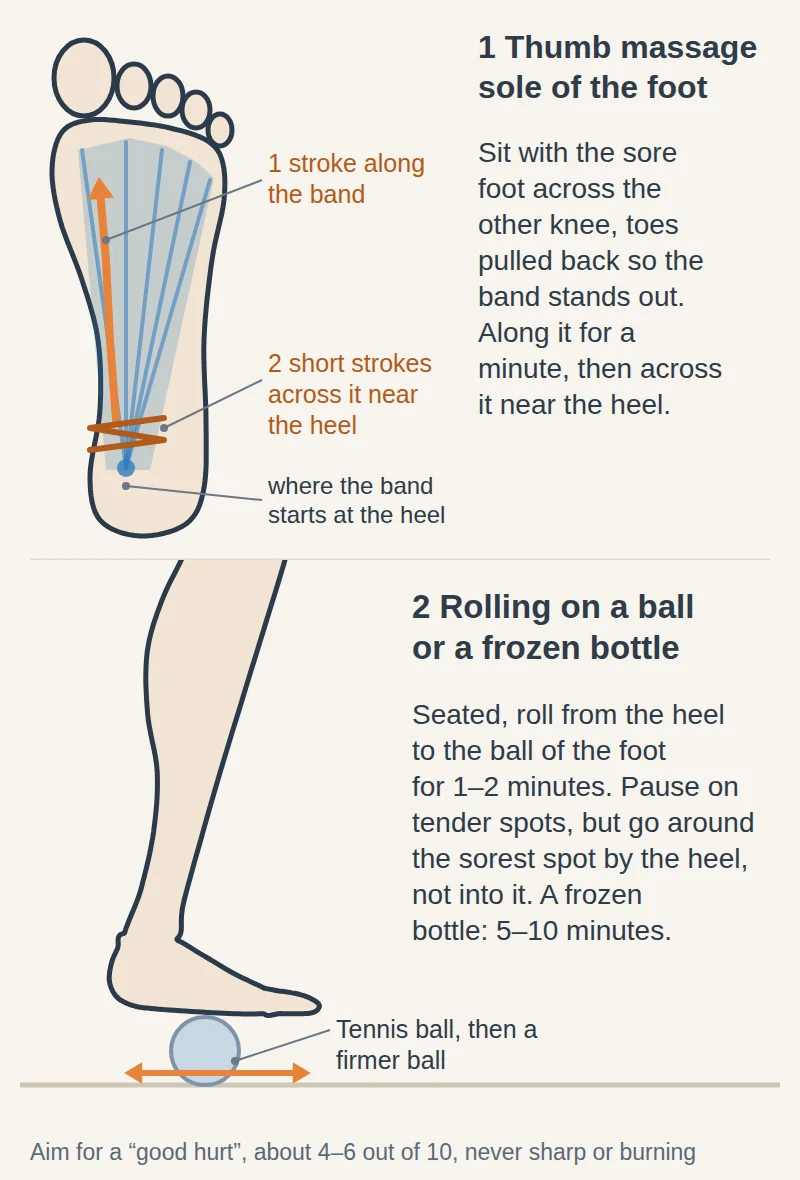
- Pull the toes back towards the shin with one hand until the band under the arch tightens. Massaging the fascia on stretch lets you find it and work along it.
- Stroke along the arch with the other thumb, from just in front of the heel towards the ball of the foot, firm and slow, for about a minute.
- Then work across the band close to the heel, where it hurts: short back-and-forth strokes across the fibres rather than along them, for another minute. This is deep friction massage, and it is the version described in the clinical literature for the arch and the fascia attachment.
- Finish with the plantar-fascia stretch, ten holds of ten seconds, before you stand.
Rolling on a ball
A ball lets you use body weight instead of thumb strength, which suits people with sore hands or stiff hips.
- Which ball. Start with a tennis ball, which is soft and forgiving. Move to a lacrosse ball or a firm massage ball when the tennis ball feels like nothing. Spiky balls feel intense and do not do anything a smooth firm ball cannot.
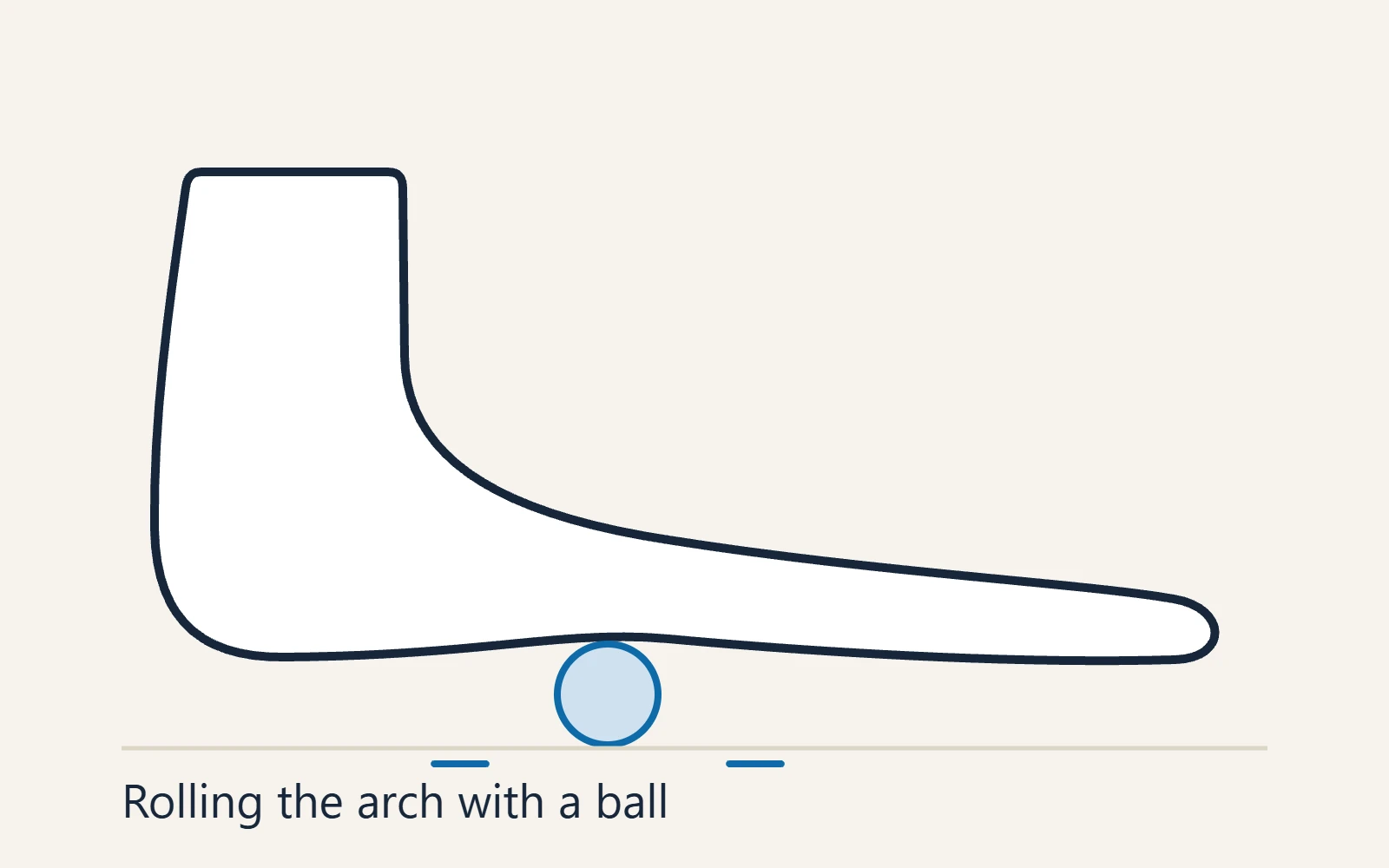
- Sitting first. Seated, roll slowly from the heel to the ball of the foot and back for one to two minutes. Pause on tender spots for 20 to 30 seconds and let them ease.
- Standing for more pressure, holding a counter, once seated rolling is comfortable.
- Go around the sorest spot, not into it. Grinding full body weight into the exact point where the fascia meets the heel bone tends to leave it angrier the next morning. Work the arch in front of it.
Frozen water bottle roll
Freeze a plastic water bottle and roll the arch over it, seated, for five to ten minutes. You get cold and massage together, which is why it is the go-to after a long day on your feet or during a flare. Put a thin cloth over it if the cold is too sharp, and stop at ten minutes.
Like ice in general, it settles symptoms rather than changing the tissue. It is not for anyone with reduced sensation in the feet, poor circulation or Raynaud’s, where cold can injure skin without warning.
Calf release: the part most people skip
A tight calf pulls on the heel at every step and raises the load the fascia carries. In one well-known study, people whose ankles could not bend upwards past neutral had a far higher risk of plantar fasciitis than people with good ankle movement. In the trigger point trial above, tenderness eased in the calf muscles as well as over the heel. So massage the calf too:
- Foam roller or ball. Sit on the floor with the calf on the roller, lift your hips, and roll slowly from just above the Achilles to just below the knee for one to two minutes. Turn the leg in and out to reach both sides.
- Hands. Seated, knead the bulk of the calf with both hands, and press into tender spots for 20 to 30 seconds.
- Then stretch the calf, knee straight and knee bent, 30 seconds each. The massage makes the stretch easier; the stretch is what counts.
Do not massage a calf that is swollen, warm, red or tender to squeeze, especially after a long journey, surgery, a period in a cast or boot, or if you take hormonal medication. Those are warning signs of a blood clot. Get it checked the same day rather than rubbing it.
Massage guns for plantar fasciitis
A massage gun is most useful on the calf, where there is plenty of muscle to work on. On the sole it needs care: use the lowest setting and a soft, rounded head, keep it moving over the arch, and stay off the heel bone and the most tender spot. Thirty to sixty seconds on the arch is plenty. Many people find the thumb or a ball gives them more control for the foot itself.
Skip it over bone, numb skin, swelling or bruising, and ask first if you take blood thinners. For specific models, Dr. Biernacki’s practice site keeps a hands-on comparison of foot massagers and massage guns for plantar fasciitis, and our shoes, inserts and kit page covers how to judge any of them.
How hard, how long, how often
| What to aim for | |
|---|---|
| Pressure | Firm enough to feel a “good hurt”, about 4 to 6 out of 10. Never sharp, burning or tingling. |
| Time | One to two minutes per technique, five to ten minutes in total. More is not better. |
| When | Before the first steps of the day (thumb massage and stretch), after long periods on your feet, and in the evening. |
| How often | Daily is fine for most people, as long as the next morning is no worse. |
| The test | First-step pain the next morning. If it is worse after massage, you went too hard or too close to the sore spot. |
Who should not massage the heel
- Diabetes, neuropathy or poor circulation. Firm tools and cold bottles can injure skin you cannot feel properly. Ask the clinician who knows your feet first.
- Pain when the sides of the heel are squeezed, or pain that builds through the day. That pattern can be a heel stress fracture, which massage will aggravate.
- Burning, tingling or numbness. That points at a trapped nerve, and pressing on an irritated nerve makes it worse.
- A sudden pop or bruising under the arch. A partial tear of the fascia needs protecting, not rubbing. See sudden heel pain.
- Broken skin, infection, or a heel that is hot and red.
Massage feels good. Loading does the treating. Dr. Tom’s free 14-day plan from The Heel Pain Playbook adds the stretch before your first step and the slow towel heel raise, in the order he uses in clinic, with photos and a tracker. Get the free 14-day plan.
Common questions
Does massage help plantar fasciitis?
Yes, as part of a plan that includes stretching and strengthening. Hands-on soft tissue treatment carries the strongest grade in the physical therapy guideline for plantar fasciitis, and trials show it adds short-term relief to stretching. At home, massage is best used before the stretch, to make it easier, and to settle flare-ups. On its own it manages the pain rather than treating the tissue.
Should you massage plantar fasciitis if it hurts?
Moderate discomfort, about 4 to 6 out of 10, is fine. Sharp pain means ease off or move away from the spot. The real test is the next morning: if the first steps are worse after a massage, it was too hard or too close to where the fascia attaches to the heel bone.
Is a massage gun good for plantar fasciitis?
It is most useful on the calf. On the sole, use the lowest setting and a soft head, keep it moving, and stay off the heel bone. Many people get more out of their thumbs or a firm ball for the foot itself, because they can control the pressure and the spot.
What is the best ball for plantar fasciitis?
A tennis ball to start, then a lacrosse ball or a firm massage ball as you tolerate more pressure. A frozen water bottle is the best choice during a flare, because it adds cold. Spiky balls are not more effective, just more intense.
How long should I massage my foot for plantar fasciitis?
About one to two minutes per technique and five to ten minutes in total, once or twice a day. Longer and harder sessions tend to irritate the attachment rather than help it.
Can massage make plantar fasciitis worse?
Yes, if it is too aggressive or aimed at the wrong problem. Digging hard into the attachment point can leave it sorer the next morning, and massage aggravates a stress fracture or an irritated nerve. If massage keeps making things worse, get the diagnosis checked.
Related heel pain guides
- Plantar fasciitis stretches and exercises — the loading work massage is meant to support.
- Plantar fasciitis treatment — where massage sits in the full plan.
- KT tape and low-Dye taping — another way to take the edge off while the tissue recovers.
- Heel pain in the morning — why the first steps are the worst, and what reduces them.
- Night splints — keeping the fascia from shortening overnight.
- Shoes, inserts and kit — how to judge balls, rollers and massage guns before you buy.
- Koc TA, et al. Heel Pain – Plantar Fasciitis: Revision 2023. Clinical Practice Guidelines, Journal of Orthopaedic & Sports Physical Therapy.
- Renan-Ordine R, Alburquerque-Sendín F, de Souza DP, Cleland JA, Fernández-de-las-Peñas C. Effectiveness of myofascial trigger point manual therapy combined with a self-stretching protocol for the management of plantar heel pain: a randomized controlled trial. Journal of Orthopaedic & Sports Physical Therapy, 2011.
- Ajimsha MS, Binsu D, Chithra S. Effectiveness of myofascial release in the management of plantar heel pain: a randomized controlled trial. The Foot, 2014.
- Riddle DL, Pulisic M, Pidcoe P, Johnson RE. Risk factors for plantar fasciitis: a matched case-control study. Journal of Bone and Joint Surgery, 2003.
- Buchanan BK, Sina RE, Kushner D. Plantar Fasciitis. StatPearls, NCBI Bookshelf.
Heel pain in Michigan?
If massage, stretching and supportive shoes have not moved your heel pain in two or three months, it is worth checking that it is plantar fasciitis at all. Dr. Biernacki sees heel pain in Howell and Bloomfield Township.
This page is education, not a diagnosis. Do not massage a swollen or warm calf, a foot with reduced feeling, or a heel that may be fractured. Read our editorial policy for how it was written and what it will not claim.