
Footwear
Best Running Shoes for Plantar Fasciitis (2026)
For most runners with plantar fasciitis, the right shoe has a firm heel counter, a midsole that resists twisting, a heel-to-toe drop of roughly 8–10 mm and a rocker that rolls you off the forefoot. The Brooks Ghost 18 suits most neutral runners. Overpronators do better in the Adrenaline GTS 26 or Gel-Kayano 33, and the Hoka Bondi 9 gives the most cushioning for heavier runners and long, slow miles.
Plantar fasciitis is one of the most common reasons runners come to see me, and most of them ask the same thing first: do I have to stop, and what should I be running in? A shoe does not cure plantar fasciitis. What it can do is cut the strain on the fascia with every step, and when you take around a thousand steps a mile, that adds up.
The shoes below are current models as of October 2026. Specs were checked against brand and retailer listings and independent lab and clinician reviews; where a figure could not be confirmed, I describe the feature instead.
How we choose: each pick is judged against the clinical criteria in the four features that matter. No brand pays for placement. Links to Amazon are affiliate links, so we may earn a commission at no cost to you (disclosure).
Quick picks
Best overall: Brooks Ghost 18
A 10 mm drop, a very stiff heel counter and four widths. It is the traditional daily trainer most heel strikers with PF settle into.
Best stability: Brooks Adrenaline GTS 26
The same 10 mm geometry as the Ghost, with GuideRails to control a foot that rolls in.
Best max cushion: Hoka Bondi 9
A very deep midsole, a rocker and torsional stiffness above average. It comes in narrow through extra-wide.
Best lighter rocker: Hoka Clifton 11
An 8 mm drop and a MetaRocker in a lighter package. It works for runners who find the Bondi too much shoe.
Best for orthotic users: ASICS Gel-Nimbus 28
A torsionally stiff, stable neutral shoe that one clinician review rates orthotic-friendly.
Best if the back of the heel is sore too: Saucony Triumph 24
A 10 mm drop and a heel that a clinician review rates suitable for Haglund’s.
On this page
What to look for in a running shoe for plantar fasciitis
The plantar fascia is a thick band running from the heel bone to the base of the toes. Each time your arch flattens and your toes bend at push-off, it is pulled tight. A good running shoe for plantar fasciitis limits both movements and protects the heel where the fascia attaches. In clinic, I look for:
- A midsole that resists twisting. Hold the shoe at both ends and wring it like a towel. If it twists easily through the middle, it will not support the arch under load.
- A firm heel counter. Squeeze the back of the shoe. A firm counter keeps the heel’s natural fat pad sitting under the bone, where it cushions best.
- A moderate to high drop. A drop of roughly 8–10 mm takes some tension off the calf and Achilles, which feed into the fascia. Dropping suddenly to a low-drop or zero-drop shoe during a flare is a common way to make things worse.
- A rocker sole. A curved forefoot rolls you through toe-off, so the big toe does not have to bend as far. That lowers the windlass pull on the fascia.
- Room for an insert. A removable sockliner lets you use a prefabricated arch support or a custom orthotic. See our guide to plantar fasciitis insoles.
Soft foam alone is not on the list. Cushioning helps the heel, but structure protects the fascia.
The best running shoes for plantar fasciitis
1. Brooks Ghost 18 — best overall for neutral runners
The Ghost has always been a dependable neutral trainer, and that dependability is what you want with a sore heel. Version 18 has a 36 mm heel and 26 mm forefoot, giving a 10 mm listed drop. RunRepeat’s lab measured the drop higher, at about 12 mm, which helps a tight calf and a strained fascia. The same lab gave the heel counter its top stiffness score, so the heel stays centred over the fat pad.
The DNA Loft v3 midsole is on the firmer side. That suits plantar fasciitis better than a mushy shoe, because the platform does not sink under the arch. The Ortholite insole is removable, so you can add a supportive insole if your arches flatten.
- Drop: 10 mm listed (lab-measured nearer 12 mm)
- Type: neutral daily trainer
- Widths: narrow, standard, wide, extra-wide
- Removable insole: yes
Good for: heel strikers who want a traditional, durable shoe for easy and steady runs, around $150 list.
Skip it if: you have a narrow, low-volume forefoot or need lots of toe room (the toebox tapers), or you want a lively shoe for faster sessions.
2. Brooks Adrenaline GTS 26 — best stability shoe
If your arch collapses noticeably when you run, a stability shoe takes some of that load off the fascia. The Adrenaline keeps the Ghost’s 36/26 mm geometry and 10 mm drop and adds GuideRails, which are firmer sidewalls that limit how far the heel and knee drift inward. They do not force the foot into a fixed position, which I prefer over the old hard medial posts.
Version 26 goes on sale on 1 November 2026 at around $155 list. The discounted GTS 25 is a perfectly good choice while stock lasts.
- Drop: 10 mm
- Type: stability (GuideRails)
- Widths: Brooks lists women’s narrow, standard, wide and extra-wide; the GTS 25 is offered narrow to extra-wide in men’s
- Removable insole: not confirmed by the sources I checked for the 26
Good for: runners with flexible flat feet or visible overpronation who want a familiar, high-drop ride.
Skip it if: you have a high, rigid arch or tend to roll outward, where guidance adds nothing and can feel intrusive.
3. Hoka Bondi 9 — best max-cushion shoe
The Bondi is the shoe I suggest most often to heavier runners and to anyone whose heel is tender to press. Running Warehouse lists the stack at 44 mm in the heel. Under all that foam is a structured platform: RunRepeat rated its torsional rigidity above average, and the MetaRocker rolls you forward without much toe bend. It is a lot of shoe, but it protects the heel well.
One number to understand: Hoka lists a 5 mm drop, but RunRepeat measured about 9 mm. In practice, the Bondi does not feel like a low-drop shoe, and the rocker does much of the work a higher drop would do. It is still at version 9 as of October 2026.
- Drop: 5 mm listed (lab-measured around 9 mm)
- Type: max cushion, rocker, neutral
- Widths: narrow, standard, wide, extra-wide
- Removable insole: yes
Good for: recovery runs, long slow miles, heavier runners and anyone whose fat pad is also sore. Around $170–$175 list.
Skip it if: you run fast sessions, you are prone to ankle sprains (a tall stack is less stable on uneven ground), or you dislike a heavy shoe.
4. Hoka Clifton 11 — best lighter rocker
The Clifton gives you the Hoka rocker without the bulk of the Bondi. Version 11 went on sale in July 2026. Running Warehouse lists a 43 mm heel and 35 mm forefoot for men, an 8 mm drop and a CMEVA midsole with a rearfoot frame that cradles the heel.
For plantar fasciitis it sits in a sensible middle ground. You get enough drop and enough rocker to ease the fascia, and enough cushioning for daily mileage.
- Drop: 8 mm
- Type: neutral, rocker
- Widths: standard and a wide edition
- Removable insole: not confirmed by the sources I checked
Good for: neutral runners who want a rocker for daily miles, and runners stepping down from a Bondi as symptoms settle. Around $155 list.
Skip it if: you need medial support (look at the Adrenaline or Kayano), or you have a bunion; one reader reported more pressure there than in the previous version.
5. ASICS Gel-Nimbus 28 — best for orthotic users
The Nimbus 28 is a tall, stable neutral shoe: Doctors of Running list a 43.5 mm heel and 35.5 mm forefoot. The heel has a large bevel that smooths heel-strike landings, and there is a gel insert in the rearfoot. A clinician-run review rated it torsionally stiff, stable for a neutral shoe and orthotic-friendly. That is the combination to look for if you already wear a custom device.
The drop is listed at 8 mm, though one reviewer felt it ran lower.
- Drop: 8 mm listed
- Type: stable neutral, max cushion
- Widths: standard fit runs normal to slightly wide; check the ASICS wide listing for your size
- Removable insole: yes, and rated orthotic-friendly
Good for: runners with custom orthotics, heel strikers, and anyone who wants a firmer high-stack shoe. Around $170 list.
Skip it if: you have Haglund’s deformity or a sore Achilles insertion, because the back edge of the heel counter can press there. Skip it too if you have narrow feet.
6. ASICS Gel-Kayano 33 — best stability alternative with wide fits
The Kayano is the other long-running stability shoe. Version 33 has an 8 mm drop (39/31 mm in men’s) and support concentrated under the inner heel. If your foot rolls in mainly at landing, that is useful. Reviewers found the ride soft at walking pace and firmer at running pace. ASICS offers men’s narrow, wide and extra-wide, and a women’s wide.
Clinician reviewers noted the support is lighter through the midfoot than at the heel, and the heel has little bevel, so the transition can feel clunky. I rank it below the Adrenaline for runners, and above it for people who walk and stand a lot as well as run.
- Drop: 8 mm
- Type: stability
- Widths: men’s narrow, standard, wide (2E), extra-wide (4E); women’s standard and wide (D)
- Removable insole: not confirmed by the sources I checked
Good for: easy-pace runners with heel-focused overpronation, especially those who need extra width. Around $170 list.
Skip it if: your heel is sensitive at the back (the counter is stiff and its padding compresses with time), or you need firm support through the arch rather than the heel.
7. Saucony Triumph 24 — best if the back of the heel is sore too
Some runners have plantar fasciitis and an irritable Achilles insertion or a Haglund’s bump at the same time. For them, the heel counter matters as much as the sole. The Triumph 24 has a 10 mm drop and a 43/33 mm stack. Doctors of Running rated it suitable for Haglund’s deformity, and the reviewer reported a secure heel without slipping.
It is soft and comparatively light for its height, with a gradual rocker. The trade-off is that soft foam gives the arch less to push against. Clinician reviewers also rated it not orthotic-friendly and less steady for standing and walking.
- Drop: 10 mm
- Type: neutral, max cushion
- Widths: standard fit with a slightly roomy forefoot; check Saucony for wide sizing
- Removable insole: not confirmed; rated not orthotic-friendly
Good for: neutral runners with heel pain both under and behind the heel. Around $170 list.
Skip it if: you overpronate, use orthotics, or find very soft foam unsettling. The Adrenaline will serve you better.
8. New Balance Fresh Foam X 860 v15 — best full-length medial support
The 860 v15 is a substantial stability shoe. It has an 8 mm drop on a 43/35 mm stack and a medially wedged plate that runs the full length of the shoe. Doctors of Running also describe an early, long forefoot rocker and a forefoot that does not flex, so it behaves almost like a rocker-bottom shoe. For a fascia irritated by a flattening arch, that is a strong mechanical combination.
The fit is wide and low in volume, and an extra-wide option is available. It is heavy, and the reviewer found the heel counter very stiff with little padding, which is why it sits last for runners.
- Drop: 8 mm
- Type: stability, rocker
- Widths: wide-fitting standard, plus extra-wide
- Removable insole: not confirmed; rated not orthotic-friendly
Good for: wide, flat feet that need support from heel to toe, and easy or recovery runs. Around $150 list.
Skip it if: you have Haglund’s or a tender back of heel, roll outward or have a history of lateral ankle sprains, or want a light shoe.
Why the New Balance 1080 v15 is not here. It is a lovely shoe to run in, but its 6 mm drop, narrow forefoot and lack of support under the arch make it a poor fit for an irritated fascia. It is a better choice once you have recovered.
Comparison table
| Model | Type | Drop (listed) | Best for |
|---|---|---|---|
| Brooks Ghost 18 | Neutral | 10 mm | Most neutral heel strikers |
| Brooks Adrenaline GTS 26 | Stability | 10 mm | Overpronation, flexible flat feet |
| Hoka Bondi 9 | Max cushion, rocker | 5 mm (measured ~9 mm) | Heavier runners, sore fat pad, slow miles |
| Hoka Clifton 11 | Neutral, rocker | 8 mm | Lighter daily rocker |
| ASICS Gel-Nimbus 28 | Stable neutral | 8 mm | Custom orthotic users |
| ASICS Gel-Kayano 33 | Stability | 8 mm | Heel overpronation, extra-wide feet |
| Saucony Triumph 24 | Neutral, max cushion | 10 mm | PF plus back-of-heel sensitivity |
| New Balance 860 v15 | Stability, rocker | 8 mm | Wide flat feet, full-length support |
Neutral or stability?
Plantar fasciitis does not automatically mean you need a stability shoe. What I tell patients is this. If your arch flattens noticeably when you stand on one leg, your shoes wear heavily on the inner heel, or you have had other overuse injuries on the inside of the leg, start with a stability shoe such as the Adrenaline, Kayano or 860. If your arch holds its shape and your old shoes wear evenly, a structured neutral shoe such as the Ghost, Nimbus or Bondi is usually the better fit. A supportive insole can then close the gap.
If you already own a pair that felt good before the heel started hurting, check its mileage. Most cushioned trainers lose much of their support somewhere around 300–500 miles. Worn-out shoes are one of the triggers AAOS lists for heel pain in runners. The heel pain in runners guide covers the other usual suspects.
Returning to running with plantar fasciitis
Most runners with plantar fasciitis do not need to stop completely. They need to run less, on easier ground, and watch how the heel responds. The approach I use in clinic:
- Use a pain rule. Mild discomfort during a run, around 3 out of 10 or less, that settles within 24 hours is acceptable. If first-step pain the next morning is worse than usual, the previous run was too much.
- Cut volume before you cut frequency. Three short runs a week load the fascia more gently than one long one.
- Stay on flat, forgiving surfaces. Avoid hills, cambered roads and speedwork until your morning pain has been steady for two to three weeks.
- Rebuild gradually. Many clinicians use a rough ceiling of about 10% more weekly distance. Walk–run intervals are a sensible restart after a long break.
- Do the exercises. Calf and plantar fascia stretching, plus progressive calf and foot strengthening, is where the evidence is strongest. Start with our plantar fasciitis exercises.
- Do not change everything at once. A new shoe, a new insole and new mileage all in the same week make it impossible to tell what helped or hurt.
Cycling, swimming and pool running keep your fitness up while the fascia settles. For a realistic recovery timeline, see how long plantar fasciitis lasts.
When to stop running
Stop running and get the heel examined if:
- pain builds during a run rather than easing once you warm up
- you limp during or after a run, or the pain changes how you land
- squeezing the sides of the heel bone hurts (a classic sign of a heel stress fracture)
- the heel stays painful at rest or wakes you at night
- morning pain keeps getting worse week after week despite cutting back
- you feel a sudden pop under the heel, followed by bruising, which can mean a partial fascia tear
When shoes are not the answer.
If pain is worse the more you walk or run and does not ease, or there is swelling or bruising, stop and have it assessed. A stress fracture of the heel bone can look like plantar fasciitis at first.
Numbness, burning or tingling points at a nerve rather than the fascia, and cushioning will not fix it. See heel nerve pain.
If you have diabetes or reduced sensation, have footwear assessed professionally before you change shoes or start running again.
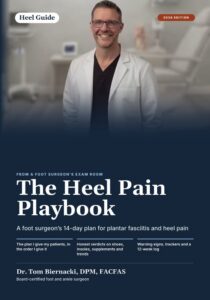
The shoe is half of it. A good running shoe takes load off the fascia; slow heel raises build it back up. Dr. Tom’s free 14-day plan from The Heel Pain Playbook has both, with a simple pain rule for when to back off. Get the free 14-day plan.
Common questions
Can I keep running with plantar fasciitis?
Usually, yes, with less volume and closer attention. If pain stays mild during a run and your first steps the next morning are no worse than usual, the load is tolerable. Cut distance, avoid hills and speedwork, and do daily calf and fascia stretches. Stop if the pain builds as you run, makes you limp, or is present at rest. Those patterns suggest something more than a simple flare.
Are Hoka or Brooks better for plantar fasciitis?
Neither brand is better overall. It depends on which design suits your foot. Hokas such as the Bondi and Clifton rely on deep cushioning and a rocker sole. Brooks shoes such as the Ghost and Adrenaline use a more traditional, higher-drop shape with a very firm heel. Rocker lovers and heavier runners tend to prefer Hoka, while heel strikers who like a firmer ride often prefer Brooks. Our Hoka vs Brooks comparison goes through the details.
What heel drop is best for plantar fasciitis?
A moderate to high drop, roughly 8–12 mm, suits most people during a flare. The raised heel eases tension in the calf and Achilles, which are linked to the fascia. Low-drop and zero-drop shoes are not harmful in themselves. The problem is switching to them suddenly, which loads the calf and fascia more than they are used to. If you want to run in a lower drop, make the change after symptoms have settled, and do it gradually.
Should I run in a stability shoe if I have plantar fasciitis?
Only if your foot needs it. Stability shoes help when the arch collapses or the heel rolls inward, because that movement adds strain to the fascia. If your arch holds its shape well, a structured neutral shoe with a firm heel counter and good twist resistance usually works as well and feels more natural. An inexpensive supportive insole in a neutral shoe is a reasonable middle option.
How often should I replace running shoes with plantar fasciitis?
Most cushioned running shoes are worth replacing at somewhere between 300 and 500 miles, and sooner if you are heavier or notice the midsole creasing. With plantar fasciitis, a shoe that has lost its structure is a common reason symptoms return. Keep a log of your mileage, and consider rotating two pairs so each midsole has time to recover between runs.
Do I need an insole as well as a good running shoe?
Not always. The 2023 physical therapy guideline found that orthoses work best combined with stretching and other treatment, not on their own. A supportive prefabricated insole is worth trying if your arch flattens or your neutral shoe feels unsupported. If you use one, choose a shoe with a removable sockliner and enough depth to fit it. See our insole guide.
- Koc TA Jr, Bise CG, Neville C, Martin RL, McDonough CM, et al. Heel Pain – Plantar Fasciitis: Revision 2023. Journal of Orthopaedic & Sports Physical Therapy.
- Allam AE, Chang KV. Plantar Heel Pain. StatPearls Publishing.
- American Academy of Orthopaedic Surgeons. Heel Pain. OrthoInfo.
- Medina Pabón MA, Bergman R, Naqvi U. Achilles Tendinopathy. StatPearls Publishing.
Related heel pain guides
- Best shoes for plantar fasciitis
- Best walking shoes for plantar fasciitis
- Best Hoka for plantar fasciitis
- Best Brooks for plantar fasciitis
- Hoka Bondi vs Clifton
- Heel pain in runners
- Plantar fasciitis treatment
- Plantar fasciitis taping
- Best shoes for heel pain
Heel pain in Michigan?
Dr. Biernacki sees heel pain at Balance Foot & Ankle in Howell and Bloomfield Township. If the right shoes have not settled it, an assessment can work out which tissue is responsible.
This page is education, not a diagnosis. Read our editorial policy for how it was written and what it will not claim.