
Footwear
Best shoes for plantar fasciitis: the four features that actually matter
There is no single best shoe for plantar fasciitis, and any list that names one has skipped the part that matters. A shoe that suits a flexible flat foot is the wrong shoe for a rigid high-arched one. What follows is how to judge a shoe yourself.
Footwear is the most powerful thing most people with heel pain can change, and the most badly advised. The standard recommendation — a list of ten model numbers — fails because the right shoe depends on the shape and behaviour of your foot, and because models are revised every twelve to eighteen months, so a name that was right two years ago may describe a different shoe now.
Features do not change that fast. Learn the four that matter and you can walk into any shop, or open any website, and sort the useful from the useless in about thirty seconds.
Want named models? Each guide below applies these four features to current shoes, with who each one suits and who should skip it. If you are keeping your current shoes, start with our insole comparison. Links to retailers are affiliate links, so we may earn a commission at no extra cost to you.
Specific models, by situation
On this page
The four features that matter
- Midfoot stiffness. The shoe should not fold in half or twist like a dishcloth. When the shoe flexes through the arch, the plantar fascia has to do the work the shoe is failing to do. A shoe that bends only at the ball of the foot, and resists twisting, takes tension off the fascia with every step. This is the single most important property and the easiest to test.
- A firm heel counter. The cup at the back of the shoe should resist being squashed inwards between your fingers. A rigid heel counter controls how much the heel rolls at contact, which in turn controls how much the fascia is stretched. Squeeze the back of the shoe: if it collapses, the shoe is not going to help.
- Some heel-to-toe drop. A raised heel — roughly eight to twelve millimetres for most people — reduces resting tension in both the calf and the plantar fascia. Flat and zero-drop shoes do the opposite. This is why a supportive trainer often feels better than a flat canvas shoe with more cushioning.
- A rocker, or generous toe spring. A curved sole lets you roll through the step instead of levering over the big toe joint. Because the fascia tightens as the toes extend, limiting that extension at push-off directly reduces the load it carries. Rockered shoes are the most underrated category in heel pain.
Cushioning is the fifth factor, and it is more conditional than the others. It matters a great deal if your heel pad has thinned, and much less if your problem is fascial tension. Soft alone is not supportive — a very cushioned shoe with a collapsing heel counter is a poor choice.
Two tests that take ten seconds
Hold the shoe by the heel and the toe and try to bend it. It should resist, then hinge at the ball of the foot, not fold at the arch. Then hold it the same way and try to wring it like a towel. It should resist that too. A shoe that passes both tests has a functional shank; one that fails them is a sock with a sole, whatever the marketing says.
Finally, squeeze the heel counter between thumb and forefinger. Firm is good. If the sides meet, put it back.
Drop, minimalism and the barefoot question
Minimalist and zero-drop shoes have a legitimate following, and there are people who run in them without trouble for years. During an episode of plantar fasciitis they are the wrong tool. Removing heel height increases the tension the calf and fascia carry through the whole gait cycle, and removing the shank transfers arch support work back to the fascia that is already failing.
If you want to move towards a more minimal shoe as a long-term project, that is a reasonable goal to pursue once the heel is asymptomatic, over months rather than weeks, and with the strengthening work done first. Attempting the transition while the heel hurts is the most common self-inflicted setback in this condition.
Matching the shoe to your foot
| Your foot | What to look for | What tends not to work |
|---|---|---|
| Flexible, flat, rolls inwards | Stability or structured shoes with a firm medial midsole and a rigid heel counter | Soft neutral shoes with a plush midsole and little structure |
| High, rigid arch that does not flatten | Neutral, well-cushioned shoes with a rocker; shock absorption matters more than control | Firm stability posting, which pushes an already supinated foot further out |
| Thin or tender heel pad | Maximal cushioning under the heel, plus a heel cup that contains the pad | Thin, flat outsoles and hard surfaces; open-backed shoes |
| Stiff or painful big toe joint | A pronounced rocker sole and a stiff forefoot, so the toe does not have to extend | Very flexible forefoot shoes that force toe extension at push-off |
| Wide foot, or wearing an orthotic | Wide fittings and a removable factory insole, so a device sits at the right depth | Narrow lasts and glued-in insoles — adding a device makes the shoe too tight |
| On your feet all day at work | Rockered, cushioned, stiff-shanked work shoes; two pairs alternated day to day | A single pair worn every shift until the midsole is dead |
Categories that work, with familiar examples
These are examples of each category rather than endorsements, and specifications change between versions — judge the pair in front of you with the tests above.
- Cushioned neutral trainers suit most high-arched and neutral feet. The Brooks Ghost, Hoka Clifton, New Balance 1080 and Saucony Triumph families sit here.
- Stability trainers suit flexible, inward-rolling feet. The Brooks Adrenaline GTS, ASICS GT-2000, Saucony Guide and New Balance 860 families are the long-standing options.
- Maximal cushioning suits thinned heel pads and hard floors. The Hoka Bondi is the reference point; most brands now have an equivalent.
- Rockered walking and work shoes suit stiff big toe joints and long days standing. Look for a visibly curved sole and a stiff forefoot.
- Indoor and recovery footwear is the category most people never buy and most need. Structured sandals and clogs with a real arch contour — Oofos, Vionic and the Birkenstock-style contoured footbeds — are for wearing at home instead of going barefoot.
The change most people skip
Almost everyone optimises the shoes they wear outside and then walks barefoot on tile and hardwood at home for four or five hours every evening. For most people with plantar fasciitis that is the single largest uncontrolled load in the day, and it is the reason the morning pain does not shift despite good trainers.
Buy a supportive indoor shoe or a contoured sandal, leave it beside the bed, and wear it from the first step of the day until you get into bed. It is a smaller investment than custom orthotics and it changes more. See why the first steps out of bed hurt most for why that first load matters so much.
When to replace them
Midsole foam loses its ability to absorb and return load long before the upper looks worn. For running shoes the usual guidance is roughly three hundred to five hundred miles. For work and walking shoes, judge by the midsole: press your thumb into it and look for compression lines and creasing, check whether the shoe still passes the twist test, and look at whether the heel is worn unevenly. A shoe that has gone soft is a common reason heel pain returns after months of doing well.
Footwear is one part of treatment, not the whole of it.
If a new pair makes the pain sharply worse within days, stop wearing them rather than persevering.
If heel pain worsens as the day goes on instead of easing, the problem may be bone rather than fascia and shoes will not fix it.
If you have diabetes or reduced sensation in your feet, have footwear assessed professionally rather than self-selecting, and check your feet daily for rubbing.
Numbness, burning or pins and needles points at a nerve and needs a different assessment.
Where shoes fit in the plan
Footwear and insoles change the load the fascia carries. Stretching and progressive loading change what the fascia can tolerate. You need both: shoes alone tend to take the edge off without resolving anything, and exercise alone struggles against eight hours a day in the wrong shoes. The full treatment sequence sets out the order to work through.
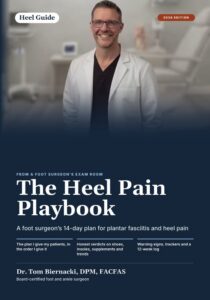
Want the whole plan, not just the shoes? The free 14-day plan from Dr. Tom’s Heel Pain Playbook puts shoes, stretches and heel raises in the order he gives them in clinic, with a tracker that shows by day 14 whether it is working. Get the free 14-day plan.
Watch
Dr. Biernacki goes through insoles and shoe selection for plantar fasciitis, and what to look for in a pair.
Common questions
What is the single best shoe for plantar fasciitis?
There is not one. The features that help are consistent — a stiff midfoot, a firm heel counter, some heel-to-toe drop and a rocker sole — but which shoe delivers them in a shape that fits your foot is individual. A flexible flat foot needs structure a rigid high-arched foot would find uncomfortable. Judge shoes by the bend and twist tests rather than by model name.
Are zero-drop or barefoot shoes bad for plantar fasciitis?
During an active episode, yes, for most people. Removing heel height increases resting tension in the calf and fascia, and removing the shank transfers arch work back to the tissue that is already failing. If you want to move to a more minimal shoe, treat it as a project to start once the heel is comfortable, progressed over months.
Do I need expensive shoes?
No, but very cheap shoes rarely have a functional shank or a firm heel counter, which are the two properties that matter most. The useful range is broad and mid-priced. Spending more tends to buy lighter materials and better uppers rather than more support, so a mid-range stability or cushioned trainer from an established line is usually the sensible purchase.
Should I wear shoes indoors?
If you have plantar fasciitis and hard floors, yes. Barefoot walking on tile or hardwood is often the largest unmanaged load of the day and a frequent reason morning pain does not improve. A supportive indoor shoe or a contoured sandal worn from the first step of the day is one of the highest-value changes available.
How often should I replace my shoes?
Running shoes generally lose useful midsole function between three hundred and five hundred miles. For walking and work shoes, judge by the midsole rather than the mileage: look for compression creasing, check whether the shoe still resists twisting, and look for uneven heel wear. Heel pain returning after a good spell is often a dead midsole.
Can I just add insoles to the shoes I already own?
Often yes, and it is a reasonable first step — provided the shoe has a removable factory insole so the device sits at the right depth, and provided the shoe itself is not the problem. A device inside a shoe that folds in half and has a collapsing heel counter does much less than the same device in a structured shoe.
- American Academy of Orthopaedic Surgeons, OrthoInfo. Heel Pain.
- Koc TA, et al. Heel Pain – Plantar Fasciitis: Revision 2023. Clinical Practice Guidelines, Journal of Orthopaedic & Sports Physical Therapy.
- Landorf KB, Keenan AM, Herbert RD. Effectiveness of foot orthoses to treat plantar fasciitis: a randomized trial. Archives of Internal Medicine, 2006 — the customised-versus-prefabricated comparison.
- Riddle DL, Pulisic M, Pidcoe P, Johnson RE. Risk factors for plantar fasciitis: a matched case-control study. Journal of Bone and Joint Surgery, 2003 — the source of the calf-tightness and standing-occupation associations.
- Allam AE, Chang KV. Plantar Heel Pain. StatPearls, NCBI Bookshelf.
Related heel pain guides
- Insoles and orthotics for plantar fasciitis
- Shoes for heel pain, by cause
- Shoes for Achilles tendonitis
- Heel cups
- Plantar fasciitis treatment
- Plantar fasciitis exercises and stretches
- Plantar fasciitis
- Heel fat pad atrophy
- Product guides
- Heel pain: how to work out what you have
- Heel pain in runners
- Heel pain in pregnancy
- Heel spur treatment
- Back of heel pain
- Are Birkenstocks good for plantar fasciitis?
- Are Crocs good for plantar fasciitis?
- Hoka vs On Cloud for plantar fasciitis
- Hoka Bondi vs Clifton
- Brooks Ghost vs Glycerin
Heel pain in Michigan?
Dr. Biernacki sees heel pain at Balance Foot & Ankle in Howell and Bloomfield Township. If you have worked through footwear and insoles and the heel has not settled, an assessment can establish which tissue is actually responsible and what will change it.
This page is education, not a diagnosis. Read our editorial policy for how it was written and what it will not claim.