Heel pain causes
Haglund’s Deformity: The Bump at the Back of the Heel
A bony prominence at the back of the heel bone. It is rarely the bump itself that hurts — it is what the bump presses against, which is why changing your shoes can work better than anything aimed at the bone.
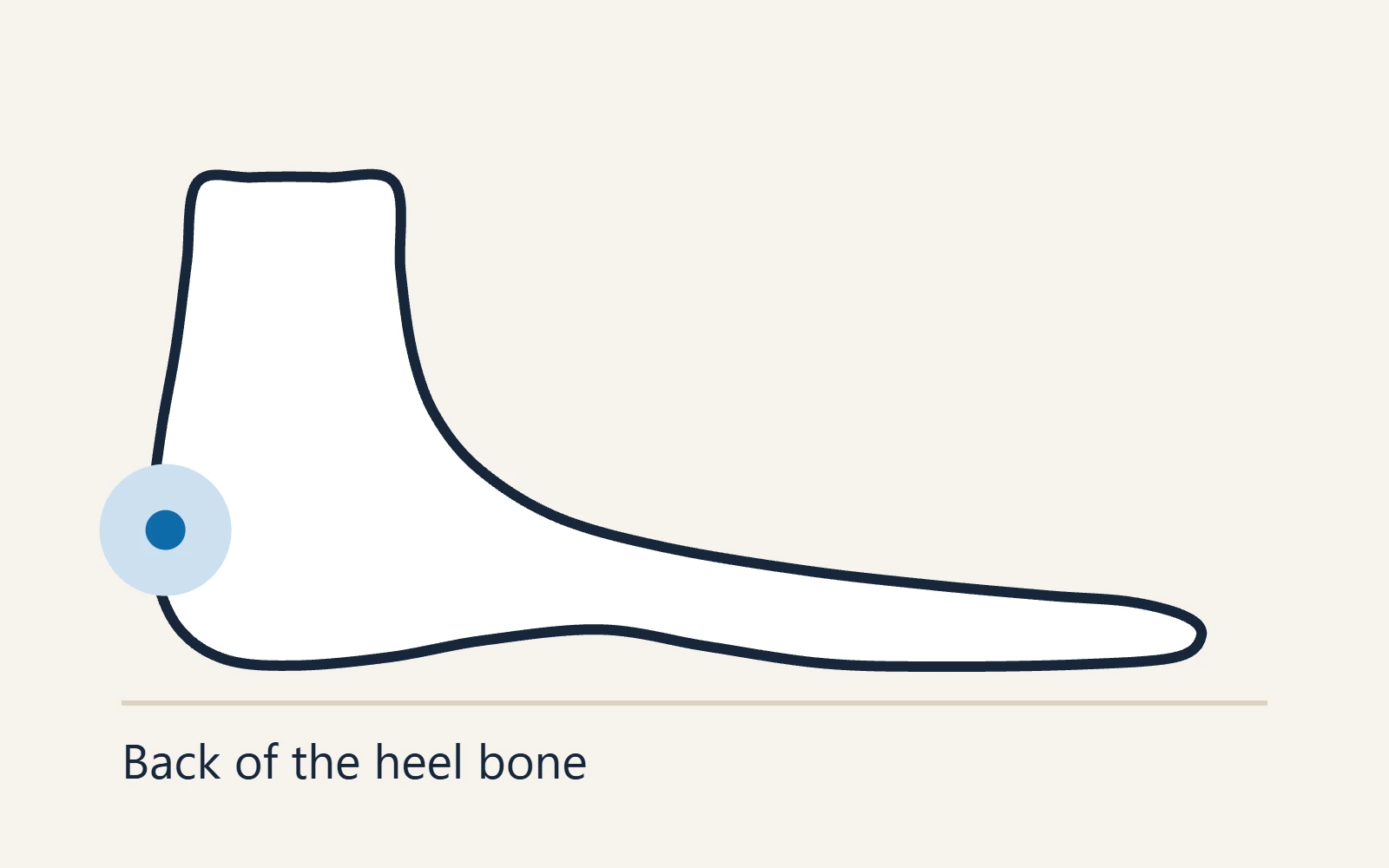
Somewhere on the upper outer corner of the heel bone, most people have a modest prominence. In some feet it is pronounced enough to be visible as a firm lump under the skin at the back of the heel, and that is what gets called a Haglund’s deformity.
The thing worth understanding immediately is that the bump and the pain are two different facts. Plenty of people have a prominent one and have never given it a thought. It becomes a problem when it starts compressing the soft tissue sitting directly in front of and behind it — and that compression is usually created by a shoe.
Why it hurts, when it hurts
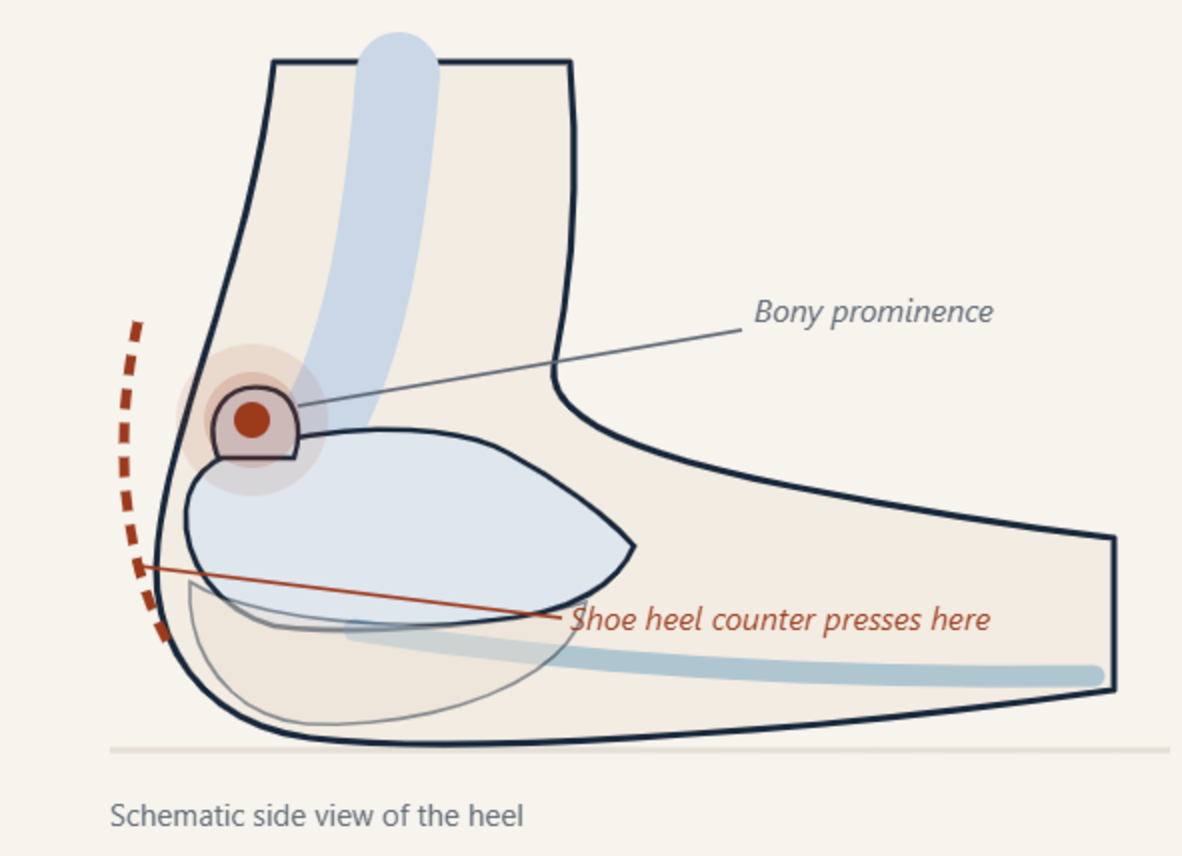
Three structures are packed into a very small space at the back of the heel: the bony prominence, the retrocalcaneal bursa immediately in front of the Achilles tendon, and the tendon’s insertion onto the bone. Squeeze them together repeatedly and all three become irritated. When all three are involved at once it is sometimes called Haglund’s syndrome, which is a useful name because it makes the point that treating only one of the three tends to disappoint.
Two things drive the compression. The first is the rigid heel counter of a shoe sitting at exactly the height of the prominence — the reason the older name is a pump bump. The second is ankle position: bending the ankle upwards drives the prominence into the bursa and the tendon, which is why deep dorsiflexion stretching makes this specific problem worse.
How to recognise it
| Haglund’s and the tissue around it | Plantar fasciitis | |
|---|---|---|
| Where | Back of the heel, on or just above the bone, often with a visible or palpable lump | Underneath the heel, toward the inner front corner |
| What provokes it | Specific shoes; the back of the heel rubbing; walking uphill | The first steps of the day; long periods standing |
| Appearance | Often red, thickened or shiny skin over the bump | Nothing to see |
| Stretching off a step | Makes it worse | Generally helps |
| Barefoot | Frequently the most comfortable option | Usually uncomfortable |
The most informative question is which shoes hurt. Pain that is bad in one stiff-backed pair, fine in a soft trainer and absent in a backless slipper is compression, and compression is the most treatable version of this problem. Pain that is equally bad barefoot points more toward the tendon insertion itself, which takes longer and needs loading work rather than a shoe change.
What actually helps
Almost all of the early gains come from taking the pressure off. This is unglamorous and it works.
- Change the back of the shoe. A soft or collapsible heel counter, or an open-backed shoe, removes the mechanism directly. This alone settles a good proportion of cases.
- Add a heel lift. Around 6 to 12 millimetres, in both shoes. It reduces Achilles tension and lifts the prominence clear of the counter’s rim at the same time. It is cheap and it tells you quickly whether compression is the issue.
- Stop the aggravating stretch. If you have been diligently dropping your heel off a step, that is very likely part of why this is not settling.
- Load the calf properly, within range. Strength work helps the tendon insertion, but done with the heel on the floor and the movement stopped at neutral — never below it.
- Manage the hill and speed work. Uphill running holds the ankle in dorsiflexion under load, which is the provoking position repeated several hundred times.
- Protect the skin. A silicone sleeve over the bump stops the rubbing while the rest of the plan takes effect.
Two things to be careful about.
The stretch off the edge of a step. Worth repeating because it is so commonly prescribed. Deep dorsiflexion compresses exactly the structures that are already irritated. Good for mid-portion Achilles problems, actively unhelpful here.
Steroid injection around the insertion. There is a recognised risk of weakening or rupturing the Achilles, and it is not a routine step for this problem. If it is proposed, it warrants a specific conversation about what is being injected where, and why.
How long it takes
If compression is the main driver and the shoes change, improvement often starts within a few weeks. Where the tendon insertion is genuinely involved, the honest timescale is months rather than weeks, because insertional tendon problems are slow regardless of what is done to them. Surgery is reserved for people who have given six to twelve months to a real non-surgical effort without success — it is effective, but it frequently involves detaching and reattaching part of the Achilles, and recovery runs to several months.
Common questions
Will the bump go away?
Not on its own, and not with exercises. It is bone, and bone does not reabsorb because you stretched it. That sounds discouraging and mostly is not: the bump is usually painless in itself, and people who have had one for decades often only discover it when a new pair of shoes starts rubbing. The realistic goal is a bump that does not hurt, not a heel without a bump.
Why does it hurt in some shoes and not others?
Because the pain comes from compression, not from the bone. A rigid heel counter that sits exactly at the height of the prominence presses the bump into the bursa and the tendon behind it every step. Move the pressure point — a softer counter, a different height, an open back — and the same foot stops hurting. This is why it is sometimes called a pump bump.
Should I stretch my calf by dropping the heel off a step?
No — not for this. Dropping the heel below the level of the step forces the ankle into deep dorsiflexion, which is precisely the position that jams the prominence against the bursa and the tendon insertion. It is a good exercise for problems in the mid-portion of the Achilles and a poor one here. Do calf work with the heel on the floor and stop the movement at neutral.
Does a heel lift really help?
It usually does, and it surprises people because it seems like it should make a bump stick out more. It does two useful things at once: it takes tension off the Achilles, and it raises the prominence so it sits above the rigid rim of the heel counter rather than against it. A lift of about 6 to 12 millimetres in both shoes is a cheap, fast test of whether compression is the problem.
Is a steroid injection a good idea?
It deserves a careful conversation first. Injecting steroid around the Achilles insertion carries a recognised risk of weakening or rupturing the tendon, and it can thin the heel’s fat pad. It is not a routine step here. If it is offered, ask specifically what is being injected, where, and why that outweighs the risk in your case.
When is surgery worth considering?
When a genuine six to twelve months of shoe modification, heel lift, load management and appropriate strengthening has failed, and the compression is clearly the problem. It is effective but not minor — removing enough bone often means detaching and reattaching part of the Achilles insertion, and recovery runs to several months in a boot. It is a reasonable operation at the end of a proper non-surgical effort, and a poor one as a shortcut.
- American Academy of Orthopaedic Surgeons, OrthoInfo. Heel Pain.
- American Academy of Orthopaedic Surgeons, OrthoInfo. Achilles Tendinitis.
- Martin RL, Chimenti R, Cuddeford T, et al. Achilles pain, stiffness, and muscle power deficits: midportion Achilles tendinopathy revision 2018. Journal of Orthopaedic & Sports Physical Therapy, 2018.
- Vaishya R, Agarwal AK, Azizi AT, Vijay V. Haglund’s Syndrome: A Commonly Seen Mysterious Condition. Cureus, 2016.
Related heel pain guides
- Heel bursitis
- Achilles tendonitis
- Heel spurs
- Best shoes for plantar fasciitis
- Calcaneal stress fracture
- Heel pain: how to work out what you have
Heel pain in Michigan?
Whether the bone, the bursa or the tendon insertion is driving the pain decides which treatment comes first, and that comes from an examination rather than a photograph of the bump. If you are in Livingston or Oakland County, it is usually sorted in one appointment.
This page is education, not a diagnosis. Read our editorial policy for how it was written and what it will not claim.