Footwear
Best Shoes for Achilles Tendonitis (2026)
The best shoes for Achilles tendonitis have a heel-to-toe drop of around 10 mm or more, a heel collar that does not dig into the back of the heel, and enough cushioning to soften each landing. For most people that means a Brooks Ghost 18 or Adrenaline GTS 26 for daily wear, with a heel lift added if the tendon is still sore.
Achilles pain is one of the few heel problems where the shoe itself can make a difference within days. Heel height changes how far the tendon stretches with every step, and a badly shaped heel tab can press on the sore spot hundreds of times a mile. Get those two things right and the tendon has a quieter environment in which to recover.
How we choose: picks are judged on heel-to-toe drop, heel collar and counter design, cushioning and rocker geometry, using the same clinical approach as the four features that matter; no brand pays for placement, and specifications come from manufacturer listings and independent reviews checked in October 2026. Links to Amazon are affiliate links, so we may earn a commission at no cost to you (disclosure).
Quick picks
Best overall: Brooks Ghost 18
A 10 mm drop and a collar reviewers found did not press on the Achilles.
Best stability: Brooks Adrenaline GTS 26
The same 10 mm drop with GuideRails support.
Best for insertional pain: Saucony Triumph 24
A 10 mm drop with room behind the heel.
Best for runners with mid-portion pain: Nike Pegasus 42
A 10 mm drop in a quicker trainer.
On this page
- Mid-portion or insertional: why it matters for shoes
- What to look for in a shoe for Achilles tendonitis
- The ten-second heel counter test
- The best shoes for Achilles tendonitis
- Comparison table
- The Hoka question: low drop, big rocker
- Work boots, dress shoes, women’s shoes and home
- Shoes to be cautious with
- Heel lifts: the cheapest upgrade
- Common questions
Mid-portion or insertional: why it matters for shoes
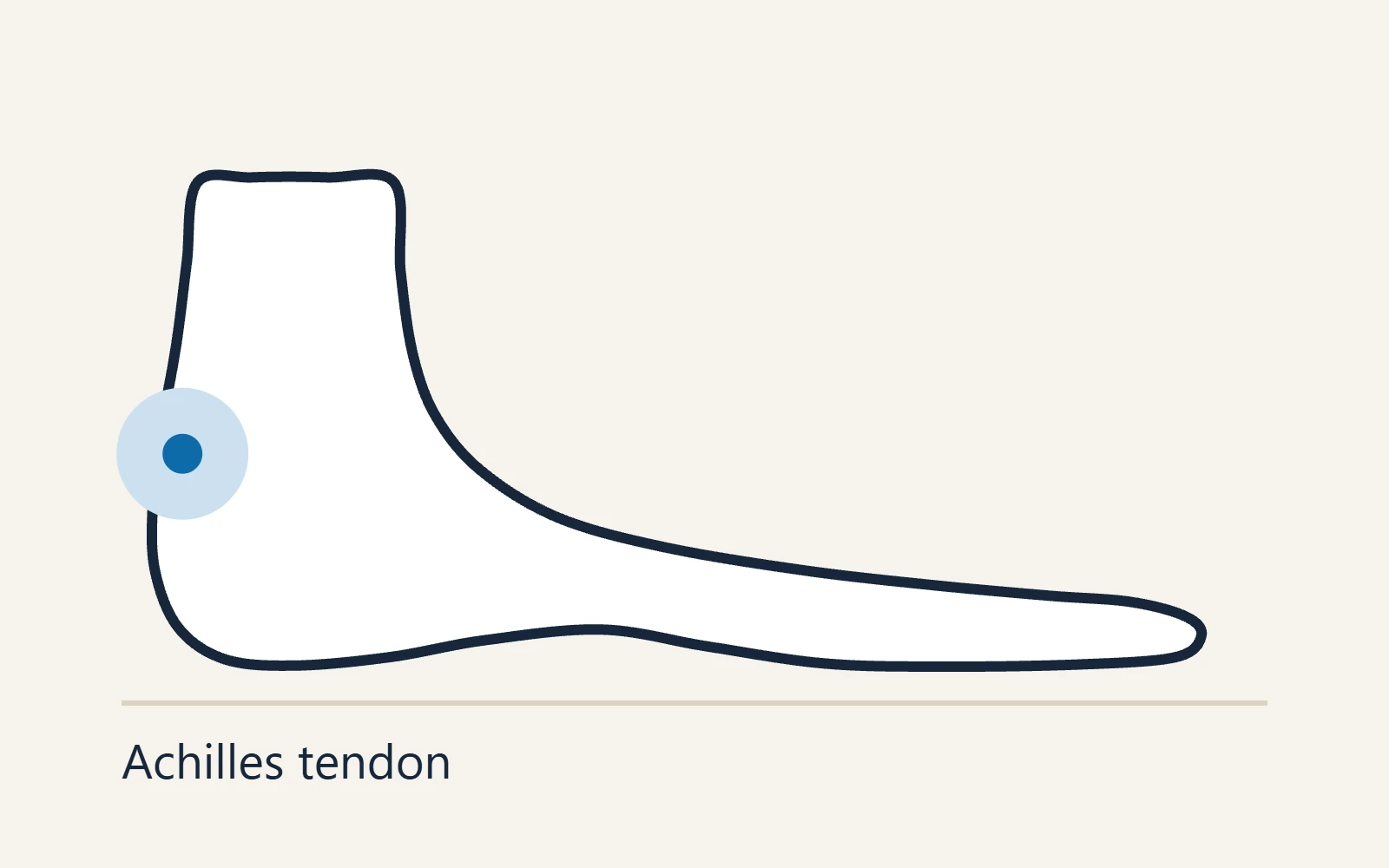
Mid-portion Achilles tendinopathy hurts roughly two to six centimetres above the heel bone, in the cord of the tendon itself. It is common in runners, and the tendon often feels thickened when pinched. Here drop matters most.
Insertional Achilles tendinopathy hurts at the point where the tendon attaches to the back of the heel bone. It often comes with a bony bump (Haglund’s deformity), an inflamed bursa or small spurs. Drop still matters, but the heel collar becomes just as important, because anything pressing on the back of the heel pushes into inflamed tissue. Our guide to insertional Achilles tendonitis covers this in more depth, and Haglund’s deformity has its own page.
If you are not sure which you have, press gently along the tendon from the heel upwards. Pain at the attachment suggests insertional; a few finger-widths higher suggests mid-portion. If the pain is more around the sides, read our guide to back of heel pain, as bursitis can look similar.
| Feature | Mid-portion | Insertional, Haglund’s, bursitis |
|---|---|---|
| Heel-to-toe drop | High: roughly 10–12 mm or more | High: roughly 10–12 mm or more |
| Heel collar and counter | Comfortable; less critical | Soft, low or notched; must not press on the sore spot |
| Rocker sole | Helpful | Helpful |
| Forefoot stiffness | Moderately stiff reduces calf work at push-off | Moderately stiff reduces calf work at push-off |
| Heel lift insert | Useful, and supported by trial evidence | Useful; check the counter after adding it |
What to look for in a shoe for Achilles tendonitis
The features I check in clinic, in order of importance:
1. A heel-to-toe drop of 10 mm or more. Drop is the height difference between heel and forefoot. A higher heel keeps the ankle slightly pointed, so the Achilles does not lengthen as far with each step. For an irritable tendon, 10 to 12 mm is a sensible target; zero-drop shoes do the opposite. Traditional running and walking shoes sit around 10 to 12 mm, while many modern cushioned shoes are lower, often 4 to 8 mm, and moving from a high-drop shoe to a low-drop one is a common trigger for an Achilles flare.
2. A heel collar that leaves the insertion alone. A tall, stiff heel tab that curves towards the tendon presses on the insertion as the ankle flexes. A soft, notched or flared collar is kinder, especially for insertional pain.
3. A firm heel counter below the collar. The counter is the stiff cup around the heel bone; the collar is its top edge. You want the counter firm enough to hold the heel steady and the collar above it soft.
4. Cushioning and a smooth heel-to-toe roll. A rockered sole lets the foot roll forwards without the ankle bending as far, easing load on the tendon at push-off.
5. Widths and room for a heel lift. A heel lift needs depth at the back of the shoe, or your heel rides up into the collar.
Do not drop the heel suddenly. Orthopaedic guidance notes that an abrupt footwear change can increase Achilles strain. Switch gradually, keeping the old pair for longer days at first.
The ten-second heel counter test
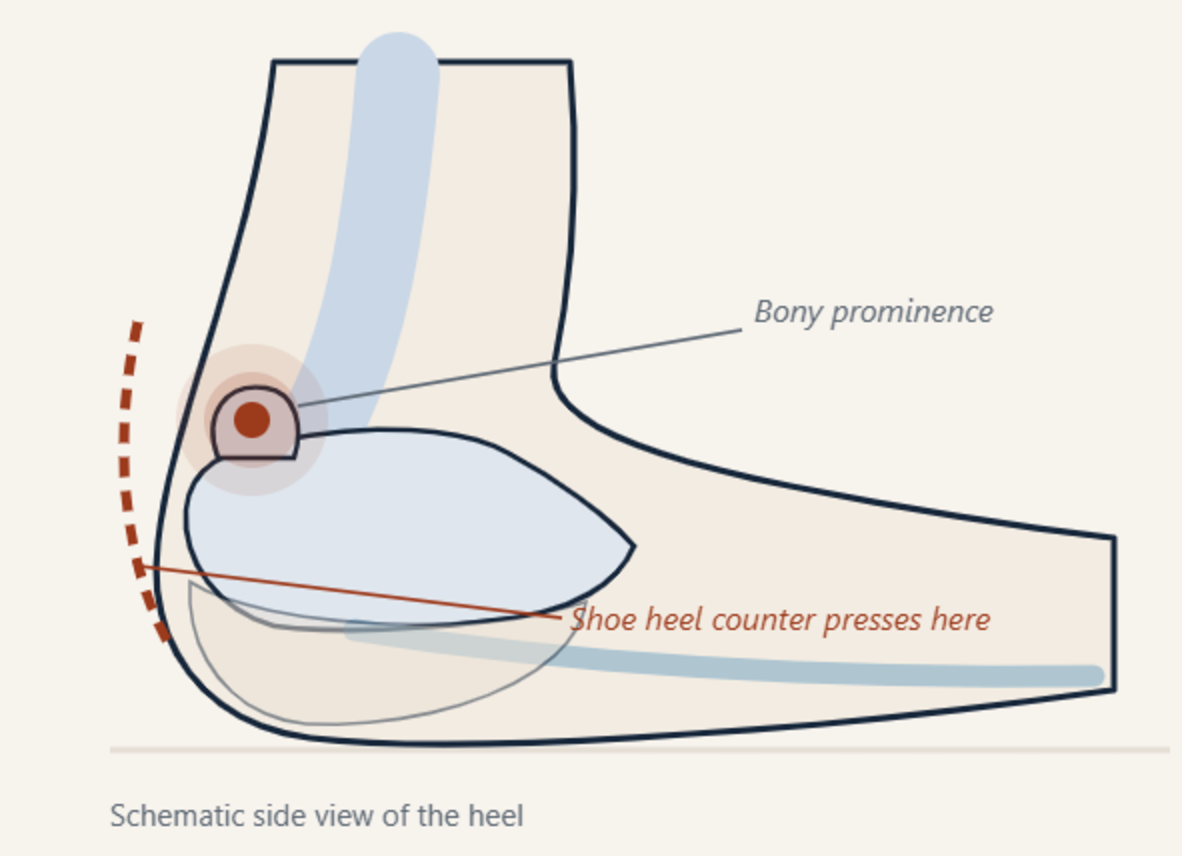
At the insertion, the tendon and the bursa beneath it are compressed between the heel bone and whatever is behind them. A stiff, high heel counter, a hard heel tab or a tight boot collar adds pressure from outside, thousands of times a day. No review can tell you how a particular collar meets your particular heel, so test every shoe on this page yourself.
Put the shoe on, stand, and feel where the top edge of the counter sits. If it crosses the sore spot or the bump, that shoe will keep it irritated however well it is cushioned. Look instead for:
- A soft, padded collar that gives under thumb pressure.
- A low or notched heel tab that curves away from the tendon rather than pressing into it.
- Enough depth that the heel sits snugly without the counter being the thing holding it.
- Backless options at home: a contoured clog or slide with a raised, cushioned heel removes counter pressure entirely while still lifting the heel.
The best shoes for Achilles tendonitis
Every shoe below is a current model as of October 2026, with manufacturer drops and stack heights as published by independent reviewers and specialist retailers.
1. Brooks Ghost 18 — best overall
The Ghost has been a 10 mm drop shoe for a long time, and the Ghost 18 keeps it, on a 36 mm heel and 26 mm forefoot. That is the right geometry for a sore Achilles without an extreme stack.
What earns it the top spot is the heel. The counter is stiff, but independent testers at Doctors of Running reported no rubbing or pressure on the Achilles and rated the shoe as potentially suitable for Haglund’s deformity. It comes in D, 2E and 4E for men.
- Drop: 10 mm (36 mm heel / 26 mm forefoot)
- Type: neutral daily trainer
- Widths: men’s D, 2E, 4E
- Heel and collar: stiff counter, no Achilles pressure reported
- Price: around $150 list
Good for: mid-portion and mild insertional pain in easy-paced walkers and runners.
Skip it if: you need a custom orthotic in it, because reviewers rated it not orthotic-friendly, or you want a soft, plush ride.
2. Brooks Adrenaline GTS 26 — best stability shoe
The Adrenaline is often described as a 12 mm shoe, but that is out of date: both the GTS 25 and GTS 26 are listed at 10 mm, on the same 36 mm heel and 26 mm forefoot as the Ghost. The difference is the GuideRails system, which limits excessive inward roll of the heel and knee.
For the heel, the GTS 26 brings a refreshed knit collar and a new heel loop, so you can pull the shoe on without crushing the back of it. A crushed counter loses its shape and starts to rub. Running Warehouse lists D, 2E and 4E widths for men.
- Drop: 10 mm (36 mm heel / 26 mm forefoot)
- Type: stability
- Widths: men’s D, 2E, 4E
- Heel and collar: refreshed knit collar, heel pull loop
- Price: around $155 list
Good for: people with flatter feet or visible overpronation alongside Achilles pain, and anyone who stands or walks all day.
Skip it if: you have a neutral foot and do not need guidance, as the Ghost 18 gives you the same drop with less structure.
3. Saucony Triumph 24 — best for insertional pain
The Triumph 24 pairs a 10 mm drop with a tall 43 mm heel and 33 mm forefoot, so the heel sits well up and well cushioned. For insertional pain, the key finding from Doctors of Running was the space behind the heel: testers reported sufficient room behind the Achilles and no posterior pressure, while still getting good heel hold without slipping.
It is also light for its size, and Saucony sells a wide version in men’s and women’s sizing.
- Drop: 10 mm (43 mm heel / 33 mm forefoot)
- Type: neutral max cushion
- Widths: standard and wide
- Heel and collar: room behind the Achilles, no posterior pressure reported
- Price: around $170 list
Good for: insertional Achilles pain, Haglund’s bumps and people who want maximal heel cushioning without losing the drop.
Skip it if: you feel unsteady on tall soles, have weak or recently sprained ankles, or need medial support.
4. Brooks Addiction Walker 2 — best for walking and work
Many of the patients I see are on their feet at work rather than running. The Addiction Walker 2 has a 12 mm drop, the highest on this list, and comes in narrow, medium, wide and extra-wide.
Reviewers describe it as heavy, which is a reasonable trade for a tendon that needs offloading through a long shift.
- Drop: 12 mm
- Type: supportive walking shoe
- Widths: narrow (2A), medium, wide (2E), extra wide (4E)
- Heel and collar: not described in the sources I checked; try it on and press the back of the collar against the sore spot
Good for: walking, standing jobs, older adults and anyone who wants maximum drop and width options.
Skip it if: you want to run in it, or you dislike a heavy, traditional-looking shoe.
5. Hoka Clifton 11 — best Hoka for the Achilles
Most Hoka shoes sit at a 5 mm drop, which is not ideal for an irritable Achilles. The Clifton changed that with version 10, moving to an 8 mm drop, and the Clifton 11, released in summer 2026, keeps the same 8 mm drop and 42 mm heel stack. Doctors of Running noted that runners with past Achilles trouble may get on better with this higher drop.
You also get an early forefoot rocker. On the Clifton 10, testers found a stiff, heavily padded counter and warned sensitive heels to take care as the padding breaks in; the Clifton 11 changes the upper and sockliner, not the heel.
- Drop: 8 mm (42 mm heel)
- Type: neutral, rockered
- Widths: standard, wide, extra wide
- Heel and collar: stiff, heavily padded counter (per Clifton 10 testing)
- Price: around $150–$155 list
Good for: mid-portion pain in people who like the Hoka feel and want a rocker.
Skip it if: you have an inflamed Haglund’s bump that reacts to any firm counter, or your symptoms flare with anything under 10 mm.
6. Nike Pegasus 42 — best for runners with mid-portion pain
The Pegasus 42, released in spring 2026, keeps the familiar 10 mm drop on a 37 mm heel and 27 mm forefoot. It gives runners with mid-portion pain the drop they need in a quicker package.
The heel is where you need to be honest with yourself. Road Trail Run describes a rigid, high counter with a tall, well-padded extension at the Achilles. That gives excellent heel hold, but a tall tab can press on an insertional tendon or Haglund’s bump, so it is here for mid-portion pain only. It runs small with a narrow toe box.
- Drop: 10 mm (37 mm heel / 27 mm forefoot)
- Type: neutral daily trainer
- Widths: check availability; runs narrow in the toe box
- Heel and collar: rigid high counter with a tall padded Achilles extension
- Price: around $140–$145 list
Good for: runners with pain in the middle of the tendon who want a quicker shoe.
Skip it if: your pain is at the insertion, you have a Haglund’s bump, or you have a wide forefoot.
7. ASICS Gel-Kayano 33 — best wide-fitting stability option
The Kayano 33 is listed at 8 mm, and RunRepeat’s lab measured it at 8.5 mm, so it sits a little lower than the Brooks pair above. What it offers is a stable platform, plenty of heel collar padding and an unusually wide range of widths: narrow, standard, wide and extra-wide for men, and narrow, standard and wide for women. The heel tab is a finger loop built into the collar rather than a tall spike.
Doctors of Running noted the collar padding compresses over time, leaving the firm counter closer to the heel — worth watching if your pain is insertional.
- Drop: 8 mm (39 mm heel / 31 mm forefoot, men’s)
- Type: stability
- Widths: men’s narrow to extra wide; women’s narrow to wide
- Heel and collar: heavily padded collar, finger-loop tab, firm counter
- Price: around $170 list
Good for: wide or flat feet that need support, and mid-portion pain in people who overpronate.
Skip it if: you need a full 10 mm or more, or your insertional pain flares with firm counters.
Comparison table
| Shoe | Drop | Type | Best for | Insertional-friendly heel? |
|---|---|---|---|---|
| Brooks Ghost 18 | 10 mm | Neutral | Everyday, mid-portion | Yes, generally |
| Brooks Adrenaline GTS 26 | 10 mm | Stability | Overpronation, standing all day | Generally, softer collar |
| Saucony Triumph 24 | 10 mm | Max cushion | Insertional, Haglund’s | Yes, room behind heel |
| Brooks Addiction Walker 2 | 12 mm | Walking | Work, walking, wide feet | Try on first |
| Hoka Clifton 11 | 8 mm | Neutral rocker | Hoka fans, mid-portion | Caution with sensitive heels |
| Nike Pegasus 42 | 10 mm | Neutral | Runners, mid-portion | No, tall tab |
| ASICS Gel-Kayano 33 | 8 mm | Stability | Wide or flat feet | Moderate |
The Hoka question: low drop, big rocker
Whether Hokas suit Achilles tendonitis depends on the model and on you. Most, including the Bondi 9, have a 5 mm drop — lower than I would like for a sore tendon — but their rockers reduce how far the ankle bends, offsetting some of that load.
Some people with Achilles pain feel better in a Bondi and some feel worse. If your tendon is settling in Hokas, there is no need to change. If you are mid-flare in a 5 mm shoe, try a 10 mm shoe or a heel lift. The Clifton 11 at 8 mm is the middle ground. The same logic applies to other rocker shoes such as the Brooks Ghost Max 4, which has a 6 mm drop and a pronounced rocker: reasonable with a heel lift, less so without one. Doctors of Running did not recommend the Bondi 9 for Haglund’s deformity, so for insertional pain it is not my first choice. We compare the two most popular Hokas in Hoka Bondi vs Clifton.
Work boots, dress shoes, women’s shoes and home
- Running. Stay in a shoe with a familiar or higher drop while the tendon is sore, and avoid switching to a new, lower-drop or racing shoe mid-flare. The loading programme in Achilles exercises sets the pace for returning to running.
- Work boots. High, rigid boot collars can press on the tendon. Look for a padded collar, and try lacing the top eyelets more loosely. A heel lift can be added if the boot is flat.
- Dress shoes. A shoe with a modest block heel is kinder to the Achilles than a completely flat one. Check the back seam does not cross the sore spot. Loafers with a hard back edge are a common aggravator for insertional pain.
- Women’s shoes. A low to moderate, stable heel generally feels better than flats for an Achilles. Very high, narrow heels shift load to the forefoot and are a poor trade.
- At home. Flat slippers and bare feet undo the day’s work. A supportive indoor shoe or a contoured sandal with a raised heel is worth having by the bed.
Shoes to be cautious with
Zero-drop and minimalist shoes. Shoes with no height difference between heel and forefoot ask the Achilles to lengthen fully on every step.
Completely flat shoes such as flip-flops, ballet flats and canvas plimsolls, which offer no heel raise.
Tall, inward-curving heel tabs. For insertional pain they can keep the area inflamed.
Rigid-collared boots, including ski boots and skates, which press directly on the tendon.
Worn-out shoes whose heel has compressed, effectively lowering the drop.
The ASICS Gel-Nimbus 28. Its listed 8 mm drop felt closer to 5 to 6 mm to reviewers, and Doctors of Running noted the back of the heel tilts forwards into the Achilles. They did not recommend it for Haglund’s. For insertional pain I would pick the Triumph 24 instead.
Heel lifts: the cheapest upgrade
A heel lift is a wedge that sits under your heel inside the shoe, raising it a few millimetres. It increases the effective drop of whatever you are wearing, which reduces the stretch on the tendon. Reference texts describe 12 to 15 mm lifts as a common adjunct for Achilles tendinopathy, and a small 2024 study in insertional tendinopathy found symptom scores improved over two weeks, though it had no control group. For mid-portion tendinopathy, the HEALTHY randomised trial compared heel lifts with eccentric calf exercise and found heel lifts at least as effective over 12 weeks. If you love a shoe with a lower drop, a heel lift inside it adds the height back.
- Hapad Heel Lifts. Made from wool felt and sold in pairs in several fixed thicknesses, from 3/16 inch upwards. Felt moulds to your heel and is easy to trim.
- Spenco RX Heel Cushions. A cushioned heel pad with a 1/4-inch heel lift and a tapered edge that fits dress, casual and athletic shoes.
- Use a lift in both shoes so your pelvis stays level.
- Check the heel collar after fitting. If the lift pushes your heel up into the collar, use a deeper shoe or thinner lift.
- Treat it as a temporary aid. As the tendon settles and your Achilles strengthening exercises progress, reduce the lift gradually rather than stopping overnight.
Heel cups also lift the heel slightly; our heel cups guide compares them.
Shoes support recovery; loading drives it. The strongest evidence for Achilles tendinopathy is for progressive strengthening of the calf and tendon. The right shoe lowers daily irritation so exercise can work. If six to eight weeks in good shoes has not helped, the next step is a loading programme or an assessment, not another pair of trainers.
When shoes are not the answer.
If you felt a sudden pop or a sensation like being kicked in the back of the heel, and now struggle to push off or rise onto your toes, the tendon may have ruptured. Stop walking on it and seek urgent medical assessment the same day.
If pain is worse the more you walk and does not ease, or there is swelling or bruising across the heel bone, a stress fracture of the heel needs to be ruled out.
If the calf is swollen, warm or red, it needs checking for a blood clot.
If both Achilles tendons ache with stiffness elsewhere, the cause can be inflammatory.
Numbness, burning or tingling points at a nerve rather than the tendon, and shoes alone are unlikely to fix it.
If you have diabetes or reduced sensation, have footwear and any heel lift assessed professionally, as pressure from a lift or a stiff collar can cause skin damage you may not feel.
If you have recently taken a fluoroquinolone antibiotic and developed Achilles pain, tell your doctor promptly, as these medicines are linked to tendon injury.
More model comparisons on our sister review site Podiatrist Tested, by the same surgeon (its retailer links are affiliate links): Haglund’s deformity, all reviews tagged for Achilles tendinitis, shoes after Achilles rupture surgery, zero-drop shoes, supportive slippers, sandals and the heel-to-toe drop chart, which compares stated and measured drop.
Common questions
What heel drop is best for Achilles tendonitis?
For most people with an irritable Achilles, a drop of 10 to 12 mm is a sensible target. The higher heel keeps the ankle slightly pointed so the tendon does not have to stretch as far with each step. Around 8 mm can work, particularly with a heel lift, but zero-drop shoes generally increase tendon strain during a flare. Change drop gradually.
What are the best running shoes for Achilles tendonitis?
For runners, the Brooks Ghost 18 and Adrenaline GTS 26 both offer a 10 mm drop with heels that do not tend to press on the tendon. The Saucony Triumph 24 is a strong choice if your pain is at the insertion. The Nike Pegasus 42 suits mid-portion pain, but its tall heel tab makes it a poor choice for insertional pain.
What shoes are best for insertional Achilles tendonitis?
Look for a 10 mm or higher drop and, just as importantly, a heel collar that leaves the back of the heel alone. Soft, notched or flared collars are kinder than tall, stiff tabs. The Saucony Triumph 24 and Brooks Ghost 18 both drew positive comments from independent reviewers for the absence of pressure on the Achilles. Backless or open-heeled shoes can also help during flare-ups.
Are Hokas good for Achilles tendonitis?
Some are, some are less so. Most Hoka models have a 5 mm drop, which is lower than ideal for an irritable tendon, but their rocker soles reduce how much the ankle has to bend. The Hoka Clifton 11 has an 8 mm drop, making it the better Hoka for the Achilles.
Do heel lifts help Achilles tendonitis?
Heel lifts raise the heel inside the shoe, increasing the effective drop and reducing tendon stretch. They are a recognised adjunct to treatment, and a small 2024 study found symptom improvement over two weeks in people with insertional tendinopathy. Use them in both shoes and reduce them gradually as strengthening progresses.
Are zero-drop shoes bad for Achilles tendonitis?
During a flare, yes, for most people. Removing heel height increases how far the Achilles stretches with every step. Some people transition to them successfully once the tendon is healthy, but the change needs to be gradual, over months, with the calf strengthening done first.
Do insertional and mid-portion Achilles tendonitis need different shoes?
Partly. Both benefit from a higher drop and a rocker. Insertional pain adds a second requirement: the back of the shoe must not press on the insertion. A stiff, high heel counter that is fine for a mid-portion problem can keep an insertional one irritated.
Is it better to wear heels or flats with Achilles tendonitis?
A low to moderate, stable heel generally feels better than a completely flat shoe, because it puts slack in the tendon. Very high or narrow heels are not a good trade, because they overload the forefoot and make the calf work differently. A block heel of a few centimetres is a reasonable middle ground.
Can I wear backless shoes with Achilles tendonitis?
For insertional pain, a backless clog or slide with a raised, contoured heel can be very comfortable, because nothing presses on the tendon. Avoid flat, flimsy backless shoes such as flip-flops, which offer no heel raise and make the toes grip.
- Medina Pabón MA, Bergman R, Naqvi U. Achilles Tendinopathy. StatPearls, NCBI Bookshelf (updated 2026).
- American Academy of Orthopaedic Surgeons. Achilles Tendinitis. OrthoInfo.
- Chimenti RL, Neville C, Houck J, et al. Achilles Pain, Stiffness, and Muscle Power Deficits: Midportion Achilles Tendinopathy Revision – 2024. Journal of Orthopaedic & Sports Physical Therapy.
- Alghamdi NH, Pohlig RT, Seymore KD, et al. Immediate and Short-Term Effects of In-Shoe Heel-Lift Orthoses on Clinical and Biomechanical Outcomes in Patients With Insertional Achilles Tendinopathy. Orthopaedic Journal of Sports Medicine, 2024.
- Rabusin CL, Menz HB, McClelland JA, et al. Efficacy of heel lifts versus calf muscle eccentric exercise for mid-portion Achilles tendinopathy (HEALTHY): a randomised trial. British Journal of Sports Medicine, 2021.
Related heel pain guides
- Heel lifts for Achilles tendonitis
- Best shoes for heel pain
- Achilles tendon rupture
- Achilles tendonitis: causes and treatment
- Insertional Achilles tendonitis
- Haglund’s deformity
- Achilles tendonitis exercises
- Back of heel pain
- Heel bursitis
- Achilles taping
- Heel pain in runners
- Best heel cups
- Best running shoes for plantar fasciitis
Heel pain in Michigan?
Dr. Biernacki sees heel pain at Balance Foot & Ankle in Howell and Bloomfield Township. If the right shoes have not settled it, an assessment can work out which tissue is responsible.
This page is education, not a diagnosis. Read our editorial policy for how it was written and what it will not claim.