Footwear
Best Shoes for Heel Pain (2026): Matched to Where It Hurts
The best shoe for heel pain depends on where the heel hurts. Pain underneath the heel usually needs a firm heel counter, a moderate to high drop and a rocker sole, as in the Brooks Ghost 18 or Adrenaline GTS 26. Pain at the back of the heel needs a higher drop and a heel collar that does not press, as in the Saucony Triumph 24. A thinning heel pad needs depth of cushioning above all, which is where the Hoka Bondi 9 and Brooks Ghost Max 4 come in.
“Heel pain” covers several different problems. A shoe that eases one can aggravate another. The classic example is a rigid heel counter. It is exactly what an irritated plantar fascia needs, and exactly what a Haglund’s bump at the back of the heel does not. So before choosing a shoe, find where the pain sits.
This guide is organised by location. Each section names two or three current shoes, explains why they suit that problem, and links to the condition guide. Every model and spec below was checked against brand or specialist listings and clinician or lab reviews in October 2026.
How we choose: picks are judged against the clinical criteria in the four features that matter, adjusted for where the heel hurts. No brand pays for placement. Links to Amazon are affiliate links, so we may earn a commission at no cost to you (disclosure).
Quick picks
Underneath the heel: Brooks Ghost 18
A 10 mm drop, a very stiff heel counter and four widths. A dependable choice for plantar fasciitis.
Underneath, with flat feet: Brooks Adrenaline GTS 26
The same geometry with GuideRails to control a collapsing arch.
Back of the heel: Saucony Triumph 24
A 10 mm drop and a heel rated suitable for Haglund’s by clinician reviewers.
Thin or bruised heel pad: Hoka Bondi 9
The deepest heel cushioning here, on a structured rocker platform.
On this page
Find where your heel hurts
Press around your heel with your thumb and note where it is most tender. Then think about when it hurts.
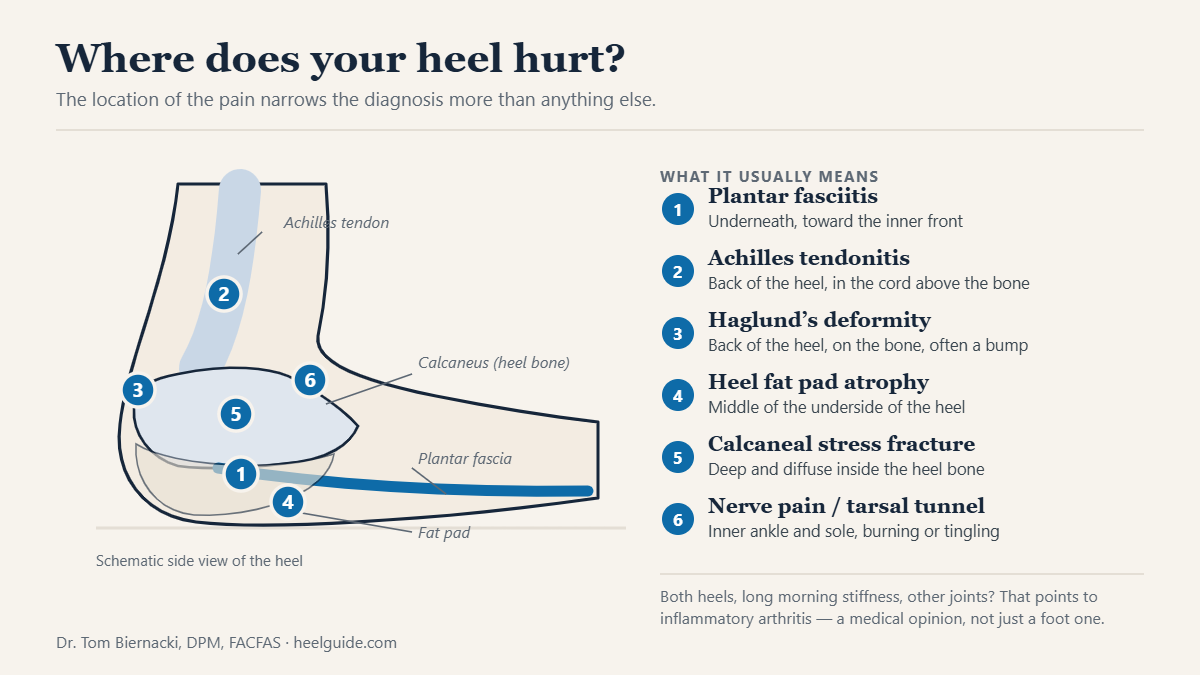
- Underneath, towards the inner front edge of the heel, worst with the first steps in the morning or after sitting. This is the typical pattern of plantar fasciitis. A heel spur on X-ray often sits in the same place and is usually a bystander.
- Underneath, right in the centre of the heel, a deep bruised ache that worsens the longer you stand on hard floors. This points more towards the heel’s fat pad. See heel fat pad atrophy and bruised heel.
- At the back, where the Achilles meets the bone, often with a bump and pain from shoe backs. This is insertional Achilles tendonitis, Haglund’s deformity or heel bursitis. These often occur together.
- Higher up the back of the leg, a few centimetres above the heel. That is usually mid-portion Achilles tendonitis, which has its own footwear guide: best shoes for Achilles tendonitis.
Not sure which applies? The heel pain quiz walks you through it in about two minutes.
The shoe, cause by cause
Once you know the likely cause, this table sets out what the shoe has to do and what it must not do. The sections below name models for the three commonest patterns.
| Cause | What the shoe needs | What to avoid |
|---|---|---|
| Plantar fasciitis under the heel, worst on first steps |
Stiff midfoot, firm heel counter, 8–12 mm heel-to-toe drop, rocker sole | Flat, flexible shoes; zero-drop and minimalist shoes; barefoot on hard floors |
| Heel spur an X-ray finding, usually with plantar fasciitis |
The same as plantar fasciitis, plus generous heel cushioning | Shoes sold on a “spur cut-out”; the spur is rarely the source of pain |
| Fat pad atrophy bruised feeling in the centre, worse on hard floors |
Thick, soft heel cushioning inside a firm heel cup that keeps the pad contained | Thin soles, flat sandals, open backs, hard floors barefoot |
| Insertional Achilles, Haglund’s, bursitis back of the heel |
A raised heel, and a soft, low or notched heel collar that does not press on the bump | Stiff, high heel counters; flat shoes; zero drop; tight dress shoes and boots |
| Mid-portion Achilles the cord, two to six centimetres up |
A raised heel and a rocker; counter shape matters less | Zero-drop and minimalist shoes; sudden changes of shoe |
| Stress fracture deep ache that worsens with activity |
An assessment first; then a cushioned, rockered shoe during recovery | Running through it in any shoe |
| Nerve pain burning, tingling, numb inner heel |
A stable, supportive shoe with a firm midsole that limits inward collapse | Very soft, unstable midsoles; tight straps or laces over the inner ankle |
| Sever’s disease children, back and sides of the heel |
A cushioned heel with a slight raise; heel cups in sports boots | Flat, thin-soled football boots and court shoes; barefoot sport |
Pain underneath the heel
For plantar fasciitis and heel spur pain, the aim is to reduce the stretch on the fascia with each step. That means a firm heel counter, a midsole that resists twisting, a drop of roughly 8–12 mm, and a rocker or stiff forefoot so the big toe does not have to bend as far at push-off. StatPearls notes that rocker-soled shoes combined with an orthosis are a sensible footwear approach for plantar fasciitis.
Brooks Ghost 18 — best for most people with plantar fasciitis
The Ghost 18 has a 10 mm listed drop, measured nearer 12 mm by RunRepeat’s lab, on a 36/26 mm stack. The same lab gave its heel counter the top score for stiffness. That keeps the heel firmly centred and gives the fascia an easier time. The midsole is firm rather than squashy, and the Ortholite insole lifts out if you use an orthotic. It comes in narrow, standard, wide and extra-wide.
- Drop: 10 mm listed
- Type: neutral
- Widths: narrow to extra-wide
- Removable insole: yes
Good for: plantar fasciitis and heel spur pain in people whose arch holds its shape, for walking or running. Around $150 list.
Skip it if: the back of your heel is also sore and dislikes firm counters, or your forefoot is wide but your heel is narrow, because the toebox tapers.
Brooks Adrenaline GTS 26 — best if your arch collapses
If your arch flattens noticeably when you stand, the fascia is stretched further with every step. The Adrenaline keeps the Ghost’s 10 mm drop and 36/26 mm platform and adds GuideRails, firm sidewalls that limit inward roll without a hard post. Version 26 arrives on 1 November 2026 at around $155 list, in women’s narrow to extra-wide. The outgoing GTS 25 is a sound alternative while it is discounted.
- Drop: 10 mm
- Type: stability
- Widths: narrow to extra-wide
- Removable insole: not confirmed for version 26
Good for: plantar fasciitis with flexible flat feet or overpronation.
Skip it if: you have a high, rigid arch or tend to roll outward. A neutral shoe will suit you better.
Hoka Clifton 11 — best lighter rocker
For people who like the feel of a rocker but find the Bondi too heavy, the Clifton 11 is a good middle ground. It was released in July 2026, with an 8 mm drop, a 43/35 mm stack in men’s sizes and a MetaRocker sole. The rearfoot frame cradles the heel, and the rocker rolls you through push-off. A wide edition is available.
- Drop: 8 mm
- Type: neutral, rocker
- Widths: standard and wide
- Removable insole: not confirmed by the sources I checked
Good for: plantar fasciitis in neutral feet, for daily walking or running. Around $155 list.
Skip it if: you need arch support built into the shoe. Look at the Adrenaline instead.
For more options, see best shoes for plantar fasciitis, running shoes, walking shoes and shoes for heel spurs.
About heel spurs specifically. Spurs are common in heels that do not hurt, and their size does not track with pain. A spur does not need a hole cut under it. Treat the heel as plantar fasciitis with a little more cushion, and see plantar fasciitis vs heel spurs for why.
Pain at the back of the heel
Insertional Achilles pain, Haglund’s deformity and retrocalcaneal bursitis share two needs. The first is a higher heel. A drop of 10 mm or more shortens the distance the Achilles has to stretch, and StatPearls notes that heel lifts of around 12–15 mm are commonly used for Achilles tendinopathy. The second is a heel collar that does not dig in. AAOS lists shoes rubbing the back of the heel as one cause of bursitis there. A rigid, sharp-edged counter pressing on a bump is a common reason this pain will not settle.
Saucony Triumph 24 — best for Haglund’s and insertional Achilles pain
The Triumph 24 has a 10 mm drop on a soft 43/33 mm stack. Clinician reviewers at Doctors of Running rated it suitable for Haglund’s deformity, which is notable in a shoe that still holds the heel securely. The gradual rocker eases push-off, which also reduces load on the Achilles.
- Drop: 10 mm
- Type: neutral, max cushion
- Widths: standard fit with a slightly roomy forefoot
- Removable insole: not confirmed; rated not orthotic-friendly
Good for: pain at the back of the heel, or under and behind the heel together, in neutral feet. Around $170 list.
Skip it if: you need a firm, stable platform for long hours of standing, or you wear a custom orthotic.
Brooks Addiction Walker 2 — best high-drop walking shoe for the back of the heel
At 12 mm, the Addiction Walker 2 has the highest listed drop of any shoe on this page. That helps an irritated Achilles insertion when you walk all day. It is a supportive leather walking shoe with a slip-resistant sole and comes in narrow to extra-wide. I could not verify how its heel collar is built. If you have a prominent bump, try it on and walk around before committing.
- Drop: 12 mm
- Type: motion control walker
- Widths: narrow, standard, wide, extra-wide
- Removable insole: not confirmed by the sources I checked
Good for: insertional Achilles pain in people who walk or stand at work, especially with flat feet. Around $130 list.
Skip it if: the shoe’s collar presses directly on your bump. In that case, the heel height will not make up for the friction.
A note on the Brooks Ghost 18. Clinician reviewers rated it potentially suitable for Haglund’s, and its drop is high. A lab rated its heel counter very stiff, though. If you have a bump, test it in person. Some people find the padding protects them, and others find it presses on the bump.
Simple changes help too. Open-backed shoes on days the bump is inflamed, skipping the top eyelet, and a small heel lift can all reduce pressure. With any shoe, stand up and feel where the top edge of the heel counter sits. If it rides across the sore spot, that shoe will keep it irritated however well it is cushioned. Our guides to back of heel pain and Achilles taping explain more, and the sibling roundup covers shoes for Achilles tendonitis in detail.
A night splint is the wrong tool here. It holds the ankle in exactly the position that compresses the back of the heel. See night splints for who they do help.
A thin or bruised heel pad
The fat pad under your heel bone is a natural shock absorber. With age, steroid injections or years of high impact, it can thin out and lose its spring. The pain is usually central and deep, and it gets worse on hard floors. StatPearls lists cushioned, supportive footwear and silicone heel cups as first-line care. A firm heel counter also helps here, because it gathers what fat pad remains under the bone. That is also why a heel cup inside a well-cushioned shoe often helps more than a softer shoe on its own. Wear the cushioned shoe indoors as well as out; flat sandals, open-backed slip-ons and thin dress shoes are the usual aggravators.
Hoka Bondi 9 — best overall for heel pad pain
Running Warehouse lists 44 mm under the heel, the deepest stack on this page. RunRepeat rated its torsional rigidity above average, so the platform stays structured rather than mushy. The rocker reduces how long the heel stays loaded at the start of each step. It comes in narrow through extra-wide, and the insole is removable if you add a heel cup.
- Drop: 5 mm listed (lab-measured around 9 mm)
- Type: max cushion, rocker
- Widths: narrow, standard, wide, extra-wide
- Removable insole: yes
Good for: fat pad atrophy, bruised heels and all-day standing on concrete. Around $170–$175 list.
Skip it if: you walk on uneven ground or have unstable ankles. The tall stack makes rough terrain harder.
Brooks Ghost Max 4 — best stable cushioning for standing
The Ghost Max 4 has a 40/34 mm stack, a 6 mm drop and a broad, sidewalled base. It is deeply cushioned but steadier underfoot than many max-cushion shoes, which matters if you stand for long periods. The GlideRoll rocker smooths each step. Women’s come in B, D and 2E, and men’s go up to extra-wide.
- Drop: 6 mm
- Type: max cushion, rocker, stable neutral
- Widths: women’s B, D, 2E; men’s to extra-wide
- Removable insole: yes on the previous version; not separately confirmed for the 4
Good for: heel pad pain in people who stand all day, and wide feet. Around $165 list.
Skip it if: the back of your heel is sensitive (reviewers flagged the stiff, padded counter on the previous version), or a tight calf makes lower-drop shoes uncomfortable.
ASICS Gel-Nimbus 28 — best if you also use a heel cup or orthotic
The Nimbus 28 is the tallest shoe here (43.5 mm heel in men’s) and has a gel insert in the rearfoot. Clinician reviewers rated it stable, torsionally stiff and orthotic-friendly. That makes it a good base if you want to add a heel cup or custom device under a thin fat pad.
- Drop: 8 mm listed
- Type: stable neutral, max cushion
- Widths: standard fit runs normal to slightly wide
- Removable insole: yes
Good for: heel pad pain combined with an orthotic or heel cup. Around $170 list.
Skip it if: you also have a Haglund’s bump or a sore Achilles insertion, because reviewers noted the heel counter edge can press there.
Comparison table
| Where it hurts | Model | Drop (listed) | Key feature |
|---|---|---|---|
| Underneath | Brooks Ghost 18 | 10 mm | Very stiff heel counter, four widths |
| Underneath, flat feet | Brooks Adrenaline GTS 26 | 10 mm | GuideRails stability |
| Underneath | Hoka Clifton 11 | 8 mm | Lighter rocker |
| Back of heel | Saucony Triumph 24 | 10 mm | Rated Haglund’s-suitable |
| Back of heel | Brooks Addiction Walker 2 | 12 mm | Highest drop, leather walker |
| Heel pad | Hoka Bondi 9 | 5 mm (~9 mm measured) | Deepest heel cushioning |
| Heel pad | Brooks Ghost Max 4 | 6 mm | Stable max cushion |
| Heel pad | ASICS Gel-Nimbus 28 | 8 mm | Orthotic-friendly, rearfoot gel |
Burning, numb or steadily worsening pain
Burning, tingling or numbness on the inner heel points at a nerve rather than the fascia, most often the small nerve described in Baxter’s nerve entrapment, or the larger tibial nerve in tarsal tunnel syndrome. A stable, supportive shoe that stops the foot rolling inwards reduces the stretch on these nerves. Very plush, unstable midsoles that let the foot collapse tend to do the opposite, and straps or tight lacing over the inner ankle can press directly on the nerve.
Pain that gets worse the longer you are on your feet, aches deep in the heel bone, and hurts when the sides of the heel are squeezed, can be a calcaneal stress fracture. No shoe fixes that, and continuing to run or walk long distances on it is how a small crack becomes a long recovery. Get it assessed. During recovery, a cushioned, rockered shoe is the usual step down from a walking boot.
Children aged 8 to 14
An active child with heel pain at the back and sides of the heel, worse with running sports, very often has Sever’s disease: irritation of the growth plate where the Achilles pulls on the heel bone. Thin, flat football boots and court shoes are the usual aggravators, because they combine no heel raise with no cushioning. A shoe with a cushioned, slightly raised heel helps, and a soft heel cup inside sports boots is often the single most useful purchase.
What to avoid
- Completely flat, flexible shoes such as canvas pumps, ballet flats, flip-flops and minimalist trainers. They combine no heel raise, no shank and no heel counter, and give the heel and fascia no help.
- A sudden switch to zero-drop. This loads the calf, Achilles and fascia more than they are used to. If you want to move to zero-drop shoes, do it once the heel is settled, over months.
- Hard heel counters with a sharp top edge if you have a bump or pain at the back of the heel.
- Worn-out shoes. A crushed midsole provides little cushioning or structure. AAOS notes that worn shoes can aggravate plantar fasciitis in active people. Foam loses its ability to absorb load long before the upper looks worn, so press the midsole, look for compression creases and check the shoe still resists twisting.
- Going barefoot on hard floors at home during a flare, especially first thing in the morning. See slippers for plantar fasciitis.
If you are keeping the shoes you have, insoles for heel pain covers which insert suits which cause.
When shoes are not the answer.
If pain is worse the more you walk and does not ease, or there is swelling or bruising, stop and have it assessed. A heel stress fracture can look like plantar fasciitis at first.
Numbness, burning or tingling points at a nerve rather than the fascia or fat pad, and footwear alone will not settle it. See heel nerve pain.
Pain in both heels with morning stiffness elsewhere can be inflammatory.
If you have diabetes or reduced sensation, have footwear assessed professionally before making changes. See when to worry about heel pain.
A sudden snap or a feeling of being kicked at the back of the heel can mean an Achilles rupture and needs same-day assessment.
Shoes first, then the moves. For pain under the heel, Dr. Tom’s free 14-day plan from The Heel Pain Playbook starts with a pain map and a 60-second safety check, then five moves with photos and a tracker. Get the free 14-day plan.
Watch
Dr. Biernacki on choosing shoes and insoles for heel pain, and what to look for in a pair.
More model comparisons on our sister review site Podiatrist Tested, by the same surgeon (its retailer links are affiliate links): standing all day, work boots, heel fat pad atrophy, Haglund’s deformity, Baxter’s nerve, stress fracture recovery, Sever’s disease, sandals and the heel-to-toe drop chart.
Common questions
What type of shoe is best for heel pain?
For most heel pain, a cushioned shoe with a firm heel counter, a sole that resists twisting, a moderate to high heel-to-toe drop and a rocker sole works best. The exact priority depends on where it hurts. Pain under the heel needs structure and a rocker. Pain at the back needs a higher drop and a heel collar that does not press. A thin heel pad needs depth of cushioning.
Are Hokas good for heel pain?
Many people with heel pain do well in Hokas. The Bondi 9 and Clifton 11 combine deep cushioning with a rocker sole, which suits plantar fasciitis and a thinning heel pad. Some models have lower listed drops than traditional shoes, though, so people with Achilles pain at the back of the heel sometimes do better in a higher-drop shoe. See best Hoka for plantar fasciitis.
What shoes are best for pain at the back of the heel?
Choose a drop of 10 mm or more and a heel collar that does not press on the bone or bump. The Saucony Triumph 24 has a 10 mm drop and was rated suitable for Haglund’s by clinician reviewers. The Brooks Addiction Walker 2 has a 12 mm drop for walkers. Open-backed shoes on bad days and a small heel lift can also reduce pressure.
Should shoes for heel pain be soft or firm?
Both, in different places. The cushioning under the heel should be generous, but the shoe’s structure should be firm: a heel counter that holds its shape and a midsole that does not fold under the arch. Very soft shoes without structure feel comfortable at first but often let the arch collapse. That increases strain on the plantar fascia over the course of a day.
Can the wrong shoes cause heel pain?
They can contribute. Flat, unsupportive shoes, worn-out trainers and sudden changes in heel height are common triggers for plantar fasciitis. Stiff shoe backs that rub can inflame the bursa behind the heel. Shoes are rarely the only cause, though. Calf tightness, a sudden rise in activity and body weight usually play a part, so footwear works best alongside stretching and load management.
How long before new shoes help heel pain?
Many people notice less pain within the first week or two of switching to a more supportive shoe. The underlying tissue takes longer to settle, often weeks to months. If you have had no improvement after six to eight weeks of better footwear plus stretching, it is worth having the heel assessed to confirm the diagnosis. See the heel pain playbook. If a new pair makes the pain sharply worse within days, stop wearing it.
Do I need different shoes for heel spurs than for plantar fasciitis?
Usually not. A plantar heel spur is most often a sign of long-standing tension at the fascia attachment rather than the cause of the pain, so the same shoe features help. A little more heel cushioning is reasonable. Shoes or inserts with a hole cut out under the spur are rarely needed.
Should I wear shoes in the house?
With most kinds of heel pain, yes. Several hours barefoot on tile or hardwood in the evening is often the largest unmanaged load of the day. A supportive indoor shoe or a contoured sandal worn from the first step out of bed is one of the cheapest and most effective changes available.
- Koc TA Jr, Bise CG, Neville C, Martin RL, McDonough CM, et al. Heel Pain – Plantar Fasciitis: Revision 2023. Journal of Orthopaedic & Sports Physical Therapy.
- Allam AE, Chang KV. Plantar Heel Pain. StatPearls Publishing.
- Medina Pabón MA, Bergman R, Naqvi U. Achilles Tendinopathy. StatPearls Publishing.
- American Academy of Orthopaedic Surgeons. Heel Pain. OrthoInfo.
- Rabusin CL, Menz HB, McClelland JA, et al. Efficacy of heel lifts versus calf muscle eccentric exercise for mid-portion Achilles tendinopathy (HEALTHY): a randomised trial. British Journal of Sports Medicine, 2021.
Related heel pain guides
- Insoles for heel pain
- Heel lifts for Achilles tendonitis
- Sever’s disease
- Heel pain: causes and treatment
- Heel pain quiz
- Best shoes for plantar fasciitis
- Best running shoes for plantar fasciitis
- Best walking shoes for plantar fasciitis
- Best shoes for Achilles tendonitis
- Best shoes for heel spurs
- Best heel cups
- Haglund’s deformity
- Heel fat pad atrophy
Heel pain in Michigan?
Dr. Biernacki sees heel pain at Balance Foot & Ankle in Howell and Bloomfield Township. If the right shoes have not settled it, an assessment can work out which tissue is responsible.
This page is education, not a diagnosis. Read our editorial policy for how it was written and what it will not claim.