Heel pain causes
Burning heel pain: when the problem is a nerve, not the fascia
Heel pain that burns, tingles or gets steadily worse the longer you stand — and never has the sharp first-step spike in the morning — is often a trapped nerve. It is the single most common reason a heel fails to respond to good plantar fasciitis treatment.
Almost everyone with a sore heel is treated for plantar fasciitis first, and most of the time that is correct. But a proportion of heels never respond, and the usual conclusion — that this is simply an obstinate case — is often wrong. In a meaningful minority the fascia was never the problem. A small nerve running under the heel was being compressed the whole time.
This matters practically, because nerve pain and fascia pain respond to different things, and a couple of the standard fasciitis measures can make nerve pain worse.
On this page
The two nerves that do this
| Baxter’s nerve entrapment | Tarsal tunnel syndrome | |
|---|---|---|
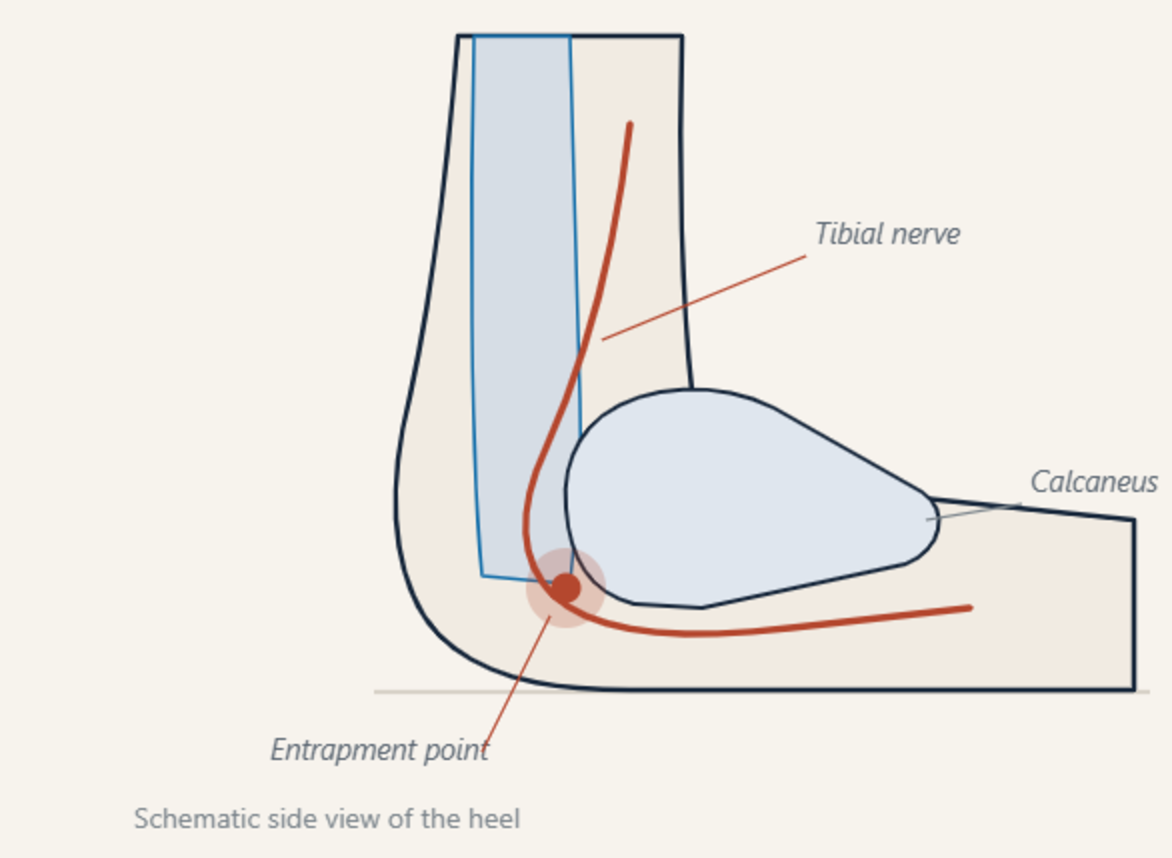
| Which nerve | The first branch of the lateral plantar nerve, a small nerve that turns sideways under the heel | The posterior tibial nerve, the main nerve to the sole, before it divides |
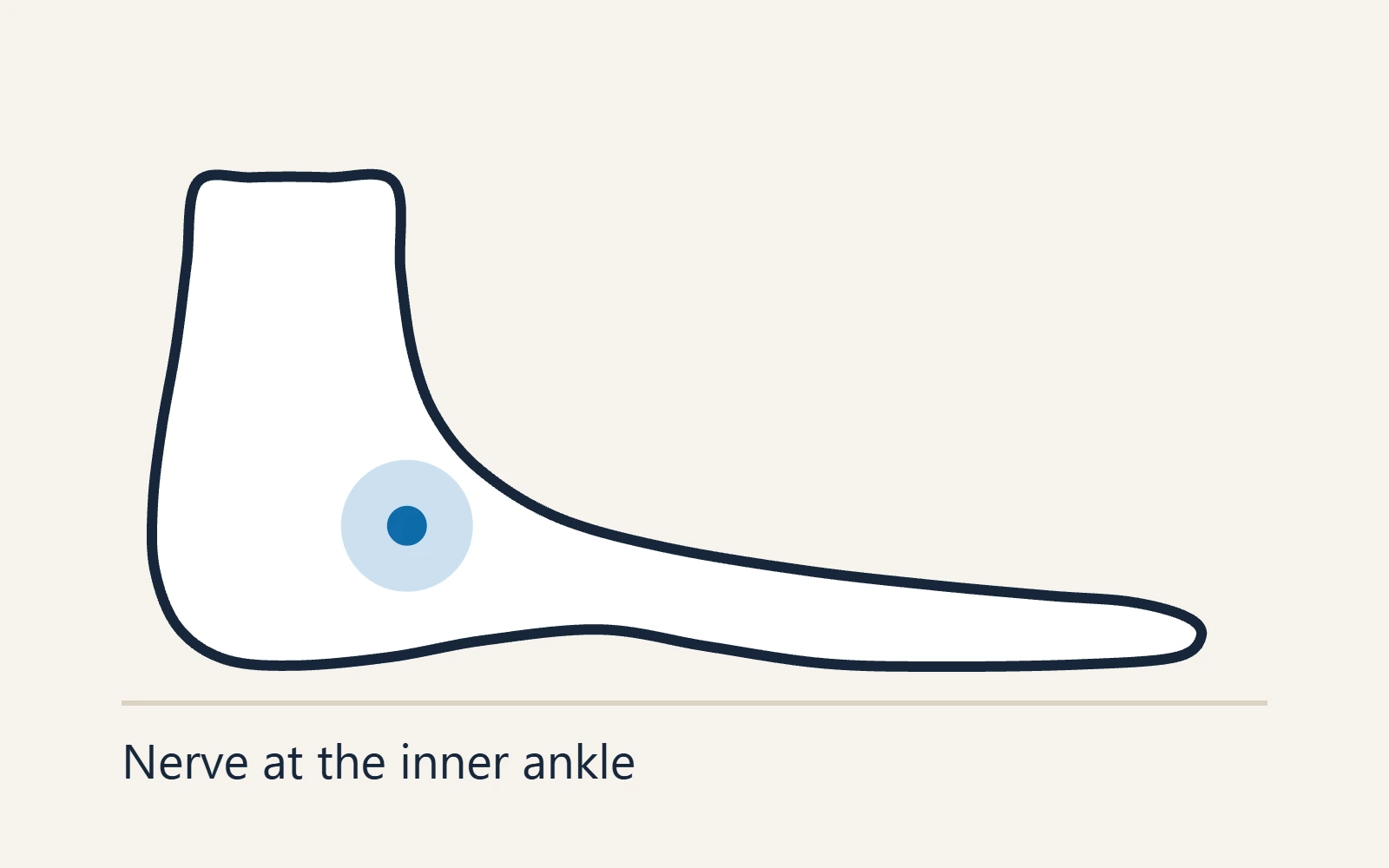
| Where it is squeezed | Deep inside the arch side of the heel, where it passes between two muscles near the fascia’s attachment | Behind and below the inner ankle bone, under a tight band of tissue |
| What you feel | Burning or deep aching under the heel, often spreading across toward the outer edge | Burning and tingling that spreads into the arch and sole, sometimes the toes |
| Tapping test | Tapping the inner heel, low down, sends a jolt into the sole | Tapping just behind the inner ankle bone sends a jolt into the arch or toes |
| Common cause | Chronic fascia thickening or swelling crowding the nerve; often coexists with true fasciitis | Frequently something taking up space — a ganglion cyst, varicose veins, scarring after injury, an extra muscle |
| Imaging that helps | Usually none; MRI occasionally shows the muscle it supplies has wasted | MRI, because finding a space-occupying cause changes the treatment |
How nerve heel pain differs from fasciitis
| Nerve | Plantar fasciitis | |
|---|---|---|
| First steps in the morning | Usually unremarkable. Mornings can be the best part of the day. | The defining feature — sharp, then easing over a few minutes |
| As the day goes on | Steadily worse the longer you are upright | Better with early movement, worse again after long standing |
| Character | Burning, tingling, electric, numb, or a deep unpleasant ache | Sharp, mechanical, tied to load |
| At rest and at night | Can carry on aching or burning when you are off it | Typically quiet once you are off your feet |
| Where | Often spreads, and may cross the heel from inner to outer | Stays at a small point at the inner front of the heel |
| Response to stretching and night splints | Little, and sometimes worse | Usually part of what helps |
The most useful single question is about mornings. A heel that is at its worst on the first few steps and eases is behaving like a fascia. A heel that starts tolerable and deteriorates through the day is behaving like a nerve.
Why it gets missed
Three reasons. It is less common than fasciitis, so it is not the first thought. It frequently sits alongside genuine fasciitis rather than replacing it, so treating the fascia produces partial improvement that looks like progress. And the test most people expect to settle it — a nerve conduction study — is unreliable for a nerve this small and a normal result is routinely taken as proof there is no nerve problem.
The diagnosis is made on the story and the examination: where the tenderness sits, whether tapping over the nerve reproduces the symptoms, and whether the pain behaves like a nerve through the day.
An important distinction first
Burning in both feet, symmetrically, spreading up from the toes is a different problem. That pattern points to a generalised peripheral neuropathy — from diabetes, vitamin deficiency, thyroid disease, alcohol and various other causes — rather than a nerve trapped locally at one heel.
Entrapment is typically one heel, localised, and reproducible by pressing or tapping one specific spot. Symmetrical burning in both feet deserves a medical workup, not a foot orthotic.
What actually works
- Take the load off the fascia anyway. Where a thickened, irritated fascia is crowding the nerve, calming the fascia decompresses the nerve indirectly. This is why many of these heels do improve on fasciitis treatment, just more slowly and never completely.
- Change the shape of the support, not just its firmness. A tall, rigid arch pressing exactly where the nerve is compressed can aggravate it. A softer device, or one relieved over the inner heel, often works far better than the firmest orthotic available. If a new insert made things worse, that is information rather than failure.
- Take the pressure off the inner ankle. Tight straps, high stiff boot collars and laces cinched over the inner ankle can compress the tarsal tunnel directly. Easy to overlook, easy to fix.
- Treat the pain as nerve pain. Medication aimed at nerve pain rather than at inflammation is often more effective here. Anti-inflammatories tend to underperform because there is little inflammation to address.
- Consider a targeted injection. An injection at the suspected compression point can be both a treatment and a test: clear temporary relief in the right place supports the diagnosis and informs what comes next.
- Image the tarsal tunnel if that is the suspicion. When the symptoms point behind the inner ankle, MRI is worth doing, because a cyst or a vein cluster taking up space is treatable in a way that a diffuse squeeze is not.
- Decompression surgery, last. Releasing the tight tissue over the nerve is a reasonable option for a well-localised entrapment that has failed everything else — and it works best when there is a clearly identified structure doing the compressing.
Numb heel: what it means
Numbness is different from pain, and it is worth taking more seriously. A patch of numb or “dead” skin on the heel usually means a sensory nerve is not passing messages properly, and the pattern points to where:
- One heel, the skin under the heel: the small sensory branch to the heel (the medial calcaneal nerve), or the main nerve in the tarsal tunnel, often with tingling into the arch.
- With back pain, or symptoms running down the back of the leg: a nerve root in the lower back (S1) can cause heel numbness, and the foot is not where the problem is.
- Both feet, starting at the toes: a generalised neuropathy, from diabetes, vitamin deficiency, thyroid disease, alcohol or other causes, which needs a medical work-up.
- After an injection, surgery or a fracture near the heel: irritation or injury of a small nerve branch.
Numbness that is spreading, comes with weakness, or appears in both feet should be assessed rather than treated at home. With diabetes, any new numbness matters, because feet that cannot feel are feet that get injured without warning.
Baxter’s nerve stretches and exercises
No stretch frees a trapped nerve directly, and aggressive stretching can irritate one. What gentle exercise can do is take tension off the fascia and calf that crowd the nerve, and keep the nerve moving freely. Stop anything that makes the burning or tingling spread or linger.
- Calf stretch, knee straight and bent. Hands on a wall, heel down, lean in until you feel the calf. Hold 30 seconds, three times each way, daily. A tight calf keeps the fascia under tension.
- Gentle plantar fascia stretch. Seated, pull the toes back towards the shin until the arch, not the heel, tightens. Ten seconds, ten times. Ease off if it provokes nerve symptoms.
- Nerve glide. Sitting on a chair, straighten the knee, then slowly flex the ankle up and point it down, ten times. The nerve should slide, not stretch: a mild pull is fine, tingling that builds is not.
- Foot strength. Towel scrunches, or lifting the arch without curling the toes, two or three sets of ten, to support the arch without a rigid insert pressing on the nerve.
Give it a few weeks alongside the footwear and insert changes above. If nothing changes, the nerve needs examining rather than more exercise.
What tends to make it worse
A very firm, high-arched orthotic pressing on the inner heel, in the cases where that is exactly where the nerve is being squeezed.
Aggressive deep massage or rolling a hard ball over the inner heel. Nerves do not respond to being mobilised the way a tight fascia does.
Repeated steroid injections into the same heel, which carry their own costs — including thinning of the heel’s fat pad — and rarely resolve an entrapment on their own.
When to be seen
Arrange an assessment if you have numbness rather than just pain, weakness in the foot, symptoms in both feet, symptoms spreading up the leg, a heel that burns at night, a lump you can feel behind the inner ankle, or a history of diabetes with new burning in the feet.
Also worth an opinion: three months of proper fasciitis treatment with no meaningful change. At that point the question is no longer whether the treatment is working, but whether the diagnosis is right.
Common questions
Can I have this and plantar fasciitis at the same time?
Yes, and it is common. A chronically thickened fascia and the swelling around it can crowd the nerve that runs just past it. That combination explains the classic story of a heel that improves perhaps halfway with good treatment and then stalls for months.
My nerve test was normal. Does that rule it out?
No. Nerve conduction studies are poor at assessing a branch this small and deep, and a normal study is entirely compatible with a genuine entrapment. Unfortunately it is often treated as proof that nothing is wrong. The diagnosis rests on the pattern of symptoms and the examination.
Why does it hurt more in the evening?
Compressed nerves are cumulative. Time spent upright means sustained pressure and some swelling around the nerve, and symptoms build through the day. A fascia behaves in the opposite way, protesting when you first load it and settling as it warms up. That reversal is the most useful clue you have.
Is a heel spur pressing on the nerve?
Rarely, and the assumption causes trouble. Spurs are found in plenty of pain-free heels, and removing one is not a reliable way to fix nerve symptoms. Where a nerve is genuinely entrapped it is normally caught in soft tissue rather than impaled on bone.
Will it get better on its own?
Sometimes, particularly where the trigger was a swollen irritated fascia that then settles. Entrapments with a structural cause — a cyst, scarring, a crowded tunnel — are less inclined to resolve unsupervised, which is why identifying the cause is worth the effort rather than persisting with generic heel treatment.
- Baxter’s nerve: the hidden culprit of chronic heel pain. PubMed.
- Allam AE, Chang KV. Plantar Heel Pain. StatPearls, NCBI Bookshelf.
- Baxter’s Nerve Entrapment. Physiopedia.
- American Academy of Orthopaedic Surgeons, OrthoInfo. Heel Pain.
Related heel pain guides
- Tarsal tunnel syndrome
- Plantar fasciitis
- Heel fat pad atrophy
- Heel spurs
- Heel pain in the morning
- Heel pain: how to work out what you have
- When to worry about heel pain
- Heel and ankle pain together
- Pain on the side of the heel — telling a nerve from a tendon on the inner and outer heel.
Heel pain in Michigan?
Dr. Biernacki sees heel pain that has not responded to treatment at Balance Foot & Ankle in Howell and Bloomfield Township. Separating a trapped nerve from a stubborn fascia is an examination question, and getting it right changes the plan completely.
Not sure this is your problem? Start with working out what you have. This page is general education, not medical advice, and it cannot diagnose your heel.
This page is education, not a diagnosis. Read our editorial policy for how it was written and what it will not claim.