Heel pain causes
Heel bursitis: which of the two bursae is inflamed, and why it changes the treatment
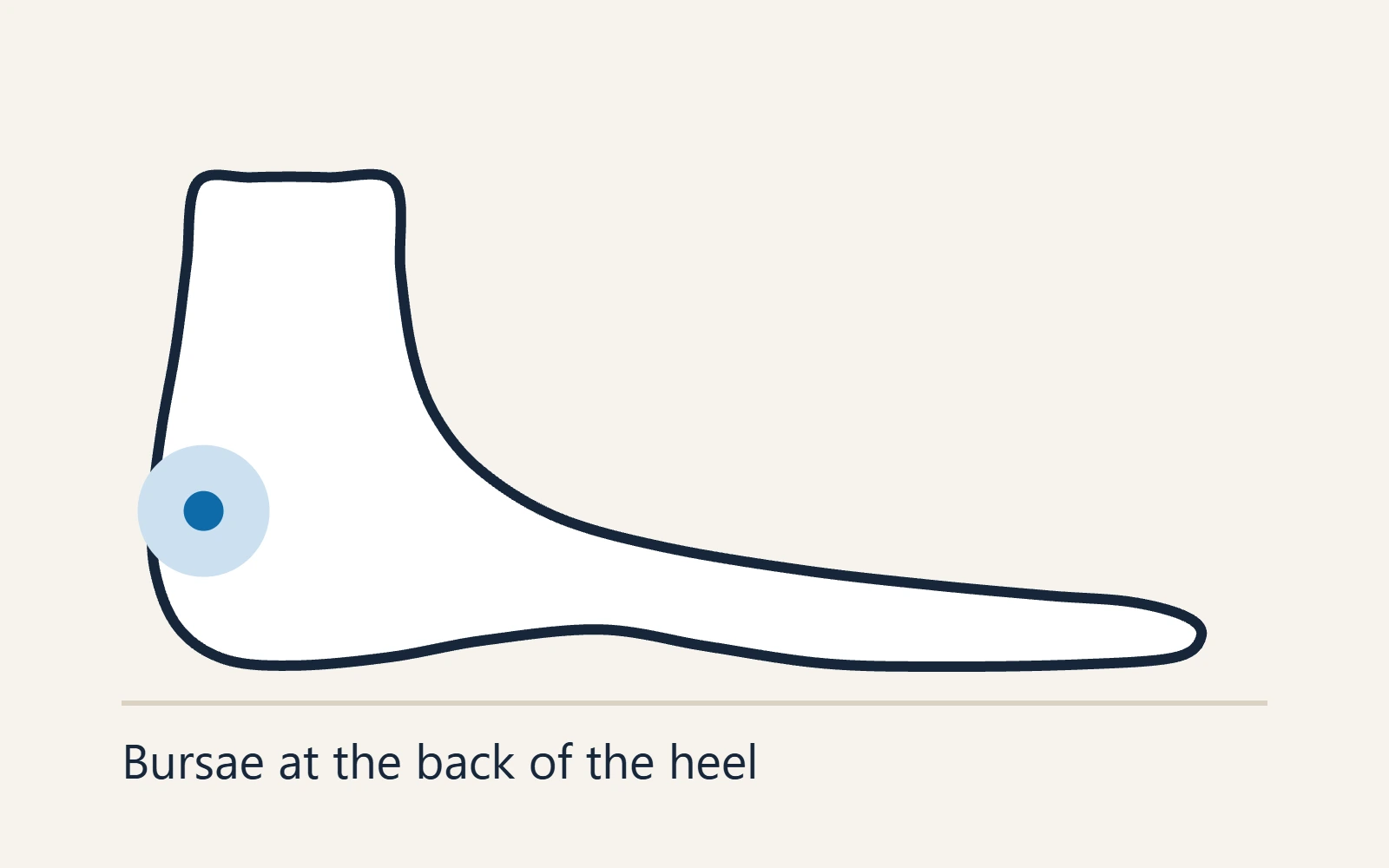
There are two separate bursae at the back of the heel, a few millimetres apart. They are irritated by different things and they respond to different fixes — and the stretch most people are told to do makes one of them worse.
Pain at the back of the heel gets called Achilles tendonitis almost by reflex. Often that is right. But sitting immediately in front of and immediately behind the tendon’s attachment are two small fluid-filled sacs, and when one of them is the problem the treatment plan shifts in ways that matter.
You will also see this called Achilles bursitis. Most of the time that means retrocalcaneal bursitis, the deeper of the two sacs, between the tendon and the heel bone.
On this page
The two bursae
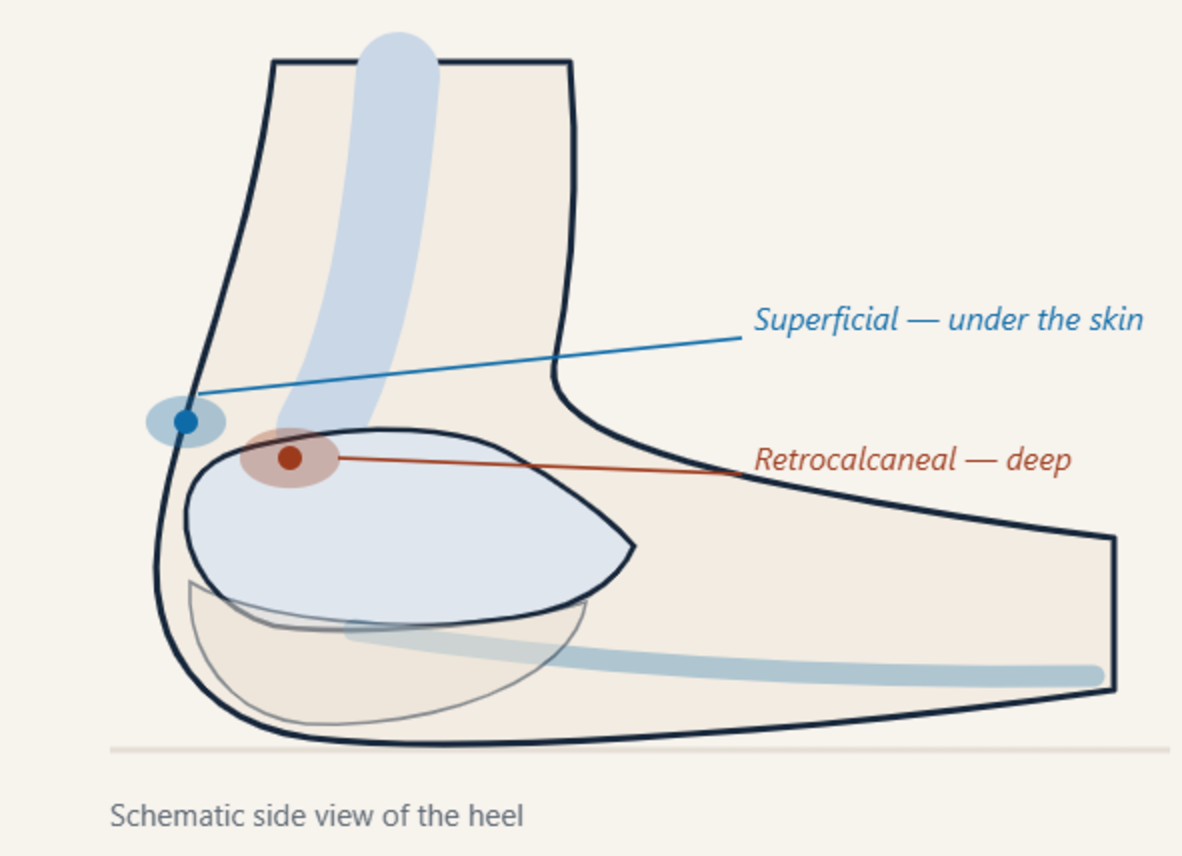
A bursa is a thin cushion that lets a tendon glide over bone without grinding. At the heel there are two, and their positions explain everything about how they behave.
| Retrocalcaneal bursa (deep) | Superficial calcaneal bursa | |
|---|---|---|
| Where it sits | In FRONT of the Achilles tendon, between the tendon and the back of the heel bone | BEHIND the tendon, just under the skin |
| What irritates it | Compression between tendon and bone, worst when the ankle bends upward | Direct pressure from the back of a shoe |
| What you feel | Tender when you squeeze the soft hollows on BOTH sides of the tendon, an inch or so above where it attaches | Tender right on the back, often with thickened or reddened skin over it |
| What makes it worse | Uphill walking, stairs, sprinting, stretching the calf off a step | Stiff heel counters, dress shoes, boots, skates |
| What helps first | A small heel lift, which reduces the upward bend and takes the tendon off the bone | Getting the pressure off — open-back or soft-backed shoes |
How to tell which one you have
Put a finger and thumb either side of the Achilles tendon, about an inch above where it meets the heel, and squeeze gently inward. If that reproduces your pain, the problem is deep — the retrocalcaneal bursa, sitting between tendon and bone. If instead the sore spot is directly on the back of the heel where your shoe rubs, and the skin there looks thickened or angry, it is the superficial bursa.
One more test worth doing: pull your foot upward toward your shin. Deep bursitis usually hates that, because bending the ankle up is exactly what squeezes the bursa against the bone.
Bursitis at the heel rarely travels alone. A prominent corner of heel bone (a Haglund’s deformity), an irritated retrocalcaneal bursa and a degenerating Achilles insertion frequently occur together as one problem with three names. That is why treatment aimed at only one of them so often disappoints.
Why it started
- Footwear. A rigid heel counter pressing on the back of the heel is the single most common cause of the superficial kind.
- A tight calf. Less ankle motion means more compression at the top of every step.
- A change in load. Hills, speed work, a new job on your feet, or a sudden return to running after time off.
- A drop in heel height. Moving from a heeled shoe to flats increases how far the ankle has to bend, and the bursa feels it.
- Shape. Some heels simply have a more prominent posterosuperior corner, which leaves less room for the bursa to begin with.
What actually helps
- Take the pressure off. For the superficial bursa this alone can be most of the cure: open-back shoes, or shoes with a soft, low counter, for as long as it takes.
- Add a small heel lift. Six to twelve millimetres in both shoes reduces how far the ankle bends and unloads the deep bursa. Both shoes, not one.
- Stretch the calf — but on the floor. See the warning below. This is where most people go wrong.
- Reduce the aggravator. Flatten the hills and the speed work for a few weeks rather than stopping entirely.
- Give it months, not weeks. Bursae at the heel settle slowly, and the most common reason for failure is stopping the shoe changes as soon as it feels better.
Two mistakes worth avoiding.
The first is the stretch off the edge of a step. Dropping the heel below the level of the step forces the ankle into exactly the position that compresses the retrocalcaneal bursa against the bone. It is a good exercise for mid-tendon Achilles problems and a poor one here. Do your calf work with the heel on the floor instead, and stop the movement at neutral.
The second is a steroid injection into the area. Injecting around the Achilles insertion carries a recognised risk of weakening or rupturing the tendon, and this is not a routine step for heel bursitis. If it is offered, it deserves a careful conversation about why, and about what is being injected where.
Swollen heel: bursitis or something else?
A visible swelling at the back of the heel is most often the superficial bursa, sitting just under the skin where the shoe presses, sometimes with thickened or reddened skin over it. Deep retrocalcaneal bursitis shows as fullness in the hollows either side of the tendon rather than a lump on the back.
Other causes of a swollen heel look different:
- Swelling along the tendon itself, a thickened cord above the heel: Achilles tendonitis.
- Swelling after a fall or hard landing, with bruising and pain taking weight: a possible fracture. Get it X-rayed.
- A hot, red, swollen heel with fever, or spreading redness: possible infection, including an infected bursa. Same-day care.
- Both heels, or other joints swollen too: an inflammatory arthritis, including gout, needs a medical opinion.
- Swelling of the whole ankle and foot, especially in one leg with a tender calf: a blood clot needs ruling out the same day.
Heel bursitis stretches and exercises
The rule for both bursae: keep the heel on the floor and stop the movement at neutral. Anything that drops the heel below the level of your toes squeezes the deep bursa against the bone.
- Wall calf stretch, heel on the floor. Hands on the wall, sore leg behind, lean in gently. Hold 30 seconds, three times. Stop short of any pinch at the back of the heel.
- Bent-knee calf stretch, the same position with the back knee bent. Hold 30 seconds, three times.
- Floor-level heel raises. Rise onto both toes and lower slowly until the heel touches the floor, never below it. Start with 2 sets of 10 and build to 3 sets of 15 as it settles.
- Isometric holds for a flare. Rise halfway onto the toes and hold 30 to 45 seconds, five times. Holds load the calf without moving the ankle into the painful range.
Pair the exercises with the shoe changes and heel lift above; exercises alone will not beat a shoe that keeps pressing on the bursa. The same floor-level programme is set out in full on the Achilles tendonitis exercises page.
The cause almost nobody checks for
The point where a tendon anchors into bone is called an enthesis, and inflammation of the entheses is a hallmark of a family of inflammatory arthritis conditions. The Achilles insertion and the plantar fascia origin are two of the classic sites.
So there is a pattern worth taking seriously: a younger adult, pain at the back of BOTH heels, morning stiffness in the lower back that improves with movement rather than rest, and heel pain that does not behave like a mechanical overload injury. That combination deserves a proper medical work-up rather than another pair of shoes, because no amount of heel lift treats an inflammatory cause.
When to get it looked at
Sooner rather than later if the back of the heel is red, hot and swollen; if you felt a sudden pop and cannot push off properly; if both heels are involved in a younger adult with the pattern above; if you are diabetic or have neuropathy and the skin at the back of the heel has broken down; or if three months of genuine footwear change and floor-level calf work has produced nothing.
Shoes and inserts for this heel. For bursitis at the back of the heel, height and a soft collar help; cushioning underneath does not. See shoes for back-of-heel pain and heel lifts.
Common questions
What is the difference between heel bursitis and Achilles tendonitis?
The bursa is a cushion; the tendon is the rope. Bursitis is usually tender when squeezed from side to side, while tendon pain is usually tender when squeezed front to back along the tendon itself. In practice they very often coexist at the insertion, which is why the treatment overlaps — and why the midportion-versus-insertional distinction matters more than the bursitis label.
How long does heel bursitis take to settle?
Months rather than weeks, and the timeline depends far more on whether the aggravator is genuinely removed than on anything you add. People who change the shoe and keep it changed do well; people who fix it for three weeks and then return to the boots that caused it tend to cycle.
Should I put ice on it?
Ice can take the edge off a flare and it is harmless applied sensibly. It is not treatment, though. Nothing you apply to the outside of the heel changes the compression that keeps the bursa irritated — only the shoe, the heel height and the load do that.
Can heel bursitis be drained?
The deep retrocalcaneal bursa is small and sits in a tight space between tendon and bone, so it is not usually something to drain. A markedly swollen superficial bursa is occasionally aspirated, but the fluid returns unless the pressure that caused it is removed, which brings you back to footwear.
Is surgery ever needed?
Occasionally, and usually not for the bursa on its own. Where a prominent Haglund’s corner keeps compressing the bursa and the tendon insertion despite everything else, that bony prominence can be reshaped. It sits at the far end of a long conservative road, exactly like surgery for plantar fasciitis.
Is Achilles bursitis the same as heel bursitis?
Usually, yes. “Achilles bursitis” most often means retrocalcaneal bursitis, the sac between the Achilles tendon and the heel bone. Some people use it for the superficial sac just under the skin behind the tendon, the one a stiff shoe counter rubs. Both sit at the back of the heel, and telling them apart matters because the first fix differs: a small heel lift for the deep one, and taking the pressure off the skin for the superficial one.
- American Academy of Orthopaedic Surgeons, OrthoInfo. Achilles Tendinitis.
- American Academy of Orthopaedic Surgeons, OrthoInfo. Heel Pain.
Related heel pain guides
- Achilles tendonitis
- Haglund’s deformity (bump at the back of the heel)
- Calcaneal stress fracture
- Plantar fasciitis
- Best shoes for plantar fasciitis
- Heel pain: how to work out what you have
- Back of heel pain
- Achilles tendonitis exercises
Heel pain in Michigan?
Dr. Biernacki sees back-of-heel pain at Balance Foot & Ankle in Howell and Bloomfield Township. Telling the two bursae apart — and separating both from an insertional tendon problem — takes about two minutes of examination and changes what you should be doing.
Not sure the pain is even at the back of your heel? Start with working out what you have. This page is general education, not medical advice, and it cannot diagnose your heel.