
Footwear
Best Shoes for Heel Spurs (2026)
The best shoes for heel spurs are not really treating the spur. They protect the plantar fascia and heel fat pad, which are usually what hurts, with deep heel cushioning, a firm heel counter and a rocker sole. The Hoka Bondi 9 and Brooks Ghost Max 4 do that best for most people.
An X-ray that shows a heel spur can feel like the answer to months of pain. There it is: a sharp hook of bone pointing forwards from the heel. It is natural to assume that you are standing on it and that you need a shoe to cushion it.
The reality is more reassuring. Heel spurs are common in people with no heel pain at all, and in people with plantar fasciitis the spur is usually a sign of long-standing tension rather than the source of the pain. Orthopaedic guidance is clear that the spur is generally not what hurts. What hurts is the plantar fascia where it attaches to the heel, the fat pad beneath it, or both. Good shoes help because they protect those tissues. Our main heel spurs guide explains the background in detail.
How we choose: picks are judged against the clinical criteria in the four features that matter — heel cushioning, a firm counter, a rocker or stiff forefoot, and sensible drop — using specifications checked against manufacturer and independent review sources in October 2026; no brand pays for placement. Links to Amazon are affiliate links, so we may earn a commission at no cost to you (disclosure).
Quick picks
Best overall: Hoka Bondi 9
The deepest heel cushioning here, with a heel frame and gentle rocker.
Best rocker: Brooks Ghost Max 4
A pronounced rocker and thick heel padding, in three widths.
Best stability: Brooks Adrenaline GTS 26
A 10 mm drop and GuideRails support for flatter feet.
Best max cushion with drop: Saucony Triumph 24
A 43 mm heel with a 10 mm drop, light for its size.
Best for walking: Brooks Addiction Walker 2
A 12 mm drop and four widths for long days on your feet.
On this page
Is the spur really the problem?
Usually, no. A plantar heel spur forms where the plantar fascia and the short muscles of the sole attach to the heel bone. Reference texts note that spurs appear in a large proportion of people with plantar fasciitis, but also in more than one in seven people with no symptoms at all. A spur on an X-ray suggests the tissues have been under tension for many months, regardless of whether they hurt. Removing the spur during surgery has not been shown to improve outcomes.
That matters for choosing shoes in three ways:
- You do not need a shoe with a hole or a soft spot “for the spur”. The pain sits in soft tissue, so the whole heel needs protecting, not one point.
- Arch and forefoot design matter as much as the heel. The plantar fascia runs the length of the foot. A shoe that resists twisting and rolls you forwards reduces how hard the fascia pulls on the heel.
- The same shoes that help plantar fasciitis help heel spurs. If you have already read our best shoes for plantar fasciitis guide, the logic here will be familiar. This page puts slightly more weight on heel cushioning, because many people with a visible spur also have a thinning or bruised fat pad.
What to look for in a shoe for heel spurs
Deep heel cushioning. The fat pad under your heel is your natural shock absorber. If it is irritated or thinner than it used to be, a thick, well-padded heel takes over some of that work. Look for a heel stack in the high 30s or 40s of millimetres.
A firm heel counter. The counter is the stiff cup around the back of the heel. A firm one holds the fat pad together underneath the heel bone, so it spreads load rather than squashing out to the sides. Press the back of the shoe with your thumb: it should resist.
A rocker sole or stiff forefoot. A rocker lets the foot roll forwards without bending sharply at the toes. Less toe bend means less pull on the plantar fascia at its attachment — the exact point where the spur sits.
Moderate to high drop. A heel that sits higher than the forefoot, typically 6 to 12 mm, reduces tension in the calf and fascia. Very low or zero-drop shoes tend to aggravate heel pain during a flare.
Removable insole and width options. If you will add a heel cup or an arch-supporting insole, you need room for it.
Soft is not always better. A very soft, unstable midsole can let the heel roll and the arch collapse, which increases fascial strain. The ideal is a shoe that cushions the heel but stays stable underfoot. That is why each pick below pairs cushioning with a firm counter or a wide base.
The best shoes for heel spurs
All shoes below are current models as of October 2026. Specifications come from manufacturer listings and independent reviewers such as Doctors of Running and Running Warehouse.
1. Hoka Bondi 9 — best overall
For a heel that is sore on every step, the Bondi 9 offers the most protection on this list. It sits on a 43 mm heel and 38 mm forefoot, with a heel frame that widens the platform and large sidewalls that hug the heel. That combination cushions the fat pad while keeping it centred under the heel bone. A gentle, early forefoot rocker reduces the pull on the fascia at push-off.
The trade-off is a 5 mm drop, which is lower than I would choose for someone with tight calves or Achilles symptoms. Independent testers also found the counter stiff, and Doctors of Running did not recommend it for Haglund’s deformity, so it is a plantar heel shoe rather than a back-of-heel shoe. Wide and extra-wide versions are available.
- Drop: 5 mm (43 mm heel / 38 mm forefoot)
- Type: max cushion, rockered
- Widths: standard, wide, extra wide
- Heel counter: stiff, with heavy collar padding
- Price: around $170–$175 list
Good for: plantar heel pain with a spur, especially when the fat pad feels bruised or thin, and people who stand on hard floors.
Skip it if: you also have Achilles or back-of-heel pain, or you feel unstable on very tall soles.
2. Brooks Ghost Max 4 — best rocker
The Ghost Max 4 has a highly rockered sole with a particularly pronounced forefoot rocker, sitting on a 39 mm heel and 33 mm forefoot. For heel spur pain that is worst at push-off, the rocker does a lot of the work the fascia would otherwise do. The heel is thickly padded, with a stiff but well-cushioned counter.
The drop is 6 mm, and reviewers said it feels slightly lower. The standard fit runs narrow, but 2E and 4E versions are made, which also helps if you want to add a heel cup.
- Drop: 6 mm (39 mm heel / 33 mm forefoot)
- Type: max cushion rocker
- Widths: standard, 2E, 4E
- Heel counter: stiff, well padded
- Price: around $165 list
Good for: walkers and people on their feet all day who want a smooth roll and wide-fit options.
Skip it if: you have narrow feet and do not like a snug standard fit, or you need a higher drop.
3. Brooks Adrenaline GTS 26 — best stability shoe
If your arch collapses noticeably when you stand, the plantar fascia is under extra tension and the heel attachment takes the strain. The Adrenaline GTS 26 uses Brooks’ GuideRails to limit excessive inward roll, and keeps a 10 mm drop on a 36 mm heel and 26 mm forefoot. It is less plush than the Bondi or Ghost Max but more controlled.
Running Warehouse lists D, 2E and 4E widths for men, and the new heel pull loop helps you avoid crushing the counter when putting the shoe on — worth having, because a crushed counter loses its grip on the fat pad.
- Drop: 10 mm (36 mm heel / 26 mm forefoot)
- Type: stability
- Widths: men’s D, 2E, 4E
- Heel counter: structured, with heel pull loop
- Price: around $155 list
Good for: flat or flexible feet, overpronation and heel spur pain alongside tight calves.
Skip it if: your heel feels bruised and you need maximum cushioning, in which case a Bondi or Triumph will feel kinder.
4. Saucony Triumph 24 — best max cushion with a higher drop
The Triumph 24 gives you Bondi-level heel height, 43 mm, but with a 10 mm drop instead of 5 mm. For people with a heel spur and tight calves, that is the best of both worlds. Doctors of Running reported good heel hold without slippage and no pressure at the back of the heel, and rated the heel bevel good, so landings are smooth.
It is surprisingly light for such a tall shoe, and Saucony makes a wide version in men’s and women’s sizes.
- Drop: 10 mm (43 mm heel / 33 mm forefoot)
- Type: neutral max cushion
- Widths: standard and wide
- Heel counter: secure hold, no posterior pressure reported
- Price: around $170 list
Good for: heel spur pain with tight calves or coexisting Achilles symptoms, and heavier walkers who want deep cushioning.
Skip it if: you need arch support built into the shoe; it is neutral, so add an insole or choose the Adrenaline.
5. ASICS Gel-Kayano 33 — best for wide feet needing support
The Kayano 33 is a stable, well-cushioned shoe with an 8 mm drop, a 39 mm heel for men, and an unusually broad range of widths, from narrow to extra-wide. RunRepeat’s lab rated the heel counter stiffer than average, which is what you want for holding the fat pad in place, and Doctors of Running described a plush heel with plenty of collar padding.
One caution from reviewers: that collar padding compresses over time. For plantar heel pain this matters less than it would for Achilles problems, but keep an eye on the fit as the shoe ages.
- Drop: 8 mm (39 mm heel / 31 mm forefoot, men’s)
- Type: stability
- Widths: men’s narrow to extra wide; women’s narrow to wide
- Heel counter: stiffer than average
- Price: around $170 list
Good for: wide or flat feet with heel spur pain, and people who like a supportive, structured feel.
Skip it if: you prefer a strong rocker, as the Kayano is more conventional in shape than the Hoka or Ghost Max.
6. Brooks Addiction Walker 2 — best for walking and work
The Addiction Walker 2 is a traditional, supportive walking shoe with a 12 mm drop and four widths, from narrow (2A) to extra wide (4E). It does not have the deep stack or rocker of the running shoes above, but it is stable, durable and available in widths that most trainers are not.
For many people with a heel spur who work on their feet, I would pair it with a gel or rubber heel cup to add the heel cushioning it lacks compared with a max-cushion shoe. Reviewers describe it as heavy.
- Drop: 12 mm
- Type: supportive walking shoe
- Widths: narrow (2A), medium, wide (2E), extra wide (4E)
- Heel counter: structured walking shoe; try on to confirm
Good for: long shifts, older adults and people who need unusual widths.
Skip it if: you want a lightweight or sporty shoe, or you want maximum heel cushioning without adding an insert.
7. Hoka Clifton 11 — best lighter option
If the Bondi feels too bulky, the Clifton 11 is a lighter way to get Hoka’s cushioning and rocker. It has a 42 mm heel and an 8 mm drop, a higher drop than most Hokas, and comes in standard, wide and extra-wide. Testers of the previous Clifton 10, which shares the same stack and drop, described a thick, stiff and well-padded counter that held the heel securely.
- Drop: 8 mm (42 mm heel)
- Type: neutral, rockered
- Widths: standard, wide, extra wide
- Heel counter: stiff and well padded (per Clifton 10 testing)
- Price: around $150–$155 list
Good for: people who want Hoka-style cushioning in a lighter, everyday shoe.
Skip it if: your heel is very tender on hard floors and you need the most cushioning available; the Bondi 9 or Triumph 24 will protect it more.
Comparison table
| Shoe | Drop | Heel stack | Rocker | Best for |
|---|---|---|---|---|
| Hoka Bondi 9 | 5 mm | 43 mm | Gentle, early | Maximum heel protection |
| Brooks Ghost Max 4 | 6 mm | 39 mm | Pronounced | Smooth roll, wide feet |
| Brooks Adrenaline GTS 26 | 10 mm | 36 mm | Mild | Flat feet, overpronation |
| Saucony Triumph 24 | 10 mm | 43 mm | Mild | Cushion plus tight calves |
| ASICS Gel-Kayano 33 | 8 mm | 39 mm | Mild | Wide feet needing support |
| Brooks Addiction Walker 2 | 12 mm | Not published | Minimal | Work and walking |
| Hoka Clifton 11 | 8 mm | 42 mm | Early forefoot | Lighter everyday shoe |
Spurs at the back of the heel
Not all heel spurs are under the foot. Some form at the back of the heel, where the Achilles tendon attaches, often alongside a bony bump called Haglund’s deformity. These posterior spurs are a different problem with different footwear needs. A firm, tall heel counter that helps a plantar spur can press directly on a posterior one.
If your pain is at the back of the heel, look for a soft or low heel collar, a higher drop and room behind the heel. Our best shoes for Achilles tendonitis guide covers those shoes, and Haglund’s deformity explains the bump itself.
Adding a heel cup or insole
A good shoe is the foundation, but many people with heel spur pain do better with an insert as well. Which one depends on what is driving your pain:
- If the heel feels bruised, worse barefoot on hard floors, and tender right in the middle of the heel pad, the fat pad is likely involved. A heel cup helps here by gathering the fat pad under the heel bone. See our guide to the best heel cups.
- If the pain is on the inside edge of the heel, worst on the first steps in the morning and better after a few minutes of walking, the plantar fascia is the main driver. An arch-supporting insole reduces fascial tension more effectively. See our plantar fasciitis insoles guide.
Avoid doughnut-shaped pads with a hole cut out “for the spur”. Because the pain is in the soft tissue rather than the bone tip, they can concentrate pressure around the edge of the hole instead of relieving it.
Shoes are one part of the plan. Calf and plantar fascia stretching, strengthening, activity changes and sometimes night splints or taping all play a part. Our heel spur treatment guide sets out what helps and in what order. Most people improve without surgery, and spur removal on its own is rarely needed.
When shoes are not the answer.
If pain is worse the more you walk and does not ease, or there is swelling or bruising across the heel, a stress fracture of the heel bone needs to be ruled out, particularly after a jump in activity.
Numbness, burning or tingling points at a nerve rather than the fascia or spur, and needs a different treatment approach.
If you have diabetes or reduced sensation, have footwear assessed professionally before relying on new shoes or inserts, as pressure points may go unnoticed.
Heel pain with fever, redness and warmth, or pain that wakes you at night, should be assessed promptly.
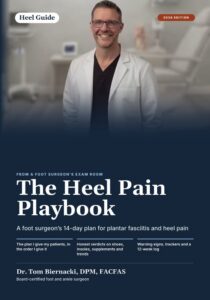
The spur is rarely the problem. The fascia usually is. Dr. Tom’s free 14-day plan from The Heel Pain Playbook treats it in the order he uses in clinic: a 60-second safety check, five moves with photos and a tracker. Get the free 14-day plan.
Common questions
What kind of shoes are best for heel spurs?
Shoes with deep heel cushioning, a firm heel counter, a rocker or stiff forefoot and a moderate to high drop. These features protect the plantar fascia and the heel fat pad, which are usually the real source of pain. Max-cushion shoes such as the Hoka Bondi 9 and Brooks Ghost Max 4 suit most people, while stability shoes such as the Brooks Adrenaline GTS 26 suit flatter feet.
Do heel spurs need special shoes?
Not special in the sense of medical or prescription footwear. The spur itself is usually not the cause of the pain, so the aim is to protect the soft tissues around it. A well-chosen, widely available trainer or walking shoe with good heel cushioning and a firm counter does that. Some people add a heel cup or insole for extra protection.
Are Hokas good for heel spurs?
For pain under the heel, Hokas are often a good choice because of their thick heel cushioning and rocker soles. The Bondi 9 provides the most protection, and the Clifton 11 is a lighter alternative with a higher 8 mm drop. For spurs at the back of the heel, Hokas with stiff, padded counters can press on the sore area, so a shoe with a softer collar may be better.
Should I wear shoes with a cut-out for the heel spur?
I generally advise against cut-out or doughnut pads. The pain in heel spur syndrome comes from the soft tissue at the heel, not from the tip of the bone, so concentrating pressure around a hole rarely helps. A full heel cup or a cushioned heel spreads load more evenly and is usually more comfortable.
Is walking barefoot bad for heel spurs?
During a painful phase, walking barefoot on hard floors often makes heel spur pain worse, because there is nothing to cushion the fat pad or support the arch. Wearing supportive shoes or slippers indoors, especially for the first steps in the morning, usually helps. Our slippers guide covers indoor options.
Can the right shoes make a heel spur go away?
No. Shoes do not dissolve bone, and a spur usually stays visible on X-ray even after the pain has gone. That is fine, because the spur was rarely the problem. Good shoes reduce strain on the plantar fascia and fat pad so they can settle, and many people become pain-free with the spur still present.
- Allam AE, Chang KV. Plantar Heel Pain. StatPearls, NCBI Bookshelf.
- American Academy of Orthopaedic Surgeons. Heel Pain. OrthoInfo.
- Orthopaedic Section, APTA. Heel Pain – Plantar Fasciitis: Revision 2023. Journal of Orthopaedic & Sports Physical Therapy.
- American Academy of Orthopaedic Surgeons. Achilles Tendinitis. OrthoInfo.
Related heel pain guides
- Heel spurs: what they are and what they are not
- Heel spur treatment
- Plantar fasciitis
- Heel fat pad atrophy
- Plantar fasciitis insoles
- Best heel cups
- Best shoes for heel pain
- Best walking shoes for plantar fasciitis
- Heel pain in the morning
Heel pain in Michigan?
Dr. Biernacki sees heel pain at Balance Foot & Ankle in Howell and Bloomfield Township. If the right shoes have not settled it, an assessment can work out which tissue is responsible.
This page is education, not a diagnosis. Read our editorial policy for how it was written and what it will not claim.