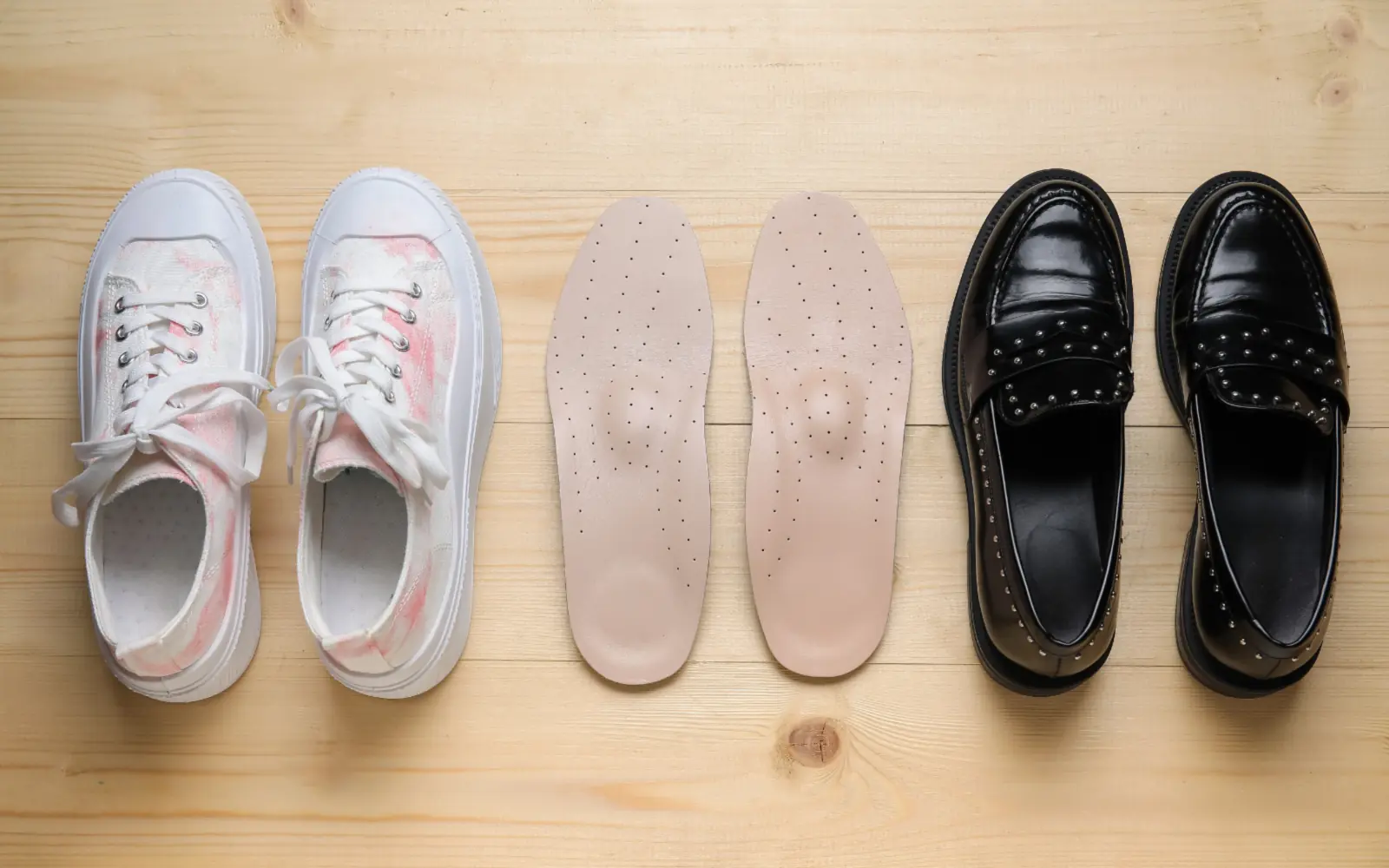
Footwear
Best Walking Shoes for Plantar Fasciitis (2026)
The best walking shoes for plantar fasciitis have a firm heel cup, a sole that will not twist through the arch, a raised heel and a rocker that rolls you onto the next step. For most walkers that means the Hoka Bondi 9 or Brooks Ghost Max 4. If you need maximum support or a leather shoe for work, the Brooks Addiction Walker 2 is the better choice. Every pick below comes in women’s and men’s sizes, and most come in wide fits.
Walking is often harder on an irritated plantar fascia than running. You spend more time on your feet, often on hard floors, and often in shoes chosen for looks rather than support. Many of my patients with plantar fasciitis are not runners at all. They are nurses, teachers, retail staff and people who walk for exercise and have found that their heel will not tolerate it any more.
This guide covers walking-specific shoes and running shoes that walk well, because many of the best walking shoes for heel pain are running shoes. Every version number, drop and width option was checked against brand or specialist retailer listings and independent reviews in October 2026. Where I could not confirm a figure, I have left it out.
How we choose: each pick is judged against the clinical criteria in the four features that matter. No brand pays for placement. Links to Amazon are affiliate links, so we may earn a commission at no cost to you (disclosure).
Quick picks
Best overall: Hoka Bondi 9
Deep cushioning, a rocker and above-average twist resistance, from narrow to extra-wide.
Best for all-day standing: Brooks Ghost Max 4
A broad, stable base and a GlideRoll rocker. Women’s come in B, D and 2E.
Best maximum support: Brooks Addiction Walker 2
A 12 mm drop, a leather upper and a slip-resistant sole, in four widths.
Most structured: New Balance 990v6
Maximum torsional stiffness in lab testing, six widths and a removable insole.
Best built-in arch support: Vionic 23Walk Classic
A podiatrist-designed removable orthotic and a firm heel counter, with the APMA seal.
Best budget: ASICS Gel-Contend 9
An 8 mm drop, a firm heel counter and wide fits for about $70 list.
On this page
What makes a good walking shoe for plantar fasciitis
When you walk, your heel lands first and your weight rolls forward slowly. That puts more of each step on the heel and arch than running does. The features I look for in clinic:
- A firm heel counter. Squeeze the back of the shoe. It should hold its shape and keep the heel’s natural fat pad centred under the bone.
- Twist resistance through the middle. If you can wring the shoe like a cloth, it gives the arch nothing to lean on.
- A raised heel. A drop of roughly 8–12 mm, or a rocker that does the same job, eases tension in the calf, Achilles and fascia.
- A rocker or stiff forefoot. Walkers spend a long time pushing off. A curved sole cuts how far the big toe has to bend, and with it the pull on the fascia.
- A removable insole and real widths. If you use an orthotic, or your foot is wide, these matter more than any cushioning technology.
The common mistakes I see are flat, flexible fashion trainers, very soft memory-foam slip-ons, and old shoes whose midsoles have been crushed flat.
The best walking shoes for plantar fasciitis
1. Hoka Bondi 9 — best overall
The Bondi is a running shoe, but most of the people I see wearing it are walking. Running Warehouse lists a 44 mm heel stack, which is a lot of protection for a tender heel on hard floors. The MetaRocker sole rolls you forward without much toe bend. RunRepeat’s lab rated its torsional rigidity above average, so it does not fold under the arch the way soft shoes do.
Hoka lists the drop as 5 mm, but the lab measured about 9 mm. In practice it walks like a moderate-drop shoe. It is still at version 9 as of October 2026.
- Drop: 5 mm listed (lab-measured around 9 mm)
- Type: max cushion, rocker
- Widths: narrow, standard, wide, extra-wide; men’s and women’s
- Removable insole: yes
Good for: long walks, hard floors, heavier walkers, and anyone who also has a bruised-feeling heel pad. Around $170–$175 list.
Skip it if: you walk on uneven trails or have a history of ankle sprains, because the tall stack is less steady on rough ground. Skip it too if you find chunky shoes clumsy.
2. Brooks Ghost Max 4 — best for all-day standing
The Ghost Max is the Brooks answer to the Bondi, built more for stability than plushness. Version 4 has a 6 mm drop on a 40/34 mm stack and Brooks’ GlideRoll rocker. It has a broad base and raised sidewalls in place of traditional posting. The reviewer found the refined rocker smoother than before. A clinician review of the previous version rated it a strong option for long walks and standing, with a thick removable insole that took orthotics well.
It has a lower drop than I would usually choose for a flare-up. The rocker and firm platform make up for much of that, but if your calves are very tight, the Addiction Walker or Ghost 18 suit you better.
- Drop: 6 mm
- Type: max cushion, rocker, stable neutral
- Widths: women’s B, D and 2E; men’s standard, wide and extra-wide
- Removable insole: yes on the Ghost Max 3; not separately confirmed for the 4
Good for: people on their feet all day at work, and walkers who want a stable, cushioned rocker. Around $165 list.
Skip it if: your heel is sensitive at the back (clinician reviewers flagged the stiff, padded counter on the previous version), or you need a light shoe.
3. Brooks Addiction Walker 2 — best maximum support
This is the shoe for people who need a lot of support and do not want a running shoe. It has a 12 mm drop, Brooks’ highest-support rating, a full-grain leather upper and a certified slip-resistant outsole. That makes it practical for hospitals, kitchens and shop floors. It is also PDAC-coded as a diabetic shoe.
It is heavy and firm, and it will never feel sporty. For a collapsing arch and a strained fascia, though, that firmness is the point. It comes in four widths, and there are suede and hook-and-loop strap versions.
- Drop: 12 mm
- Type: motion control walker
- Widths: narrow, standard, wide, extra-wide; men’s and women’s
- Removable insole: not confirmed by the sources I checked
Good for: flat or overpronating feet, heavier walkers, and work settings that need a leather, slip-resistant shoe. Around $130 list.
Skip it if: you want a light or cushioned shoe for fitness walking. Owners also report it fits tighter than earlier versions and can squeak.
4. New Balance 990v6 — most structured
The 990 is an everyday sneaker with a running-shoe chassis, and it is structured. RunRepeat’s lab gave it the maximum score for torsional rigidity and an above-average score for heel counter stiffness. It also measured a drop of about 15 mm, which is far higher than most shoes and helpful when the calf is tight. The insole is removable, and it comes in six widths, which is unusual.
The trade-offs are price and stiffness. It feels firm, it is not light, and at around $200 list it is the most expensive shoe here.
- Drop: about 15 mm (lab-measured)
- Type: structured everyday trainer
- Widths: six width options
- Removable insole: yes
Good for: walkers who want maximum structure and a high heel, people needing extra-wide or narrow fits, and those who want a shoe that suits jeans.
Skip it if: you have a sore Achilles insertion and dislike stiff heel counters, you are on a budget, or you want a soft, flexible feel.
5. ASICS Gel-Kayano 33 — best stability running shoe for walkers
Clinician reviewers at Doctors of Running felt the Kayano 33 was better for walking and standing than for running. They found it soft at walking pace, with support concentrated under the inner heel. It has an 8 mm drop. For a walker whose heel rolls in at landing, that is the right place for the support.
- Drop: 8 mm
- Type: stability
- Widths: men’s narrow, standard, wide (2E), extra-wide (4E); women’s standard and wide (D)
- Removable insole: not confirmed by the sources I checked
Good for: walkers with flexible flat feet or heel-focused overpronation, especially in wide fits. Around $170 list.
Skip it if: the back of your heel is sensitive, because the counter is stiff and its padding compresses over time. Skip it too if you need firm support under the midfoot rather than the heel.
6. Vionic 23Walk Classic — best built-in arch support
Also listed by some retailers as the Vionic Walker Classic, this is a leather or suede walking shoe built around a removable, podiatrist-designed orthotic footbed. It has a firm thermoplastic heel counter and the APMA Seal of Acceptance. For someone who will not wear a running shoe but needs real arch contouring, it is a simple solution.
The footbed is contoured, so it takes a few days to get used to. Build up wear gradually rather than starting with an eight-hour shift. Vionic does not publish a drop figure.
- Drop: not published
- Type: orthotic walking shoe
- Widths: women’s medium (B) and wide (D); men’s medium (D) and wide (E)
- Removable insole: yes (the orthotic footbed)
Good for: walkers who want built-in arch support in a smart, leather shoe, and those with flexible flat feet.
Skip it if: you have a high, rigid arch that dislikes pressure under the midfoot, or need extra-wide sizing beyond wide.
7. Skechers GO WALK Arch Fit 2.0 — best lightweight casual walker
Most Skechers walking shoes are too soft and flexible for plantar fasciitis. The Arch Fit line is the exception I mention to patients. It has a removable, podiatrist-certified arch insole and has the APMA Seal of Acceptance. It is light and easy to slip on, which matters for people who will not wear anything bulkier around the house or on errands.
It is less structured than the running-derived shoes above. Treat it as a comfortable casual shoe with decent arch support, not as treatment during a bad flare.
- Drop: not published
- Type: casual walker with arch insole
- Widths: standard on the women’s styles I checked; men’s versions available
- Removable insole: yes
Good for: light daily walking and casual wear once symptoms are mild, and as an upgrade from flat canvas or fashion trainers.
Skip it if: your heel is very sore, you walk long distances, or you need wide sizing in the specific style you want. Choose the Bondi or Ghost Max instead.
8. ASICS Gel-Contend 9 — best budget pick
You do not have to spend $170. The Gel-Contend 9 is a simple, inexpensive trainer that meets more of the criteria than its price suggests. RunRepeat measured an 8 mm drop and a heel counter firmer than average, and it has a removable sockliner that is easy to swap for a supportive insole. It comes in wide and extra-wide for men and wide for women, at about $70 list.
It has much less cushioning than the shoes above, especially in the forefoot, and its twist resistance is only around average.
- Drop: 8 mm
- Type: neutral budget trainer
- Widths: men’s standard, wide, extra-wide; women’s standard and wide
- Removable insole: yes
Good for: shorter daily walks on a budget, especially paired with an over-the-counter arch support.
Skip it if: you walk long distances, stand all day on concrete, or have a thin heel pad that needs deep cushioning.
Comparison table
| Model | Type | Drop | Widths | Best for |
|---|---|---|---|---|
| Hoka Bondi 9 | Max cushion, rocker | 5 mm listed (~9 mm measured) | Narrow to extra-wide | Long walks, hard floors |
| Brooks Ghost Max 4 | Max cushion, rocker | 6 mm | Women’s B/D/2E; men’s to extra-wide | All-day standing |
| Brooks Addiction Walker 2 | Motion control | 12 mm | Narrow to extra-wide | Flat feet, work, leather |
| New Balance 990v6 | Structured trainer | ~15 mm measured | Six widths | Maximum structure |
| ASICS Gel-Kayano 33 | Stability | 8 mm | Men’s to 4E; women’s to D | Heel overpronation |
| Vionic 23Walk Classic | Orthotic walker | Not published | Medium and wide | Built-in arch support |
| Skechers GO WALK Arch Fit 2.0 | Casual walker | Not published | Varies by style | Light casual wear |
| ASICS Gel-Contend 9 | Budget neutral | 8 mm | Men’s to extra-wide; women’s to wide | Budget |
Women’s walking shoes for plantar fasciitis
Plantar fasciitis is common in women, and the shoes are the same in principle. Women’s versions are built on a different last, usually narrower at the heel relative to the forefoot. The points that come up most in clinic:
- Width matters as much as cushioning. Many women with heel pain are squeezing a wide forefoot into a standard B width, which pushes them to grip with their toes. The Ghost Max 4 in D or 2E and the Bondi 9 in wide or extra-wide are the easiest ways to fix that.
- Lighter stacks. Women’s sizes of some shoes run slightly lower. The Clifton 11, for instance, sits about 4 mm lower in women’s sizes than men’s, while keeping the same drop.
- Flats and ballet pumps are a common trigger. If your work shoes are flat and thin-soled, the best walking shoe in the world will not help if you spend eight hours in the other pair. For work options, see work shoes for plantar fasciitis.
- Barefoot at home counts. Hard floors and bare feet cause many flare-ups. A supportive house shoe or recovery sandal makes a real difference; see slippers and sandals.
For most women, my default suggestions are the Bondi 9 or Ghost Max 4 for comfort, the Kayano 33 or Addiction Walker 2 if the arch collapses, and the Vionic 23Walk Classic if you want built-in support in a leather shoe.
Getting the fit right
- Shop late in the day, when your feet are at their largest.
- Bring your insole or orthotic and try the shoe with it in place. Take out the stock insole first.
- Check the heel. It should not lift as you walk. A firm counter only works if the heel is held in it.
- Leave about a thumb’s width beyond your longest toe.
- Rotate two pairs if you walk daily, and replace them when the midsole creases or the heel wears unevenly.
- Change gradually. A big change in drop or a contoured footbed needs a week or two of building up.
Shoes work best alongside other treatment. In clinic, the patients who recover fastest change their footwear and also stretch and strengthen the calf and fascia daily. Our plantar fasciitis exercises take about ten minutes a day.
When shoes are not the answer.
If pain is worse the more you walk and does not ease, or there is swelling or bruising, stop and have it assessed. A stress fracture of the heel bone can be mistaken for plantar fasciitis.
Numbness, burning or tingling points at a nerve, not the fascia, and cushioning will not settle it. See heel nerve pain.
If you have diabetes or reduced sensation, have footwear assessed professionally. Do not rely on comfort to tell you whether a shoe fits.
Walking more comfortably is step one. Dr. Tom’s free 14-day plan from The Heel Pain Playbook adds what to do before your first step each morning and the slow heel raises that build the heel back up, with a tracker. Get the free 14-day plan.
Common questions
Are running shoes or walking shoes better for plantar fasciitis?
For many people, a cushioned running shoe is the better walking shoe. Running shoes tend to have more developed rockers, firmer heel counters and more width options than shoes sold for walking. Dedicated walkers such as the Brooks Addiction Walker 2 make sense when you need maximum support, a leather upper or slip resistance for work. Choose by features, not by the label on the box.
What are the best women’s walking shoes for plantar fasciitis?
The Hoka Bondi 9 and Brooks Ghost Max 4 suit most women. Both are cushioned rocker shoes available in wider women’s fits, including D and 2E for the Ghost Max 4. If your arch collapses, the ASICS Gel-Kayano 33 or Brooks Addiction Walker 2 add support. If you prefer a leather walking shoe with built-in arch contouring, the Vionic 23Walk Classic comes in medium and wide.
Are Skechers good for plantar fasciitis?
Most standard Skechers are too soft and flexible to support an irritated fascia. The Arch Fit range is better because it has a removable, podiatrist-certified arch insole and the APMA Seal of Acceptance. It is a reasonable casual shoe once symptoms are mild. For a bad flare, or long walks, a more structured shoe such as the Bondi 9 or Ghost Max 4 is the safer choice.
How far should I walk with plantar fasciitis?
Walk as far as your heel tolerates without getting worse. Mild discomfort that settles within a day is acceptable. If your first steps the next morning are noticeably more painful, the previous day’s walk was too long. Break walks into shorter sessions, choose flat paths, and increase distance slowly. If walking is becoming impossible, read when plantar fasciitis makes walking hard.
Should I walk barefoot with plantar fasciitis?
During a flare, it is better not to. Walking barefoot on hard floors removes all heel cushioning and arch support, and many people find their pain rises after a day at home without shoes. Wear a supportive house shoe or recovery sandal, especially for the first steps in the morning, which are often the worst. See heel pain in the morning for why.
Do I need wide shoes for plantar fasciitis?
Only if your feet are wide. But a shoe that is too narrow makes your toes grip and your foot work harder, which adds strain on the fascia. If the sides of your foot press against the upper or spill over the edge of the insole, try a wide. The Bondi 9, Addiction Walker 2 and New Balance 990v6 offer the broadest choice of widths.
- Koc TA Jr, Bise CG, Neville C, Martin RL, McDonough CM, et al. Heel Pain – Plantar Fasciitis: Revision 2023. Journal of Orthopaedic & Sports Physical Therapy.
- Allam AE, Chang KV. Plantar Heel Pain. StatPearls Publishing.
- American Academy of Orthopaedic Surgeons. Heel Pain. OrthoInfo.
Related heel pain guides
- Best shoes for plantar fasciitis
- Best running shoes for plantar fasciitis
- Best work shoes for plantar fasciitis
- Best shoes for heel pain
- Hoka Bondi vs Clifton
- Plantar fasciitis insoles
- Plantar fasciitis explained
- Plantar fasciitis treatment
- Heel pain in the morning
Heel pain in Michigan?
Dr. Biernacki sees heel pain at Balance Foot & Ankle in Howell and Bloomfield Township. If the right shoes have not settled it, an assessment can work out which tissue is responsible.
This page is education, not a diagnosis. Read our editorial policy for how it was written and what it will not claim.