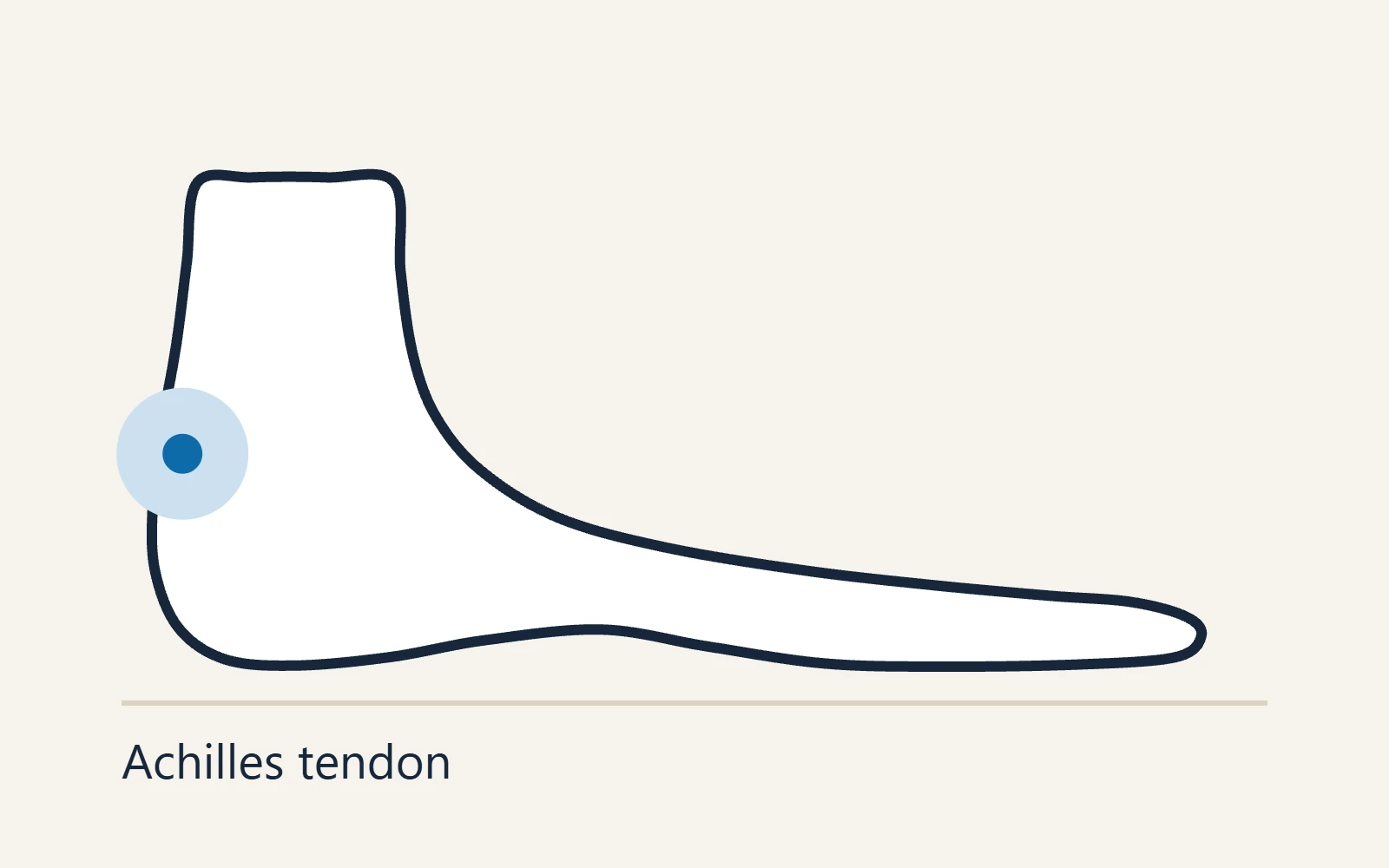
Heel pain treatment
Heel lifts for Achilles tendonitis: who they help and how to use them
A heel lift is a small wedge under the heel, and it is one of the better-evidenced simple measures for Achilles pain. It works by putting slack in the tendon. Used in both shoes, at a modest height, and alongside the loading exercises, it can make a painful tendon tolerable while it recovers.
Most heel pain advice is about the arch. Achilles pain is different: the arch has little to do with it, and the thing that changes the load on the tendon is how far the heel drops relative to the toes with each step. A heel lift reduces that drop. That simple mechanism is why lifts appear in almost every treatment plan for Achilles tendinopathy, and why they do very little for plantar fasciitis.
On this page
How a heel lift works
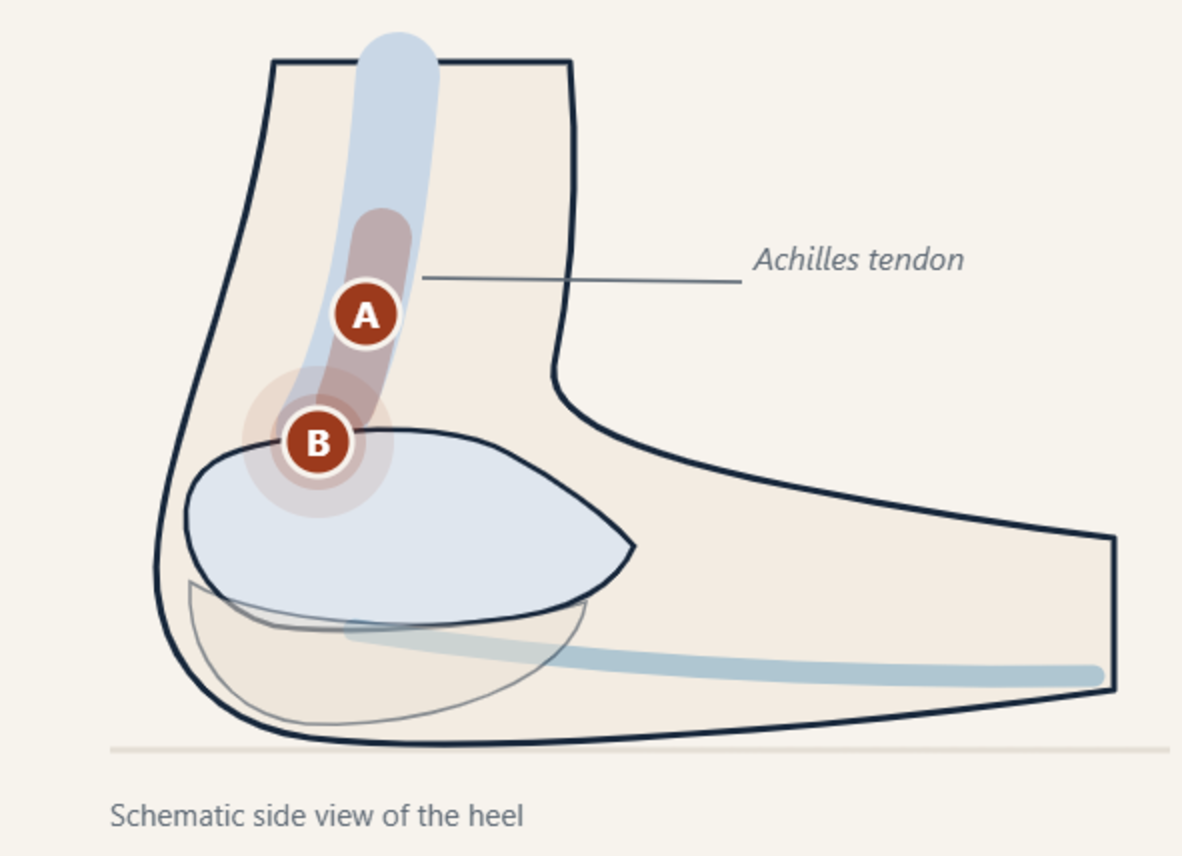
Every step bends the ankle upwards as the body passes over the foot. That movement stretches the Achilles, and the further the heel sits below the toes, the further it stretches. Raising the heel by a few millimetres means the tendon starts each step with a little slack, so the peak stretch — and the load that comes with it — is lower.
At the insertion there is a second effect. When the ankle bends upwards, the tendon wraps around the back of the heel bone and is pressed against it, squeezing the tendon and the bursa in front of it. Less upward bend means less of that compression. This is the same reason a night splint, which holds the ankle bent upwards, can aggravate pain at the back of the heel.
What the evidence shows
The best evidence comes from a randomised trial in people with mid-portion Achilles tendinopathy that compared in-shoe heel lifts with the standard eccentric calf-lowering programme. Over twelve weeks, the heel lift group improved more on the main symptom and function score. The margin was modest — just under the size the researchers had set in advance as clinically worthwhile — and side effects such as knee or foot aches were similar in both groups. It was a single trial of a hundred people, but it was well run, and it showed lifts are a treatment in their own right rather than only a stop-gap.
For insertional Achilles pain the evidence is smaller — mostly studies of immediate and short-term effects — but the mechanism is strong, and lifts are a standard part of insertional management because they reduce compression at the bone.
A lift is not a replacement for the loading exercises. The tendon recovers by being progressively loaded. A lift lowers the load enough for daily life and the exercises to be tolerable. Use both. The Achilles exercise programme sets out the progression.
Mid-portion or insertional: does it matter?
| Mid-portion | Insertional | |
|---|---|---|
| Where it hurts | The cord itself, two to six centimetres above the heel; often a thickened, tender area | Right at the back of the heel bone, where the tendon attaches; often with a bump |
| Why a lift helps | Reduces peak tendon stretch and load | Reduces stretch and compression against the bone |
| Heel counter | Less important | Critical: check the lift does not push the sore spot into the counter |
| Exercise change | Standard heel drops off a step are fine | Do heel raises on flat ground; dropping below the step compresses the insertion |
If you are not sure which you have, Achilles tendonitis explains how to tell them apart, and insertional Achilles tendonitis covers the second in detail.
Choosing a heel lift
- Height. Most commercial lifts are a few millimetres to around a centimetre. Start at the lower end and only go higher if the tendon is still very irritable. Very tall lifts push the heel out of the shoe and shift load onto the forefoot.
- Material. Firm cork, foam or plastic lifts keep their height. Soft gel lifts cushion more but compress under body weight, so the effective lift is lower than the label. Layered, adjustable lifts let you reduce the height as you improve.
- Heel only or full length. A heel-only wedge is cheap and moves between shoes. A full-length insole with a built-in raised heel is more stable and less likely to slip, but needs a shoe with a removable insole.
- The shoe. A lift adds height inside the shoe. Lace-up trainers with a reasonably deep heel are ideal. Shallow dress shoes and loafers often let the heel ride out once a lift is added.
The shoe itself can provide most of the lift. A trainer with a higher heel-to-toe drop already gives the tendon some slack; see shoes for Achilles tendonitis, and compare drops across models on Podiatrist Tested’s heel-to-toe drop chart (our sister review site; its retailer links are affiliate links, so we may earn a commission at no extra cost to you).
How to use one
- Put one in both shoes. A lift in one shoe creates a leg-length difference, which can cause hip and back aches. The only exception is a measured leg-length difference that a clinician has asked you to correct.
- Wear it in every shoe you walk in. Including at home. A lift in your trainers does nothing during an evening barefoot or in flat slippers.
- Check the heel counter. With the lift in, feel where the top edge of the heel counter sits. For insertional pain it must not now press across the sore spot. A softer or lower-backed shoe may be needed.
- Keep doing the exercises. The lift buys tolerance; the loading programme builds the tendon. Lifts used alone tend to leave the tendon as sensitive as before when they come out.
- Wean off gradually. Once daily walking is comfortable and the exercises are progressing, reduce the height over a few weeks rather than removing the lift overnight. Many people keep a lower lift for running or long days.
When not to use a heel lift
A sudden snap, a feeling of being kicked in the back of the leg, or being unable to push off can be an Achilles rupture. That needs urgent assessment, not a lift. After a rupture, any heel wedges in a boot follow your surgeon’s or therapist’s protocol.
Pain under the heel on the first steps of the day is usually plantar fasciitis, where arch support helps more than a lift. See insoles for heel pain.
Calf pain with swelling, warmth or redness needs checking for a blood clot before anything else.
Diabetes or reduced feeling in the feet means inserts should be fitted professionally.
Common questions
Do heel lifts help Achilles tendonitis?
Yes, for many people. Raising the heel reduces how far the Achilles stretches with each step and, at the insertion, how hard it is pressed against the heel bone. In a randomised trial in mid-portion Achilles tendinopathy, heel lifts improved symptoms more than eccentric calf exercise over twelve weeks. They work best combined with a progressive loading programme.
How high should a heel lift be for Achilles tendonitis?
Most people do well with a modest lift, from a few millimetres up to around a centimetre. Start at the lower end. Higher lifts can push the heel out of the shoe and load the forefoot more. Firm materials hold their height; soft gel compresses, so the effective lift is lower than stated.
Should I put a heel lift in one shoe or both?
Both, even if only one side hurts. A lift in one shoe makes that leg functionally longer and can cause hip, knee or back aches. Use a single-sided lift only to correct a leg-length difference that has been measured.
Are heel lifts good for insertional Achilles tendonitis?
They are a standard part of treating it, because they reduce compression of the tendon against the back of the heel bone. The key extra step is checking the shoe’s heel counter: if the lift raises the sore spot into a stiff counter, choose a softer or lower-backed shoe.
How long should I use heel lifts?
Until daily walking is comfortable and the loading exercises are progressing well, which is usually weeks to a few months. Then reduce the height gradually over a few weeks. Many runners keep a small lift, or a shoe with a higher drop, for longer runs.
Can I just wear shoes with a higher heel instead?
Often, yes. A trainer with a ten to twelve millimetre heel-to-toe drop already gives the tendon some slack, and a modest block heel can do the same in a dress shoe. Very high or narrow heels are a different matter and are not a good substitute.
- Rabusin CL, Menz HB, McClelland JA, et al. Efficacy of heel lifts versus calf muscle eccentric exercise for mid-portion Achilles tendinopathy (HEALTHY): a randomised trial. British Journal of Sports Medicine, 2021.
- Martin RL, Chimenti R, Cuddeford T, et al. Achilles pain, stiffness, and muscle power deficits: midportion Achilles tendinopathy revision 2018. Clinical Practice Guidelines, Journal of Orthopaedic & Sports Physical Therapy, 2018.
- American Academy of Orthopaedic Surgeons, OrthoInfo. Achilles Tendinitis.
Related heel pain guides
- Achilles tendonitis
- Insertional Achilles tendonitis
- Achilles exercises (printable)
- Shoes for Achilles tendonitis
- KT tape for Achilles tendonitis
- Haglund’s deformity
- Insoles for heel pain
Achilles pain in Michigan?
Dr. Biernacki sees Achilles and heel pain at Balance Foot & Ankle in Howell and Bloomfield Township. If a lift, good shoes and twelve weeks of loading have not settled it, an examination and imaging can show what the tendon is doing.
This page is education, not a diagnosis. Read our editorial policy for how it was written and what it will not claim.