Heel pain treatment
Heel spur treatment: how to get rid of the pain when the spur stays
No stretch, cream or supplement removes a heel spur, and you do not need it gone to be pain-free. The pain comes from the tissue around the spur, and that tissue responds to treatment.
If an X-ray has shown a spur under your heel, the plan below is the one that works. It is the same plan as for plantar fasciitis, because in most painful heels with a spur, the fascia is what hurts. People regularly become completely pain-free with the spur still sitting on the next X-ray. For why the spur is usually a bystander, see heel spurs; this page is the treatment.
On this page
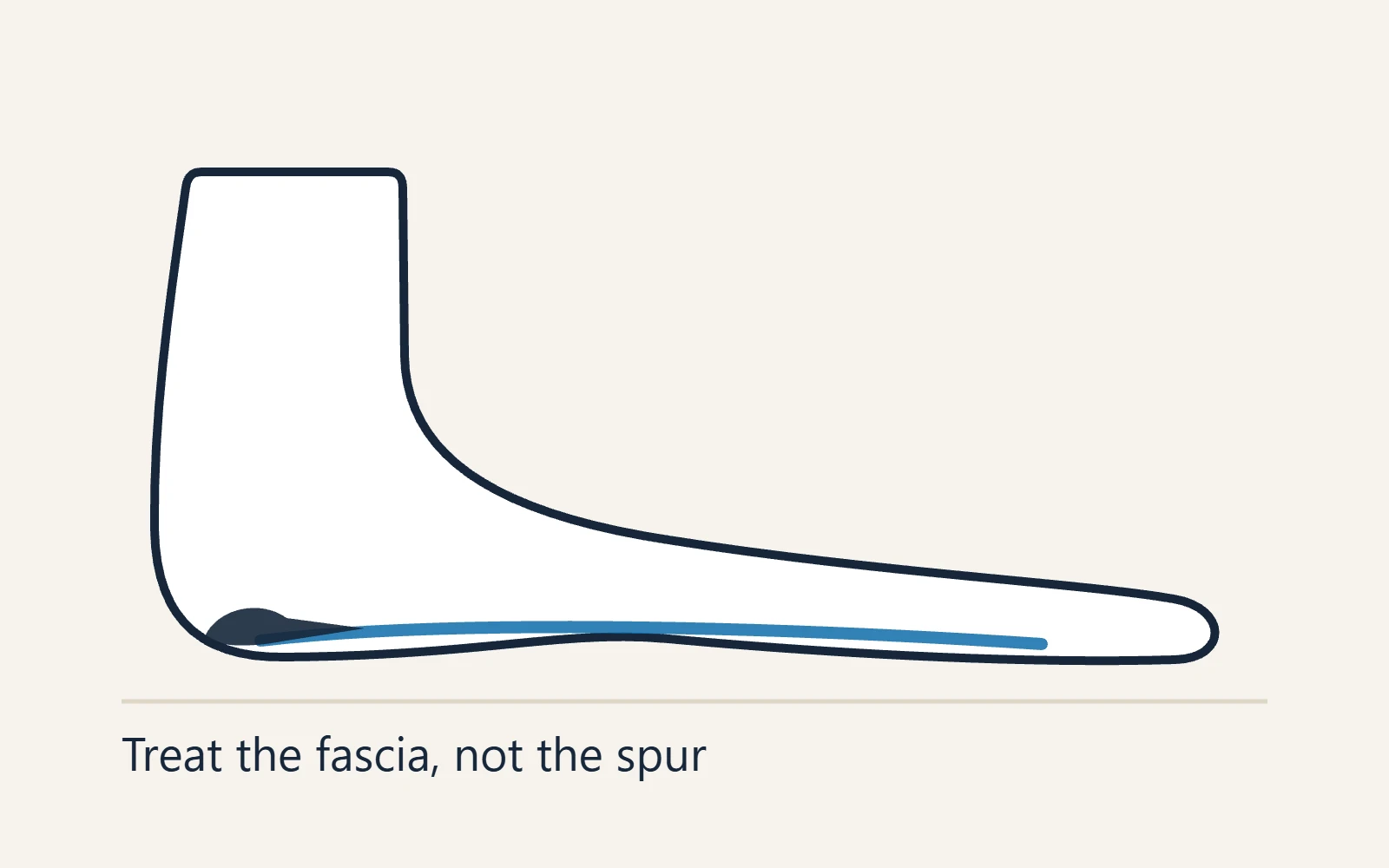
Treat the fascia, not the spur
Spurs and plantar fasciitis travel together. In one X-ray study, 89% of people with plantar fasciitis had a spur, against 32% of a comparison group of the same age and sex. But common is not the same as causal: more than 15% of people with no heel pain at all have a spur on X-ray, the pain settles while the spur stays, and spur size does not track with how much it hurts.
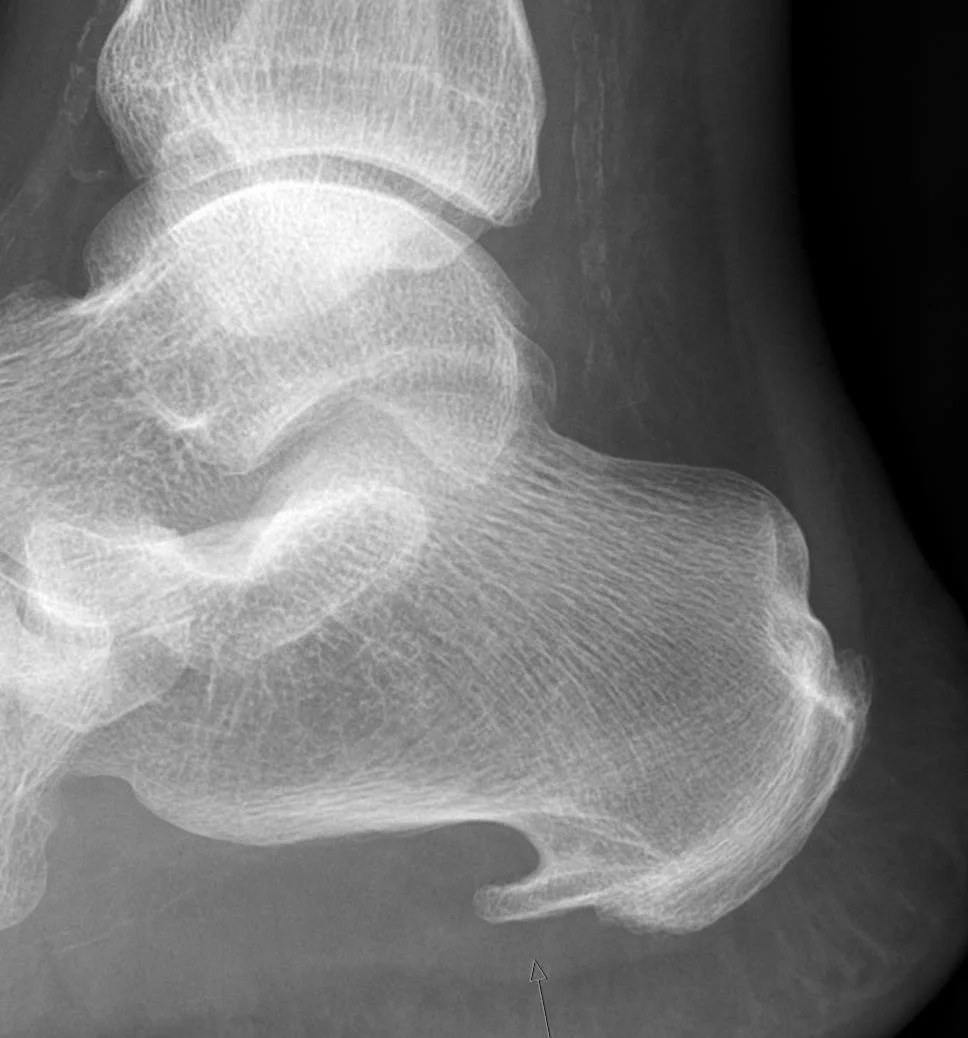
The spur is best read as a record of years of pull at the heel. The thing to treat is the overloaded soft tissue producing the pain, which is what every step below is aimed at.
The fastest way to settle heel spur pain
There is no overnight fix, but there is a fastest route. Start all of these in the first week and keep them going:
- Stretch the fascia before your first steps. Sitting on the edge of the bed, pull your toes back towards your shin until the band under the arch goes tight, and hold ten seconds, ten times. Doing it before you stand takes the sharp edge off the worst step of the day. In a randomised trial, this fascia-specific stretch beat a standard calf stretch for first-step pain.
- Stop walking barefoot on hard floors. Supportive shoes or supportive slippers indoors, from the moment you get up. This single change undoes more heel pain than people expect.
- Add support and cushioning under the heel: an insert with real arch contour, and a heel cup if the pain feels deep and bruise-like.
- Take the spike out of the load for six to eight weeks: shorter periods standing still on hard floors, fewer long walks or runs, cycling or swimming for fitness in the meantime. Reduce, do not stop.
- Calm flare-ups with a frozen water bottle rolled under the arch for five to ten minutes, or taping for a hard day on your feet.
- Start the strengthening in the second or third week, once the first steps are easing (see below).
Give it eight to twelve weeks before you judge it. About three in four cases of plantar fasciitis settle within a year even without much treatment; the plan above aims to make that months rather than a year.
Heel spur exercises
These are aimed at the fascia and calf, where the pain and the pull come from. Full dosing and progressions are on the plantar fasciitis stretches and exercises page, which also has a printable sheet.
| Exercise | How | How often |
|---|---|---|
| Plantar fascia stretch | Seated, foot across the opposite knee, pull the toes back until the arch band is tight. Hold 10 seconds. | 10 holds, 3 times a day, one set before the first steps |
| Calf stretch, knee straight and bent | Hands on a wall, heel down, lean in. Then bend the back knee, heel still down. | 3 holds of 30–45 seconds each, most days |
| Heel raise with a towel under the toes | On a step, toes resting up on a rolled towel. Up over three seconds, hold two, down over three. | Every second day, 3 sets of 12, getting heavier over weeks |
| Towel scrunches | Seated, pull a towel towards you by curling the toes. | 2–3 sets of 20, most days |
| Arch roll | Roll a ball or frozen bottle under the arch, avoiding the most tender point. | 1–2 minutes, when sore |
The heel raise is the one that changes the tissue, and the one most often done too lightly. Rolling and massage relieve symptoms but do not load the fascia; see plantar fasciitis massage for how to do them well.
Shoes, inserts and heel cups
- Shoes: a firm heel counter that does not fold when squeezed, a sole that bends at the toes rather than the middle, and a little heel-to-toe drop. Soft is not the same as supportive. More on the best shoes for plantar fasciitis page.
- Inserts: start with a good off-the-shelf insert with real arch contour. Custom orthotics earn their cost when an off-the-shelf one helped but not enough. See insoles and orthotics.
- Heel cups and pads: a deep silicone heel cup helps most when the pain is central and bruise-like, which points at the fat pad. For classic fascia pain they are a comfort measure. A pad with a cut-out under the tender spot can take pressure off a single sore point.
When first-line treatment is not enough
If three months of the steps above, done consistently, have not changed much, the first move is to recheck the diagnosis. A stress fracture, a trapped nerve, a thinned fat pad and inflammatory arthritis all get labelled as heel spurs. After that, the second-line options are:
| Option | What it offers | The trade-off |
|---|---|---|
| Shockwave therapy | Reasonable evidence in heel pain that has resisted first-line care. No downtime. | Several sessions, often self-funded, and results take weeks. |
| Cortisone injection | Strong short-term relief, useful when pain is blocking the rehab. | Fades, and carries a small risk of fat pad thinning or fascia rupture, higher with repeat shots. See cortisone injections. |
| Custom orthotics | Help when foot shape or mechanics are driving the load. | Cost, and not clearly better than a good off-the-shelf insert for ordinary cases. |
| A period in a walking boot or cast | Can break the cycle in a very irritable heel. | Weakens the calf and stiffens the ankle. Needs an end date. See walking boots. |
| Surgery | For a small minority still disabled after 6 to 12 months of proper treatment. | Recovery in months, with real risks. Removing the spur is not the point of the operation. See heel spur surgery. |
If the spur is at the back of the heel
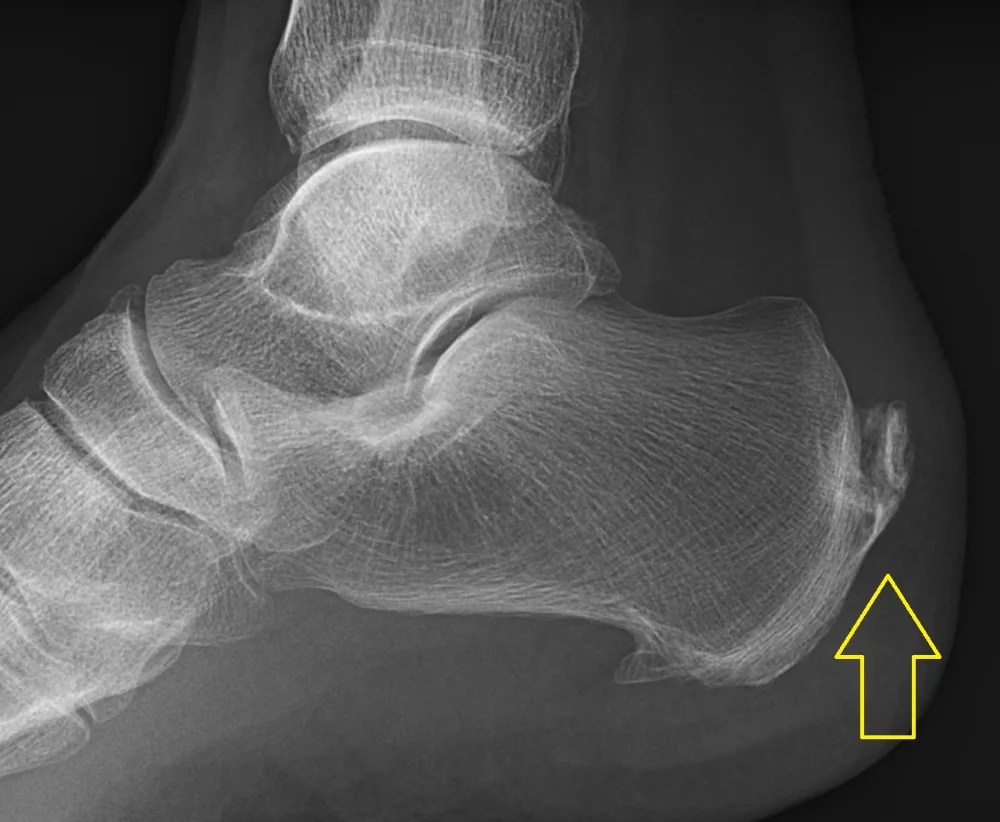
A spur at the back of the heel, where the Achilles attaches, is a different problem with different treatment. It sits with insertional Achilles tendonitis and often a Haglund’s bump, and the calf stretches above can aggravate it. The treatment there is a heel lift in both shoes, shoes that do not press on the back of the heel, and floor-level Achilles exercises. Posterior spurs are also the ones that sometimes do need surgery. Back of heel pain sorts out which problem you have.
Get it seen promptly if the heel is hot, red or swollen, you cannot put weight on it, the pain started with a pop or a fall, it keeps you awake at night, or you have numbness, diabetes or a circulation problem. Those are not heel spur questions.
Want the first-line steps as a day-by-day plan? Dr. Tom’s free 14-day plan from The Heel Pain Playbook puts them in order: shoes by the bed tonight, the stretch before your first step, then heel raises from day 4, with a tracker. Get the free 14-day plan.
Common questions
What is the fastest way to heal a heel spur?
The spur itself does not heal or dissolve, and it does not need to. The fastest way to get rid of heel spur pain is to treat the fascia around it from the first week: stretch before your first steps, stop going barefoot on hard floors, add arch support and heel cushioning, reduce the aggravating load for six to eight weeks, and start the strengthening exercises. Most people see real change over eight to twelve weeks.
Can heel spurs go away on their own?
The spur does not. Bone that has formed stays visible on X-ray. The pain very often does go away, with or without the spur changing, because the pain comes from the soft tissue and that tissue recovers.
What exercises are good for heel spurs?
The plantar fascia stretch, calf stretches with the knee straight and bent, and a slow heel raise with a towel under the toes to load the fascia. Towel scrunches add foot strength. If the spur is at the back of the heel, use the floor-level Achilles exercises instead and skip deep calf stretches.
Should I walk with a heel spur?
Yes, within comfort, in supportive shoes. Walking is not what damages the heel; long periods of standing still on hard floors and sudden jumps in activity are the usual aggravators. Keep walks shorter while it is sore and build back up as the first steps of the day improve.
Do heel spur cushions and heel cups work?
They help comfort, especially when the pain feels like a deep bruise in the centre of the heel, which suggests the fat pad. They do not treat the fascia on their own, so use them alongside the stretches and supportive shoes rather than instead of them.
When does a heel spur need surgery?
Rarely. Surgery is considered for the small minority still disabled after six to twelve months of proper treatment, and even then the operation is usually on the fascia or the calf, not the spur. Spurs at the back of the heel are more often operated on. See heel spur surgery for the details.
Related heel pain guides
- Best shoes for heel spurs
- Heel spurs — what a spur is, and the evidence that it is usually not the pain.
- Plantar fasciitis vs heel spurs — why the spur on the X-ray report is rarely the problem.
- Heel spur surgery — what the operation really involves, and who needs it.
- Plantar fasciitis stretches and exercises — full dosing, progressions and a printable sheet.
- Plantar fasciitis treatment — the whole treatment ladder in order.
- Back of heel pain — when the spur is at the back of the heel instead.
- Johal KS, Milner SA. Plantar fasciitis and the calcaneal spur: fact or fiction? Foot and Ankle Surgery, 2012.
- Kirkpatrick J, Yassaie O, Mirjalili SA. The plantar calcaneal spur: a review of anatomy, histology, etiology and key associations. Journal of Anatomy, 2017.
- Allam AE, Chang KV. Plantar Heel Pain. StatPearls, NCBI Bookshelf.
- Buchanan BK, Sina RE, Kushner D. Plantar Fasciitis. StatPearls, NCBI Bookshelf.
- DiGiovanni BF, Nawoczenski DA, Lintal ME, et al. Tissue-specific plantar fascia-stretching exercise enhances outcomes in patients with chronic heel pain. Journal of Bone and Joint Surgery, 2003.
- Koc TA, et al. Heel Pain – Plantar Fasciitis: Revision 2023. Clinical Practice Guidelines, Journal of Orthopaedic & Sports Physical Therapy.
- American Academy of Orthopaedic Surgeons, OrthoInfo. Plantar Fasciitis and Bone Spurs.
Heel spur pain in Michigan?
If you have been told a spur is the problem and three months of treatment has not helped, an examination can settle which tissue is actually responsible. Dr. Biernacki sees heel pain in Howell and Bloomfield Township.
This page is education, not a diagnosis. Read our editorial policy for how it was written and what it will not claim.