Heel pain treatment
Cortisone Injections for Plantar Fasciitis: What They Buy You, and What They Cost
A steroid injection is the fastest way to make a painful heel comfortable, and it is not a cure. Understanding what it actually does — and the two specific risks that come with it — makes it a much better decision either way.
By the time most people are offered an injection they have had a sore heel for months, tried the stretches, bought the inserts, and want it to stop. That is a reasonable place to be, and cortisone is a reasonable thing to consider from there. It is also the intervention most often described in the extremes — either a miracle or a thing that will wreck your foot — and neither is right.
What the injection actually does
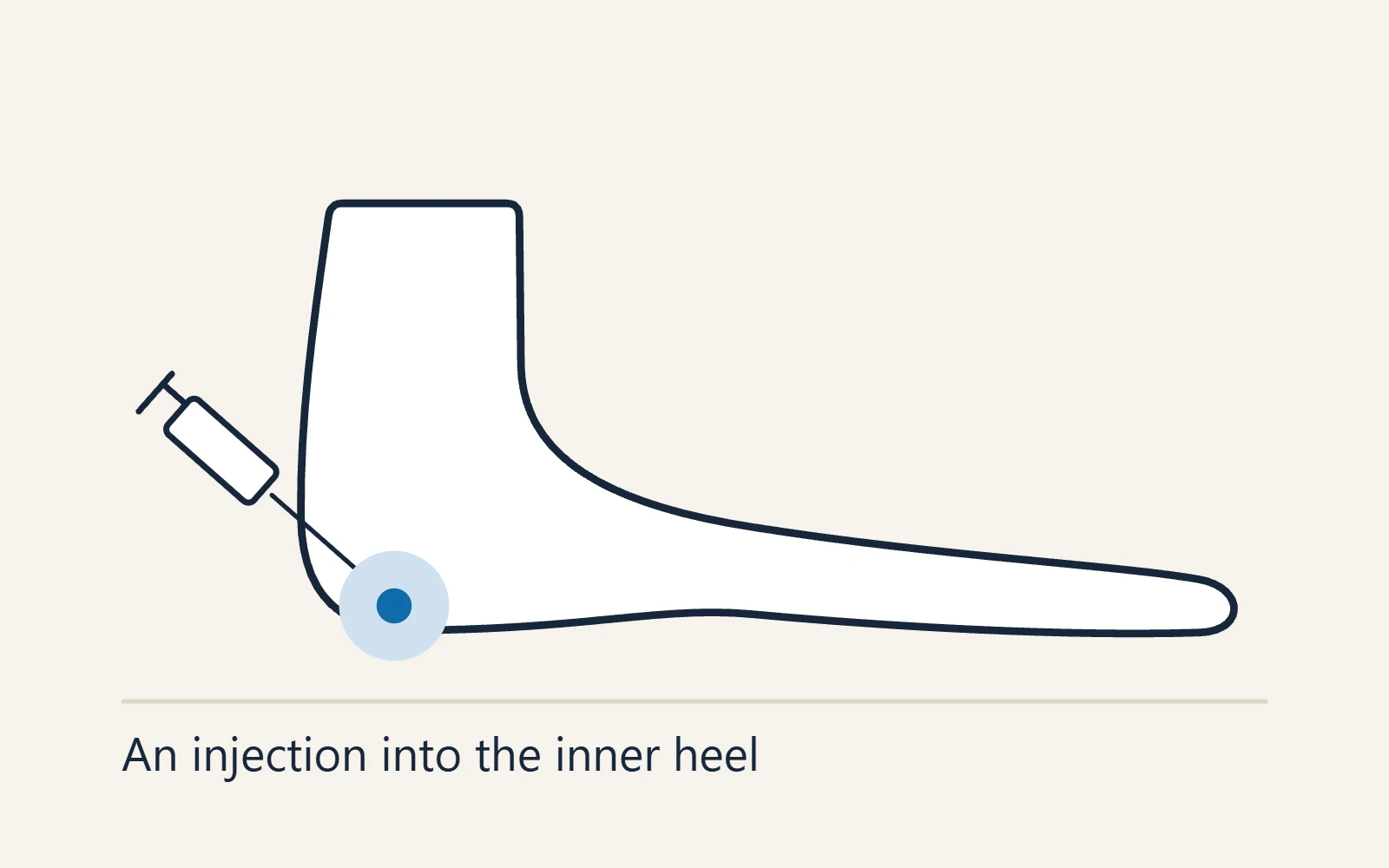
Corticosteroid is a potent anti-inflammatory. Injected around the origin of the plantar fascia, it suppresses the inflammatory component of the problem, and the pain usually drops substantially within a few days.
The catch is in the word inflammatory. Tissue taken from a heel that has hurt for many months does not look inflamed — it looks degenerative, with disorganised collagen in a structure that has been overloaded and has not repaired well. Steroid does nothing about that. It is treating the part of the picture that responds to it and leaving the part that generated the problem untouched. That single fact explains both why the relief is real and why it wears off.
The most useful way to think about it is as a window, not a treatment. A few comfortable months is time in which you can do the heel raises properly, walk normally, sleep, and get your calf and foot strength back. People who use the window that way often do not need a second injection. People who treat the injection as the fix, stop everything, and wait, are usually back within the year.
How well it works, and for how long
| Timeframe | What the evidence broadly shows |
|---|---|
| First few days | Often a flare before improvement. The anaesthetic wears off before the steroid takes effect. |
| 2 to 12 weeks | The clearest benefit. Injected heels do meaningfully better than untreated ones over this window. |
| 3 to 6 months | The advantage narrows. Other treatments, and time, catch up. |
| Beyond 6 months | Little measurable difference from not having had one. The long-term outcome is decided by what else was done. |
The two risks that actually matter
Most of what gets listed on a consent form is minor — a flare, a temporary rise in blood sugar, a small pale patch of skin. Two are worth real attention because they are not reversible.
- Rupture of the plantar fascia. Steroid weakens collagen, and a fascia that is already degenerate can tear, sometimes weeks later and sometimes during ordinary activity. It is uncommon, but it is a recognised consequence rather than a theoretical one, and it tends to follow repeated injections more than a single one. A rupture usually announces itself as a sudden pop or tearing sensation with immediate change in the pain and often a flattening arch.
- Thinning of the heel fat pad. Steroid placed too superficially can atrophy the cushion under the heel bone. That produces a different, deeper, bruise-like pain which is its own problem, does not respond to fascia treatment, and does not grow back. This is the one that most often turns a treatable heel into a permanently uncomfortable one.
The number of injections matters more than whether you have one at all.
A single, well-placed injection in a heel that has genuinely failed three months of proper loading is a defensible decision with a small risk attached. A third or fourth into the same heel is a different proposition: the risks accumulate, the benefit typically shrinks each time, and the fact that it keeps coming back is itself information.
If a heel has had several injections and the pain has changed character — from a sharp first-step pull to a constant bruised ache underfoot — that is worth raising specifically. It is the pattern of a thinned fat pad, and it changes what should happen next.
What to do before saying yes
- Check the diagnosis is right. An injection aimed at the fascia does nothing for a trapped nerve, a stress fracture or a thinned pad — and for the last of those it makes things worse. If nothing has helped at all, that is a reason to re-examine rather than to inject.
- Check the loading work was actually done properly. Most people have done some version of the exercises. Far fewer have done the high-load work at the right dose and tempo, every other day, for three months. If that has not happened, the injection is being used to skip the treatment rather than to enable it.
- Ask where it is going. Into the fascia at its attachment, not into the fat pad. If ultrasound guidance is available, it is a reasonable thing to prefer.
- Plan the window. Decide in advance what the comfortable months are for. Going back to the strength work as soon as the heel allows is the entire point.
- Protect it afterwards. Reduced impact for a couple of weeks after the injection is sensible, precisely because the heel feels better than the tissue is.
Before you say yes to the injection. Dr. Tom’s free 14-day plan from The Heel Pain Playbook gives the first-line steps a fair trial, in the order he uses in clinic, with a tracker to bring to your appointment if a shot is still on the table. Get the free 14-day plan.
Common questions
How long does a cortisone shot last for plantar fasciitis?
Most people get useful relief for somewhere between a few weeks and about three months. The trials are consistent on the shape of it: injected heels are clearly better than untreated ones early on, and by six months the gap has largely closed. That is not an argument against having one — a few good months can be exactly what lets you do the loading work properly — but it is an argument against expecting it to be the end of the story.
Does the injection cure plantar fasciitis?
No, and the reason is worth understanding. Long-standing plantar fasciitis is a degenerative problem rather than an inflamed one — the tissue is disorganised, not swollen. Steroid is very good at suppressing inflammation and does nothing to reorganise collagen. So it turns the volume down on the symptom while leaving the thing generating the symptom where it was. Use the quiet period to load the tissue, not to stop.
How much does it hurt?
The injection itself is genuinely uncomfortable — the sole is thick and well supplied with nerves. Most injections are given with local anaesthetic mixed in, so there is often a numb, easy few hours afterwards. A proportion of people then get a post-injection flare for a day or two before the steroid takes effect, which is normal and not a sign anything has gone wrong.
Can I have more than one?
You can, but each additional injection into the same heel adds to the cumulative risk rather than resetting it, and the returns tend to fall. There is no magic maximum number, but a heel that has needed three or more is a heel where the plan is not working, and the right response is usually to re-examine the diagnosis rather than to inject again.
Should it be done under ultrasound?
If it is available, yes. Ultrasound lets the person injecting see the fascia, the fat pad and the needle, which makes it easier to place the steroid where it is meant to go and to avoid the fat pad. Plenty of injections are given accurately by landmarks alone, so this is a preference rather than a requirement — but it is a reasonable thing to ask about.
What are the alternatives if I would rather not?
Shockwave therapy (ESWT) has the best evidence of the non-injection options and carries none of the rupture or fat pad risk, though it usually means several sessions and is not always covered. Platelet-rich plasma is promising and less settled. Botox has small positive trials and larger negative ones. Needle fenestration — deliberately perforating the fascia to provoke a healing response — is sometimes done at the same visit. All of them sit above a properly dosed loading programme, not instead of it.
Further reading
- The treatment ladder — where an injection sits among everything else, and what the other second-line options offer.
- Plantar fasciitis exercises — the loading work the injection is meant to make possible.
- Heel fat pad atrophy — the complication worth recognising early.
- Plantar fasciitis surgery — the step after this one, which most people never need.
- Koc TA, et al. Heel Pain – Plantar Fasciitis: Revision 2023. Clinical Practice Guidelines, Journal of Orthopaedic & Sports Physical Therapy.
- Buchanan BK, et al. Plantar Fasciitis. StatPearls, NCBI Bookshelf.
- Allam AE, Chang KV. Plantar Heel Pain. StatPearls, NCBI Bookshelf.
- American Academy of Orthopaedic Surgeons, OrthoInfo. Plantar Fasciitis and Bone Spurs.
Heel pain in Michigan?
Whether an injection is the right next step depends on what the heel has actually had, and on the diagnosis being right in the first place — both of which come from an examination. If you are in Livingston or Oakland County, that is usually one appointment.
This page is education, not a diagnosis. Read our editorial policy for how it was written and what it will not claim.