Heel pain treatment
Heel spur surgery: what the operation really involves, and who actually needs it
For a spur under the heel, surgery is rare and the spur is not the target. For a spur at the back of the heel, surgery is more common and a much bigger undertaking. Here is how the two differ, and what recovery looks like.
“Heel spur surgery” is used for two quite different operations, and people researching one are often reading about the other. Which one applies depends on where your spur is: underneath the heel, where the plantar fascia attaches, or at the back, where the Achilles tendon attaches. This page takes them in turn, then covers recovery, risks, and the questions to ask before you agree to either.
On this page
Two different operations
| Spur under the heel (plantar) | Spur at the back of the heel (posterior) | |
|---|---|---|
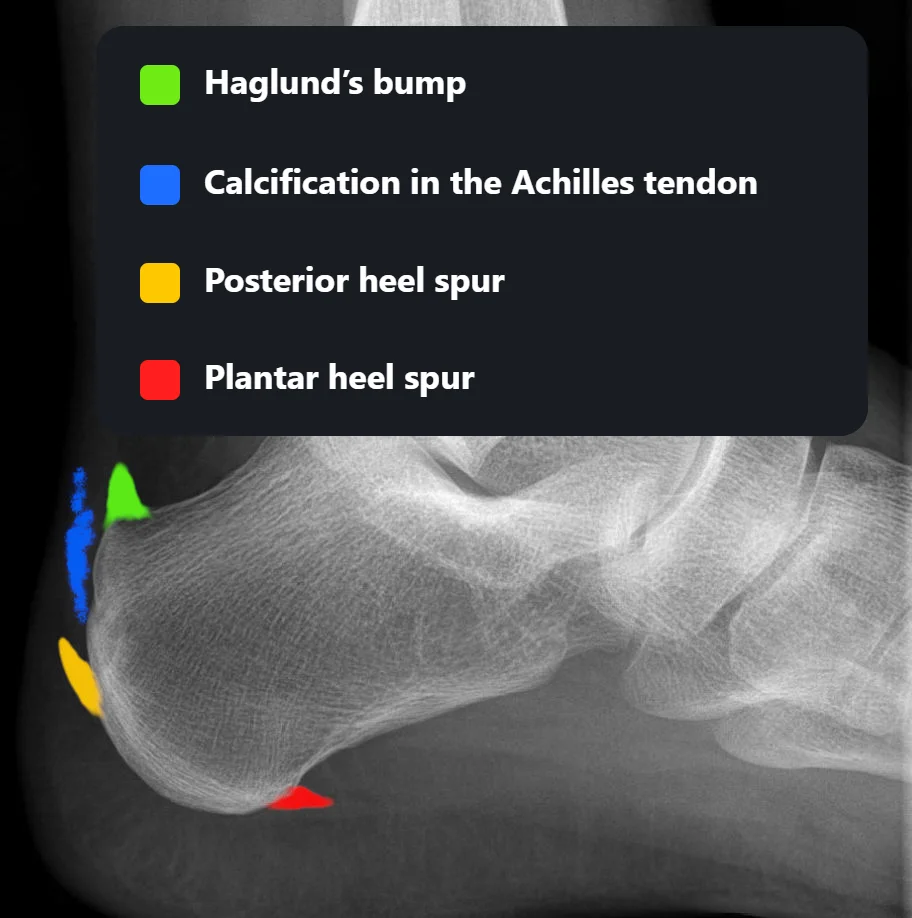
| What usually hurts | The plantar fascia at its attachment, not the spur | The Achilles insertion, the bursa and a bony prominence, all pressed together |
| How often surgery is needed | Rarely; a small minority after 6 to 12 months of proper treatment | More often, when shoes, heel lifts and loading have failed |
| What the operation targets | The fascia or the calf; the spur is sometimes removed along the way | The degenerate tendon, the bursa and the spur or Haglund’s bump |
| Scale of recovery | Weeks of protection, 3 to 6 months to full activity | Weeks off weight-bearing, often 7 months to a year to full activity |
Surgery for a spur under the heel
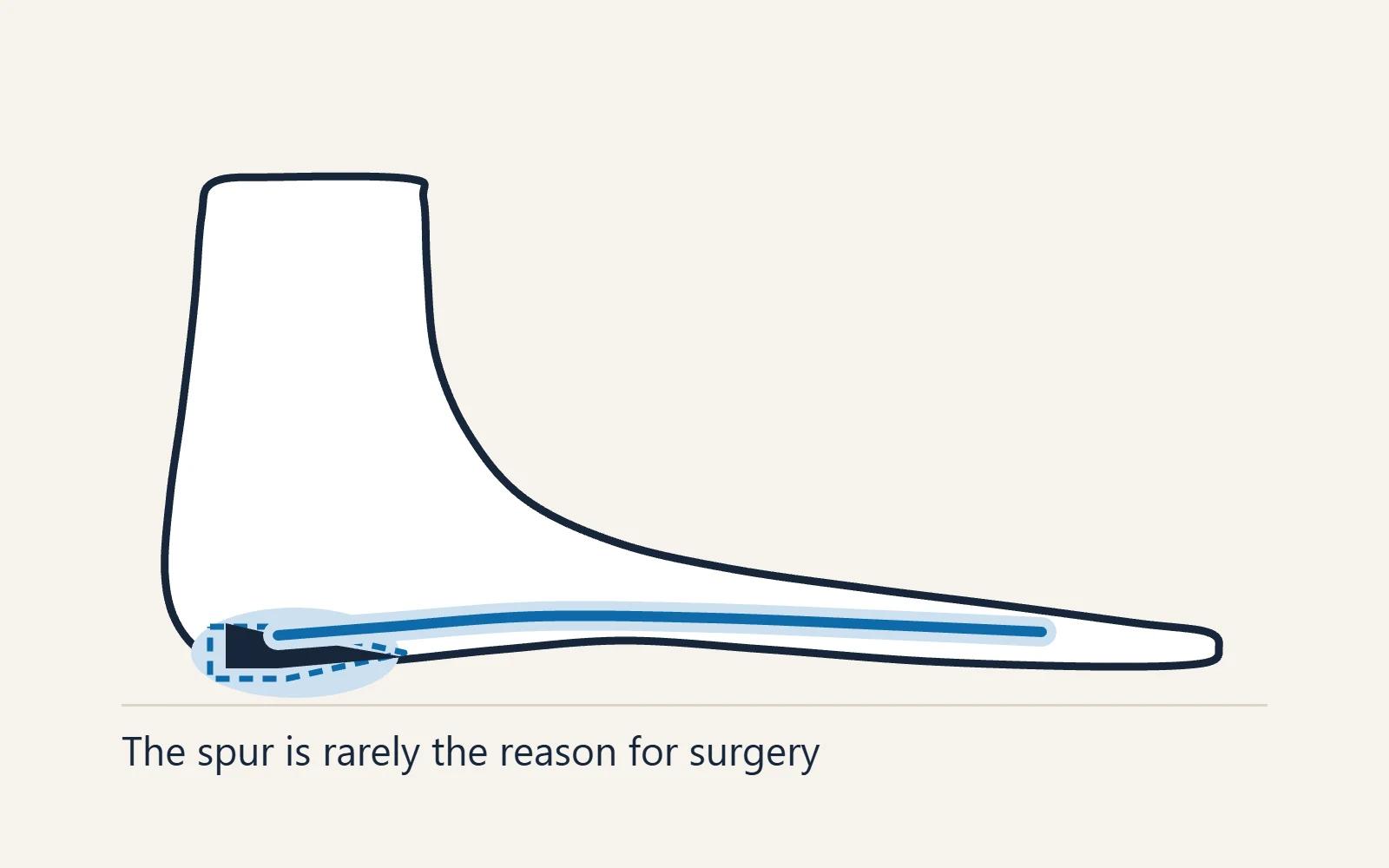
This is the operation most people picture, and the one least often needed. A spur under the heel is present in more than 15% of people with no heel pain at all, and pain settles in most people while the spur stays exactly where it is. So when surgery is done for pain under the heel, it treats the soft tissue that hurts:
- Partial plantar fascia release, open or through small incisions with a camera. Part of the fascia is divided near the heel to reduce tension. A spur may be taken off at the same time if it is in the way, but removing it is not what relieves the pain.
- Gastrocnemius recession, which lengthens a tight calf muscle instead of cutting the fascia, treating the tension at its source.
- Less invasive debridement of degenerate tissue at the attachment, in selected cases.
The threshold is the same as for plantar fasciitis surgery: six to twelve months of properly done non-surgical treatment, a confirmed diagnosis, and pain that is still limiting your life. About 5% of people with plantar fasciitis end up having surgery, and results are good but not guaranteed. An operation that promises to “shave the spur off” as the fix deserves a second opinion.
Surgery for a spur at the back of the heel
A spur at the back of the heel grows into the Achilles attachment, often alongside a Haglund’s bump and an inflamed bursa. Here the bone can be part of the problem, and surgery is a more realistic end point when floor-level Achilles loading, heel lifts and shoe changes have not worked after six to twelve months.
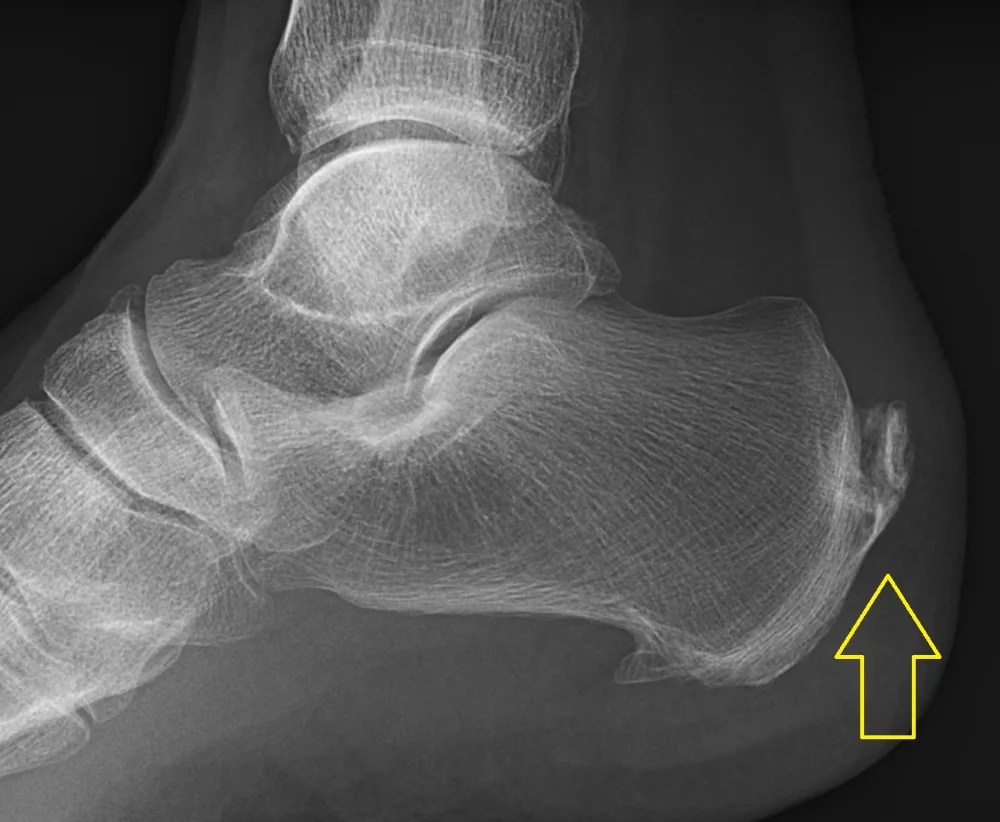
The usual operation removes the degenerate part of the tendon, the inflamed bursa, the spur and the prominent corner of the heel bone. Getting to the spur often means detaching part of the Achilles and reattaching it to the bone with anchors, which is why recovery is long. Published results for this combined procedure are very good: a success rate of more than 95% has been reported, with return to activity at around seven months on average. Some surgeons use a smaller procedure that removes a wedge of heel bone to change the tendon’s angle instead of removing the bump.
Heel spur surgery recovery time
Your own surgeon’s protocol wins, and it varies with the procedure. As a typical outline:
| Stage | Spur under the heel | Spur at the back of the heel |
|---|---|---|
| First 2 weeks | Protected walking in a boot or surgical shoe, foot up as much as possible | Usually no weight on the foot, in a cast or splint with the toes pointed down |
| Weeks 2–6 | Stitches out, building up walking in the boot, gentle stretching | Stitches out, gradual weight-bearing in a boot with heel lifts |
| Weeks 6–12 | Back in supportive shoes, physical therapy, longer walks | Out of the boot into shoes with a heel lift, physical therapy to rebuild the calf |
| Months 3–6 | Return to long days on your feet, then running and sport | Walking normally; strength and endurance still building |
| Months 6–12 | Occasional swelling and ache as the last of it settles | Return to running and sport, often around seven months and sometimes up to a year |
Swelling that comes and goes for months is normal after both. Time off work depends on the job: desk work is often possible within a couple of weeks, while jobs on your feet may need several weeks after a plantar release and several months after surgery at the back of the heel.
Risks worth understanding
- Incomplete relief. A real minority are not fully better afterwards, especially if the diagnosis was wrong to begin with.
- Nerve irritation or injury. Small nerves run through both surgical areas.
- Arch flattening and outer-foot pain after releasing too much of the plantar fascia, which is why modern releases are partial.
- Achilles weakness or rupture after surgery at the back of the heel, particularly if the rehabilitation is rushed.
- Wound problems and infection, more likely with smoking, diabetes and poor circulation.
- Blood clots, a risk of any lower-leg surgery with a period of immobilisation.
Questions to ask first
- What exactly is causing my pain? Have a nerve problem, a stress fracture and inflammatory arthritis been ruled out?
- What will you actually do? Release the fascia, lengthen the calf, remove the spur, detach the Achilles?
- Why not keep going with non-surgical treatment? Have I had a fair trial of loading exercise, heel lifts, shoes and shockwave?
- What will the first six weeks look like, and when can I realistically go back to work and to what I want to do?
- What happens if I am in the group that does not improve?
If you have not yet had six months of the treatment on the heel spur treatment page, you are probably not a surgical candidate yet, which is good news.
Common questions
Is heel spur surgery worth it?
For the right person, yes. For a spur at the back of the heel that has resisted months of good treatment, surgery has high reported success rates, although the recovery is long. For a spur under the heel, surgery is rarely needed, and when it is, the operation is on the fascia or the calf rather than the spur.
How long is recovery from heel spur surgery?
For surgery under the heel, expect a few weeks of protected walking and three to six months to full activity. For surgery at the back of the heel that involves the Achilles, expect several weeks off weight-bearing or in a boot, and around seven months to a year before running and sport.
Can a heel spur be removed without surgery?
No. A spur is bone, and no stretch, injection, shockwave or supplement removes it. The good news is that you rarely need it gone: the pain comes from the surrounding tissue, which does respond to non-surgical treatment.
Can heel spurs grow back after surgery?
Some bone can re-form, particularly at the back of the heel. Reported outcomes suggest that recurrent calcification there is common but does not usually make the result worse.
Is heel spur surgery painful?
The first days are the most uncomfortable and are managed with elevation, a nerve block or anaesthetic at the time, and pain relief afterwards. Most people find the harder part is the length of the recovery rather than the pain of the operation.
Will I need a boot after heel spur surgery?
Usually, yes. A boot or surgical shoe for a few weeks after surgery under the heel, and a cast or splint followed by a boot, often with heel lifts, after surgery at the back of the heel.
Related heel pain guides
- Heel spur treatment — what to do first, and for how long, before surgery is on the table.
- Plantar fasciitis surgery — the operations under the heel in more depth.
- Heel spurs — why the spur on the X-ray is usually not the pain.
- Haglund’s deformity — the bump at the back of the heel.
- Achilles tendonitis — insertional pain, which the back-of-heel operation treats.
- Buchanan BK, Sina RE, Kushner D. Plantar Fasciitis. StatPearls, NCBI Bookshelf.
- Medina Pabón MA, Bergman R, Naqvi U. Achilles Tendinopathy. StatPearls, NCBI Bookshelf.
- Allam AE, Chang KV. Plantar Heel Pain. StatPearls, NCBI Bookshelf.
- Johal KS, Milner SA. Plantar fasciitis and the calcaneal spur: fact or fiction? Foot and Ankle Surgery, 2012.
- Kirkpatrick J, Yassaie O, Mirjalili SA. The plantar calcaneal spur: a review of anatomy, histology, etiology and key associations. Journal of Anatomy, 2017.
- American Academy of Orthopaedic Surgeons, OrthoInfo. Plantar Fasciitis and Bone Spurs.
Considering heel spur surgery in Michigan?
Dr. Biernacki is a board-certified foot and ankle surgeon. If surgery has been suggested, a second look at the diagnosis and at what has been tried is worth one appointment, in Howell or Bloomfield Township.
This page is general education, not medical advice, and it cannot tell you whether you need surgery. That decision belongs to you and a surgeon who has examined your foot. Read our editorial policy for how it was written and what it will not claim.