Heel pain treatment
Shockwave Therapy for Plantar Fasciitis: Who It Helps and What to Expect
Shockwave is one of the best-studied options for heel pain that has outlasted three months of proper treatment. It is not a first step and it is not magic, but the evidence behind it is better than its reputation.
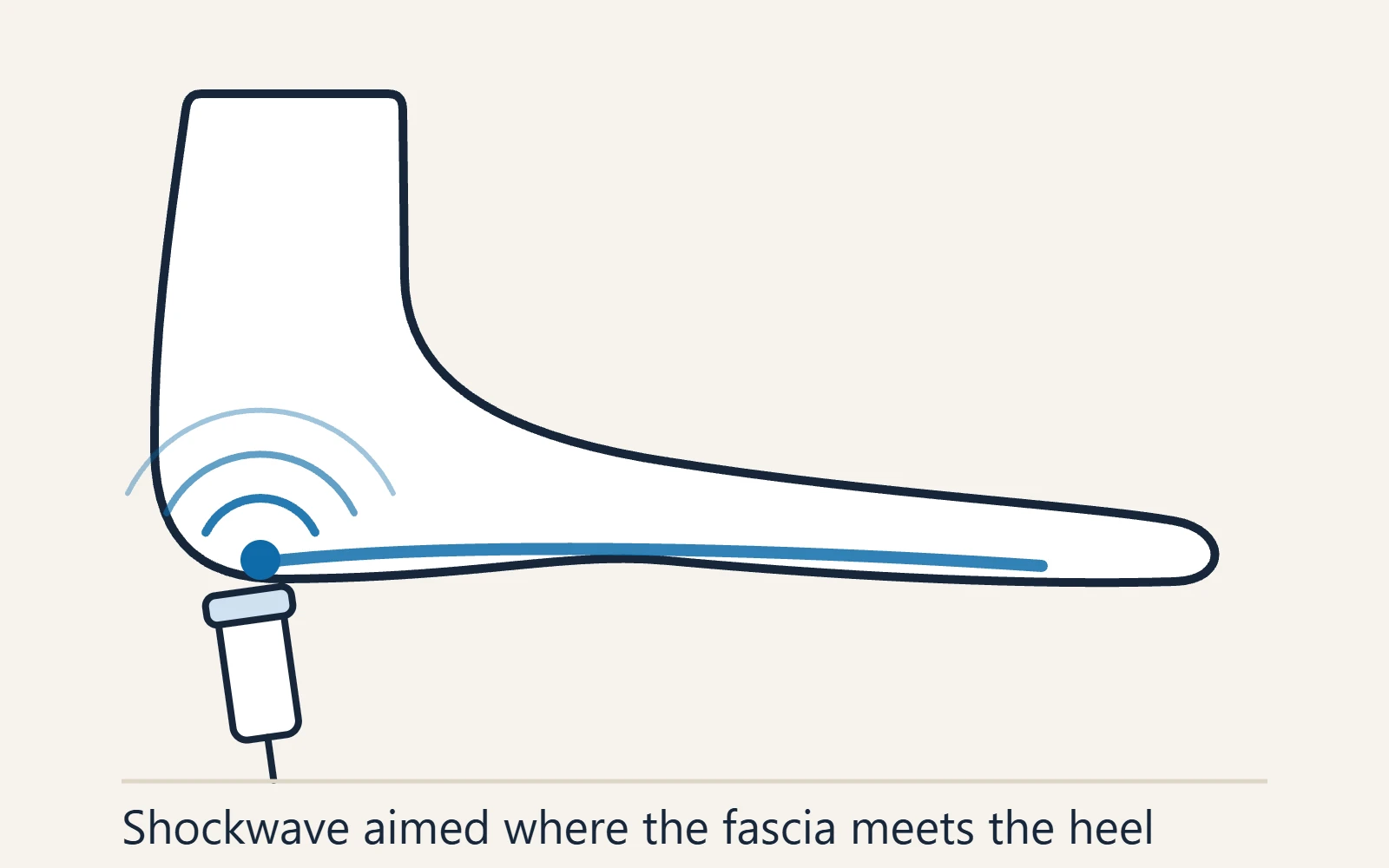
Shockwave therapy (extracorporeal shockwave therapy, or ESWT) sends short pulses of acoustic energy into the sore attachment of the plantar fascia under the heel. It is meant for plantar fasciitis that has not settled after about three months of stretching, loading and the right shoes. A course is usually three short sessions a week apart, with no needle, and most people walk out and carry on with their day.
In two large, recent placebo-controlled trials, heel pain fell by about 70% with shockwave against 35 to 45% with a sham treatment, and between half and nearly two-thirds of patients counted as a success. That makes it a genuine option for a heel that has stalled. It is not a shortcut for heel pain that started last month: at that stage, a simple stretching programme does better.
On this page
What shockwave therapy is
A shockwave is a very short, sharp pressure pulse, delivered through a gel-coupled applicator held against the skin. The leading explanation for why it helps is that the mechanical stimulus restarts a healing response in tissue that has stalled. Long-standing plantar fasciitis is mostly degenerative rather than inflamed, which is why a treatment that provokes repair can work where anti-inflammatories only blunt the symptoms.
Two kinds of machine are in use, and the difference matters when you compare clinics:
Focused shockwave
The energy converges on a point a few centimetres deep, at the fascia’s attachment to the heel bone. This is the type tested in the US Food and Drug Administration trial below, and the type with the most consistent evidence.
Radial pressure waves
A projectile strikes the applicator and the energy spreads outwards from the skin, strongest where it enters. Some clinics call this EPAT. The machines are cheaper and widely used; the trials are positive but less consistent than for focused treatment.
Strictly, radial pulses are pressure waves rather than true shockwaves, which is why the two are not interchangeable in the research. A clinic should be able to tell you which one it uses.
Who it is for, and who should wait
Shockwave is a second-line treatment. It is for heel pain that has lasted three months or more despite doing the first-line work properly: plantar-fascia stretching, progressive loading, supportive shoes and inserts, and fewer hours barefoot on hard floors. That is the group the main placebo-controlled trials recruited, people whose heel pain had persisted despite conservative care, and the group that does well. If the basics have not really been tried, start with the treatment ladder.
Earlier than that, it loses to a stretch. In a trial of 102 people whose heel pain was six weeks old or less and untreated, an eight-week plantar-fascia stretching programme beat three sessions of radial shockwave: 65% of the stretching group were satisfied at two months, against 29% of the shockwave group, and the gap held at four months. By fifteen months there was no significant difference between the groups. New heel pain needs the basics first; shockwave is for heel pain that has outlasted them.
The diagnosis has to be right. Shockwave aimed at the fascia is not a treatment for a trapped nerve, a stress fracture or a thinned heel pad. If nothing at all has helped, that is a reason to have the heel re-examined before paying for any device.
Achilles pain is a different story. For pain where the Achilles attaches to the back of the heel, a 2026 review of the sham-controlled trials found no clinically meaningful benefit from shockwave. The evidence on this page is for plantar fasciitis; for the back of the heel, see insertional Achilles tendonitis.
What the evidence shows
For a device treatment, plantar fasciitis has unusually good evidence: large, multicentre, placebo-controlled trials, including one run for the US Food and Drug Administration, and several pooled analyses. The two most recent large trials and two of the pooled analyses are summarised below.
| Study | Who and what | Result |
|---|---|---|
| Gollwitzer 2015, 250 patients | Chronic plantar fasciitis. Focused shockwave or a sham, three weekly sessions, no anaesthetic. An FDA trial. | Heel pain fell 69% with shockwave and 35% with the sham at 12 weeks. Success rates of 50 to 65%. |
| Gerdesmeyer 2008, 245 patients | Chronic plantar fasciitis that had resisted treatment. Radial shockwave or a sham, three sessions. | Pain fell 72% against 45%. 61% against 42% counted as a success at 12 weeks, and the gap was wider at 12 months. |
| Aqil 2013, 7 trials, 663 patients | Pooled trials in heel pain that had resisted at least three months of treatment. | Shockwave beat placebo on pain. The benefit was clear by 12 weeks, and the evidence suggested it lasted up to 12 months. |
| Sun 2017, 9 trials, 935 patients | Focused and radial shockwave analysed separately. | Shockwave more than doubled the odds of improvement, but the trials varied a lot. The authors concluded focused shockwave relieves pain, drew no firm conclusions for radial shockwave or for shockwave overall, and called for more trials. |
Read those numbers honestly. The sham groups improved too, by a third to nearly a half, partly because chronic heel pain fluctuates and slowly improves on its own and partly through the placebo effect. Shockwave tilts the odds in your favour rather than guaranteeing a result, and not every trial has been positive: a 2003 German trial of 272 people found no benefit, while a 2004 US trial of 293 found complete success in 47% against 30% with a sham. Device trials are expensive and few, so the best dose, the number of sessions and radial versus focused are still argued over. But the core finding, that shockwave beats a sham for chronic heel pain, has held up in the large recent trials and in several meta-analyses.
Two recent findings show where it fits. A 2023 review of 236 trials, covering every plantar fasciitis treatment that has been tested in a randomised trial, found many options that ease pain in the short term, but shockwave was the only one that beat control in the medium and long term. And a 2026 trial of 84 people found that adding three weekly sessions of radial shockwave to a structured home exercise programme did not improve the 12-week result over the exercises alone; pain and function improved in every group, exercises alone included. Shockwave is for heel pain that has outlasted a properly done exercise programme, not a replacement for one.
Shockwave, a cortisone shot, PRP or laser?
These are the options people weigh once the basics have run out, and each wins on something.
- Against a cortisone shot, a pooled analysis of six trials found both worked at three months. Shockwave came out slightly ahead on pain, by just under one point on a ten-point scale, though the trials disagreed widely, and there was no difference in function. A 2025 analysis found shockwave ahead of the steroid on a foot-function score. Those trials mostly stopped at three months; beyond that, a steroid’s benefit tends to fade by around six months, and injections carry risks to the heel’s fat pad and the fascia itself that shockwave does not. Cortisone shots explains what an injection buys you.
- Against platelet-rich plasma (PRP), a 2025 pooled analysis of 15 trials comparing shockwave with other treatments found PRP injections beat it for pain and function, and custom orthotics beat it for function. PRP is an injection made from your own blood, and the authors noted it is the more technically demanding procedure. See PRP for plantar fasciitis.
- Against laser, head-to-head analyses find the two close on pain, with a small edge to shockwave on foot function against high-intensity laser. Laser is painless; shockwave has more evidence for lasting benefit. See laser therapy for plantar fasciitis.
- Where shockwave earns its place is that it is needle-free, has very few downsides, and leaves the heel intact for anything else that might be needed later.
What a session is like
- No numbing. The heel is not injected with local anaesthetic first. In a trial of 86 people having low-energy shockwave, adding anaesthetic cut the share who reached a 50% reduction in pain from 67% to 29%, and the large trials since have been run without it.
- Finding the spot. Gel goes on the heel and the applicator is placed over the most tender point, usually the inner front of the heel where the fascia attaches.
- The treatment itself. A few thousand pulses (the two large trials in the table used 2,000 a session), felt as a rapid, firm tapping. It is uncomfortable over the sore spot, and the intensity can be adjusted. In Dr. Tom’s clinic a session takes about five minutes within an ordinary appointment.
- Afterwards. Soreness, mild swelling or small bruises for a day or two are the usual price. Keep up the stretching and loading programme: shockwave is meant to work alongside it, not replace it.
- Repeat. Usually three sessions about a week apart, the schedule used in the FDA trial.
How quickly it works
Not overnight. Some people feel easier straight after a session, but that early relief is not the measure. The large trials judged results twelve weeks after the last session, and in those that followed patients for a year, the benefit held, and in one widened, at twelve months.
Track your first-step pain in the morning, the most reliable sign of how the fascia is doing. If it is no better three months after the last session, shockwave has had a fair trial. How long plantar fasciitis lasts sets out the realistic timeline.
Who should not have it
Shockwave is low-risk. Pain during treatment and minor bruising are the side effects usually reported. Serious complications are rare: a 2018 review noted isolated reports of bone injury and Achilles tendon rupture in older adults treated with focused shockwave.
- Tell the clinic first if you are pregnant, take a blood thinner or have a bleeding disorder, or have an infection or broken skin over the heel. A 2020 orthopaedic review lists a severe bleeding disorder (for high-energy treatment), a pregnancy in the treatment area and a severe infection at the target as reasons not to treat.
- Children’s heel pain between about 8 and 14 is usually Sever’s disease, a growth-plate problem with its own treatment.
- Diabetes with reduced feeling in the feet is a reason to have the heel examined before any treatment, because the cause and the risks are different.
Cost and insurance
Shockwave is often not covered by insurance. Ask for the total self-pay price for the whole course, usually three sessions, before you start, and whether a follow-up visit is included. Dr. Tom covers treatment time and cost in the video above.
A clinic that recommends shockwave for heel pain that began a few weeks ago, or without examining you, is selling the machine rather than treating the heel.
If it does not work
Give it the full three months after the last session. If the heel is no better:
- Re-check the diagnosis. Nerve entrapment, a stress fracture and a thinned fat pad all imitate plantar fasciitis, and none of them responds to treatment aimed at the fascia.
- Check the loading work was done at the right dose. The high-load heel raise programme, every other day for three months, is the part most people never quite finish.
- Consider the other second-line options. An injection or PRP, described on the treatment ladder, then a needle-sized procedure such as Tenex, and for a small minority, surgery.
Before you book a course. Dr. Tom’s free 14-day plan from The Heel Pain Playbook gets the first-line steps started properly, in the order he uses in clinic, with a tracker for your first-step pain to bring to the appointment. Get the free 14-day plan.
Common questions
Does shockwave therapy work for plantar fasciitis?
For heel pain that has lasted three months or more despite proper treatment, it helps more often than not. In two large, recent placebo-controlled trials, pain fell by about 70% against 35 to 45% with a sham, and between half and nearly two-thirds of patients counted as a success. In heel pain only a few weeks old, a simple stretching programme beat it at two and four months.
How many shockwave sessions do you need for plantar fasciitis?
Usually three, about a week apart, which is what the FDA trial used. If the heel has not improved three months after a standard course, have the diagnosis checked before buying more sessions.
Does shockwave therapy hurt?
It is uncomfortable, and it can be painful over the sore spot: a rapid, firm tapping. It is done without numbing, because anaesthetic made low-energy shockwave less effective in a trial, and the intensity can be turned down. The heel can be sore for a day or two afterwards.
How long does shockwave therapy take to work?
Results are judged about twelve weeks after the last session, and in trials that followed patients for a year, the benefit was still there at twelve months. Some people feel easier straight after a session, but that early relief is not the measure.
Can shockwave therapy break up a heel spur?
It is used to treat the pain, not to remove the spur. Spurs are common in heels that never hurt, and the pain comes from the fascia, so whether the spur changes is beside the point. See heel spurs and heel spur treatment.
Is radial shockwave (EPAT) as good as focused shockwave?
Both have positive placebo-controlled trials. When the trials were pooled, the benefit of focused shockwave was the more consistent, and radial results varied more from trial to trial. A clinic using either should be able to tell you which it is and why.
Is shockwave therapy covered by insurance?
Often not. Ask for the self-pay price for the whole course, usually three sessions, before you start.
Can I keep walking and exercising during shockwave treatment?
Walking, yes, and keep doing the stretching and strengthening: shockwave is meant to work alongside them. It is sensible to go easy on running and jumping for a couple of days after each session.
Related heel pain guides
- The plantar fasciitis treatment ladder
- Cortisone shots: what they buy you
- Laser therapy for plantar fasciitis
- PRP injections for plantar fasciitis
- Botox for plantar fasciitis: what the trials show
- Plantar fasciitis exercises (printable)
- How long plantar fasciitis lasts
- Plantar fasciitis surgery: who needs it
- Plantar fasciitis explained
- Heel spur treatment, step by step
- Night splints: who they help
- Insertional Achilles tendonitis
- Heel pain quiz
Considering shockwave in Michigan?
Dr. Tom Biernacki uses shockwave at Balance Foot & Ankle for heel pain that has outlasted the basics, after an examination to make sure it is the right heel problem to treat.
Howell — 4330 E Grand River Ave, Howell, MI 48843
Bloomfield Township — 43494 Woodward Ave #208, Bloomfield Township, MI 48302
Monday to Thursday, 9:00am–4:30pm; Friday, 9:00am–2:30pm · (810) 206-1402
Further reading
- Gollwitzer H, Saxena A, DiDomenico LA, et al. Clinically relevant effectiveness of focused extracorporeal shock wave therapy in the treatment of chronic plantar fasciitis: a randomized, controlled multicenter study. Journal of Bone and Joint Surgery, American Volume. 2015;97(9):701–708. doi:10.2106/JBJS.M.01331
- Gerdesmeyer L, Frey C, Vester J, et al. Radial extracorporeal shock wave therapy is safe and effective in the treatment of chronic recalcitrant plantar fasciitis: results of a confirmatory randomized placebo-controlled multicenter study. American Journal of Sports Medicine. 2008;36(11):2100–2109. doi:10.1177/0363546508324176
- Rompe JD, Cacchio A, Weil L Jr, et al. Plantar fascia-specific stretching versus radial shock-wave therapy as initial treatment of plantar fasciopathy. Journal of Bone and Joint Surgery, American Volume. 2010;92(15):2514–2522. doi:10.2106/JBJS.I.01651
- Rompe JD, Meurer A, Nafe B, Hofmann A, Gerdesmeyer L. Repetitive low-energy shock wave application without local anesthesia is more efficient than repetitive low-energy shock wave application with local anesthesia in the treatment of chronic plantar fasciitis. Journal of Orthopaedic Research. 2005;23(4):931–941. doi:10.1016/j.orthres.2004.09.003
- Aqil A, Siddiqui MR, Solan M, Redfern DJ, Gulati V, Cobb JP. Extracorporeal shock wave therapy is effective in treating chronic plantar fasciitis: a meta-analysis of RCTs. Clinical Orthopaedics and Related Research. 2013;471(11):3645–3652. doi:10.1007/s11999-013-3132-2
- Sun J, Gao F, Wang Y, Sun W, Jiang B, Li Z. Extracorporeal shock wave therapy is effective in treating chronic plantar fasciitis: a meta-analysis of RCTs. Medicine (Baltimore). 2017;96(15):e6621. doi:10.1097/MD.0000000000006621
- Xiong Y, Wu Q, Mi B, et al. Comparison of efficacy of shock-wave therapy versus corticosteroids in plantar fasciitis: a meta-analysis of randomized controlled trials. Archives of Orthopaedic and Trauma Surgery. 2019;139(4):529–536. doi:10.1007/s00402-018-3071-1
- Tung WS, Daher M, Covarrubias O, Herber A, Gianakos AL. Extracorporeal shock wave therapy shows comparative results with other modalities for the management of plantar fasciitis: a systematic review and meta-analysis. Foot and Ankle Surgery. 2025;31(4):283–290. doi:10.1016/j.fas.2024.11.005
- Alotaibi MN, Alharran AM, Alasmari OY, et al. Comparison of laser therapy and extracorporeal shock wave therapy in the treatment of patients with plantar fasciitis: a systematic review and meta-analysis of prospective studies. Lasers in Medical Science. 2026;41(1):29. doi:10.1007/s10103-026-04824-5
- Wu PC, Liu DH, Cheng YS, Lin CS, Yang FA. High-intensity laser therapy versus extracorporeal shockwave therapy for plantar fasciitis: a systematic review and meta-analysis. Bioengineering (Basel). 2026;13(1):90. doi:10.3390/bioengineering13010090
- Haake M, Buch M, Schoellner C, et al. Extracorporeal shock wave therapy for plantar fasciitis: randomised controlled multicentre trial. BMJ. 2003;327(7406):75. doi:10.1136/bmj.327.7406.75
- Ogden JA, Alvarez RG, Levitt RL, Johnson JE, Marlow ME. Electrohydraulic high-energy shock-wave treatment for chronic plantar fasciitis. Journal of Bone and Joint Surgery, American Volume. 2004;86(10):2216–2228. doi:10.2106/00004623-200410000-00013
- Guimarães JS, Arcanjo FL, Leporace G, et al. Effects of therapeutic interventions on pain due to plantar fasciitis: a systematic review and meta-analysis. Clinical Rehabilitation. 2023;37(6):727–746. doi:10.1177/02692155221143865
- Kosehasanogullari M, Büyükvural Şen S, Okur Yılmaz N, Aygün Bilecik N, Koçyiğit BF. Home exercise with or without high-intensity laser or radial shockwave therapy for plantar fasciitis: a randomized controlled trial. Foot & Ankle International. 2026;47(3):386–397. doi:10.1177/10711007251408439
- Korakakis V, Kotsifaki R, Sotiralis Y, Malliaras P. Shockwave therapy for midportion and insertional Achilles tendinopathy: a nail in the coffin? A systematic review with meta-analysis. Journal of Orthopaedic & Sports Physical Therapy. 2026;56(5):282–299. doi:10.2519/jospt.2026.13985
- Auersperg V, Trieb K. Extracorporeal shock wave therapy: an update. EFORT Open Reviews. 2020;5(10):584–592. doi:10.1302/2058-5241.5.190067
- Reilly JM, Bluman E, Tenforde AS. Effect of shockwave treatment for management of upper and lower extremity musculoskeletal conditions: a narrative review. PM&R. 2018;10(12):1385–1403. doi:10.1016/j.pmrj.2018.05.007
This page is education, not a diagnosis. Read our editorial policy for how it was written and what it will not claim.