Plantar fasciitis
Plantar Fasciitis So Bad You Can’t Walk? What to Do Today
A bad flare can turn every step into a limp. Today’s job is to protect the heel, and to check that it really is plantar fasciitis rather than something that only looks like it.
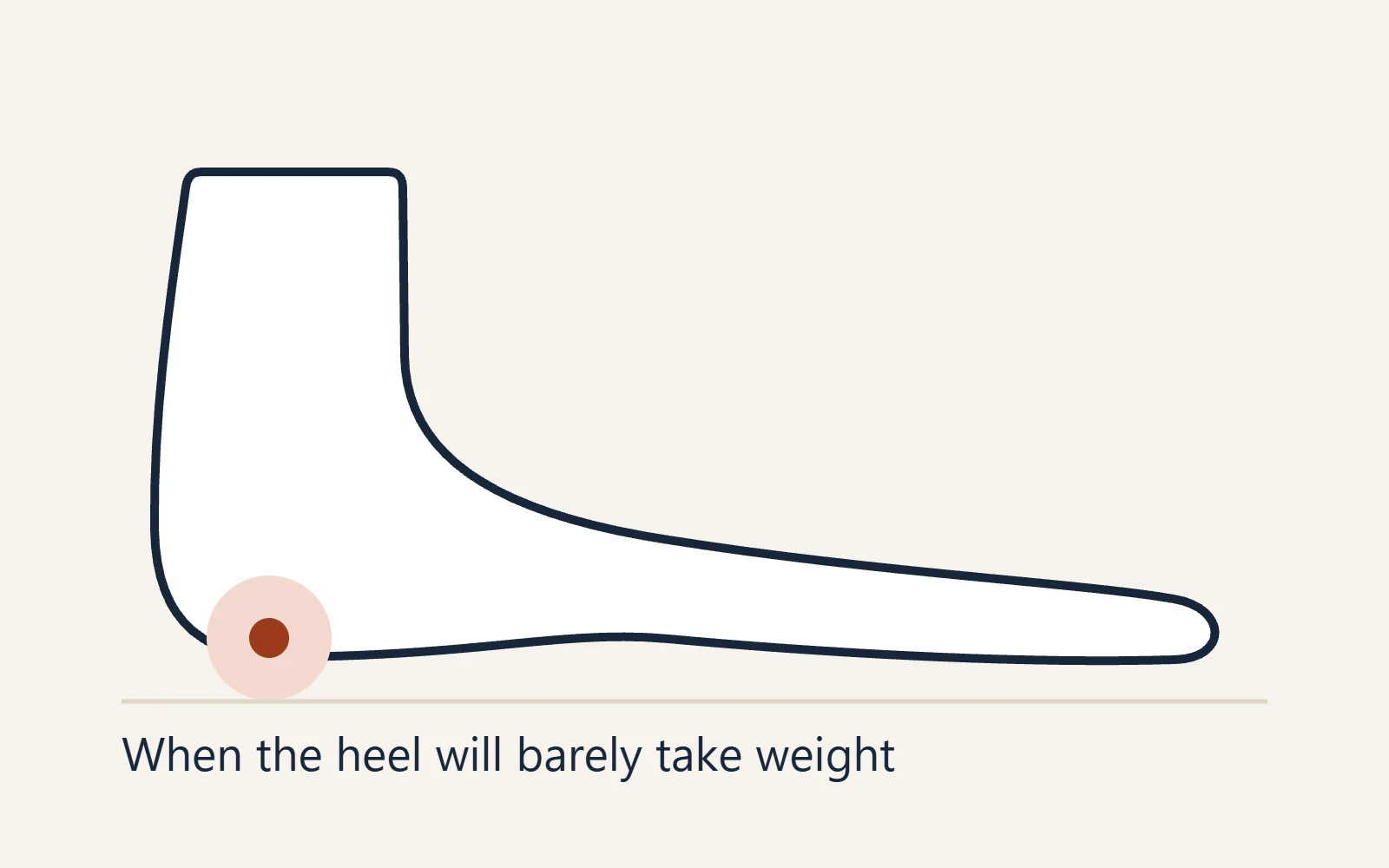
If plantar fasciitis is so bad you can’t walk, protect the heel today: supportive shoes from your first step, much less time on your feet, ice and over-the-counter pain relief if they suit you, and crutches or a walking boot for a short spell if every step is a limp. If the foot will not take any weight at all, you felt a pop, or the heel is hot and swollen, have it examined instead, the same day for most of those, because a fracture, a tear or an infection can look like a flare at first.
Usually “can’t walk” means agonising first steps and a limp after them, while the foot still takes your weight. That is a typical severe plantar fasciitis flare, and the plan below is safe to start.
On this page
What to do in the first 24 to 72 hours
Be seen today instead if the foot will not take any weight, especially after a fall or a hard landing; you felt a pop at the back of the ankle, even if you can still walk; or the heel is hot, red and swollen, you have a fever, or there is a wound on it.
Otherwise, if it behaves like plantar fasciitis, worst on the first steps after rest and sore at the inner front of the heel, start these now:
- Shoes on before your first step. Keep a cushioned, supportive pair by the bed and put them on before you stand. Bare feet on tile or hardwood give the heel no cushioning and the arch no support.
- Cut the load, not all movement. Relative rest means far less of whatever provokes it, such as standing, long walks, running and jumping, not a week in bed. Sit for jobs you would normally stand for.
- Take the weight off if every step is a limp. Use crutches for a day or two if you can manage them safely, or a walking boot. A boot is also how a stress fracture or a torn fascia is protected, so be examined before relying on one; see walking boots for plantar fasciitis.
- Ice for comfort. A wrapped ice pack, or the arch rolled gently over a frozen water bottle, for short spells. Never put ice directly on skin, and skip it if your feet are numb or your circulation is poor.
- Over-the-counter pain relief, if it suits you, taken as directed on the label. Anti-inflammatories such as ibuprofen are not safe for everyone: ask a pharmacist or doctor first if you have kidney or liver disease, heart failure or other heart disease, past stomach ulcers or bleeding, take a blood thinner, or are pregnant. Still needing painkillers after ten days is a reason to be examined.
- Tape the arch for a hard day. Rigid or elastic taping gives short-term relief, which the physical therapy guideline supports. Not on a foot with diabetes, neuropathy, poor circulation or fragile skin without advice; see how to tape your foot.
- Stretch gently, only if it does not spike the pain. Before standing, pull your toes and ankle back until you feel the arch stretch, then add a gentle calf stretch. Stretching is among the best-supported treatments, but a stretch that turns sharp is too much, and a heel that might be torn should not be stretched until examined.
Why plantar fasciitis flares up
Plantar fasciitis often follows a recent increase in weight-bearing activity. The usual triggers:
- A jump in load: a holiday of long walking days, a new job on your feet, a return to running.
- Long hours standing, especially on hard floors with little shock absorption.
- Footwear that takes cushioning or support away: a new pair with less of either, shoes that have worn out, or going barefoot at home.
- Weight gain. Higher body mass is one of the clearer risk factors in people who are not athletes.
- A tight calf, which shifts more load onto the fascia.
- A cortisone injection. A rise in pain just after the injection is a recognised side effect; later, a heel that felt normal may have been asked to do too much; and rarely, a sudden change is a tear.
Finding the trigger is part of the treatment: the physical therapy guideline favours advice on adjusting work, exercise and daily loads, and on footwear.

Once the worst has passed, follow a plan rather than guessing. The free 14-day plan from Dr. Tom’s Heel Pain Playbook starts with what to do before you stand up, then builds from there, with a tracker for your first-step pain. Get the free 14-day plan.
When severe heel pain is not ordinary plantar fasciitis
Plantar fasciitis is the commonest cause of heel pain in adults, so a flare is the likeliest explanation. These are the lookalikes:
| Possible cause | What points to it | What to do |
|---|---|---|
| Plantar fasciitis flare | Worst on the first steps after rest, easing somewhat as you go; sore at the inner front of the heel | The plan above; see plantar fasciitis |
| Plantar fascia tear (rupture) | A pop or tearing feeling under the heel or arch, often while pushing off; bruising on the inner sole; most reported cases follow cortisone injections | Protect it, no stretching or massage; be examined within a day or two (more below) |
| Calcaneal stress fracture | Comes on gradually after more activity or harder surfaces, and builds the longer you are on your feet; squeezing the sides of the heel hurts | Stop what provokes it; be examined this week, as early X-rays are often normal. See heel stress fracture |
| Nerve entrapment | Burning, tingling, shooting pain or numbness, often worse the longer you stand | Be examined this week; see heel nerve pain and tarsal tunnel syndrome |
| Heel fat pad problems | A deep, bruise-like ache in the middle of the heel, worse barefoot, on hard floors or the longer you stand | Cushioning and a heel cup; see heel fat pad atrophy and bruised heel |
| Achilles tendon rupture | A pop at the back of the ankle, then pain and swelling near the heel; walking or rising onto tiptoe may be difficult or impossible | Same day; see Achilles tendon rupture |
| Infection | A hot, red, swollen heel, a wound or puncture, fever; more serious with diabetes | Same day |
| Inflammatory arthritis | Morning stiffness lasting an hour or more that eases with movement; the back or other joints involved; psoriasis, bowel or eye inflammation | A medical opinion this week; see inflammatory heel pain |
| Fracture after a fall | Unable to bear weight after a fall from height, a jump or a heavy landing | Same day, for imaging |
Plantar fascia tear or rupture: how to tell
A plantar fascia tear, or rupture, is uncommon, but it is the lookalike where flare advice has to wait: do not stretch or massage a heel that might be torn until it has been examined. The clues:
- A pop or tearing sensation under the heel or arch with sudden pain, often while pushing off to sprint or jump.
- Bruising on the inner sole or arch over the following days, sometimes with swelling.
- A previous cortisone injection. In a systematic review of 155 people with ruptures, 130 had had steroid injections beforehand.
- A change in the pain, not just more of it. After injection-related ruptures the old heel pain often eased, replaced by aching in the arch and along the outer side and top of the midfoot.
Not every tear pops: in one series of injection-related ruptures, one in three people noticed only a gradual change, so an injected heel that starts behaving differently deserves an examination.
Ultrasound or MRI can confirm it; plantar fascia tear sets out the full recovery plan. Almost all reported tears are treated without surgery, mostly with good results: protection, often in a boot, then a gradual return to load. Recovery can still be slow: in that injection series, half had good or excellent results at an average of 27 months and half fair or poor. Cortisone shots for plantar fasciitis sets out the trade-offs of injecting.
Can’t put weight on your heel? How soon to be seen
| How soon | If you notice |
|---|---|
| Today: your own clinician, urgent care or the emergency department | The foot will not take any weight, especially after a fall or a heavy landing; a pop at the back of the ankle, even if you can still walk; a hot, red, swollen heel, fever or feeling unwell; a wound or puncture on the heel, especially with diabetes; numbness or weakness that is getting worse; a swollen, warm, painful calf on one side |
| Within a day or two, protecting the heel meanwhile | A pop or tearing feeling under the heel or arch; new bruising on the sole; a sudden change in the pain after a cortisone injection |
| This week | Pain that builds the longer you are up; pain when you squeeze the sides of the heel; burning, tingling or numbness; long morning stiffness or other joints involved; any new heel pain with diabetes, poor circulation or reduced feeling; a limp that is not easing after a few days of the plan above |
A flare that settles into ordinary plantar fasciitis but then stops improving deserves a routine appointment; when to worry about heel pain has the full list.
What a podiatrist does for a severe flare
The examination does most of the work, because the diagnosis decides the rest.
Examination
Where it is tender, how the first steps feel, squeezing the heel bone, tapping over the nerves, checking the Achilles and fat pad. Usually this, not a scan, makes the diagnosis.
Imaging, when it changes the plan
An X-ray first if a bone problem is possible; ultrasound or MRI for a suspected tear, nerve problem, or a stress fracture the X-ray cannot yet show.
Protection
A walking boot for a short, planned spell if the heel will not settle in shoes, or longer if a fracture or tear is found, plus padding or taping.
An injection, in selected cases
When pain blocks everything else, cortisone can buy relief, though short-term at best. Plantar fascia rupture and fat pad thinning are recognised risks, so a possible tear is ruled out first.
Orthoses and exercise
Insoles alongside other treatment, not instead of it; off-the-shelf ones often do as well as custom. Then progressive stretching and strengthening.
Shockwave, then rarely surgery
Shockwave for pain that has resisted months of the basics: trials disagree, but meta-analyses favour it over control treatments. Surgery is for the few still limited after that.
Getting back to normal walking
Give the heel its ordinary day back in stages, using the next morning as your guide.
- Ordinary walking before extra walking. Manage a normal day without a limp, in supportive shoes, before adding errands and then longer walks.
- Add one thing at a time. If the next morning’s first steps are clearly worse, hold at that level for a few days.
- Come out of a boot gradually, not straight back into old shoes and old workloads; the walking boot guide sets out how.
- Start strengthening as the first steps ease, building over weeks. In one trial, high-load strength training improved outcomes more than a stretching programme at three months, though both groups got better; see the exercises.
- Keep the supports while you rebuild: supportive shoes indoors and out, an arch-supporting insole, tape for long days.
- Running and sport come last, once ordinary walking is comfortable.
Most people get there: about 80% of people with plantar fasciitis improve within a year with non-surgical treatment. How long plantar fasciitis lasts has the realistic timeline, and plantar fasciitis treatment the full plan.
Common questions
Why can’t I walk in the morning with plantar fasciitis?
First-step pain after sleep or sitting, easing as you keep moving, is the classic pattern of plantar fasciitis. Stretching before you stand, and shoes on before your feet touch the floor, both help. If mornings are consistently the worst part, the physical therapy guideline recommends a one- to three-month trial of a night splint, though trials disagree on how much it adds; see heel pain in the morning.
How long does a plantar fasciitis flare-up last?
It varies too much to put a number on. What matters is the trend over days once the load comes down: if it is worsening, or no better after a few days, have it examined. Plantar fasciitis as a whole is slower: about 80% of people improve within a year with non-surgical treatment.
Should I go to urgent care or the ER for plantar fasciitis?
Plantar fasciitis by itself is not an emergency. Go the same day if the foot will not take any weight, you felt a pop at the back of the ankle, the heel is hot, red and swollen, you have a fever, or there is a wound on the heel; then follow up with a foot and ankle specialist.
Did I tear my plantar fascia?
Suspect it after a pop or tearing feeling, bruising on the inner sole, or a sudden change in a heel that has had a cortisone injection. Protect it, skip stretching and massage, and have it examined within a day or two; ultrasound can confirm it.
Related heel pain guides
- Supportive slippers for the house
- Plantar fasciitis: why the first step hurts
- Plantar fasciitis treatment
- Walking boot for plantar fasciitis
- Cortisone shots for plantar fasciitis
- Heel stress fracture
- Sudden heel pain without injury
- When to worry about heel pain
- Plantar fasciitis: what one week of treatment can do
Heel too painful to walk on?
A heel you can barely walk on deserves a diagnosis, because a bad flare, a tear and a stress fracture are each protected differently. Dr. Tom Biernacki sees these at Balance Foot & Ankle.
Howell — 4330 E Grand River Ave, Howell, MI 48843
Bloomfield Township — 43494 Woodward Ave #208, Bloomfield Township, MI 48302
Monday to Thursday, 9:00am–4:30pm; Friday, 9:00am–2:30pm · (810) 206-1402
Further reading
- Koc TA Jr, Bise CG, Neville C, et al. Heel pain – plantar fasciitis: revision 2023. Journal of Orthopaedic & Sports Physical Therapy. 2023;53(12):CPG1–CPG39. doi:10.2519/jospt.2023.0303
- Trojian T, Tucker AK. Plantar fasciitis. American Family Physician. 2019;99(12):744–750. aafp.org
- Tu P. Heel pain: diagnosis and management. American Family Physician. 2018;97(2):86–93. aafp.org
- Acevedo JI, Beskin JL. Complications of plantar fascia rupture associated with corticosteroid injection. Foot & Ankle International. 1998;19(2):91–97. doi:10.1177/107110079801900207
- Mosca M, Fuiano M, Massimi S, et al. Ruptures of the plantar fascia: a systematic review of the literature. Foot & Ankle Specialist. 2022;15(3):272–282. doi:10.1177/1938640020974889
- Louwers MJ, Sabb B, Pangilinan PH. Ultrasound evaluation of a spontaneous plantar fascia rupture. American Journal of Physical Medicine & Rehabilitation. 2010;89(11):941–944. doi:10.1097/PHM.0b013e3181f711e2
- American Academy of Orthopaedic Surgeons, OrthoInfo. Achilles Tendon Rupture (Tear).
- Sen R, Goyal A, Hurley JA. Seronegative Spondyloarthropathy. StatPearls, NCBI Bookshelf; updated July 17, 2023.
- U.S. National Library of Medicine, MedlinePlus. Ibuprofen. Drug information; last revised September 15, 2023.
This page is education, not a diagnosis. See our editorial policy, and if your foot will not take any weight, have it examined rather than reading on.