Heel pain causes
Plantar Fascia Tear: Symptoms, Recovery Time and Treatment
A torn plantar fascia often announces itself with a pop and sharp pain under the heel or arch. Most tears heal without surgery, but the foot needs protecting first, and the stretches that help plantar fasciitis can hold a fresh tear back.
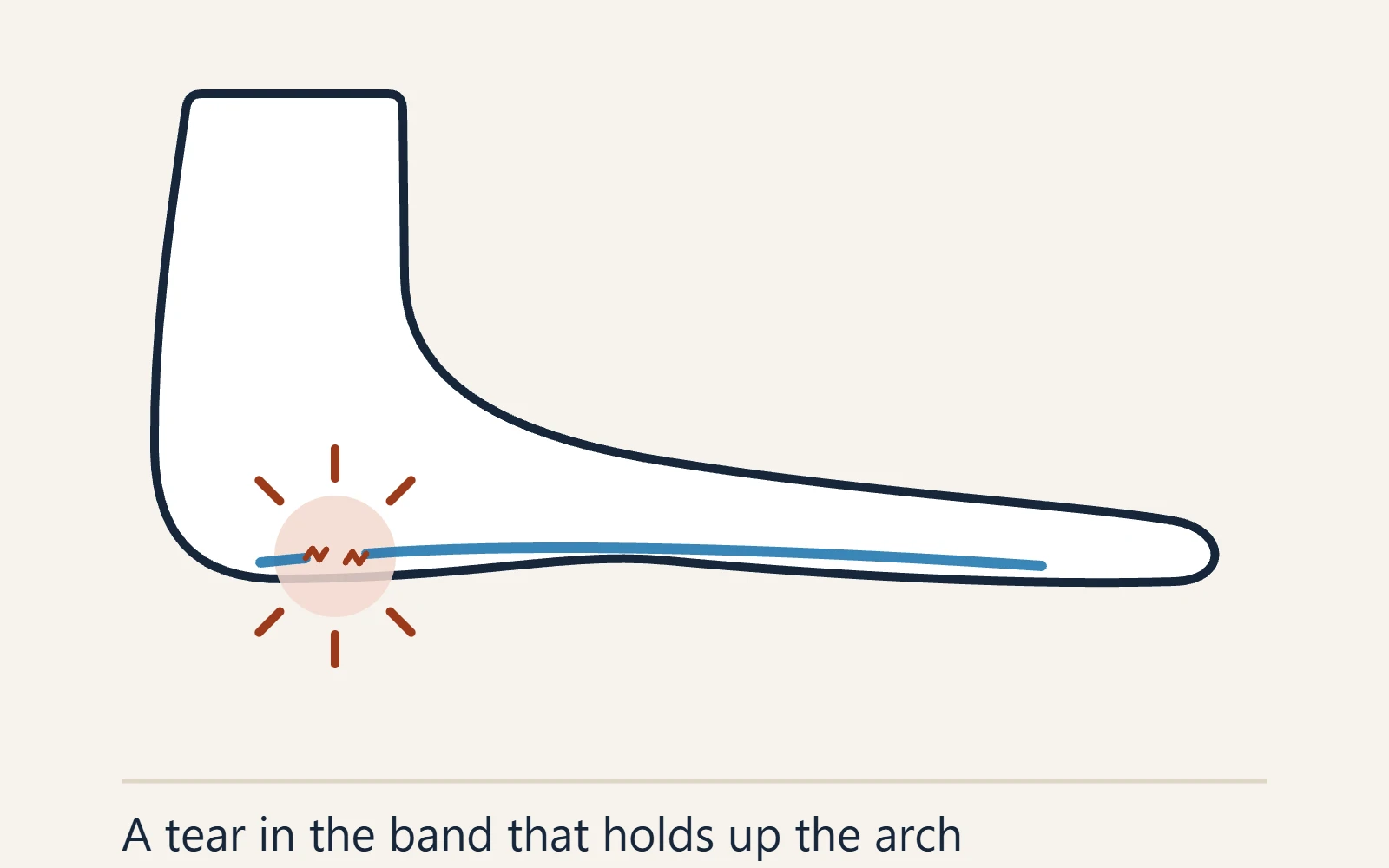
The plantar fascia is the tough band that runs from the heel bone to the base of the toes and holds up the arch like the string of a bow. A tear is a partial or complete break in that band, often close to where it attaches to the heel. Tear and rupture are used almost interchangeably, though strictly a rupture goes through the full thickness of the band. It is uncommon, and it behaves very differently from ordinary plantar fasciitis: it usually starts in a single moment, it often bruises, and it needs protecting rather than stretching.
The reassuring part is that most tears heal without an operation. In a review of 155 published cases, almost all were treated without surgery, and most did well. The part people miss is that tears in a fascia already weakened by plantar fasciitis, especially after cortisone shots, tend to leave more lasting arch aches than tears in athletes.
On this page
Symptoms of a torn plantar fascia
- A pop or tearing feeling under the heel or arch, during a push-off, a jump, a sprint, or sometimes something as ordinary as stepping down off a step.
- Sudden, sharp pain that makes the next steps difficult, often with a limp.
- Swelling and bruising in the arch or heel over the following hours to days. Ordinary plantar fasciitis does not bruise.
- Pain along the arch rather than only at the heel, and sometimes a tender gap you can feel in the band.
Not every tear pops. In two series of ruptures after cortisone injections, between a third and two-thirds of people remembered a sudden tearing; the rest noticed only a gradual change in their pain.
The trap: old heel pain that suddenly gets better. When a fascia weakened by long-standing plantar fasciitis gives way, the pull on its sore attachment is released, and the familiar heel pain can ease. In two published series of ruptures after cortisone injections, most patients found their original heel pain was relieved by the rupture, only for new aches to appear along the arch and the outer midfoot. If your heel pain eased after a pop or a sudden sharp pain in the arch, or new arch or outer-midfoot pain has taken its place, keep weight off the foot and have it examined. Do not read it as recovery.
Tear or plantar fasciitis?
| Feature | Plantar fascia tear | Plantar fasciitis |
|---|---|---|
| Start | Usually sudden, during one movement; can be gradual after cortisone shots | Gradual, over weeks to months |
| Pain | A pop, then sharp pain with every step | Worst on the first steps in the morning, easing as you move |
| Bruising | Common in the arch or heel | Absent |
| Swelling | Often obvious | Little or none |
| Where it hurts | Along the arch as well as the heel | Focused at the inner front of the heel |
| What helps first | Protection in a boot, no stretching | Stretching, loading, supportive shoes |
In an athlete, the order of events usually settles it: a tear has a moment, plantar fasciitis has a slow build. In a heel that has had cortisone shots, a tear can creep in instead, so a change in where and how it hurts matters as much as a pop. For other causes of a heel that hurts out of nowhere, see sudden heel pain.
Who tears it, and why
Athletes. The classic tear happens in a runner, a court-sport player or a jumper, during an explosive push-off. In a series of 18 athletes (average age about 41), all but two tears were in the inner (medial) part of the band. Not every foot was healthy beforehand: some had had heel symptoms for up to a year, and four had had injections. Even so, all 18 got back to activity.
A fascia already weakened by plantar fasciitis. This is the more common story in published cases. Long-standing plantar fasciitis thickens and degenerates the band, and cortisone shots can thin it further, so it can give way under a trivial load. In a review of 155 published patients with ruptures, 138 had a diagnosis of plantar fasciitis and 130 had received steroid injections beforehand. This group has more lasting arch and midfoot symptoms afterwards.
Out of the blue. A rupture with no previous plantar fasciitis, injection or injury is rare: one 2018 report found only seven such case reports since 1978.
How it is diagnosed
The story and the examination usually point the way: a pop, bruising, tenderness along the band and sometimes a palpable gap. Imaging confirms it and shows how much of the band has failed, which shapes the plan.
- Ultrasound shows the torn fibres and fluid at the tear, can be done in the clinic, and lets the band be watched as the toes are bent back.
- MRI gives the most complete picture of the size and position of the tear, and is useful when the diagnosis is uncertain.
- X-ray does not show the fascia, but it can show a small fragment of bone pulled off the heel or a heel stress fracture. An early stress fracture may not show for two to three weeks, so a normal X-ray does not rule one out; MRI can.
Have a suspected tear examined promptly. A same-day podiatry visit is ideal, because the examination and ultrasound that confirm it can be done in the office. Until then, keep weight off the foot as much as you can. Go to an emergency department if you cannot be seen that day and cannot bear any weight, or if the foot looks deformed or a fracture seems likely, and go straight away if the foot is cold, pale or blue, or numb. Any sudden heel or arch pain in a foot that has had cortisone injections also deserves a prompt check. When to worry about heel pain lists the warning signs.
Treatment, step by step
There are no randomised trials of plantar fascia tear treatment, so the plan rests on case series and clinical experience. Published protocols vary, and reviews describe non-surgical care as unstandardised, but most start by protecting the band and then rebuild. A 2020 review of 124 patients found 94% were treated without surgery, most commonly with up to three weeks in a rigid walking boot, putting weight through it as pain allowed. This is how Dr. Tom stages it:
- Protect (about the first four to six weeks). A walking boot, with weight through the foot as pain allows and crutches if needed. Ice and elevation for the swelling. No stretching of the arch: pulling on a fresh tear is the opposite of what it needs.
- Transition (after the boot, up to about week eight). Out of the boot into supportive shoes with an arch support, plus gentle movement and strengthening of the small muscles of the foot. Still no aggressive fascia stretching.
- Rebuild (around weeks eight to twelve). Back to low-impact activity, with the calf and foot loading progressed step by step.
- Return to impact (from about twelve weeks). Running and jumping come back gradually, guided by symptoms rather than the calendar.
- If it stalls. For a partial tear still painful after six to eight weeks of good protection, a platelet-rich plasma (PRP) injection is an option Dr. Tom considers. A cortisone shot, which can weaken the fascia further, is best avoided.
An arch support is worth keeping after a complete tear. The fascia is one of the arch’s main supports, and studies in cadaver feet show that dividing it lets the arch drop and shifts load onto the metatarsals. See insoles and orthotics for how to choose one.
Recovery time
The protected phase is short; the rebuilding phase is longer. Running and jumping usually start to come back from about three months, and a full return to sport takes three to six months; a complete tear can take six to twelve. Athletes can be quicker: in the series of 18 athletes, everyone returned to activity, on average about nine weeks after the injury, with a range of two to 26 weeks, and none needed surgery or tore it again. A partial tear usually settles faster than a complete one.
The outlook is less tidy when the fascia had been weakened beforehand. In a series of tears linked to cortisone injections, 26 of 40 feet still had symptoms a year after the rupture, half of the patients had fair or poor results a little over two years later (27 months on average), and many had new problems such as arch strain, outer midfoot pain, nerve irritation or a stress fracture. That is not a reason to panic, but it is a reason to take the protection phase seriously and to keep the arch supported.
When surgery comes in
Rarely. Most partial and complete tears heal with protection and rehabilitation, and surgery is kept for pain and loss of function that persist after several months of well-managed non-surgical care. A possible exception is a high-level jumping athlete with a complete tear. In a small report of five athletes, the two gymnasts repaired surgically returned to their previous level within a year; the three treated without surgery could run but did not get back to their previous level in jumping sports. For everyone else, recovery from an operation takes longer than recovery from the tear itself.
Cortisone shots and tears
A cortisone shot has a place in stubborn plantar fasciitis, but the link with rupture is real and worth knowing before you agree to one. In a study of 286 people with plantar fasciitis, steroid injection was the only one of the factors checked, including age, weight, activity level and foot shape, that was linked to rupture: 33 of the 35 people whose fascia tore had received steroid injections. How often it happens varies: four of 120 injected patients tore in one chart review, after an average of almost three injections each, and 12 of 122 (about 10%) in another clinic’s series. In Dr. Tom’s view, repeated shots into the same heel are the bigger concern. Cortisone shots for plantar fasciitis sets out when one is worth it.
Not a tear after all? If your heel pain built up gradually, Dr. Tom’s free 14-day plan from The Heel Pain Playbook sets out the first-line steps for plantar fasciitis in the order he uses in clinic. Get the free 14-day plan.
Common questions
How do I know if I tore my plantar fascia?
A tear often starts with a pop or tearing feeling during one movement, followed by sharp pain, a limp, and swelling or bruising in the arch or heel. Plantar fasciitis builds up gradually and does not bruise. A fascia weakened by cortisone shots can tear more quietly, so a change in the pain after an injection is worth having checked. An ultrasound or MRI confirms a tear.
Can a torn plantar fascia heal on its own?
Most tears heal without surgery, but not without help: the foot needs protecting in a walking boot for the first few weeks, then a staged return to activity. Walking on it unprotected and stretching it early can slow healing.
How long does a plantar fascia tear take to heal?
Running and jumping usually start to come back from about three months, and a full return to sport takes three to six months. A complete tear can take six to twelve months. A fascia weakened by plantar fasciitis and cortisone shots often takes longer: in one such series, 26 of 40 feet still had symptoms a year later. Athletes can be quicker: in a series of 18 athletes, return to activity took nine weeks on average, with a range of two to 26 weeks.
Can I walk on a torn plantar fascia?
Usually yes, in a walking boot and as pain allows, with crutches at first if needed. Walking on it in ordinary shoes before it has been protected is what tends to prolong the problem.
Do I need a boot for a plantar fascia tear?
For most tears, yes. Published protocols run from about three weeks in a rigid walking boot, the most common approach in a 2020 review, to four to six weeks in a series of athletes, the first two to three of them without weight on the foot. Dr. Tom typically protects a tear in a boot for four to six weeks. See walking boots.
Does a plantar fascia tear need surgery?
Rarely. Almost all published cases were treated without an operation. Surgery is considered for pain and loss of function that persist after several months of good non-surgical care, and occasionally for a complete tear in a high-level jumping athlete.
Can a cortisone shot cause a plantar fascia tear?
It can raise the risk. Most published ruptures happened in people who had received steroid injections for plantar fasciitis, often more than one. How often it happens varies: four of 120 injected patients in one chart review, and 12 of 122 (about 10%) in another clinic’s series.
Is a plantar fascia tear worse than plantar fasciitis?
It is more dramatic at the start and needs a different plan, protection rather than stretching. Many tears heal well, but a tear in a fascia already weakened by plantar fasciitis is more likely to leave lasting arch aches.
Related heel pain guides
- Plantar fasciitis explained
- Cortisone shots: what they buy you
- Walking boots: when one helps
- Sudden heel pain
- Too painful to walk
- Heel stress fracture
- PRP injections for plantar fasciitis
- Insoles and orthotics
- When to worry about heel pain
- Heel pain quiz
Plantar fascia tear care in Michigan
Dr. Tom Biernacki sees plantar fascia tears at Balance Foot & Ankle, with in-office ultrasound to confirm the tear and see how much of the band has failed, and a staged plan to get you back on your feet.
Howell — 4330 E Grand River Ave, Howell, MI 48843
Bloomfield Township — 43494 Woodward Ave #208, Bloomfield Township, MI 48302
Monday to Thursday, 9:00am–4:30pm; Friday, 9:00am–2:30pm · (810) 206-1402
Further reading
- Mosca M, Fuiano M, Massimi S, et al. Ruptures of the plantar fascia: a systematic review of the literature. Foot & Ankle Specialist. 2022;15(3):272–282. doi:10.1177/1938640020974889
- Debus F, Eschbach D, Ruchholtz S, Peterlein CD. Rupture of plantar fascia: current standard of therapy: a systematic literature review. Foot and Ankle Surgery. 2020;26(4):358–362. doi:10.1016/j.fas.2019.05.006
- Saxena A, Fullem B. Plantar fascia ruptures in athletes. American Journal of Sports Medicine. 2004;32(3):662–665. doi:10.1177/0363546503261727
- Acevedo JI, Beskin JL. Complications of plantar fascia rupture associated with corticosteroid injection. Foot & Ankle International. 1998;19(2):91–97. doi:10.1177/107110079801900207
- Sellman JR. Plantar fascia rupture associated with corticosteroid injection. Foot & Ankle International. 1994;15(7):376–381. doi:10.1177/107110079401500706
- Lee HS, Choi YR, Kim SW, Lee JY, Seo JH, Jeong JJ. Risk factors affecting chronic rupture of the plantar fascia. Foot & Ankle International. 2014;35(3):258–263. doi:10.1177/1071100713514564
- Kim C, Cashdollar MR, Mendicino RW, Catanzariti AR, Fuge L. Incidence of plantar fascia ruptures following corticosteroid injection. Foot & Ankle Specialist. 2010;3(6):335–337. doi:10.1177/1938640010378530
- Schaarup SO, Burgaard P, Johannsen FE. Surgical repair of complete plantar fascia ruptures in high-demand power athletes: an alternative treatment option. Journal of Foot and Ankle Surgery. 2020;59(1):195–200. doi:10.1053/j.jfas.2019.07.018
- Sharkey NA, Ferris L, Donahue SW. Biomechanical consequences of plantar fascial release or rupture during gait: part I – disruptions in longitudinal arch conformation. Foot & Ankle International. 1998;19(12):812–820. doi:10.1177/107110079801901204
- Sharkey NA, Donahue SW, Ferris L. Biomechanical consequences of plantar fascial release or rupture during gait: part II – alterations in forefoot loading. Foot & Ankle International. 1999;20(2):86–96. doi:10.1177/107110079902000204
- Servey JT, Jonas C. Plantar fascia rupture: ultrasound to facilitate recognition. Journal of the American Board of Family Medicine. 2018;31(2):282–285. doi:10.3122/jabfm.2018.02.170268
This page is education, not a diagnosis. Read our editorial policy for how it was written and what it will not claim.