Plantar fasciitis treatment
How to Cure Plantar Fasciitis in One Week: What Is Realistic, and a 7-Day Plan
Plantar fasciitis does not heal in seven days, whatever the internet promises. A well-run week can take the edge off the first steps of the morning and start the treatment that can shorten the rest.
You cannot cure plantar fasciitis in one week. Most people recover without surgery, but over months: more than 90% improve within 10 months of starting simple treatment, according to the American Academy of Orthopaedic Surgeons, and a review in American Family Physician puts it at about 80% within a year.
A week is still worth doing well. In a randomised trial, a week of arch taping gave a small but measurable drop in first-step pain, and the stretch, shoes and strength work you start now are the same treatments that, kept up, shorten the episode. Starting early helps: the foot and ankle surgeons’ guideline notes that the longer heel pain has lasted, the longer it tends to take to resolve.
On this page
What one week can and cannot do
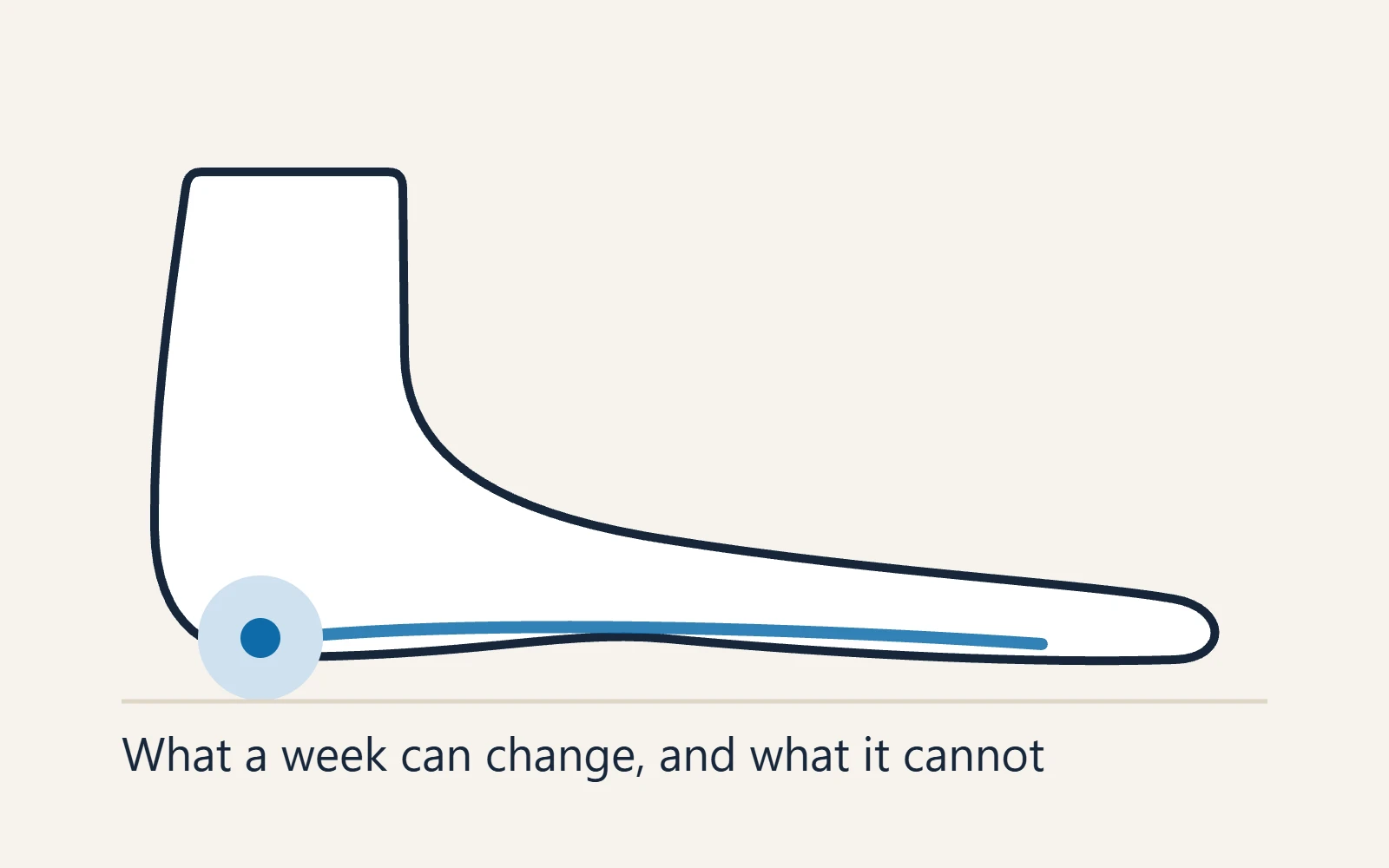
In plantar fasciitis the trouble is where the plantar fascia, the band running from the heel bone to the base of the toes, attaches to the heel. Despite the name, that tissue is largely degenerative rather than inflamed, and nothing has been shown to repair it in days: the trials behind the main treatments judged them at eight weeks and three months.
What a week can change is load. Pain peaks at predictable moments, the first steps after rest and the end of a long spell on your feet, and you can change what the heel meets at both from tonight.
A realistic day-7 target: first steps a notch less sharp, the stiffness easing a little sooner, and a routine you can keep up for the next two to three months. Anything sold as a one-week cure is selling something.
The 7-day plan
Each day adds to the one before; nothing gets dropped. The strength work starts on day 4 and runs every second day, the schedule used in the trial that tested it.
- Day 1, tonight: shoes by the bed, and the first stretch. Wear supportive shoes or structured sandals from your first step until bedtime, indoors too; the surgeons’ guideline lists avoiding flat shoes and barefoot walking among its first measures. Then learn the plantar fascia stretch: sitting, cross the sore foot over the other knee, pull the toes back towards the shin until the band under the arch goes tight, and hold for 10 seconds. Ten holds make a set.
- Day 2: stretch before you stand, and cut the spike. Do a set on the edge of the bed before your feet touch the floor and two more during the day, as in the trial that established the stretch. Add a calf stretch against a wall, back knee straight and then bent: a tight calf is a recognised risk factor. Cut back whatever rose before the pain began, such as hours on your feet or mileage, and swap impact for cycling or swimming rather than stopping. From today, note first-step pain out of 10 and the minutes it takes to ease.
- Day 3: support the arch. Put a cushioned heel cup or an arch-supporting insert in the shoes you wear most, and tape the arch with low-Dye or kinesiology tape for long days. Taping is the best-tested quick relief here: in a trial, its benefit showed within a week. Remove tape if the skin itches or the toes tingle, and do not tape a foot with numbness, poor circulation or fragile skin without medical advice. The taping guide shows both methods.
- Day 4: start loading the fascia. Stand on the sore foot, holding a counter, with a rolled towel under your toes. Rise over 3 seconds, hold for 2, lower over 3: three sets of 12, body weight only. This is the heel raise from the high-load strength trial. Too sore to do slowly? Use both feet for now. Had a steroid injection in that heel recently? Ask the clinician who gave it before starting.
- Day 5: a rest day for the raises. Stretches, shoes and support only. Compare this morning with yesterday: discomfort during the raises is fine if the next morning is no worse, and clearly worse means fewer sets next time. If first-step pain is still the worst part of your day, add a night splint at a gentle angle, built up over several nights.
- Day 6: heel raises again. Same dose, same slow tempo. The trial added weight, with a loaded backpack, only after two weeks.
- Day 7: compare, then keep going. Set this morning’s two numbers against day 2’s. Week two is the same routine. Add nothing new yet: change several things at once and you cannot tell what is helping.
Full doses and progressions are on the plantar fasciitis exercises page, and best shoes for plantar fasciitis covers what makes a shoe supportive.
Ice and painkillers are for comfort. A wrapped cold pack, or a frozen bottle rolled under the arch, can settle a sore evening; skip cold if your feet have reduced feeling or poor circulation. Over-the-counter painkillers can help, used as directed on the label, but anti-inflammatories are not safe for everyone: check with a pharmacist first if you have kidney disease, a past stomach ulcer or bleeding, or heart failure, take a blood thinner, or are pregnant.
How good the evidence is for each step
| Measure | What the evidence shows |
|---|---|
| Plantar fascia stretch | In a trial of 101 people with heel pain of ten months or more, it beat a standard Achilles stretch for worst pain and first-step pain at eight weeks. The 2023 physical therapy guideline gives fascia and calf stretching its strongest grade. |
| Taping | Strongest grade for short-term relief. In a trial, a week of low-Dye taping left first-step pain about 12 points lower on a 100-point scale than a sham treatment: small, but fast. |
| Supportive shoes, no bare feet | First-line advice from foot and ankle surgeons; expert consensus rather than trial evidence. |
| Heel cups and insoles | Help alongside other treatment, but the guideline advises against relying on them alone for short-term relief. Off-the-shelf devices have generally matched custom ones. |
| Towel heel raise | In a 48-person trial, clearly ahead of a stretching group at three months, but not at one month; the groups were similar at six and twelve months. |
| Night splint | Recommended for one to three months when first-step pain is consistent, though a family-medicine review calls the evidence inconclusive. |
What working looks like by day 7
Judge the week by the trend in your two morning numbers, not by any single day.
On track
First-step pain the same or a notch lower than on day 2, the stiffness easing a little sooner, and no flare after the heel raises.
Normal, not failure
A worse morning after a long day on your feet, and peak pain that has barely moved. The strength trial showed no advantage at one month.
Not right
Pain climbing day after day, pain that builds the longer you are on your feet, or any warning sign below.
A slow first week is not a reason to stop: the surgeons’ guideline expects most people to respond within about six weeks, and little or no improvement by then means it is time to be examined.
Day 7 is not the finish line. The free 14-day plan from Dr. Tom’s Heel Pain Playbook uses the same moves and carries them through the second week, building up the heel raises, with the pain rule and a tracker for your first-step pain. Get the free 14-day plan.
Weeks 2 to 12
Mostly the same routine, done consistently, with the heel raises getting heavier.
| When | What you do | What to expect |
|---|---|---|
| Weeks 2 to 4 | After two weeks the trial moved to 4 sets of 10 with a loaded backpack; after four, to 5 sets of 8. | Uneven progress. Keep tape for hard days. |
| Weeks 4 to 8 | Keep adding weight as the raises get easier. A night splint course is one to three months. | Most people respond by about six weeks; no change at all means get it examined. |
| Weeks 8 to 12 | The strength protocol ran for three months; the stretching trial asked for at least eight weeks, then as needed. | The strength advantage showed at three months. |
| Beyond 12 weeks | Taper gradually rather than stopping the day the pain goes. | More than 90% improve within 10 months; see how long plantar fasciitis lasts. |
What does not speed it up
- Bare feet at home. Supportive shoes all day count for less if the evening is spent barefoot on tile or hardwood. The surgeons’ advice to avoid barefoot walking applies at home too.
- Total rest, then a sudden return. A recent jump in weight-bearing activity is the classic trigger, and going from nothing straight back to everything recreates it. Reduce and swap instead.
- Repeated cortisone injections. An injection gives short-term relief at best and does not heal the fascia, and the risks of fascia rupture and fat pad thinning rise with repeated injections; one review estimates rupture in 2.4% of people given multiple injections. See cortisone injections.
- Rolling hard on a ball. Rolling is comfort, not treatment. If grinding into the sore spot leaves the next morning worse, ease off; see plantar fasciitis massage.
- A new remedy every few days. The treatments that work were judged at eight weeks and three months, not three days.
If six to eight weeks has not worked: what a podiatrist adds
If six to eight weeks of consistent work has not made a clear difference, get it examined. The first job is confirming the diagnosis; ultrasound is a reasonable test when pain persists beyond about three months. Then, as needed:
- Custom orthoses for feet that off-the-shelf shapes do not fit. For ordinary plantar fasciitis, trials have not shown them beating prefabricated devices; see insoles and orthotics.
- A cortisone injection as a short window to get the rehabilitation done, not the treatment itself. The surgeons’ consensus panel was comfortable with no more than two or three a year.
- A walking boot or cast for a very irritable heel that needs a short break from load; see walking boots.
- Physical therapy, where hands-on manual therapy carries the 2023 guideline’s strongest grade.
- Shockwave therapy for chronic heel pain; a meta-analysis cited in the guideline found it reduced pain in the medium and long term compared with controls.
- Surgery, rarely: a partial plantar fascia release or a gastrocnemius recession, which lengthens the calf. The AAOS generally reserves it for people not improving after 12 months of non-surgical treatment.
Plantar fasciitis treatment sets out the full ladder and its trade-offs.
Signs it is not plantar fasciitis
Stop the plan and get examined if any of these apply.
Squeezing the sides of the heel bone hurts, or the pain builds the longer you are on your feet after a jump in activity: a possible stress fracture, which needs protecting, not loading. Stop impact and be seen this week.
Burning, tingling or numbness, which points to a nerve: this week.
Both heels, with other joints, back stiffness or psoriasis: a possible inflammatory arthritis. This week.
Pain at rest or at night, or with weight loss or feeling unwell: this week.
A fall, a sudden pop, or you cannot put weight on it: same day.
A hot, red, swollen heel or a fever: same day, to rule out infection.
Diabetes or numb feet: have any new heel pain examined before self-treating, and do not tape or ice a foot you cannot feel properly.
When to worry about heel pain lists every red flag, and the heel pain quiz takes a minute.
Common questions
Can plantar fasciitis go away in a week?
Not in the sense of being cured. More than 90% of people improve within 10 months of starting simple treatment. A week can make the first steps easier and start the strength work that shortens the episode.
What is the fastest way to get rid of plantar fasciitis pain?
For fast relief, take load off: supportive shoes from the first step, arch taping, the stretch before you stand, and less of whatever flares it. For the fastest recovery, add the slow towel heel raise, which was ahead of stretching at three months.
Should I rest my foot completely?
No. Cut back the activity that aggravates it and swap impact for cycling or swimming, but keep walking in supportive shoes and keep the exercises going; returning to everything after complete rest is the kind of jump that sets it off.
Do I need custom orthotics or a walking boot in the first week?
Usually not. Off-the-shelf heel cups and insoles have generally matched custom devices for ordinary plantar fasciitis. A boot is for a severe heel that has not settled with the basics, ideally after an examination, since a stress fracture needs a different plan.
Related heel pain guides
- Plantar fasciitis treatment
- Plantar fasciitis stretches and exercises
- How long plantar fasciitis lasts
- Heel pain in the morning
- Night splints for plantar fasciitis
- Insoles and orthotics for plantar fasciitis
- Plantar fasciitis so bad you can’t walk
- When to worry about heel pain
Plantar fasciitis that will not settle?
If six to eight weeks of the right routine has not helped, an examination settles whether it is the fascia at all, and what to add. Dr. Tom Biernacki sees these at Balance Foot & Ankle.
Howell — 4330 E Grand River Ave, Howell, MI 48843
Bloomfield Township — 43494 Woodward Ave #208, Bloomfield Township, MI 48302
Monday to Thursday, 9:00am–4:30pm; Friday, 9:00am–2:30pm · (810) 206-1402
Further reading
- Koc TA Jr, Bise CG, Neville C, et al. Heel pain – plantar fasciitis: revision 2023. J Orthop Sports Phys Ther. 2023;53(12):CPG1–CPG39. doi:10.2519/jospt.2023.0303
- Trojian T, Tucker AK. Plantar fasciitis. Am Fam Physician. 2019;99(12):744–750. aafp.org
- American Academy of Orthopaedic Surgeons. Plantar fasciitis and bone spurs. OrthoInfo. orthoinfo.org
- DiGiovanni BF, Nawoczenski DA, Lintal ME, et al. Tissue-specific plantar fascia-stretching exercise enhances outcomes in patients with chronic heel pain: a prospective, randomized study. J Bone Joint Surg Am. 2003;85(7):1270–1277. doi:10.2106/00004623-200307000-00013
- DiGiovanni BF, Nawoczenski DA, Malay DP, et al. Plantar fascia-specific stretching exercise improves outcomes in patients with chronic plantar fasciitis: a prospective clinical trial with two-year follow-up. J Bone Joint Surg Am. 2006;88(8):1775–1781. doi:10.2106/JBJS.E.01281
- Rathleff MS, Mølgaard CM, Fredberg U, et al. High-load strength training improves outcome in patients with plantar fasciitis: a randomized controlled trial with 12-month follow-up. Scand J Med Sci Sports. 2015;25(3):e292–e300. doi:10.1111/sms.12313
- Radford JA, Landorf KB, Buchbinder R, Cook C. Effectiveness of low-Dye taping for the short-term treatment of plantar heel pain: a randomised trial. BMC Musculoskelet Disord. 2006;7:64. doi:10.1186/1471-2474-7-64
- Thomas JL, Christensen JC, Kravitz SR, et al. The diagnosis and treatment of heel pain: a clinical practice guideline – revision 2010. J Foot Ankle Surg. 2010;49(3 Suppl):S1–S19. doi:10.1053/j.jfas.2010.01.001
- Schneider HP, Baca JM, Carpenter BB, et al. American College of Foot and Ankle Surgeons clinical consensus statement: diagnosis and treatment of adult acquired infracalcaneal heel pain. J Foot Ankle Surg. 2018;57(2):370–381. doi:10.1053/j.jfas.2017.10.018
This page is education, not a diagnosis. See our editorial policy, and if your heel pain does not fit this pattern, have it examined.