Heel pain causes
Bruised Heel: Stone Bruise or Bone Bruise, and How Long It Takes
Two different injuries share the name: a bruise of the fat pad under the heel, and a bruise inside the heel bone. They start the same way, but they can heal on very different timetables.
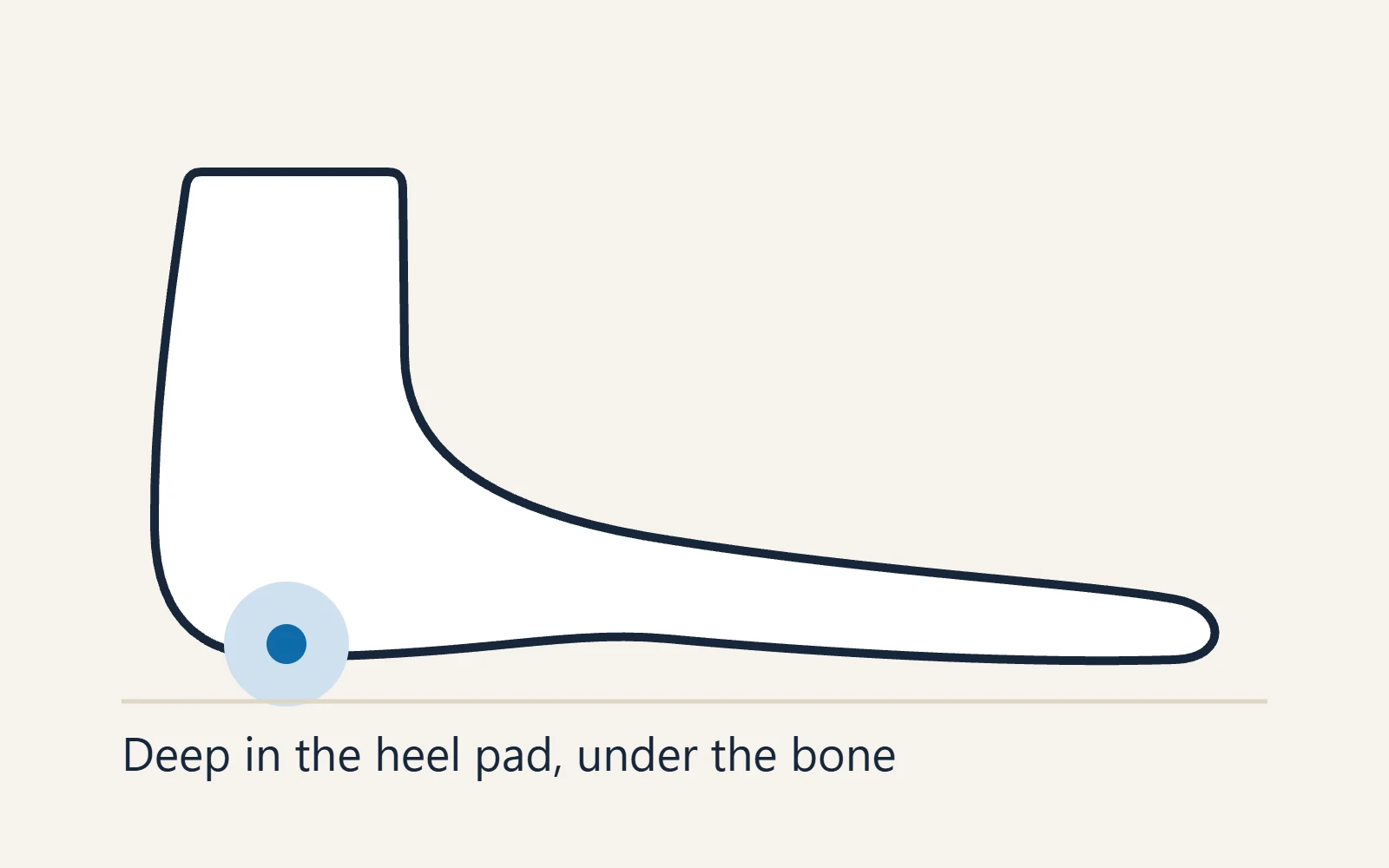
A bruised heel is a deep, aching soreness under the centre of the heel after an impact: landing hard from a jump or a fall, stepping on a stone, or a long day of heel-striking on hard ground. The name covers two injuries: a bruise of the fat pad that cushions the heel bone, the classic stone bruise, which fades gradually once you stop pounding it, and, after a harder landing, a bruise of the bone itself, which takes weeks to months.
Doctors call either one a heel contusion. The real task is telling it apart from the look-alikes, and how the pain started does most of that sorting.
On this page
What a bruised heel actually is
Which layer took the hit decides how long you will be sore.
Stone bruise: the fat pad
The cushion under the heel bone, which absorbs shock and spreads the load of each step. A stone underfoot or a heavy landing bruises it like any soft tissue; the skin may or may not change colour.
Bone bruise: the heel bone
A heavier impact can bruise the bone itself. Fluid leaks from small vessels into the marrow, which shows on MRI but not on an X-ray. It can stop you walking at first and take months to settle.
What causes a bruised heel
- Landing hard from a jump, a fall or in sport, which drives your body weight straight down through the heel.
- Stepping on a stone or another hard object, the origin of the name stone bruise.
- Repeated heel strike on hard ground: long runs or walks on concrete, or long days on hard floors, with no single moment to remember.
- Bare feet or thin soles on hard surfaces, which is exactly what provokes heel pad pain.
Age, previous steroid injections into the heel and extra body weight all reduce the pad’s elasticity, and all are linked to heel pad pain.
Bruised heel symptoms
- A deep, bruise-like ache in the middle of the heel, underneath rather than at the back.
- Pain whenever the heel takes weight, from the first step of the day, building the longer you stand; worse barefoot and on hard floors.
- Firm thumb pressure in the centre of the heel reproduces it.
- Discolouration in some cases, not all.
- With a bone bruise, pain that can stop you bearing weight at first.
That is the main contrast with plantar fasciitis, which is classically sharpest on the first steps after rest and then eases. A bruise does not warm up like that.
Bruised heel or something else?
Most look-alikes either start without an injury or behave differently over the day.
| What it is | How it starts | What it feels like | The tell |
|---|---|---|---|
| Bruised fat pad (stone bruise) | One impact, or a day of heel-striking on hard ground | Central ache from the first step; worse barefoot and with standing | Firm pressure mid-heel hurts; eases steadily with rest |
| Bone bruise | A heavier impact, such as a jump or fall onto the heels | Deeper; can stop you bearing weight at first | X-ray normal; MRI shows fluid in the marrow |
| Plantar fasciitis | No single injury; overuse | Sharp at the inner front of the heel on the first steps after rest, easing as you walk | Tender spot at the inner front of the heel; pulling the toes back often hurts |
| Heel fat pad atrophy | Gradual, over years; age, steroid injections, extra weight | The same central ache, with no injury behind it | A thin pad; ultrasound can measure it |
| Calcaneal stress fracture | After a jump in activity or a switch to harder surfaces | Worsens with activity and can later ache at rest; sometimes swelling | Squeezing the sides of the heel bone hurts; early X-rays often normal |
| Broken heel bone | A fall from a height, such as off a ladder, or a car crash | Pain, swelling and bruising; often cannot bear weight, though some smaller fractures still allow a limp | Same-day X-ray, often followed by CT |
| Sever’s disease | Active children, roughly 8 to 14; a new season or a growth spurt | Back and sides of the heel, with running and jumping | Squeezing the sides of the heel hurts; X-rays rarely help |
Bruised heel vs plantar fasciitis
Plantar fasciitis, the commonest cause of heel pain, is an overuse problem at the inner front of the heel, not an impact injury. In a study of 250 people with pain under the heel, pain that worsened with prolonged standing pointed strongly to a fat pad problem, while first-step pain pointed to plantar fasciitis. These are tendencies rather than rules, and the two can coexist.
The squeeze test
Squeeze the two sides of the heel bone firmly between thumb and fingers, below the ankle. A bruised pad hurts when pressed from underneath; pain from squeezing the sides points at the bone. In an adult, treat that as a possible stress fracture until examined, especially if it followed a jump in activity and worsens as you go.
Still not sure? The heel pain quiz asks four quick questions and points you to the guide that fits; heel pain by location does the same sorting on one page.
How to treat a bruised heel
The usual advice for a bruised heel pad, from heel cups to taping, has never been tested in a randomised trial, and a review of bone bruises in ankle injuries found no evidence that they need specific treatment. Treatment means protecting the heel while it heals:
- Take the impact out. Walk and stand less, and stop running and jumping until walking is comfortable; cycle or swim instead. Continued impact on a sore heel only makes it worse.
- Cushion every step, at home too. A well-cushioned, closed-back shoe from the first step of the day, and no bare feet on tile, wood or concrete.
- Add a heel cup: silicone, gel or a firmer deep cup. In a small laboratory study, all three cups tested cut the peak force under the heel, and a plastic cup made the pad thicker under the heel in six people with heel pain. No trial has tested them for heel pad pain, so treat them as sensible padding, not a cure; insoles and orthotics covers what to look for.
- Ice after a long day: an ice pack wrapped in a cloth for up to 20 minutes, never directly on the skin. With diabetes, neuropathy or poor circulation, ask before using ice.
- Over-the-counter pain relief if needed: an anti-inflammatory tablet or gel, or acetaminophen (paracetamol), as directed on the label. Ask a pharmacist first if you have kidney disease, a past stomach ulcer or bleeding, heart failure, take a blood thinner, or are pregnant.
- Tape it for long days on your feet. Taping is usual advice, though the only study, of arch taping, was small and had no comparison group. The heel fat pad guide shows a method that cups the pad.
- Build back gradually. Return to running or jumping once a full day of walking is comfortable, starting short. A bone bruise may need crutches or a walking boot for a time; the authors of a heel bone bruise case report advise increasing weight-bearing gradually because of a potential risk of stress fracture.
Avoid a steroid injection into a bruised heel, since steroid injections are linked to fat pad atrophy, and do not dig a massage ball into it.
Dr. Biernacki covers managing a stone bruise of the heel in this short video: imaging, over-the-counter pain relief, and where inserts or braces fit in.
How long does a bruised heel take to heal?
A bruised fat pad goes away gradually and completely with rest; a bruised heel bone usually stops hurting within about six weeks but can take several months.
| Injury | What to expect |
|---|---|
| Bruised fat pad (stone bruise) | Fades gradually with rest. Research has not put a number on it, so judge it by direction: it should be clearly better week on week. |
| Bone bruise | Pain usually settles in about six weeks, sometimes months. MRI changes clear later: about three months in one review, within six to twelve months in another. |
| Calcaneal stress fracture | Reduced activity, with little or no weight-bearing for up to six weeks if the pain is severe; these usually heal well. |
| Broken heel bone | Most people need to wait about three months before putting weight on the heel. |
Evidence specific to the heel is thin. In one published case, after a heavy load through both heels, one heel was pain-free within two weeks, the other needed four months of partial weight-bearing, and both scans were normal by six months. The broader figures come from ankle injuries. Because a scan can lag behind how you feel, marrow oedema on an MRI while you are walking comfortably is not a failure to heal.
Do you need an X-ray or an MRI?
Usually neither: a bruised heel is diagnosed from the story and an examination, and MRI is rarely needed for heel pain. Imaging helps when:
- You fell from a height or cannot walk on it: an X-ray the same day, often followed by CT if there is a fracture.
- It is not settling, or the squeeze test hurts: an X-ray is a reasonable start, but a normal one does not rule out a bone bruise or an early stress fracture.
- The answer would change the plan: MRI shows both as fluid in the marrow, and how the pain began usually separates an impact bruise from a stress injury.
- A thinning pad is the question: ultrasound can measure its thickness.
A heel spur on the X-ray does not explain a bruise: spurs correlate poorly with symptoms and turn up in people without plantar fasciitis. Plantar fasciitis vs heel spurs explains why.
When to be seen
Same day, at urgent care or an emergency department, if:
You cannot put weight on the heel, especially after a fall from a height or a heavy landing.
The heel is badly swollen, bruised or misshapen after a fall, or your back hurts after landing on your heels; the same fall can injure the spine.
Whatever you stepped on broke the skin, or the heel is red, hot and swollen, or you have a fever. A puncture is a wound, not a bruise.
The foot goes numb, tingles, or turns cold or pale after the injury.
This week, if squeezing the sides of the heel bone hurts; the pain builds with activity or aches at rest or at night; you have diabetes, neuropathy or poor circulation; or the bruise is not clearly improving after two weeks of protecting it.
A child whose heel keeps hurting with sport needs a routine appointment (see Sever’s disease); when to worry about heel pain lists every warning sign.
Preventing another one
- Cushioned shoes for long walks and hard floors, replaced when the cushioning has gone.
- A cushioned shoe or sandal by the bed, instead of bare feet on hard floors.
- Heel cups in work boots if you spend the day on concrete.
- Build up running, hiking and standing time gradually, and do not jump down from heights onto your heels; runners, see heel pain in runners.
- With diabetes or reduced feeling in your feet, check both heels daily; a bruise or puncture you cannot feel can go unnoticed.
Shoes and inserts for this heel. A cushioned heel cup offloads a bruised heel while it settles. See heel cups and shoes for heel pain.
Common questions
How long does a bruised heel take to heal?
A bruised fat pad fades gradually with rest and should be clearly better week on week; research has not put a number on it. A bone bruise usually stops hurting within about six weeks but can take months. If it is not clearly improving after two weeks of protecting it, get it examined.
Is it a bruised heel or plantar fasciitis?
The story usually tells you. A bruise follows an impact, sits mid-heel and hurts whenever the heel takes weight. Plantar fasciitis is an overuse problem at the inner front of the heel, sharpest on the first steps after rest and easing as you walk. A mixed pattern needs an examination.
Should I walk on a bruised heel?
If you can walk comfortably in a cushioned shoe, yes, but do less and stop running and jumping. If you cannot put weight on it, especially after a fall from a height, get an X-ray the same day. If it hurts more each day, or the squeeze test hurts, be seen this week.
Is a bruised heel the same as policeman’s heel?
Not reliably. Policeman’s heel is an old name for heel pain, and the U.S. National Library of Medicine’s subject index files it as another name for plantar fasciitis. Go by the pattern rather than the label: an impact followed by a deep, central ache is a bruise.
Why does my heel still hurt weeks after I bruised it?
The bone may have been bruised, not just the pad; impact may have started again too soon; or it was never only a bruise, since a stress fracture, plantar fasciitis or an already thinning fat pad can feel similar. If it is not clearly improving, have it examined.
Related heel pain guides
- Best heel cups
- Heel fat pad atrophy
- Heel stress fracture and the squeeze test
- Plantar fasciitis
- Sever’s disease (heel pain in children)
- Sudden heel pain without injury
- When to worry about heel pain
- Heel pain: how to work out what you have
- When plantar fasciitis hurts too much to walk
Bruised heel that is not settling?
A heel that is still sore weeks after a hard landing, or one that hurts when the bone is squeezed, is worth examining rather than waiting out. Dr. Tom Biernacki sees these at Balance Foot & Ankle.
Howell — 4330 E Grand River Ave, Howell, MI 48843
Bloomfield Township — 43494 Woodward Ave #208, Bloomfield Township, MI 48302
Monday to Thursday, 9:00am–4:30pm; Friday, 9:00am–2:30pm · (810) 206-1402
Further reading
- Tu P. Heel pain: diagnosis and management. American Family Physician. 2018;97(2):86–93. aafp.org
- American Academy of Orthopaedic Surgeons. Heel pain. OrthoInfo. orthoinfo.org
- American Academy of Orthopaedic Surgeons. Calcaneus (heel bone) fractures. OrthoInfo. orthoinfo.org
- Chang AH, Rasmussen SZ, Jensen AE, Sørensen T, Rathleff MS. What do we actually know about a common cause of plantar heel pain? A scoping review of heel fat pad syndrome. Journal of Foot and Ankle Research. 2022;15(1):60. doi:10.1186/s13047-022-00568-x
- Wang CL, Cheng CK, Tsuang YH, Hang YS, Liu TK. Cushioning effect of heel cups. Clinical Biomechanics. 1994;9(5):297–302. doi:10.1016/0268-0033(94)90042-6
- Szaro P, Geijer M, Solidakis N. Traumatic and non-traumatic bone marrow edema in ankle MRI: a pictorial essay. Insights into Imaging. 2020;11(1):97. doi:10.1186/s13244-020-00900-8
- Longo UG, Loppini M, Romeo G, van Dijk CN, Maffulli N, Denaro V. Bone bruises associated with acute ankle ligament injury: do they need treatment? Knee Surgery, Sports Traumatology, Arthroscopy. 2013;21(6):1261–1268. doi:10.1007/s00167-013-2383-5
- Dienst M, Blauth M. Bone bruise of the calcaneus: a case report. Clinical Orthopaedics and Related Research. 2000;(378):202–205. doi:10.1097/00003086-200009000-00030
- U.S. National Library of Medicine. Medical Subject Headings: Fasciitis, Plantar (D036981); entry terms include policeman’s heel. meshb.nlm.nih.gov
This page is education, not a diagnosis. See our editorial policy, and if your heel hurts after a fall from a height or you cannot put weight on it, get an X-ray rather than waiting for a bruise to settle.