Achilles injuries
Achilles Tendon Rupture: The Signs, the Squeeze Test and Recovery
A ruptured Achilles usually announces itself with a pop and the feeling of being kicked in the back of the leg. The trap is that many people can still walk afterwards.
An Achilles tendon rupture is a tear through the tendon that joins the calf muscles to the heel bone, usually during sport, when a jump, landing or sudden change of direction stretches the calf too quickly. If you felt a pop at the back of the ankle and cannot push off properly, get it examined today or tomorrow, even if you can still walk.
The diagnosis is usually made on examination, starting with a squeeze of the calf. The harder parts are choosing between a boot and surgery, and a recovery measured in months. Heel pain that started suddenly without a pop or weakness is covered in sudden heel pain.
On this page
A pop or snap at the back of the ankle, a feeling of being kicked in the calf, then weakness pushing off: treat it as a rupture until someone has examined you.
Get seen today, or tomorrow at the latest, at an emergency department, an urgent care clinic or a foot and ankle specialist, even if you can walk. Go to the emergency department now for an open wound, numbness, a cold or pale foot, or a bigger accident such as a fall from height.
What happens, and who it happens to
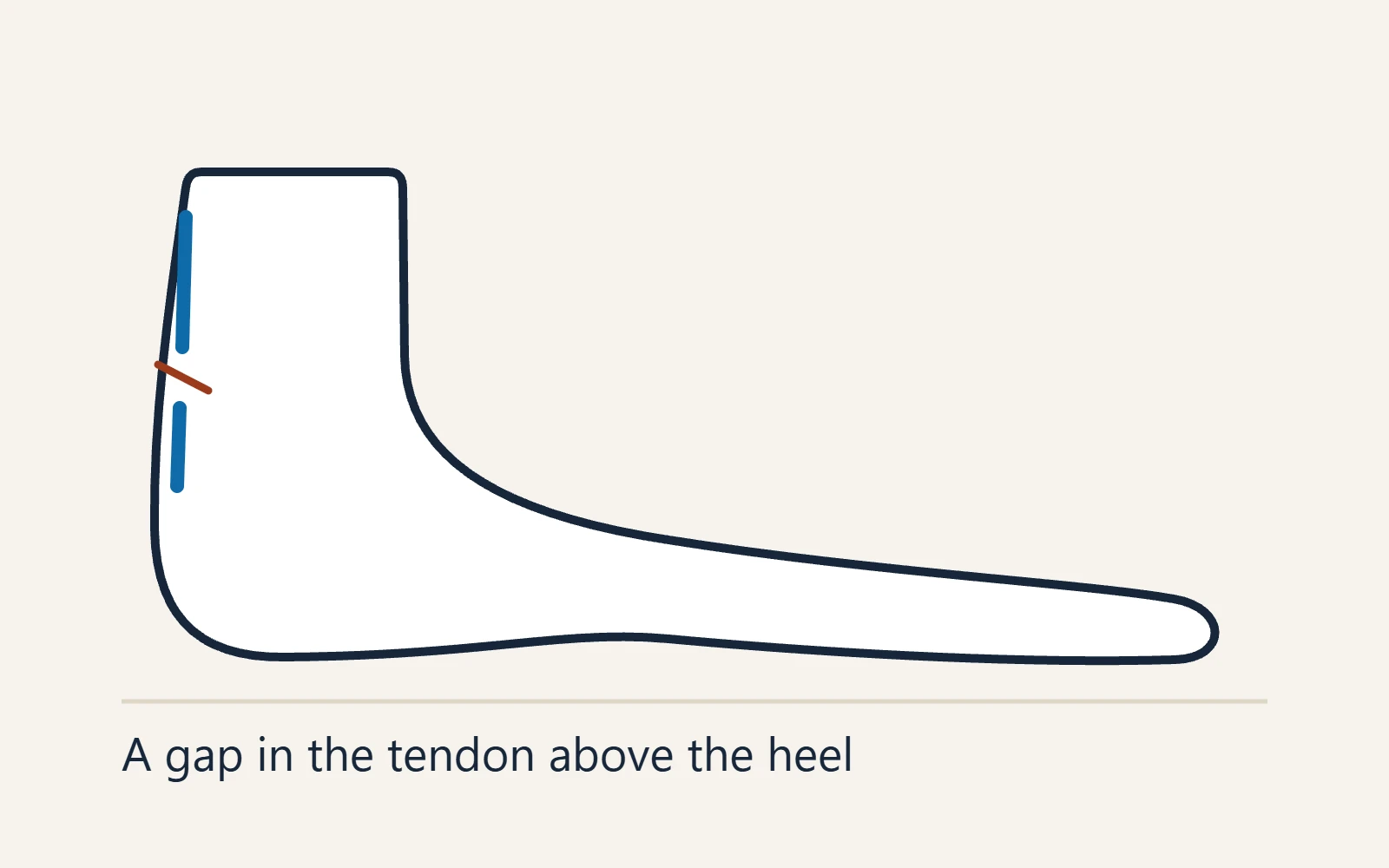
The Achilles is the cord at the back of the ankle where the calf muscles become tendon. Most ruptures go through it about 2–6 centimetres above the heel bone, typically when the calf muscle is stretched too quickly, as in landing from a jump or cutting sideways.
The typical patient is a middle-aged man playing sport. In a US series of 406 ruptures, the average age was 46.4, 83% of patients were men and 68% of ruptures happened during sport, basketball most often. A UK trial of 540 patients looked similar: average age 48.7, 79% men, 70% injured during sport.
Risk factors include increasing age; existing Achilles tendinopathy; steroid tablets; steroid injections into or around the tendon, which doctors therefore avoid; conditions that weaken tendons, such as rheumatoid arthritis, lupus, diabetes and obesity; and fluoroquinolone antibiotics such as ciprofloxacin and levofloxacin.
Fluoroquinolones carry an FDA boxed warning for tendon rupture, most often of the Achilles. The risk is higher over 60, with corticosteroids and after a kidney, heart or lung transplant, and a tendon can go within hours of starting the drug or months after finishing it. If a tendon becomes painful or swollen while you take one, the FDA-approved medication guide says to stop it and get medical help straight away. That said, only 2% of the US series had recently taken one.
Symptoms, and why walking does not rule it out
The story is usually distinctive: a pop or snap, sometimes audible; a sensation of being kicked or hit in the back of the lower leg; then pain, swelling near the heel and a weak push-off. You may not be able to rise onto tiptoe on that leg alone.
The trap is what people can still do. Smaller muscles behind the ankle also point the foot down, so many people with a complete rupture still walk, flat-footed and limping, and push the foot down against resistance; some even manage a few steps on tiptoe.
Ruptures do get missed, or waited out. In the US series, 24% were not diagnosed and treated until more than four weeks after the injury, and older patients and those with a BMI over 30 were the likeliest to have the diagnosis go unrecognised at first.
No pop, no moment of injury? Back-of-heel pain that built up over weeks and is stiff first thing is far more likely to be Achilles tendonitis. Back of heel pain sorts the gradual causes by where it hurts, and pain right on the bone may be insertional Achilles tendonitis.
What to do right now
- Stop. Do not finish the game, run it off or keep testing it.
- Do not stretch it. Treatment holds the foot pointing down; stretching does the opposite.
- Protect it. Keep weight off it as far as you can, on crutches if you have them, and do not push off through the toes.
- Ice and elevate. Ice wrapped in a cloth, in short spells, with the foot raised above hip level.
- Take simple pain relief if you need it. An over-the-counter painkiller taken as directed on the label suits most people; ask a pharmacist first if you have kidney disease, a stomach ulcer or bleeding, heart failure, take a blood thinner or are pregnant.
- Get seen today or tomorrow at an emergency department, urgent care or a foot and ankle specialist, who can examine it and splint the foot pointing down. If seen somewhere general, ask for follow-up with a foot and ankle surgeon within a few days: in the major trials treatment began within days, and surgery goes better done early. An open wound, numbness or a cold, pale foot means the emergency department now.
- Bring your medicine list, including any recent antibiotic course or steroid treatment.
The Thompson test and other checks
Home versions of these tests are everywhere online. Understand them, but do not use them to clear yourself: their accuracy was measured in clinicians’ hands, not at home.
| Check | How it is done | Points to a rupture | Accuracy |
|---|---|---|---|
| Calf squeeze (Simmonds–Thompson test) | Lying face down, feet hanging free; the examiner squeezes the calf | The foot barely moves, instead of flicking downward | Found 96% of ruptures; cleared 93% of intact tendons |
| Feeling for a gap | Fingers run along the tendon above the heel | A soft dip in the cord | The least sensitive: found 73% |
| Resting angle (Matles test) | Lying face down, knees bent to a right angle | The foot falls level instead of keeping a slight downward point | Found 88%; cleared 85% |
Those figures come from a study of 174 patients with a rupture and 28 without; every rupture produced at least two positive checks. Together the three form Simmonds’ triad, which the BMJ’s “Easily missed” review says detects nearly all ruptures, so a scan is rarely necessary. Imaging earns its place when the examination is equivocal, a partial tear is suspected, the injury is weeks old or the plan depends on it: ultrasound shows the tendon moving in real time, MRI the size and position of a tear.
Dr. Biernacki goes through two of these checks in the video. Watch it to understand the examination, not to replace one.
Surgery or a boot: what the trials found
Both are mainstream. The non-operative option here means functional treatment: a walking boot with heel wedges holding the foot pointed down, early protected weight-bearing, and the wedges removed in stages over about eight weeks. Surgery stitches the tendon ends together, through an open or a minimally invasive approach, followed by much the same boot programme.
| Study | Compared | Re-rupture | Also found |
|---|---|---|---|
| Willits, 2010 (144 patients) | Surgery vs none, both with early weight-bearing and movement | 2 patients vs 3 | 13 complications vs 6, the difference mainly soft-tissue problems after surgery; similar strength and function |
| Ochen, 2019 (meta-analysis, 15,862 patients) | Surgery vs none, pooled | 2.3% vs 3.9% | Other complications 4.9% vs 1.6%, the gap mainly infection after surgery; no significant re-rupture difference with early-movement rehabilitation |
| UKSTAR, 2020 (540 patients) | Non-operative care: plaster cast vs walking boot | 6% vs 5% | No difference in function at nine months |
| Myhrvold, 2022 (554 patients) | No surgery vs open repair vs minimally invasive repair | 6.2% vs 0.6% vs 0.6% | Nerve injuries 0.6%, 2.8% and 5.2%; no difference in function at 12 months |
Taken together: surgery cuts the re-rupture risk by a few percentage points and pays for it with a small risk of wound infection and nerve injury. Function a year on is much the same either way, and a boot you can walk in does as well as a cast.
Surgeons are more likely to recommend surgery for competitive athletes and for people whose activities depend on jumping and pushing off hard. Beyond that it is a genuine choice, which the meta-analysis authors said should rest on individual factors and shared decision-making. One caution: the 2022 trial took adults aged 18 to 60 and excluded people with diabetes, people on steroids and anyone recently given a fluoroquinolone, so it says less about them.
Recovery time, phase by phase
Protocols vary; this schedule comes from the large trials and is similar with either treatment.
| Phase | When | What happens |
|---|---|---|
| Protection | Weeks 0–2 | Cast or boot with the foot pointing down. In UKSTAR the boot group could take full weight from the day it was fitted. |
| Boot with wedges | To about week 8 | Wedges removed in stages until the foot is flat, walking in the boot as comfort allows. The boot came off at eight weeks in UKSTAR and the 2022 trial. |
| Rebuilding | From about week 8 | Physical therapy for movement, then progressive calf strengthening; running and jumping return when strength allows. |
| Return to sport | Around 6–9 months | On average six to nine months after surgery and six to eight without, in the studies that measured it. |
| Full recovery | About a year | Complete recovery can take about 12 months, sometimes closer to two years, and some loss of calf strength is usual. |
For perspective, UKSTAR patients rated their Achilles function at a median of 100 out of 100 before the injury, and the two groups averaged 74.4 and 72.8 nine months later: normal progress, not failure.
Ask your team exactly when the boot may come off, whether it stays on at night, and how to even up the height of your other shoe. While you are in it, a calf that becomes more swollen, hot or painful, or sudden breathlessness or chest pain, needs urgent assessment: in UKSTAR, 1–2% of patients developed a clot in the leg and two had a clot on the lung.
Partial tears and late ruptures
Partial tears leave the tendon in one piece. They are much less common than complete ruptures; ultrasound or MRI helps tell them from a complete tear or from tendonitis, and small ones generally do well without surgery.
Late ruptures. The US series classed a rupture diagnosed more than four weeks after injury as chronic. With time the tendon ends shorten and scar, repair becomes harder, and a surgeon sometimes has to add donor tissue to bridge the gap: the best argument for prompt examination.
Prevention and getting back to sport
A few risk factors are worth acting on. Tendinopathy and steroid injections around the tendon are both linked to rupture, so have a sore Achilles assessed and treated with a graded loading programme rather than injected (see Achilles tendonitis exercises). And take tendon pain on a fluoroquinolone seriously, especially over 60 or on steroids.
After a rupture, the tear to avoid is the second one: in the trials above, re-rupture ran from 0.6% to 6.2%. Return to sport is a progression rather than a date — walking, strengthening, then running and jumping, with testing before competitive play. Most people get back to their previous level of activity. Runners will find more in heel pain in runners.
Common questions
Can you walk with a torn Achilles?
Often, yes, which is what makes it easy to dismiss. Other muscles behind the ankle still point the foot down, so many people with a complete rupture walk flat-footed with a limp. Walking tells you little; a pop and a weak push-off tell you a lot. Get examined today or tomorrow.
Can I do the Thompson test on myself?
You can learn what it looks for: when the calf is squeezed the foot should flick downward, and after a rupture it barely moves. But its accuracy was measured as a clinician’s test, and a normal-looking result at home does not clear you.
Do I need surgery for a ruptured Achilles?
Not necessarily. In the large trials, function a year later was much the same with surgery or a boot. Surgery lowers the re-rupture risk — 0.6% against 6.2% in the 2022 trial — but adds wound and nerve complications. Competitive athletes are more often steered toward it; decide with a foot and ankle surgeon early.
How long does it take to recover from a ruptured Achilles?
Around eight weeks in a cast or boot, then months of strengthening. Return to sport averaged six to nine months in the studies that measured it, and complete recovery can take about a year, sometimes closer to two.
Related heel pain guides
- Achilles tendonitis
- Insertional Achilles tendonitis
- Achilles tendonitis exercises and stretches
- Back of heel pain
- Sudden heel pain
- When to worry about heel pain
- Heel bursitis
- Haglund’s deformity
- Heel pain in runners
- Plantar fasciitis so bad you can’t walk
Felt a pop at the back of your ankle?
A suspected rupture needs examining within a day, and the boot-or-surgery decision is best made early; if you cannot be seen that quickly, start at urgent care. Dr. Tom Biernacki sees these at Balance Foot & Ankle.
Howell — 4330 E Grand River Ave, Howell, MI 48843
Bloomfield Township — 43494 Woodward Ave #208, Bloomfield Township, MI 48302
Monday to Thursday, 9:00am–4:30pm; Friday, 9:00am–2:30pm · (810) 206-1402
Further reading
- Singh D. Acute Achilles tendon rupture. BMJ. 2015;351:h4722. doi:10.1136/bmj.h4722
- Maffulli N. The clinical diagnosis of subcutaneous tear of the Achilles tendon: a prospective study in 174 patients. American Journal of Sports Medicine. 1998;26(2):266–270. doi:10.1177/03635465980260021801
- Raikin SM, Garras DN, Krapchev PV. Achilles tendon injuries in a United States population. Foot & Ankle International. 2013;34(4):475–480. doi:10.1177/1071100713477621
- Willits K, Amendola A, Bryant D, et al. Operative versus nonoperative treatment of acute Achilles tendon ruptures: a multicenter randomized trial using accelerated functional rehabilitation. Journal of Bone and Joint Surgery, American Volume. 2010;92(17):2767–2775. doi:10.2106/JBJS.I.01401
- Ochen Y, Beks RB, van Heijl M, et al. Operative treatment versus nonoperative treatment of Achilles tendon ruptures: systematic review and meta-analysis. BMJ. 2019;364:k5120. doi:10.1136/bmj.k5120
- Costa ML, Achten J, Marian IR, et al. Plaster cast versus functional brace for non-surgical treatment of Achilles tendon rupture (UKSTAR): a multicentre randomised controlled trial and economic evaluation. Lancet. 2020;395(10222):441–448. doi:10.1016/S0140-6736(19)32942-3
- Myhrvold SB, Brouwer EF, Andresen TKM, et al. Nonoperative or surgical treatment of acute Achilles’ tendon rupture. New England Journal of Medicine. 2022;386(15):1409–1420. Protocol: ClinicalTrials.gov NCT01785264. doi:10.1056/NEJMoa2108447
- American Academy of Orthopaedic Surgeons, OrthoInfo. Achilles Tendon Rupture (Tear).
- U.S. Food and Drug Administration. Ciprofloxacin tablets and oral suspension (NDA 019537, 020780): prescribing information with boxed warning and Medication Guide, section 5.2, Tendinitis and Tendon Rupture; revised September 2024. accessdata.fda.gov
This page is education, not a diagnosis. See our editorial policy, and if you felt a pop at the back of the ankle, have it examined within a day rather than testing it yourself.