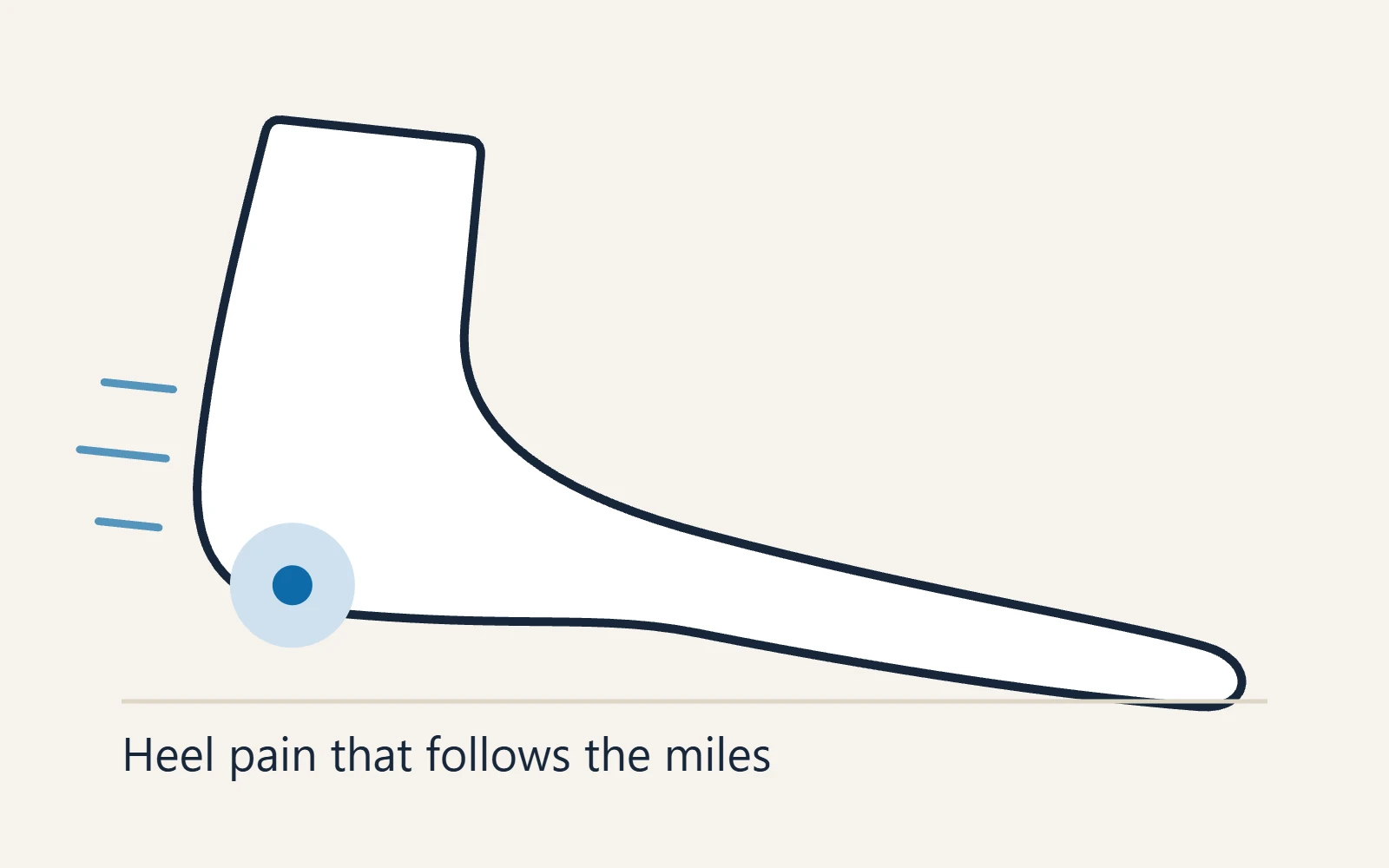
Heel pain causes
Heel pain after running: which cause you have, and what to change
Running produces several different heel problems, and they need opposite responses. One of them warms up as you go and can be trained around. One of them gets worse the further you run, and that one means stopping today.
A runner with a sore heel is told “plantar fasciitis” almost by reflex, and often that is right. But the heel is a small area with several structures in it, and the correct response ranges from “reduce your volume about twenty per cent and keep going” to “stop running now and get imaged”. Guessing wrong in the second case is the one genuinely costly mistake available in this subject.
Three questions separate almost all of it: what the pain does during a run, where exactly it sits, and what it does on the first steps in the morning.
The question that matters most
Does the pain ease as you warm up, or build as you go? Soft-tissue problems — fascia, tendon — are stiff and sore at the start and loosen within the first mile. Bone stress injuries do the opposite: tolerable at the start, worse at mile five than mile one, and worse again the next day. That single reversal is the most useful diagnostic information a runner has, and it costs nothing to observe.
The map for runners
| What you feel | Likely cause | What to change |
|---|---|---|
| Sharp under the inner front of the heel, worst on the first steps of the morning, eases within a mile | Plantar fasciitis | Cut volume rather than stop; load the calf and fascia deliberately; supportive shoes off the run |
| Back of the heel, in the cord a few centimetres above the bone, stiff first thing and warms up | Midportion Achilles tendinopathy | Reduce speed work; heel-drop loading is the treatment here and is well tolerated |
| Back of the heel right on the bone, worse on hills and speed, hates a stiff heel counter | Insertional Achilles tendinopathy | Drop hills and speed first; add a heel lift; avoid stretching the calf off a step — it compresses the insertion |
| Deep, spread through the heel bone, builds through the run, sore when you squeeze the heel side to side | Calcaneal stress fracture | Stop running and get assessed. This is the one that gets worse if you train through it |
| Burning or tingling underneath, no morning spike, worse the longer you are upright | Nerve entrapment | Check what is pressing — a firm arch shell or a tight shoe upper — before adding more support |
| Bruise-like in the centre of the heel, much worse in thin racing shoes or on concrete | Fat pad problem | More cushioning, softer surfaces, and stop running in worn-out or minimal shoes |
The pattern that means stop today
If your heel hurts more at the end of every run than at the start, and squeezing the heel bone from side to side is painful, stop running until it has been assessed.
That is the bone stress pattern. Training through fasciitis or tendinopathy mostly prolongs the misery; training through a bone stress injury can turn a problem measured in weeks into one measured in months. A normal X-ray does not settle it either — these are routinely invisible on plain film for the first few weeks, and MRI is the test that answers the question.
What actually causes it
Heel injuries in runners are load problems, and load has more inputs than weekly mileage. When a heel flares, one of these usually changed in the preceding month.
- A volume or intensity jump. The classic. Tissue adapts more slowly than fitness improves, so the fortnight where running felt easy and you added a lot is usually the fortnight that caused this.
- New shoes, or old ones. A drop change of even a few millimetres shifts load between the fascia and the Achilles — lower drop loads the Achilles more, higher drop loads the fascia more. A midsole with several hundred miles on it has lost the cushioning you are counting on.
- Racing shoes used for training. Thin, stiff, plated shoes concentrate load and are not built for daily volume.
- A surface change. Treadmill to road, grass to track, or the same cambered side of the road every day.
- Hills and speed added together. Both load the Achilles insertion hard. Introduced in the same block, they are a common cause of back-of-heel pain.
- Calf capacity that has not kept up. The most under-appreciated one. The calf and Achilles absorb an enormous share of running load, and a runner who never does resistance work is asking a small tissue to do a large job.
What to change, in order
- Work out which pattern you have first. Everything below depends on it, and the bone pattern exits this list immediately and goes to an examination.
- Reduce rather than stop. For fascia and tendon problems, complete rest feels productive and disappoints: the pain settles, nothing about the tissue’s capacity changes, and it returns within a fortnight of resuming. Find the volume that does not leave the heel worse the following morning and run that.
- Use the next-day test. Mild discomfort during a run that is gone by the next morning is acceptable. Pain that is worse the next day means the last run was too much, whatever it felt like at the time.
- Load the calf deliberately. Heavy, slow calf raises — straight-leg and bent-knee — two or three times a week. For midportion Achilles problems this is the treatment rather than an adjunct. Build capacity while you reduce running, and you come back to a tissue that can take more than it could before.
- Fix the shoe before buying an insert. Replace a midsole that is done. If the pain is at the back of the heel, a small heel lift in both shoes takes tension off the insertion immediately and costs almost nothing.
- Change one variable at a time. Runners commonly change shoes, add orthotics, start stretching and cut mileage in the same week, then learn nothing about which of them mattered.
- Rebuild gradually and keep the strength work. Return over weeks rather than days, and do not drop the calf loading the moment it stops hurting — that is what prevents the next one.
Running with plantar fasciitis
Most runners with plantar fasciitis can keep running at a reduced dose. The rules that stop it dragging on:
- Use the next-morning test. If the first steps the next morning are no worse, the run was within what the fascia can take. If they are worse, cut the next run.
- Cut volume and intensity first. Shorter and easier runs; drop speed work and hills until the mornings are settling.
- Stretch the fascia before your first steps every morning, and do the heel-raise strength work on non-running days.
- Keep the shoes supportive, including off the run. A worn midsole or flat shoes at home undo a lot.
- Tape for long runs if it helps: low-Dye or KT tape can take the edge off for a few hours.
- Stop if the pattern changes. Pain that builds through the run, or hurts when the heel is squeezed, is not plantar fasciitis behaviour. See the bone pattern above.
Full exercise dosing is on the plantar fasciitis stretches and exercises page, and the Achilles version on Achilles tendonitis exercises.
Can I keep running?
For plantar fasciitis and most tendinopathy, usually yes, at reduced volume, provided the heel is not worse the next morning. Many runners get through it without a full break.
For a bone stress injury, no — and this is the distinction the whole page exists to make. For nerve entrapment it depends on what is compressing the nerve; adding a firmer orthotic, which is the instinct, sometimes makes it worse.
Running on a sore heel? Dr. Tom’s free 14-day plan from The Heel Pain Playbook starts with the signs that mean stop and be seen, then the stretches and heel raises he gives in clinic, with a simple pain rule for when to back off. Get the free 14-day plan.
Common questions
Should I stretch before running?
Static stretching immediately before a run has little to offer and may reduce power briefly. What helps is a gradual warm-up, and calf and fascia work done as its own session rather than squeezed in at the start. One caution: if the pain is right on the bone at the back of the heel, deep calf stretching off a step compresses exactly the tissue that hurts. In that case, stop doing it.
Do I need custom orthotics?
Usually not as a first step. A good over-the-counter insert answers the question of whether support helps for a fraction of the cost, and for most runners it is as effective. Custom devices earn their place in a foot with an unusual structure, or where a well-fitted off-the-shelf option has genuinely been tried and failed. Note too that a tall, rigid arch can aggravate nerve-type heel pain.
Is it the carbon-plated shoes?
They can contribute, particularly when used for volume rather than for racing. Plated shoes change how the foot and ankle are loaded and shift work around the calf and Achilles. If heel pain appeared in the block where those shoes became your daily trainer, that is worth treating as the likely variable.
How long until I can race again?
For fasciitis and tendinopathy, think in months for full resolution but often only weeks before useful training resumes at reduced load. For a calcaneal stress fracture, typically six to twelve weeks before comfortable walking, then a graded return to impact after that. The honest answer in both cases is that it depends far more on how early you responded than on what you do afterwards.
Can I cross-train?
Yes, and you should. Cycling, swimming, pool running and upper-body work maintain fitness without asking anything of the heel. Losing condition is not a required part of recovery, and runners who keep training in some form tend to make better decisions about when to resume, because they are less desperate to.
Further reading
- Heel pain by location — the full map, if you are not sure which of these you have.
- Calcaneal stress fracture — the one that gets worse with activity, in detail.
- Achilles tendonitis — why midportion and insertional need different exercises.
- The treatment ladder — what to do first, second and last.
- Shoes, inserts and kit — how to judge what gets sold for heel pain.
- Achilles tendonitis exercises — both loading programmes, with a printable sheet.
- Back of heel pain — every cause at the back of the heel, side by side.
- Koc TA, et al. Heel Pain – Plantar Fasciitis: Revision 2023. Clinical Practice Guidelines, Journal of Orthopaedic & Sports Physical Therapy.
- Bergman R, Kaiser K. Stress Reaction and Fractures. StatPearls, NCBI Bookshelf.
- Allam AE, Chang KV. Plantar Heel Pain. StatPearls, NCBI Bookshelf.
- American Academy of Orthopaedic Surgeons, OrthoInfo. Heel Pain.
Heel pain in Michigan?
A heel that is getting worse through each run rather than warming up is the one worth having looked at sooner rather than later. If you are in Livingston or Oakland County, that distinction is usually settled in a single examination.
This page is education, not a diagnosis. Read our editorial policy for how it was written and what it will not claim.