Heel pain treatment
Tenex for Plantar Fasciitis: Who It Helps and What to Expect
Tenex clears out the worn part of the plantar fascia through a cut barely bigger than a needle, under local anaesthetic. It sits between injections and an operation, with good results in published case series but no randomised trial yet.
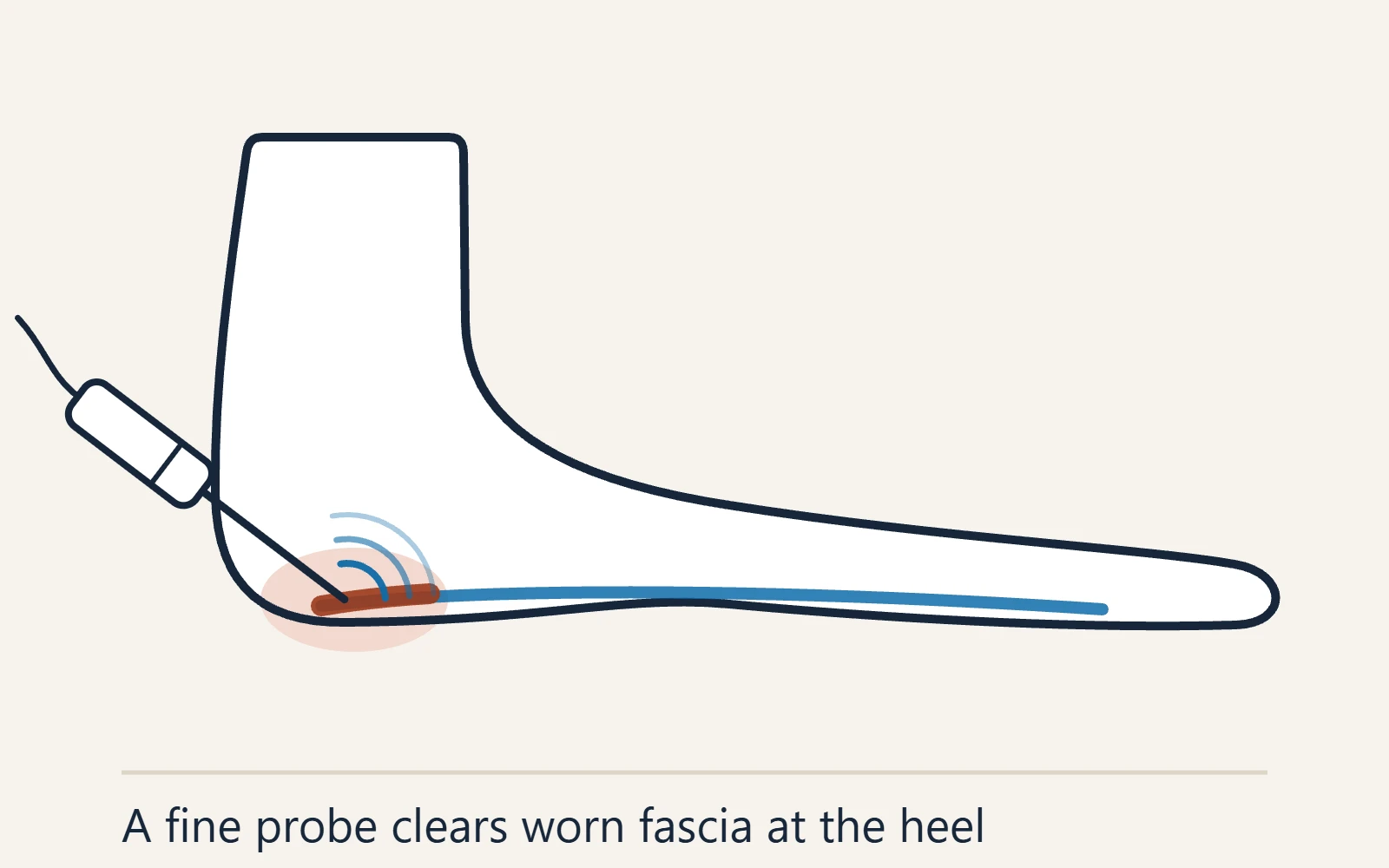
Tenex is the brand name of a minimally invasive procedure for plantar fasciitis that has not settled with months of treatment. You may also see it called percutaneous ultrasonic fasciotomy, ultrasonic debridement or, in insurance policies, percutaneous ultrasonic ablation. Under local anaesthetic, a needle-like probe goes into the heel through a tiny cut, and its vibrating tip breaks up and suctions out the degenerated part of the fascia while an ultrasound scan shows exactly where it is working.
It is a step for heel pain that has outlasted the basics and the second-line treatments, before anyone talks about an operation. In the two largest plantar fasciitis series followed for a year or more, about nine in ten were satisfied, and neither reported a complication. The catch: there is no randomised trial yet, only observational studies, and in the US most large insurers class the procedure as investigational.
On this page
What Tenex is
Long-standing plantar fasciitis is less an inflammation than a repair that has stalled. Where the fascia attaches to the heel bone it thickens and fills with disorganised, degenerated tissue that never quite heals. Stretching, loading, shockwave and PRP all try to restart that repair from the outside. Tenex takes the more direct route of removing the degenerated tissue itself, so the body can rebuild in its place.
The device is a hollow probe whose tip oscillates at ultrasonic frequency. It breaks up the tissue in front of it, and a built-in irrigation and suction system washes the fragments out through the probe. The manufacturer says the energy targets the softer, degenerated tissue and spares healthy fascia. The system, which Mayo Clinic doctors helped develop, was cleared by the US Food and Drug Administration in 2013 as an ultrasonic surgical instrument for removing soft tissue. That kind of clearance rests on similarity to existing devices; it is not proof that the procedure works for plantar fasciitis.
Tenex belongs to a family of needle-sized procedures for the plantar fascia. Others use a radiofrequency wand (Topaz), a fine blade or a plain needle to release or break up the worn tissue. This page is about the ultrasonic version.
Who it is for, and who should wait
Tenex is for plantar fasciitis that has resisted proper treatment for months. That means the first-line work done properly, usually for six months or more: plantar-fascia stretching, progressive loading, supportive shoes and inserts. Most candidates have also tried a second-line treatment such as shockwave or an injection. In the longest-running study, from the Mayo Clinic, patients had had heel pain for an average of two years before the procedure. If the basics have not really been tried, start with the treatment ladder.
It suits people who would otherwise be heading for surgery. Dr. Tom sees Tenex as an attractive alternative to an open operation for the right patient, because it is done through a cut barely bigger than a needle and the early recovery takes days to weeks rather than the months an open release can need. He would still rather see shockwave or an injection given a fair trial first: they are simpler, and many heels settle with them.
The diagnosis has to be right. An ultrasound scan should show a thickened, degenerated fascia at the heel. Tenex does nothing for a trapped nerve (including tarsal tunnel syndrome), a stress fracture, a thinned heel pad or inflammatory heel pain from conditions such as spondyloarthritis. The Mayo Clinic notes that it may not be appropriate for a complete tear of the fascia; a torn plantar fascia needs protecting, not debriding.
What the evidence shows
There is no randomised trial of Tenex for plantar fasciitis. The evidence comes from observational studies, mostly case series that follow a group of patients after the procedure without a randomised comparison group. Their results are consistently good, and the longest follow-up now runs past six years.
| Study | Who and what | Result |
|---|---|---|
| Kruse 2024, 67 patients | Chronic plantar fasciitis that had resisted standard treatment, followed prospectively at a US university sports medicine centre. | Pain scores improved by an average of 5.9 points out of 10. 94% were satisfied at 12 weeks and at one year. No complications from the procedure. |
| Ha 2025, 62 patients | 70 procedures at the Mayo Clinic, with patients surveyed an average of 6.6 years later. 82% of patients responded. | Pain fell from 6.8 to 0.7 out of 10. 91% of procedures counted as successful, and 90% would recommend it. No complications reported. |
| Encinas 2025, 56 patients | 60 procedures with the Tenex device in a multicentre US review, followed for an average of 27 months. | Pain, physical function and mobility scores all improved. The authors judged it a reliable option with high satisfaction and a good safety record. |
| Razdan 2018, 100 patients | Heel pain for at least four months after at least one non-surgical treatment had failed; treated as outpatients and followed for six months. | 96% had relief and would recommend it. One minor complication: pain that settled within three days. |
| Shomal Zadeh 2023, 35 studies, 1,674 people | Pooled studies of needle tenotomy of all kinds, with a plain needle or an ultrasonic one like Tenex, mostly for tendon problems, with some plantar fasciitis. | Large improvements in pain and function that held at long-term follow-up, with low rates of complications and failure. |
Read those numbers honestly. A case series cannot separate the effect of the procedure from time, because chronic heel pain slowly improves on its own; from the rest and protection afterwards; from the placebo effect of having a procedure; or from the fact that satisfied patients are the likeliest to answer a survey years later. A 2025 review found eight studies comparing minimally invasive procedures with non-surgical care or a placebo, none of them on Tenex: simpler needle treatments such as dry needling did better in five, but the reviewers judged the risk of bias high.
What would settle it is a trial against a sham procedure, and none has been done. Device trials are expensive, and the randomised trials of Tenex now under way are in other tendons, such as the elbow and the hip, not the heel. That is a gap in research funding, not proof that Tenex does not work. Until a heel trial exists, the honest summary is consistent, lasting improvement in carefully chosen patients, reported by respected centres, without proof of exactly how much of it the procedure itself delivers. (The longest series comes from the Mayo Clinic, which helped develop the device; its authors declared no conflicts of interest.)
Tenex, PRP, shockwave or surgery?
These options sit at different points on the ladder, and the trade-off is the same at every step: more invasive, more expensive and longer to recover, in return for a more direct attack on the worn tissue.
| Option | What it involves | Evidence |
|---|---|---|
| Shockwave | No needle; usually three short sessions a week apart, with little or no time off. | Several large trials against a sham. |
| PRP | An injection of your own concentrated platelets; sore for a few days, sport on hold for about two weeks. | Randomised trials, mostly against a cortisone shot. |
| Tenex | A needle-sized procedure under local anaesthetic; a boot for a few days, daily routine in one to a few weeks, sport in months. | Observational studies only, with good long-term results. |
| Surgery | A partial release of the fascia (open or through a keyhole) or a calf release; weeks to months of recovery. | Comparative studies, most of them at moderate to high risk of bias. |
We found no study comparing Tenex directly with shockwave or PRP for plantar fasciitis, and none comparing it with surgery. A 2026 network analysis of 21 surgical studies, none of them on Tenex, found that endoscopic (keyhole) approaches scored better on pain and function than open or percutaneous ones, and that a calf (gastrocnemius) release did best on pain, though the studies were at moderate to high risk of bias. In practice the order Dr. Tom recommends is the same as for any stubborn heel: the basics first, then shockwave or an injection, and a procedure only when those have had a fair trial.
Add-ons. Some clinics inject PRP or an amniotic preparation at the end of the procedure. In one retrospective study of 30 patients, those who also had PRP reported lower pain afterwards; in another of 31, an amniotic injection seemed to speed early relief, with no difference at a year. Neither is proof, and both add cost.
What the procedure is like
- Mapping the fascia. An ultrasound scan, sometimes with an MRI beforehand, locates and measures the degenerated tissue.
- Numbing. The heel is numbed with local anaesthetic. You stay awake; a general anaesthetic is not needed. It is often done in a clinic or procedure room rather than an operating theatre.
- The probe. A small incision just large enough for the needle-like probe is made, usually on the inner or outer side of the heel. Guided by the ultrasound picture, the vibrating tip breaks up the degenerated tissue and the suction carries it away. The treatment itself takes only minutes.
- Closing. No stitches: the cut is closed with adhesive skin tape and a pressure bandage.
- Afterwards. Rest the foot for several days. You may need a walking boot or crutches to take pressure off the heel. The manufacturer’s patient leaflet advises wearing any boot your doctor provides for the first three days and avoiding weight-bearing exercise or activities for two weeks. Your clinic will give you its own plan.
Recovery, and how quickly it works
Most people are back to their daily routine within one to a few weeks (the Mayo Clinic says a week to ten days), but returning to the activity that brought on the plantar fasciitis, whether that is running or long shifts on hard floors, can take several months. The repair takes time to mature, and pain usually eases gradually rather than overnight.
In pooled studies of needle procedures for tendons and the plantar fascia, the largest gains came over the first three months and continued after that, and in the Mayo series the improvement was still there more than six years on. Judge it on first-step pain in the morning at about three months, and expect it to keep improving for up to a year.
Once your clinic clears you, usually after a couple of weeks, bring back the stretching and the heel raise programme. Tenex clears out the worn tissue; loading is what strengthens the repair that replaces it.
Risks, and who should not have it
Complications look uncommon in the published plantar fasciitis series: the two largest with long follow-up reported none, and a 100-patient series followed for six months reported one minor one. It is still a procedure, though. A case series of the same technique for the Achilles tendon concluded that it is a surgical procedure with complications similar to other Achilles surgery, and that is the right way to think about it. The risks to ask about:
- Infection or wound problems at the entry point.
- Nerve irritation. Small nerves run close to the heel. In a series of 15 patients treated with a related needle-sized release using a fine blade, two developed lasting nerve pain along the outer border of the foot.
- Taking too much. The fascia supports the arch, which is why surgeons now release only part of it. Ask how much tissue the procedure will treat.
- A flare of pain for a while afterwards, and the chance that it simply does not help.
Tell the clinic first if you take blood thinners or have a bleeding disorder, have poor circulation in the legs or smoke, have an infection or broken skin at the heel, or are allergic to local anaesthetic. Diabetes with reduced feeling in the feet is a reason to have the heel examined carefully before any procedure, because the cause and the risks are different. Children’s heel pain between about 8 and 14 is usually Sever’s disease, a growth-plate problem with its own treatment.
Cost and insurance
In the US, coverage is patchy. Large insurers including Aetna, Cigna and Anthem list Tenex for plantar fasciitis as experimental, unproven or investigational in their current policies, and so does Blue Cross Blue Shield of Michigan, so many patients pay for it themselves. Coverage varies by plan, and prices vary widely by clinic and setting.
Ask for a written, all-in price before you book: the procedure, the ultrasound, the boot and the follow-up visits. Then ask your insurer, in writing, whether it is covered under your plan. Check the other options the same way: the same Aetna and Cigna policies class shockwave and PRP for plantar fasciitis as unproven, and Aetna says the same of a calf release, although it does cover a keyhole (endoscopic) release of the fascia once six months of non-surgical treatment has failed.
If it does not work
Give it three to six months. If the heel is no better:
- Re-check the diagnosis. Nerve entrapment, a stress fracture and a thinned fat pad all imitate plantar fasciitis, and none of them is helped by a procedure aimed at the fascia.
- Check the loading work was done at the right dose. The high-load heel raise programme, every other day for three months, is the part most people never quite finish.
- Consider surgery. A calf release or a partial release of the fascia is still possible after Tenex; see plantar fasciitis surgery.
Before you book a procedure. Dr. Tom’s free 14-day plan from The Heel Pain Playbook makes sure the first-line steps have had a proper trial, in the order he uses in clinic, with a tracker for your first-step pain to bring to the appointment. Get the free 14-day plan.
Common questions
Does Tenex work for plantar fasciitis?
The published results are good: in the two largest plantar fasciitis series followed for a year or more, about nine in ten were satisfied, and pain stayed low more than six years on in the Mayo Clinic series. The limitation is that there is no randomised trial yet, so how much of the benefit comes from the procedure itself is not proven.
Is Tenex surgery?
It is a minimally invasive surgical procedure rather than an open operation: it is done under local anaesthetic through a cut just large enough for a needle-like probe, with no stitches, often in a clinic or procedure room. It carries the same kinds of risk as other surgery, such as infection and nerve irritation, so it deserves the same care.
How long is recovery after Tenex for plantar fasciitis?
Most people are back to their daily routine within one to a few weeks, often after a few days in a walking boot: the Mayo Clinic says a week to ten days, and the maker’s leaflet says to avoid weight-bearing exercise or activities for two weeks. Returning to running or to the activity that caused the problem can take several months, and pain usually keeps improving for up to a year.
Does Tenex hurt?
The numbing injection stings briefly; after that the procedure itself should not be painful, although you may feel pressure. Expect the heel to be sore for several days afterwards, which is why the foot is rested and often protected in a boot.
Is Tenex better than PRP or shockwave?
Does insurance cover Tenex for plantar fasciitis?
Often not. Large US insurers including Aetna, Cigna, Anthem and Blue Cross Blue Shield of Michigan list it as experimental, unproven or investigational for plantar fasciitis, and coverage varies by plan. Get a written price and check with your insurer before you book.
Does Tenex remove a heel spur?
Not in the standard plantar fasciitis procedure, which uses a soft-tissue tip on the fascia. The maker also sells a tip for bone that it markets for heel spurs, but a spur is rarely the source of the pain in the first place; see heel spurs.
What happens if Tenex does not work?
Give it three to six months, then have the diagnosis re-checked, because nerve entrapment, a stress fracture or a thinned fat pad can all imitate plantar fasciitis. Surgery, such as a calf release or a partial release of the fascia, is still an option afterwards.
Related heel pain guides
- The plantar fasciitis treatment ladder
- Shockwave therapy for plantar fasciitis
- PRP injections for plantar fasciitis
- Botox for plantar fasciitis: what the trials show
- Cortisone shots: what they buy you
- Plantar fasciitis surgery: who needs it
- Laser therapy for plantar fasciitis
- Plantar fascia tear
- How long plantar fasciitis lasts
- Plantar fasciitis exercises (printable)
- Heel pain quiz
Heel pain that will not settle, in Michigan?
Dr. Tom Biernacki sees heel pain that has outlasted the basics at Balance Foot & Ankle. He examines the heel to confirm what is actually causing the pain and explains where each option on this page fits for you, and in what order.
Howell — 4330 E Grand River Ave, Howell, MI 48843
Bloomfield Township — 43494 Woodward Ave #208, Bloomfield Township, MI 48302
Monday to Thursday, 9:00am–4:30pm; Friday, 9:00am–2:30pm · (810) 206-1402
Further reading
- Kruse RC, Volfson E. Ultrasonic fasciotomy for the treatment of chronic plantar fasciopathy: a prospective study. Clinical Journal of Sport Medicine. 2024;34(4):335–340. doi:10.1097/JSM.0000000000001215
- Ha CT, Romero JM, Gonzalez-Carta K, Murthy NS, Sellon JL, Boettcher BJ. Ultrasound-guided percutaneous fasciotomy and debridement for chronic plantar fasciopathy: six-year patient-reported outcomes from a retrospective case series. Foot & Ankle International. 2025;46(11):1239–1247. doi:10.1177/10711007251372136
- Encinas R, Hall S, Gauthier C, et al. Minimally invasive ultrasound-guided percutaneous plantar fasciotomy on chronic plantar fasciitis: a retrospective analysis. Foot and Ankle Surgery. 2025;31(8):737–741. doi:10.1016/j.fas.2025.05.003
- Razdan R, Vander Woude E, Braun A, Morrey BF. Percutaneous ultrasonic fasciotomy: a novel approach to treat chronic plantar fasciitis. Journal of Surgical Procedures and Techniques. 2018;3(102):1–6.
- Patel MM. A novel treatment for refractory plantar fasciitis. American Journal of Orthopedics. 2015;44(3):107–110. PubMed 25750942
- Shomal Zadeh F, Shafiei M, Shomalzadeh M, Pierce J, Thurlow PC, Chalian M. Percutaneous ultrasound-guided needle tenotomy for treatment of chronic tendinopathy and fasciopathy: a meta-analysis. European Radiology. 2023;33(10):7303–7320. doi:10.1007/s00330-023-09657-2
- Møller S, Ipsen JA, Aunass HJ, Aagaard P, Viberg B, Simony A, Riel H. Minimally invasive surgical treatments versus non-surgical treatments or placebo for plantar fasciopathy: a systematic review. Foot and Ankle Surgery. 2025;31(8):672–683. doi:10.1016/j.fas.2025.04.009
- Tan AKS, Lee DMX, Mai AS, et al. Comparative effectiveness of surgical interventions for recalcitrant plantar fasciitis: a systematic review and network meta-analysis. Journal of Foot and Ankle Surgery. 2026 (online ahead of print). doi:10.1053/j.jfas.2026.08.008
- Vajapey S, Ghenbot S, Baria MR, Magnussen RA, Vasileff WK. Utility of percutaneous ultrasonic tenotomy for tendinopathies: a systematic review. Sports Health. 2021;13(3):258–264. doi:10.1177/1941738120951764
- Turner A, Wang J, Liu G, Wukich D, VanPelt M. Retrospective evaluation of ultrasound guided percutaneous plantar fasciotomy with and without platelet rich plasma. Journal of Foot and Ankle Surgery. 2024;63(2):233–236. doi:10.1053/j.jfas.2023.11.007
- Nakagawa H, Sung K, Ashkani-Esfahani S, Waryasz G, May T, Sussman WI. Plantar fasciitis: a comparison of ultrasound-guided fasciotomy with or without amniotic membrane allograft injection. Regenerative Medicine. 2022;17(12):931–940. doi:10.2217/rme-2022-0094
- Sanchez PJ, Grady JF, Saxena A. Percutaneous ultrasonic tenotomy for Achilles tendinopathy is a surgical procedure with similar complications. Journal of Foot and Ankle Surgery. 2017;56(5):982–984. doi:10.1053/j.jfas.2017.06.015
- Malahias MA, Roumeliotis L, Tyrpenou E, Kazas ST, Sourlas I, Kaseta MK. Ultrasound-guided partial plantar fascia release with the use of a fine cutting device for the treatment of persistent plantar fasciitis: a case series. Journal of the American Podiatric Medical Association. 2022;112(2):20-244. doi:10.7547/20-244
- Mayo Clinic News Network. Mayo Clinic Q and A: treating plantar fasciitis with ultrasonic energy. 20 September 2016. newsnetwork.mayoclinic.org
- Aetna. Plantar fasciitis treatments. Clinical Policy Bulletin 0235, last reviewed 27 April 2026. aetna.com
- Cigna. Plantar fasciitis treatments. Medical Coverage Policy 0097, effective 15 May 2026. cigna.com
- Anthem. Percutaneous ultrasonic ablation of soft tissue. Medical Policy SURG.00149, last reviewed 19 February 2026. anthem.com
- Blue Cross Blue Shield of Michigan and Blue Care Network. Percutaneous ultrasonic ablation as treatment of chronic pain due to tendonitis and fasciitis (Tenex Health TX). Medical policy, effective 1 January 2026. bcbsm.com
This page is education, not a diagnosis. Read our editorial policy for how it was written and what it will not claim.