Heel pain treatment
PRP Injections for Plantar Fasciitis: Who They Help and What to Expect
PRP uses a concentrate of your own platelets to restart healing in a stalled plantar fascia. It can be slower to start than a cortisone shot, but in most trials it comes out ahead from about three months.
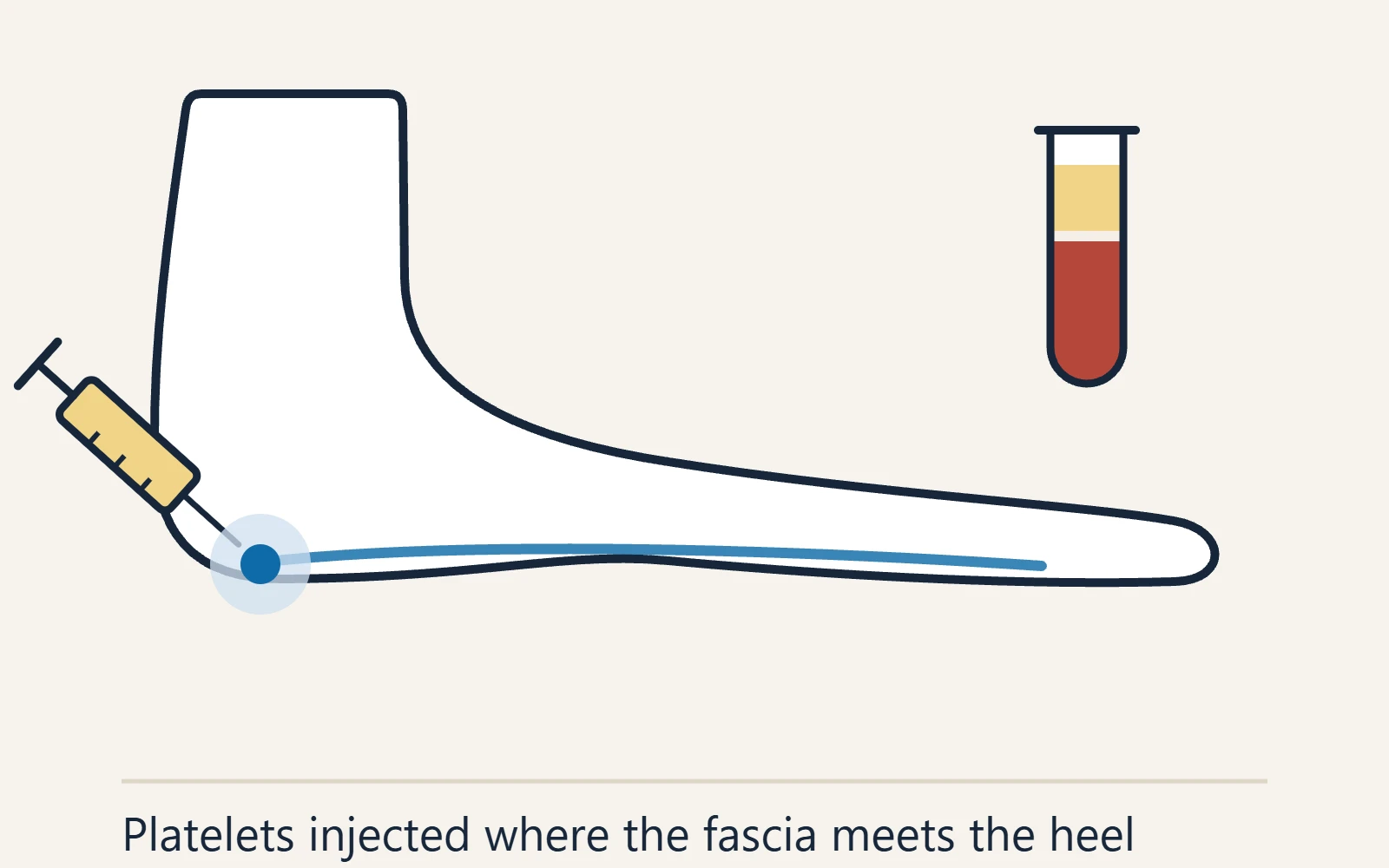
Platelet-rich plasma (PRP) is made from a small sample of your own blood. The blood is spun in a centrifuge to concentrate the platelets, and the platelet-rich layer is injected into the thickened attachment of the plantar fascia under the heel, ideally under ultrasound guidance. It is meant for plantar fasciitis that has not settled after several months of stretching, loading and the right shoes.
Against a cortisone shot, PRP can be slower to start but tends to pull ahead from about three months: a 2025 pooled analysis of 24 trials found less pain with PRP at three and six months. The caveats are real, though. There are few trials against a true placebo, every clinic prepares PRP a little differently, and in the US it is usually self-pay.
On this page
What PRP is
Platelets, the tiny cell fragments in blood that start the repair process after an injury, carry growth factors that draw in the cells that rebuild tissue. Long-standing plantar fasciitis is mostly degenerative rather than inflamed: the fascia has thickened and its repair has stalled. The idea behind PRP is to deliver a concentrated dose of those growth factors into the stalled tissue to restart healing, rather than to switch inflammation off, which is what a steroid does.
There is no single recipe. The amount of blood drawn, how it is spun, how concentrated the platelets end up and whether white cells are included all vary between preparation systems. That is one reason trial results differ, and one reason a clinic should be able to tell you which system it uses.
Who it is for, and who should wait
PRP is a second-line treatment. It is for heel pain that has lasted several months despite doing the first-line work properly: plantar-fascia stretching, progressive loading, supportive shoes and inserts. The trials recruited people with chronic plantar fasciitis, most of whom had already been through months of conservative care. If the basics have not really been tried, start with the treatment ladder.
It suits people who want to avoid steroid. A cortisone shot often works faster, but steroid injections carry a small risk of thinning the heel’s fat pad and weakening the fascia. PRP is not known to carry those risks, and unlike a steroid it does not push up blood sugar, which matters if you have diabetes. That makes it a reasonable choice when a cortisone shot has already worn off, or for an active person who would rather not have steroid in the fascia.
The diagnosis has to be right. PRP aimed at the fascia is not a treatment for a trapped nerve, a stress fracture or a thinned heel pad. An ultrasound scan can confirm a thickened fascia before anything is injected.
What the evidence shows
Most PRP trials compare it with a cortisone shot, because that is the injection it would replace. Steroid often works faster in the first few weeks, though by one month the pooled trials show no real difference; from about three months, PRP comes out ahead.
| Study | Who and what | Result |
|---|---|---|
| Peerbooms 2019, 115 patients | Chronic plantar fasciitis. PRP or a cortisone shot, double-blind, across several hospitals. | Cortisone eased pain faster, but the PRP group had lower pain at one year. Of those who completed the year, 84% of the PRP group improved by at least a quarter, against 56% of the cortisone group. |
| Monto 2014, 40 patients | Plantar fasciitis that had failed at least four months of treatment. One ultrasound-guided PRP injection or a cortisone shot. | The cortisone group’s improvement faded back to near the starting point by 12 months; the PRP group’s held to two years. |
| Shetty 2019, 90 patients | PRP, a cortisone shot or a placebo injection, followed for 18 months. | All three groups improved. Cortisone was better in the short term, PRP in the longer term, and both beat the placebo. |
| Zuo 2025, 24 trials, 1,653 patients | Pooled trials of PRP against cortisone. | Less pain with PRP at three and six months, with no significant difference at one month or one year. Foot function scores favoured PRP from three months. |
Read those results with care. Many of the trials are small, and a 2021 review rated most of the evidence as moderate to very low quality, with a high risk of bias in nine of fifteen studies. The weakest link is the comparison that matters most: PRP against a true placebo. Two placebo-controlled trials found PRP did better than a placebo injection, but a 28-person pilot trial found PRP and saline improved heel pain about equally at six months, and two other small trials found PRP no better than an injection of the patient’s own plasma without the extra platelets, or of their own blood.
That raises a fair question: how much of the benefit comes from the platelets, and how much from needling the fascia and from time? Nobody knows yet, because the large, independent placebo-controlled trial that would settle it has not been done, and it is the kind of study that needs independent funding. In the meantime, the trials against cortisone are the best guide to what PRP can do.
PRP, a cortisone shot or shockwave?
These are the options people weigh once the basics have run out, and each wins on something.
- Against a cortisone shot, steroid often gives faster relief in the first weeks, and PRP tends to give better relief from about three months. A cortisone shot is cheaper and usually covered by insurance; PRP is not known to carry steroid’s small risks of fat pad thinning and fascia rupture. Cortisone shots explains what a steroid injection buys you.
- Against shockwave, a 2024 pooled analysis of six trials found slightly less pain with PRP at three to six months, but the authors judged the difference too small to matter clinically. A 2025 analysis of shockwave trials found PRP ahead on pain and function by a margin that mattered; the two analyses come largely from the same research group. Shockwave needs no needle or blood draw. See shockwave therapy for plantar fasciitis.
- Against botulinum toxin, a 2026 network analysis of 59 trials ranked botulinum toxin first and PRP second among the injections it compared, and a 2024 trial found botulinum toxin better at one month and PRP better in the long term. Botulinum toxin is not approved for heel pain in the US, so it is used off-label.
What the injection is like
- A blood draw. Blood is taken from your arm, typically 20 to 60 ml depending on the preparation system.
- Spinning it down. The blood goes into a centrifuge for 10 to 20 minutes, which separates the platelet-rich layer from the red cells.
- The injection. The platelet-rich plasma is injected into the thickened fascia at the heel, ideally guided by ultrasound so it lands in the damaged tissue. It is about as uncomfortable as a cortisone shot. Some clinics use a little local anaesthetic; others avoid it, because anaesthetic may blunt the platelets.
- Afterwards. Expect the heel to be sore for a few days, sometimes a week or two. Rest it on the day, walk with limited strain for the next few days, and expect to hold off running and sport for about two weeks. Dr. Tom’s clinic asks patients to avoid anti-inflammatory painkillers such as ibuprofen for about two weeks, because they may dampen the healing response PRP is meant to start.
- Back to the programme. Once the soreness settles, usually within two to three weeks, restart the stretching and build the loading back up; your clinic will say when. PRP is meant to restart healing, and the loading programme does the rebuilding.
How quickly it works
Gradually. In some trials a cortisone shot eased pain faster in the first weeks; pooled across trials there was no real difference at one month, and PRP was ahead at three and six months. In a double-blind trial of 115 people, the PRP group’s pain kept falling and was lower than the cortisone group’s at one year. Expect gradual improvement over weeks to months rather than overnight relief.
Judge it on first-step pain in the morning. If there is no real improvement three months after the injection, have the diagnosis and the loading programme checked before paying for another. How long plantar fasciitis lasts sets out the realistic timeline.
Risks, and who should not have it
Because PRP comes from your own blood, an allergic reaction to it is not a concern. The common downside is pain: in a 2025 review of 16 foot and ankle trials, side effects were reported more often after PRP than after the comparison treatments: roughly one extra person with a side effect for every 13 treated. Almost all of it was pain at the injection site, reported by about 15% of PRP patients against 10% after the comparison treatments. Serious complications were rare, and no infections were reported.
- Tell the clinic first if you have a blood or platelet disorder or anaemia, take blood thinners, have a weakened immune system, have or have had cancer, are allergic to local anaesthetic, have had a cortisone shot in the last four to six weeks, or have an infection or broken skin at the heel.
- Diabetes with reduced feeling in the feet is a reason to have the heel examined before any injection, because the cause and the risks are different.
- Children’s heel pain between about 8 and 14 is usually Sever’s disease, a growth-plate problem with its own treatment.
Cost and insurance
In the US, PRP for plantar fasciitis is usually self-pay: Medicare and most private insurers do not cover it for plantar fasciitis or tendon problems, which most insurers class as investigational. Prices vary with the preparation system and the clinic, commonly about $500 to $1,500 per injection. Ask for the total price, including ultrasound guidance and the follow-up visit, before you book.
Many of the trials used a single injection, and some clinics give up to three over four to six weeks. Ask what the plan is before you start, and whether further injections depend on how you respond to the first.
If it does not work
Give it three months. If the heel is no better:
- Re-check the diagnosis. Nerve entrapment, a stress fracture and a thinned fat pad all imitate plantar fasciitis, and none of them is helped by an injection aimed at the fascia.
- Check the loading work was done at the right dose. The high-load heel raise programme, every other day for three months, is the part most people never quite finish.
- Consider the other second-line options. Shockwave, described with the rest on the treatment ladder, then a needle-sized procedure such as Tenex, and for a small minority, surgery.
Before you book an injection. Dr. Tom’s free 14-day plan from The Heel Pain Playbook gets the first-line steps started properly, in the order he uses in clinic, with a tracker for your first-step pain to bring to the appointment. Get the free 14-day plan.
Common questions
Does PRP work for plantar fasciitis?
For chronic plantar fasciitis, the trials are encouraging. Against a cortisone shot, PRP can be slower to start but tends to give better pain relief from about three to six months, and in some trials at a year. The evidence against a true placebo is thinner, and preparations vary between clinics.
Is PRP better than a cortisone shot for plantar fasciitis?
Not in the first few weeks: steroid often works faster at first, although by one month the pooled trials show no real difference. From about three months, most trials and pooled analyses favour PRP, and it is not known to carry steroid’s small risks to the fat pad and fascia. A cortisone shot is cheaper and usually covered by insurance. See cortisone shots for plantar fasciitis.
How many PRP injections do you need for plantar fasciitis?
Often one. Many of the trials used a single injection, and some clinics give up to three over four to six weeks. If there is no real improvement three months after treatment, have the diagnosis checked before paying for more.
How long does PRP take to work for plantar fasciitis?
Weeks to months. A cortisone shot often works faster at first; in pooled trials PRP was ahead at three and six months.
Does a PRP injection in the heel hurt?
The injection is about as uncomfortable as a cortisone shot, and the heel is often sore for a few days afterwards, sometimes a week or two. Pain at the injection site is the most common side effect of PRP.
Is PRP for plantar fasciitis covered by insurance?
Usually not. Most insurers, Medicare included, do not cover PRP for plantar fasciitis, so ask for the total self-pay price before you book.
Is PRP or shockwave better for plantar fasciitis?
Both are reasonable second-line options. Pooled analyses favour PRP on pain at three to six months; one judged the gap too small to notice, another found it large enough to matter. Shockwave avoids a needle and a blood draw. See shockwave therapy for plantar fasciitis.
Can I walk after a PRP injection for plantar fasciitis?
Yes, gently. Rest it on the day, walk with limited strain for the next few days, and expect to hold off running and sport for about two weeks.
Related heel pain guides
- Cortisone shots: what they buy you
- Shockwave therapy for plantar fasciitis
- Laser therapy for plantar fasciitis
- The plantar fasciitis treatment ladder
- Plantar fasciitis exercises (printable)
- How long plantar fasciitis lasts
- Plantar fasciitis surgery: who needs it
- Plantar fasciitis explained
- Heel fat pad atrophy
- Heel pain quiz
Considering PRP in Michigan?
Dr. Tom Biernacki offers ultrasound-guided PRP at Balance Foot & Ankle for plantar fasciitis that has not settled with the basics, after an examination to make sure the fascia is the problem.
Howell — 4330 E Grand River Ave, Howell, MI 48843
Bloomfield Township — 43494 Woodward Ave #208, Bloomfield Township, MI 48302
Monday to Thursday, 9:00am–4:30pm; Friday, 9:00am–2:30pm · (810) 206-1402
Further reading
- Peerbooms JC, Lodder P, den Oudsten BL, Doorgeest K, Schuller HM, Gosens T. Positive effect of platelet-rich plasma on pain in plantar fasciitis: a double-blind multicenter randomized controlled trial. American Journal of Sports Medicine. 2019;47(13):3238–3246. doi:10.1177/0363546519877181
- Monto RR. Platelet-rich plasma efficacy versus corticosteroid injection treatment for chronic severe plantar fasciitis. Foot & Ankle International. 2014;35(4):313–318. doi:10.1177/1071100713519778
- Shetty SH, Dhond A, Arora M, Deore S. Platelet-rich plasma has better long-term results than corticosteroids or placebo for chronic plantar fasciitis: randomized control trial. Journal of Foot and Ankle Surgery. 2019;58(1):42–46. doi:10.1053/j.jfas.2018.07.006
- Mahindra P, Yamin M, Selhi HS, Singla S, Soni A. Chronic plantar fasciitis: effect of platelet-rich plasma, corticosteroid, and placebo. Orthopedics. 2016;39(2):e285–e289. doi:10.3928/01477447-20160222-01
- Johnson-Lynn S, Cooney A, Ferguson D, et al. A feasibility study comparing platelet-rich plasma injection with saline for the treatment of plantar fasciitis using a prospective, randomized trial design. Foot & Ankle Specialist. 2019;12(2):153–158. doi:10.1177/1938640018776065
- Malahias MA, Mavrogenis AF, Nikolaou VS, et al. Similar effect of ultrasound-guided platelet-rich plasma versus platelet-poor plasma injections for chronic plantar fasciitis. The Foot. 2019;38:30–33. doi:10.1016/j.foot.2018.11.003
- Bildik C, Kaya O. Platelet-rich plasma vs autologous blood injection to treat plantar fasciitis: a prospective randomized, double-blinded, controlled trial. Foot & Ankle International. 2022;43(9):1211–1218. doi:10.1177/10711007221114122
- Hohmann E, Tetsworth K, Glatt V. Platelet-rich plasma versus corticosteroids for the treatment of plantar fasciitis: a systematic review and meta-analysis. American Journal of Sports Medicine. 2021;49(5):1381–1393. doi:10.1177/0363546520937293
- Zuo A, Gao C, Jia Q, et al. Platelet-rich plasma versus corticosteroids in the treatment of plantar fasciitis: a systematic review and meta-analysis. American Journal of Physical Medicine & Rehabilitation. 2025;104(7):613–621. doi:10.1097/PHM.0000000000002677
- Daher M, Covarrubias O, Herber A, Oh I, Gianakos AL. Platelet-rich plasma vs extracorporeal shock wave therapy in the treatment of plantar fasciitis at 3-6 months: a systematic review and meta-analysis of randomized controlled trials. Foot & Ankle International. 2024;45(7):796–803. doi:10.1177/10711007241231959
- Tung WS, Daher M, Covarrubias O, Herber A, Gianakos AL. Extracorporeal shock wave therapy shows comparative results with other modalities for the management of plantar fasciitis: a systematic review and meta-analysis. Foot and Ankle Surgery. 2025;31(4):283–290. doi:10.1016/j.fas.2024.11.005
- Wang Z, Zhang Y, Yuan J, et al. Comparative efficacy of six injection therapies for plantar fasciitis: a systematic review and network meta-analysis. International Journal of Surgery. 2026;112(2):5172–5189. doi:10.1097/JS9.0000000000003926
- Ruiz-Hernández IM, Gascó-Adrien J, Buen-Ruiz C, et al. Botulinum toxin A versus platelet rich plasma ultrasound-guided injection in the treatment of plantar fasciitis: a randomised controlled trial. Foot and Ankle Surgery. 2024;30(2):117–122. doi:10.1016/j.fas.2023.10.004
- Fucaloro SP, Berhane M, Mulvey M, Bragg J, Krivicich L, Salzler M. Platelet-rich plasma injections for foot and ankle pathologies have significantly more complications compared with hyaluronic acid injections, saline solution injections, and dry needling: a systematic review. Arthroscopy. 2025;41(10):4357–4366. doi:10.1016/j.arthro.2025.03.065
This page is education, not a diagnosis. Read our editorial policy for how it was written and what it will not claim.