Heel pain treatment
Laser Therapy for Plantar Fasciitis: What It Does and Who It Helps
Laser is the gentlest add-on treatment for a sore heel: no needle, no pain, and a 2023 guideline that says clinicians should use low-level laser alongside rehab to ease pain in the short term. Here is what it can and cannot do.
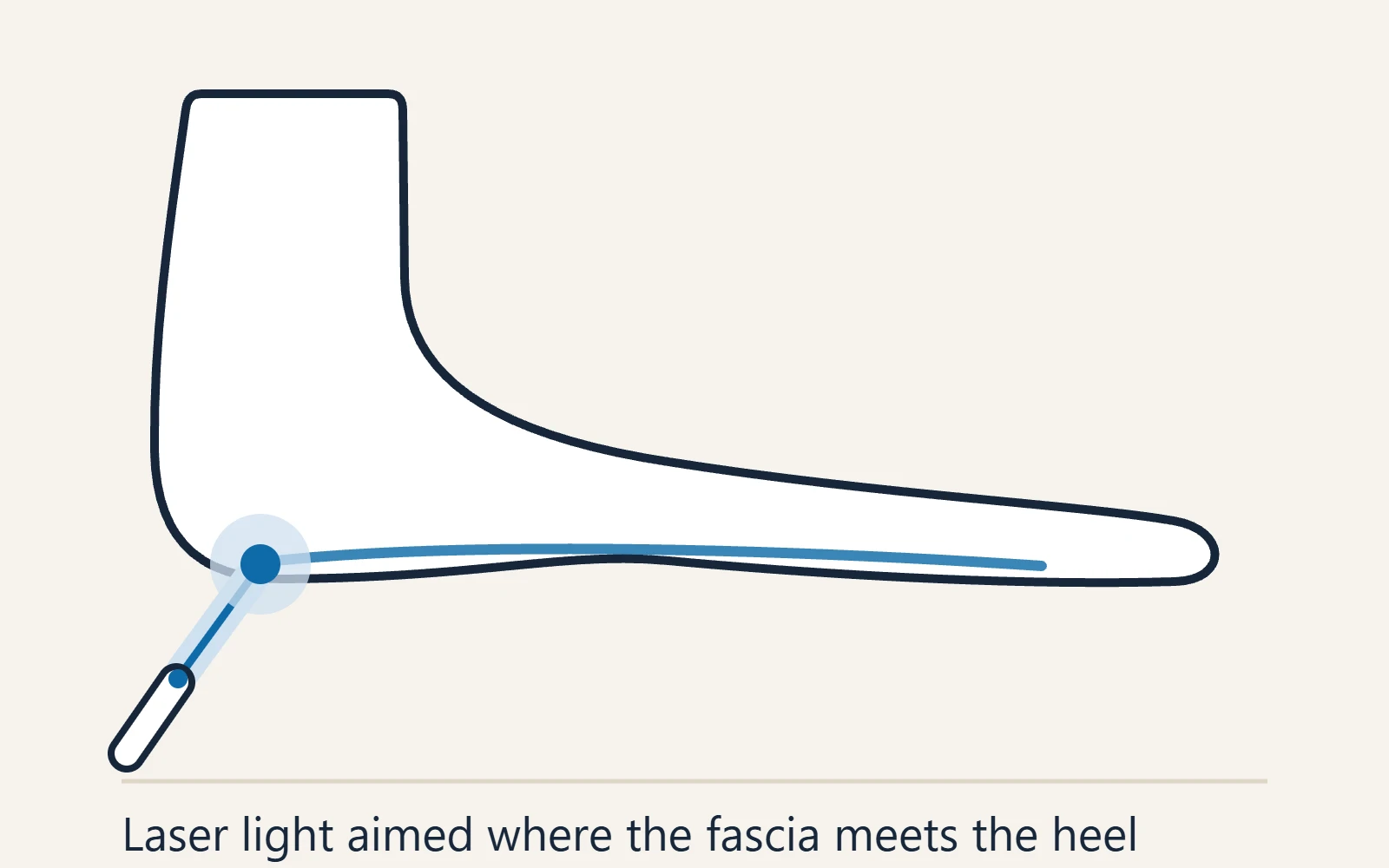
Laser therapy for plantar fasciitis shines concentrated light into the sore attachment under the heel over a short course of sessions to ease pain. It comes in two strengths: low-level laser (also called photobiomodulation or cold laser) and the more powerful high-intensity laser. Sessions are painless and take minutes, and a 2022 pooled analysis of low-level laser trials reported no adverse events.
The evidence for low-level laser is good enough that the 2023 heel pain guideline from the orthopaedic section of the American Physical Therapy Association upgraded it to a “should”: clinicians should use it as part of a rehabilitation programme to reduce pain in the short term. Pooled trials show about two points less pain on a ten-point scale over the first six weeks. The open question is not whether it eases pain, but for how long, because the trials are small and short.
On this page
How laser therapy works
Therapeutic lasers deliver red or near-infrared light at a set wavelength and dose. At low-level settings the light does not cut or heat the tissue in any meaningful way; the leading explanation is that it is absorbed by cells in the fascia and surrounding tissue and nudges their metabolism, reducing pain signalling and local inflammation. The mechanism is still being worked out, which is common for physical treatments, but the effect on pain has been measured in placebo-controlled trials.
That matters for plantar fasciitis because the problem is a stalled, degenerative tissue that hurts every time it is loaded. Anything that takes the edge off the pain makes it easier to do the stretching and strengthening work that actually changes the tissue.
Low-level or high-intensity laser?
Low-level laser
Low power, no warmth, often called cold laser or photobiomodulation. This is the type with the most trials behind it and the one the 2023 guideline recommends.
High-intensity laser
Much higher power, felt as gentle warmth, and each session delivers more energy. When the two were compared head to head in 102 people, pain relief at three to four weeks did not differ significantly, although more of the high-intensity group rated the treatment as more than 50% effective (73% against 51%). Dr. Tom’s clinic uses a class IV laser, which is in this higher-power group.
What the evidence shows
Laser is one of the better-studied physical treatments for heel pain, and the systematic reviews agree that it eases pain in the short term:
| Study | What was tested | Result |
|---|---|---|
| Macias 2015, 69 patients | Chronic plantar fasciitis. Low-level laser or a placebo laser, six sessions over three weeks. | At eight weeks, pain had improved by about 30 points on a 100-point scale with laser, against about 5 with the placebo. |
| Guimarães 2022, 14 trials, 817 patients | Low-level laser against placebo, added to rehabilitation, and against shockwave. | About two points less pain on a ten-point scale than placebo in the first six weeks (4 trials, 234 patients), but no significant difference in disability. Added to rehabilitation, a similar gain in pain. No significant difference from shockwave in the short term, on low-quality evidence. |
| Naterstad 2022, pooled trials | Low-level laser for plantar fasciitis and lower-limb tendon problems. | Pain reduced at the end of treatment and 4 to 12 weeks later; disability at the end of treatment and 4 to 9 weeks later. Added to exercise, laser at the recommended doses beat exercise alone. No adverse events reported. |
| Wang 2019, 6 trials | Low-level laser against control in plantar fasciitis. | Heel pain lower at the end of treatment and up to three months later, although one pain score, from the Foot Function Index, showed no difference. |
The weakness is duration, not direction. The trials are small and mostly follow people for weeks rather than months, so nobody can yet say how long laser’s benefit lasts on its own. That is a gap in the research rather than a sign the treatment does not work, and it is why laser belongs inside a rehabilitation programme rather than in place of one.
The same caution applies to every add-on. In a 2026 trial of 84 people, adding a 15-session course of high-intensity laser to a structured home exercise programme did not improve the 12-week result over the exercises alone, and neither did three sessions of shockwave. Every group improved; neither add-on beat the exercises on their own.
Laser or shockwave?
These are the two needle-free options people most often weigh, and on pain they come out close. A 2026 pooled analysis of 10 studies and 803 patients with chronic plantar fasciitis found no significant difference between low-level laser, high-intensity laser and shockwave on the measures it could compare. A second 2026 analysis, of five trials comparing high-intensity laser with shockwave, found no difference in pain at any point, but a small advantage for shockwave on foot function in the short and medium term.
- Laser’s advantages: it does not hurt, and the 2023 physical therapy guideline recommends low-level laser for recent as well as long-standing heel pain. That guideline did not assess shockwave, which it treated as outside physical therapy practice, so it is not a verdict between the two.
- Shockwave’s advantage: evidence of longer-lasting benefit. A 2023 review of 236 studies of plantar fasciitis treatments found shockwave was the only one that beat control for pain in the medium and long term. See shockwave therapy for plantar fasciitis.
In practice the choice often comes down to what the heel tolerates and what the clinic offers. Neither replaces the loading work.
Who it suits
Laser makes most sense for heel pain that is limiting the stretching and strengthening programme: the morning pain is so sharp, or the heel so sore after a day on your feet, that the exercises keep getting skipped. Taking two points off the pain for a few weeks can be exactly what gets someone through the loading work that resolves the problem.
It is also a reasonable option for people who want to avoid an injection or cannot tolerate shockwave. What it is not is a stand-alone fix for heel pain that has never had the basics. Start with the treatment ladder, and check the diagnosis is right: laser aimed at the fascia will not help a trapped nerve, a stress fracture or a thinned heel pad.
What a course is like
- Short sessions. The probe is held against or just above the sore heel for several minutes. Low-level laser feels like nothing at all; high-intensity laser feels like gentle warmth. In Dr. Tom’s clinic a session takes about ten minutes, and most people feel mild warmth.
- Eye protection. You and the clinician wear safety glasses, because the beam can damage the eye.
- A course, not a session. The trials cited here used six to fifteen sessions over three weeks, which is two to five a week.
- Keep loading. The stretching and strengthening carry on throughout. Laser is meant to make them easier, not unnecessary.
- Judge it at six to eight weeks. If first-step pain in the morning has not eased by then, laser has had a fair trial.
Who should not have it
No adverse events were reported in a 2022 pooled analysis of low-level laser trials, but clinics avoid a few situations as a matter of routine. Tell the clinic first if you are pregnant, have a cancer or a suspicious skin lesion in the area, have an active infection or broken skin over the heel, or take medication that makes your skin sensitive to light. In children, heel pain between about 8 and 14 is usually Sever’s disease, which needs its own plan.
Home laser devices
Handheld “cold laser” devices are sold for home use. The trials used clinic devices at measured doses, and the 2022 pooled analysis reported its pain reductions at the doses recommended by the World Association for Laser Therapy. A home device may deliver far less energy than the trials did, and there is no good way to know. If you try one, treat it as a comfort measure alongside the exercises, not a treatment with trial evidence behind it.
Get the basics right first. Dr. Tom’s free 14-day plan from The Heel Pain Playbook sets out the first-line steps in the order he uses in clinic, with a tracker for your first-step pain. Get the free 14-day plan.
Common questions
Does laser therapy work for plantar fasciitis?
For short-term pain relief, yes. Pooled trials show about two points less pain on a ten-point scale than a placebo over the first six weeks, and the 2023 physical therapy guideline recommends low-level laser as part of a rehabilitation programme. How long the benefit lasts on its own is less certain, because the trials are short.
How many laser sessions do you need for plantar fasciitis?
The trials cited here used six to fifteen sessions over about three weeks. Judge the result at six to eight weeks, by whether your first-step pain in the morning has eased.
Does laser therapy for heel pain hurt?
No. Low-level laser is usually felt as nothing at all, and high-intensity laser as gentle warmth. That is one of its main advantages over shockwave.
Is laser therapy better than shockwave for plantar fasciitis?
On pain they come out close: a 2026 pooled analysis found no significant difference between them. Shockwave has more evidence for lasting benefit and did slightly better on foot function against high-intensity laser; laser is painless, and the physical therapy guideline recommends low-level laser (it did not assess shockwave). See shockwave therapy.
What is the difference between cold laser and high-intensity laser?
Power. Cold, or low-level, laser uses low power and is felt as nothing; high-intensity laser uses much more and is felt as warmth. In a head-to-head trial of 102 people, pain relief at three to four weeks did not differ significantly.
Do home laser devices work for heel pain?
There is no good trial evidence for them. The studies used clinic devices at set, measured doses, and a home device may deliver far less energy. Treat a home device as a comfort measure alongside the exercises, not as a substitute for them.
Related heel pain guides
- Shockwave therapy for plantar fasciitis
- The plantar fasciitis treatment ladder
- Plantar fasciitis exercises (printable)
- Cortisone shots: what they buy you
- PRP injections for plantar fasciitis
- Plantar fasciitis massage
- Night splints: who they help
- How long plantar fasciitis lasts
- Plantar fasciitis explained
- Heel pain quiz
Considering laser in Michigan?
Dr. Tom Biernacki uses laser and shockwave at Balance Foot & Ankle as part of a plan for heel pain that has not settled with the basics, after an examination to make sure the fascia is the problem.
Howell — 4330 E Grand River Ave, Howell, MI 48843
Bloomfield Township — 43494 Woodward Ave #208, Bloomfield Township, MI 48302
Monday to Thursday, 9:00am–4:30pm; Friday, 9:00am–2:30pm · (810) 206-1402
Further reading
- Koc TA Jr, Bise CG, Neville C, Carreira D, Martin RL, McDonough CM. Heel pain – plantar fasciitis: revision 2023. Journal of Orthopaedic & Sports Physical Therapy. 2023;53(12):CPG1–CPG39. doi:10.2519/jospt.2023.0303
- Macias DM, Coughlin MJ, Zang K, Stevens FR, Jastifer JR, Doty JF. Low-level laser therapy at 635 nm for treatment of chronic plantar fasciitis: a placebo-controlled, randomized study. Journal of Foot and Ankle Surgery. 2015;54(5):768–772. doi:10.1053/j.jfas.2014.12.014
- Guimarães JS, Arcanjo FL, Leporace G, et al. Effect of low-level laser therapy on pain and disability in patients with plantar fasciitis: a systematic review and meta-analysis. Musculoskeletal Science and Practice. 2022;57:102478. doi:10.1016/j.msksp.2021.102478
- Naterstad IF, Joensen J, Bjordal JM, Couppé C, Lopes-Martins RAB, Stausholm MB. Efficacy of low-level laser therapy in patients with lower extremity tendinopathy or plantar fasciitis: systematic review and meta-analysis of randomised controlled trials. BMJ Open. 2022;12(9):e059479. doi:10.1136/bmjopen-2021-059479
- Wang W, Jiang W, Tang C, Zhang X, Xiang J. Clinical efficacy of low-level laser therapy in plantar fasciitis: a systematic review and meta-analysis. Medicine (Baltimore). 2019;98(3):e14088. doi:10.1097/MD.0000000000014088
- Naruseviciute D, Kubilius R. The effect of high-intensity versus low-level laser therapy in the management of plantar fasciitis: randomized participant blind controlled trial. Clinical Rehabilitation. 2020;34(8):1072–1082. doi:10.1177/0269215520929073
- Kosehasanogullari M, Büyükvural Şen S, Okur Yılmaz N, Aygün Bilecik N, Koçyiğit BF. Home exercise with or without high-intensity laser or radial shockwave therapy for plantar fasciitis: a randomized controlled trial. Foot & Ankle International. 2026;47(3):386–397. doi:10.1177/10711007251408439
- Alotaibi MN, Alharran AM, Alasmari OY, et al. Comparison of laser therapy and extracorporeal shock wave therapy in the treatment of patients with plantar fasciitis: a systematic review and meta-analysis of prospective studies. Lasers in Medical Science. 2026;41(1):29. doi:10.1007/s10103-026-04824-5
- Wu PC, Liu DH, Cheng YS, Lin CS, Yang FA. High-intensity laser therapy versus extracorporeal shockwave therapy for plantar fasciitis: a systematic review and meta-analysis. Bioengineering (Basel). 2026;13(1):90. doi:10.3390/bioengineering13010090
- Guimarães JS, Arcanjo FL, Leporace G, et al. Effects of therapeutic interventions on pain due to plantar fasciitis: a systematic review and meta-analysis. Clinical Rehabilitation. 2023;37(6):727–746. doi:10.1177/02692155221143865
This page is education, not a diagnosis. Read our editorial policy for how it was written and what it will not claim.