Heel pain treatment
Botox for Plantar Fasciitis: What the Trials Really Show
Botulinum toxin, the drug in Botox, is injected into the heel, the arch or the calf for stubborn plantar fasciitis. Small trials look promising, but the two largest placebo-controlled trials, both run by a drug maker, found no clear benefit, and in the US it is off-label and rarely covered.
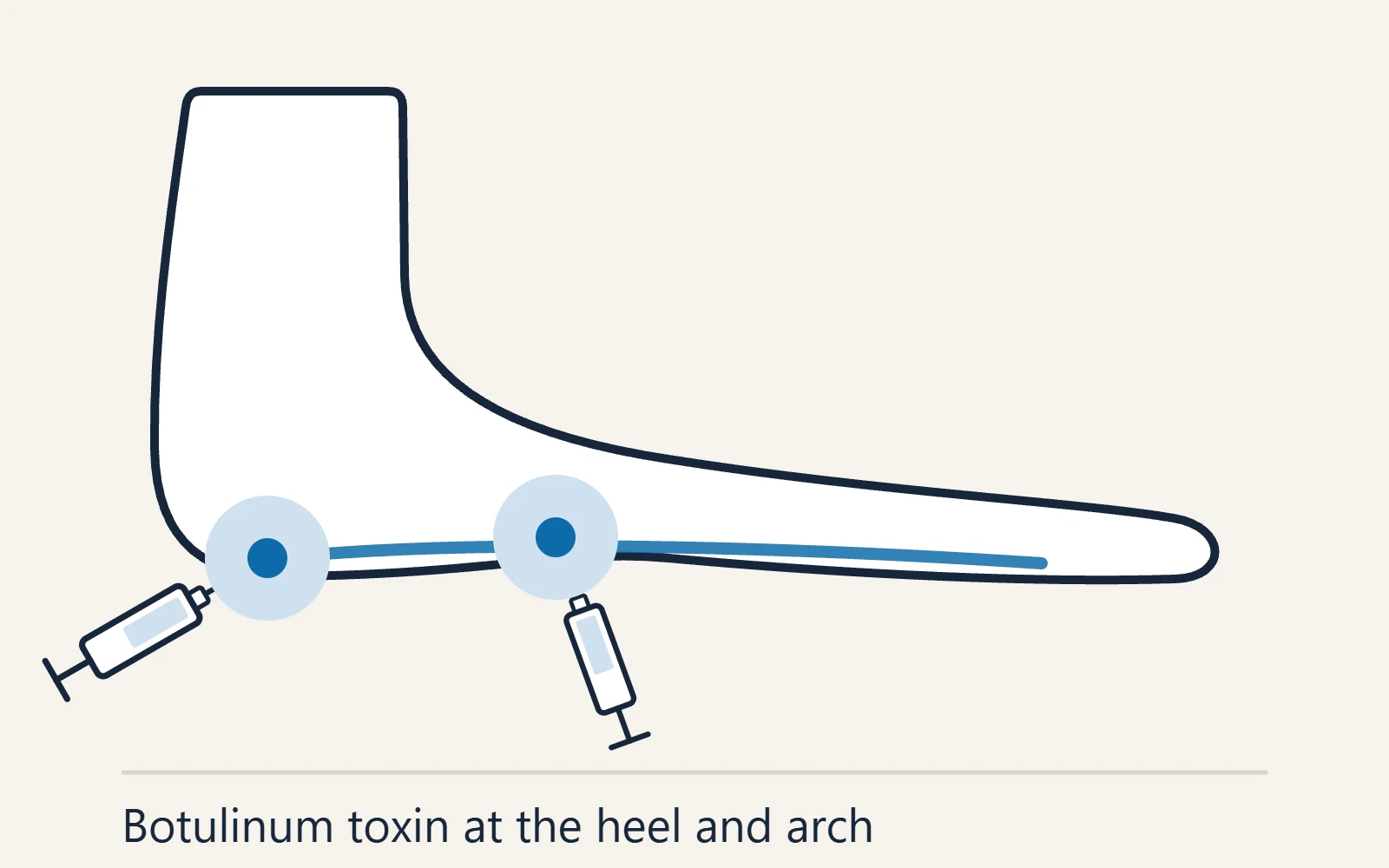
Botox is the best-known brand of botulinum toxin type A, the drug that relaxes muscles by blocking the signal from nerve to muscle. For plantar fasciitis it has been injected at the heel where the fascia attaches, into the small muscles of the arch, or into the calf. No botulinum toxin product is approved by the US Food and Drug Administration for heel pain, so any use for plantar fasciitis is off-label.
The evidence splits in an unusual way. A string of small trials from single clinics found that it helped. The placebo-controlled trials run by drug makers, including the largest trial of all, found no clear benefit over a placebo injection, and the biggest was never published in a journal. Here is what each side shows, and where that leaves an injection that can cost several hundred dollars and is rarely covered.
On this page
How it might work
What botulinum toxin does to muscle is well established: it stops the nerve from releasing the chemical that makes the muscle contract, so the injected muscle relaxes for roughly three months. How that would help plantar fasciitis is less clear. Three ideas have been put forward:
- Relaxing the calf. A tight calf pulls the heel and loads the fascia, so weakening it with an injection might take some tension off. Two small trials that injected only the calf reported good results, but a manufacturer trial that injected the calf as well as the foot found no benefit, and no trial has shown that calf relaxation is the reason.
- Relaxing the arch muscles. The small muscles under the arch sit next to the nerves of the heel, and relaxing them might ease pressure on those nerves. That has not been tested directly.
- Dulling pain directly. Animal studies and trials in nerve pain suggest the toxin can dull pain separately from its effect on muscle, but that has not been shown in plantar fasciitis.
One detail should make anyone cautious. Several positive trials reported benefits a full year after a single injection, long after the drug’s effect on muscle should have worn off. Natural recovery, stretching and the placebo effect explain much of the improvement in both groups; a gap that persists a year later in small trials may reflect chance or bias, and the larger trials found no gap even at eight weeks.
What the evidence shows
About a dozen randomised trials have been published, most giving the toxin to fewer than 40 people, with different products, doses and injection sites. The trials against a placebo matter most, because placebo injections themselves help plantar fasciitis in trials: in the largest trial, pain fell by 45% with a dummy injection alone.
| Study | Who and what | Result |
|---|---|---|
| Babcock 2005, 27 patients | 43 feet. 70 units into the heel and arch, or salt water; people with pain in both heels had the toxin in one foot and salt water in the other. | Better than placebo on pain and foot function at three and eight weeks. |
| Huang 2010, 50 patients | 50 units of Botox into the fascia under ultrasound, or salt water. | Pain fell from 5.9 to 2.0 out of 10 at three months, against 5.4 to 5.2 with placebo. |
| Ahmad 2017, 50 patients | Xeomin, a botulinum toxin, or salt water, followed for a year. One surgeon’s practice; Merz, which makes Xeomin, is listed as a collaborator. | Pain fell from 7.2 to 3.6 at six months, against 8.4 to 7.9 with placebo. |
| Abbasian 2020, 32 patients | Toxin into the calf muscle under ultrasound, or salt water. 28 of the 32 were analysed. | At a year, pain fell from 8 to 0.33 out of 10, against 7.8 to 4 with placebo. |
| Peterlein 2012, 40 patients | Sponsored by Ipsen, which makes Dysport. 200 units of Dysport into the heel, or salt water, at several German centres. | 25% of the toxin group and 5% of the placebo group improved by half or more at six weeks, a difference that was not statistically significant. |
| Revance 2020, 155 patients | Run by Revance, which makes Daxxify, at US centres, finishing in 2020. Two doses of its toxin, or a placebo. | First-step pain fell by about 3.3 points at both doses and by 2.75 with placebo at eight weeks; neither dose beat placebo. The results were posted on ClinicalTrials.gov in 2023, not published in a journal. |
| Revance 2018, 59 patients | Also run by Revance, at five US centres, finishing in 2018. 240 units of its toxin into the heel, the arch muscles and the calf, or a placebo. | Pain fell by about 42 points out of 100 with the toxin and 39 with placebo at eight weeks, and by 16 weeks the placebo group was slightly ahead. Results were posted on ClinicalTrials.gov in 2023, with no statistical comparison and no journal paper. |
Read those results with care. The positive trials were small, mostly from single clinics, and some have problems on close reading: an imbalance in pain between the groups at the start, a statistic that does not match the trial’s own numbers, or a placebo group that barely improved when salt water usually helps. The trials run by the manufacturers were multicentre, and they were negative.
This is not a case of nobody paying for the research. Two drug makers, Ipsen and Revance, ran multicentre placebo-controlled trials, and none showed a clear benefit; the one positive trial with a drug maker’s backing came from a single surgeon’s practice. The pooled analyses that rank Botox highly are built on the small positive trials, and none that we found included the unpublished 155-patient trial. They also disagree on how long any benefit lasts: a 2024 analysis of seven trials found a pain benefit over control only at one month (function stayed better for a year), while a 2026 network analysis of 63 trials ranked the toxin best only in the first six weeks, with “no sustained superiority” over other treatments after about three months, when PRP did better.
Botox, a cortisone shot, PRP or shockwave?
- Against a cortisone shot, several small trials found mixed early results and the toxin ahead at six months or later. But the most carefully designed of them, a double-blind trial comparing the toxin, a steroid and a numbing injection alone, found no difference between the three at six months, and a Cochrane review rated the evidence comparing the toxin with steroid as very low quality. In the one trial that measured it, the toxin did not thin the heel’s fat pad over three months; thinning is a known risk of steroid injections, but no trial has compared the two. See cortisone shots for plantar fasciitis.
- Against PRP, a 2024 trial of 59 patients found the toxin better at one month and PRP better over the longer term. See PRP for plantar fasciitis.
- Against shockwave, a trial of 72 patients found shockwave eased first-step pain more in the short term. Shockwave also has several large sham-controlled trials behind it, most of them positive, though two large early ones were not. See shockwave therapy for plantar fasciitis.
What the injection is like
- One session. Almost every trial used a single treatment session, sometimes split between two or more points in the foot or calf.
- The dose. Typically 50 to 100 units of Botox or Xeomin, or 200 units of Dysport. Units are not interchangeable between brands, so the number alone does not tell you the strength.
- The site. The heel where the fascia attaches, the small muscles of the arch, or the calf, depending on the doctor’s approach. The more recent trials used ultrasound to guide the needle.
- Afterwards. Many trials kept patients stretching, and the loading work still matters: there is no evidence the toxin strengthens the fascia. In the two small placebo-controlled trials that checked at three weeks, the toxin group was already doing better; the manufacturers’ trials found no clear difference at any visit.
Risks, and who should not have it
In the foot trials, side effects were few: no serious problem was linked to the injection, and pain at the injection site was no more common than with placebo. In one manufacturer trial, muscle weakness was reported in 2 of 30 people given the toxin and 1 of 29 given placebo, and numbness in 4 of 30 against none. Only about 500 people have had it in all the trials put together, so rarer problems cannot be ruled out, and little is known about what weakening the arch or calf muscles does to how you push off when you walk.
The boxed warning. Every US botulinum toxin product carries the FDA’s most serious warning: the effect can spread beyond the injection site, causing weakness, double vision, drooping eyelids, or trouble swallowing, speaking or breathing, hours to weeks after an injection. Swallowing or breathing problems can be life-threatening. It is rare, but get urgent care if any of those happen.
- Do not have it if you are allergic to any botulinum toxin product, or if there is infection at the injection site. Dysport may contain traces of cow’s milk protein.
- Tell the doctor first if you are pregnant, trying to conceive or breastfeeding; have a nerve or muscle disorder such as myasthenia gravis; have a bleeding disorder or take blood thinners; take muscle relaxants or aminoglycoside antibiotics; or have had any botulinum toxin treatment, including cosmetic, in the past three months.
- Diabetes with reduced feeling in the feet is a reason to have the heel examined carefully before any injection, because the cause and the risks are different.
- Make sure the diagnosis is right. Heel pain from a trapped nerve, a stress fracture, a thinned fat pad or a torn fascia needs a different plan.
Cost and insurance
Expect to pay yourself. Aetna lists botulinum toxin as experimental for plantar fasciitis, Cigna’s policies for Botox, Dysport and Xeomin treat any use not on their covered lists, which do not include plantar fasciitis, as not medically necessary, and none of the Medicare contractors’ coverage rules include it, including the one covering Michigan.
We found no reliable published price. For scale, Medicare’s own payment limit for the drug alone works out at about $650 for a 100-unit vial of Botox, and foot doses of 50 to 100 units usually use one vial. The injection fee and any ultrasound guidance come on top, so ask for a written, all-in price first.
Where it fits
On the evidence, Botox is not a first- or second-line treatment for plantar fasciitis. The basics come first: stretching, the high-load heel raise programme, the right shoes and inserts, given a proper three months. Then the better-supported second-line options: shockwave, which has the strongest trials, or PRP. For heel pain that has still not settled, Tenex or surgery may be discussed.
If you have tried the proven steps properly and a doctor suggests Botox, it is a reasonable thing to discuss, as long as you go in knowing three things: the largest trials were negative, the relief may last only weeks to a few months, and you will probably be paying for it yourself. The treatment ladder sets out the order in full.
Before you pay for an injection. Dr. Tom’s free 14-day plan from The Heel Pain Playbook gets the first-line steps going in the order he uses in clinic, with a tracker for your first-step pain to bring to the appointment. Get the free 14-day plan.
Common questions
Does Botox work for plantar fasciitis?
The evidence is mixed. Several small trials found it eased pain more than a placebo injection, but the placebo-controlled trials run by drug makers, including the largest at 155 patients, found no clear benefit. Pooled analyses of the small trials disagree on how long any advantage lasts, and none includes the largest trial.
Is Botox for plantar fasciitis FDA approved?
No. No botulinum toxin product is approved by the FDA for plantar fasciitis or heel pain, so it is used off-label.
Where is Botox injected for plantar fasciitis?
The trials used three sites: the heel where the fascia attaches, the small muscles of the arch, and the calf muscle. Some split the dose between the heel and the arch. Recent trials used ultrasound to guide the needle.
How long does Botox last for plantar fasciitis?
The toxin’s effect on muscle usually wears off in about three months. Some small trials reported relief lasting a year. Pooled analyses disagree: one found a pain benefit only at one month, others report benefit lasting six to twelve months, but all of them pool the same small positive trials, and none includes the negative 155-patient trial.
Is Botox better than a cortisone shot for plantar fasciitis?
Some small trials favoured Botox at six months or later, but the best-designed comparison found no difference between Botox, a steroid and a numbing injection alone at six months, and a Cochrane review rated the evidence very low quality. A cortisone shot is far cheaper and usually covered by insurance.
Is Botox or PRP better for plantar fasciitis?
In the one trial comparing them, the toxin did better at one month and PRP did better over the longer term. PRP also has more trials behind it. See PRP for plantar fasciitis.
Does insurance cover Botox for plantar fasciitis?
Rarely. Aetna lists it as experimental for plantar fasciitis, Cigna treats any use of Botox, Dysport or Xeomin not on its covered lists, which do not include plantar fasciitis, as not medically necessary, and Medicare’s coverage rules do not include it. Expect to pay yourself and ask for an all-in price.
What are the side effects of Botox in the foot?
In the trials, side effects were uncommon: occasional muscle weakness or numbness, and injection pain no more often than with placebo. Like every botulinum toxin, it carries a warning that the effect can rarely spread beyond the injection site and cause weakness or trouble swallowing or breathing.
Related heel pain guides
- The plantar fasciitis treatment ladder
- Cortisone shots: what they buy you
- PRP injections for plantar fasciitis
- Shockwave therapy for plantar fasciitis
- Tenex for plantar fasciitis
- Laser therapy for plantar fasciitis
- Plantar fasciitis exercises (printable)
- How long plantar fasciitis lasts
- Heel pain quiz
Weighing an injection, in Michigan?
Dr. Tom Biernacki sees heel pain that has outlasted the basics at Balance Foot & Ankle. He examines the heel to confirm what is causing it and tells you which injection or procedure, if any, is worth your money.
Howell — 4330 E Grand River Ave, Howell, MI 48843
Bloomfield Township — 43494 Woodward Ave #208, Bloomfield Township, MI 48302
Monday to Thursday, 9:00am–4:30pm; Friday, 9:00am–2:30pm · (810) 206-1402
Further reading
- Babcock MS, Foster L, Pasquina P, Jabbari B. Treatment of pain attributed to plantar fasciitis with botulinum toxin A: a short-term, randomized, placebo-controlled, double-blind study. American Journal of Physical Medicine & Rehabilitation. 2005;84(9):649–654. doi:10.1097/01.phm.0000176339.73591.d7
- Huang YC, Wei SH, Wang HK, Lieu FK. Ultrasonographic guided botulinum toxin type A treatment for plantar fasciitis: an outcome-based investigation for treating pain and gait changes. Journal of Rehabilitation Medicine. 2010;42(2):136–140. doi:10.2340/16501977-0491
- Ahmad J, Ahmad SH, Jones K. Treatment of plantar fasciitis with botulinum toxin. Foot & Ankle International. 2017;38(1):1–7. doi:10.1177/1071100716666364
- Abbasian M, Baghbani S, Barangi S, et al. Outcomes of ultrasound-guided gastrocnemius injection with botulinum toxin for chronic plantar fasciitis. Foot & Ankle International. 2020;41(1):63–68. doi:10.1177/1071100719875220
- Elizondo-Rodriguez J, Araujo-Lopez Y, Moreno-Gonzalez JA, Cardenas-Estrada E, Mendoza-Lemus O, Acosta-Olivo C. A comparison of botulinum toxin A and intralesional steroids for the treatment of plantar fasciitis: a randomized, double-blinded study. Foot & Ankle International. 2013;34(1):8–14. doi:10.1177/1071100712460215
- Peterlein CD, Funk JF, Hölscher A, Schuh A, Placzek R. Is botulinum toxin A effective for the treatment of plantar fasciitis? Clinical Journal of Pain. 2012;28(6):527–533. doi:10.1097/AJP.0b013e31823ae65a
- Revance Therapeutics. DaxibotulinumtoxinA for Injection for the Treatment of Plantar Fasciitis (NCT03825315). ClinicalTrials.gov; results first posted 21 September 2023. clinicaltrials.gov
- Revance Therapeutics. Revance announces results of phase 2 trial of daxibotulinumtoxinA for injection in plantar fasciitis. Press release, Business Wire, 9 November 2020. businesswire.com
- Revance Therapeutics. Phase 2 DaxibotulinumtoxinA for Injection for the Management of Plantar Fasciitis (NCT03137407). ClinicalTrials.gov; results first posted 28 August 2023. clinicaltrials.gov
- Díaz-Llopis IV, Rodríguez-Ruíz CM, Mulet-Perry S, Mondéjar-Gómez FJ, Climent-Barberá JM, Cholbi-Llobel F. Randomized controlled study of the efficacy of the injection of botulinum toxin type A versus corticosteroids in chronic plantar fasciitis: results at one and six months. Clinical Rehabilitation. 2012;26(7):594–606. doi:10.1177/0269215511426159
- Elizondo-Rodríguez J, Simental-Mendía M, Peña-Martínez V, Vilchez-Cavazos F, Tamez-Mata Y, Acosta-Olivo C. Comparison of botulinum toxin A, corticosteroid, and anesthetic injection for plantar fasciitis. Foot & Ankle International. 2021;42(3):305–313. doi:10.1177/1071100720961093
- Ahadi T, Nik SS, Forogh B, Madani SP, Raissi GR. Comparison of the effect of ultrasound-guided injection of botulinum toxin type A and corticosteroid in the treatment of chronic plantar fasciitis: a randomized controlled trial. American Journal of Physical Medicine & Rehabilitation. 2022;101(8):733–737. doi:10.1097/PHM.0000000000001900
- David JA, Sankarapandian V, Christopher PR, Chatterjee A, Macaden AS. Injected corticosteroids for treating plantar heel pain in adults. Cochrane Database of Systematic Reviews. 2017;6:CD009348. doi:10.1002/14651858.CD009348.pub2
- Roca B, Mendoza MA, Roca M. Comparison of extracorporeal shock wave therapy with botulinum toxin type A in the treatment of plantar fasciitis. Disability and Rehabilitation. 2016;38(21):2114–2121. doi:10.3109/09638288.2015.1114036
- Ruiz-Hernández IM, Gascó-Adrien J, Buen-Ruiz C, et al. Botulinum toxin A versus platelet rich plasma ultrasound-guided injection in the treatment of plantar fasciitis: a randomised controlled trial. Foot and Ankle Surgery. 2024;30(2):117–122. doi:10.1016/j.fas.2023.10.004
- Li Q, Zhang J, Sun J, Gao C, Zhao J. Therapeutic efficacy and safety of botulinum toxin A injection in plantar fasciitis: a systematic review and meta-analysis. PLoS One. 2024;19(12):e0312908. doi:10.1371/journal.pone.0312908
- Tien CH, Chiu MC, Shen YL, Ko YC, Lee JJ. Comparative effectiveness of minimally invasive therapies for plantar fasciitis: a systematic review and network meta-analysis. Scientific Reports. 2026;16(1):9074. doi:10.1038/s41598-026-40038-z
- Wang Z, Zhang Y, Yuan J, et al. Comparative efficacy of six injection therapies for plantar fasciitis: a systematic review and network meta-analysis. International Journal of Surgery. 2026;112(2):5172–5189. doi:10.1097/JS9.0000000000003926
- Peña-Martínez VM, Acosta-Olivo C, Tamez-Mata Y, et al. Normal saline injection produces a therapeutic effect in patients with plantar fasciitis: a systematic review and meta-analysis of randomized controlled trials. Foot and Ankle Surgery. 2022;28(8):1129–1138. doi:10.1016/j.fas.2022.04.005
- BOTOX (onabotulinumtoxinA) prescribing information, including the boxed warning on distant spread of toxin effect. DailyMed, US National Library of Medicine. dailymed.nlm.nih.gov
- DYSPORT (abobotulinumtoxinA) prescribing information, including the boxed warning and the cow’s milk protein contraindication. DailyMed, US National Library of Medicine. dailymed.nlm.nih.gov
- Aetna. Plantar fasciitis treatments. Clinical Policy Bulletin 0235, last reviewed 27 April 2026. aetna.com
- Cigna. Drug coverage policies: Botox (IP0637, effective 15 May 2026), Dysport (IP0638) and Xeomin (IP0639). Botox · Dysport · Xeomin
- Wisconsin Physicians Service (the Medicare contractor for Michigan). Local Coverage Determination L39909: Botulinum Toxin Injections. Medicare Coverage Database, Centers for Medicare & Medicaid Services. cms.gov
- Centers for Medicare & Medicaid Services. October 2026 Medicare Part B payment limit files (average sales price). cms.gov
This page is education, not a diagnosis. Read our editorial policy for how it was written and what it will not claim.