Plantar fasciitis
Plantar fasciitis symptoms: the 6 signs, and what else it could be
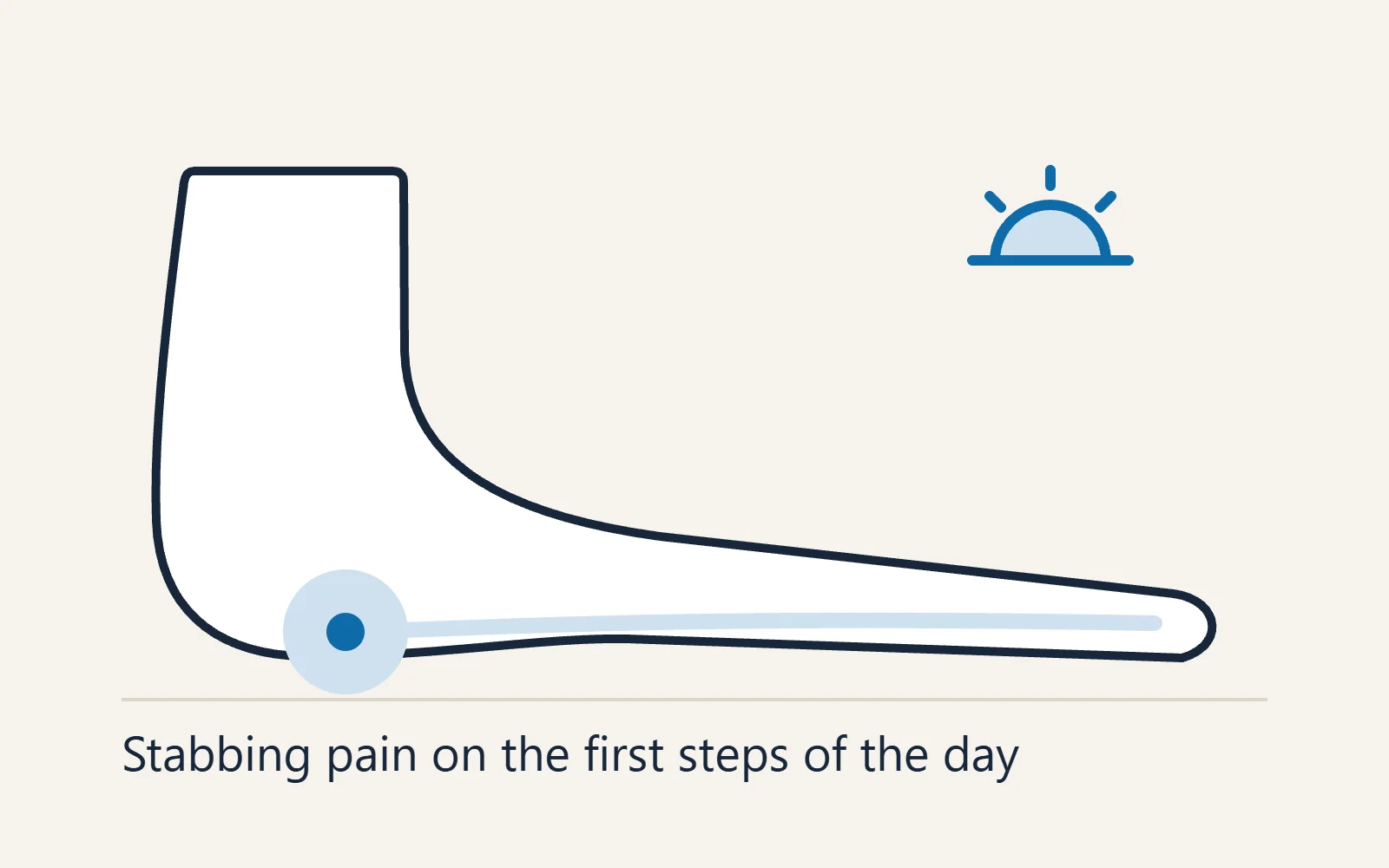
Plantar fasciitis has a pattern you can usually recognize: a stabbing pain under the heel on the first steps of the day that eases as you walk. Here are the six signs, and the symptoms that point somewhere else.
Plantar fasciitis is the most common cause of heel pain in adults. The plantar fascia is the thick band that runs from the heel to the toes, and the pain comes from where it attaches to the heel bone.
Most people with it have several of the six signs below. If your pain doesn’t fit them, the table further down shows the conditions that imitate plantar fasciitis, and the clue for each.
On this page
The six signs
Plantar fasciitis has a very recognizable pattern. Most people have several of these:
- Sharp, stabbing pain under the heel, toward the inner front edge, where the plantar fascia attaches.
- Worst on the first steps in the morning or after sitting for a while.
- Eases after a few minutes of walking, then aches again after long standing or at the end of the day.
- Hurts more after exercise than during it.
- A tender spot you can find by pressing the inner underside of the heel. Bending the big toe up can bring on the pain too.
- Usually one foot, coming on gradually, often after a jump in standing or activity, unsupportive shoes or recent weight gain. Both feet can be affected.
Some people also feel stiffness, mild swelling around the heel or a tight calf. Numbness, tingling or burning are not typical, and they point elsewhere.

What else it could be
If something about your heel doesn’t fit the six signs, it may be one of the conditions that imitate plantar fasciitis:
| If you notice | It points to | Read more |
|---|---|---|
| Burning, tingling or numbness | A trapped nerve (Baxter’s nerve, tarsal tunnel) | Heel nerve pain |
| Pain that builds with activity and later aches at rest; squeezing the heel hurts | A calcaneal stress fracture | Heel stress fracture |
| A deep, bruise-like ache in the middle of the heel pad | A thin or bruised fat pad | Heel fat pad atrophy |
| A sudden pop, then sharp pain and bruising | A plantar fascia tear | Plantar fascia tear |
| Pain behind the heel, not underneath | The Achilles tendon or a bursa | Back of heel pain |
| Both heels, with long morning stiffness in the back or other joints | Inflammatory arthritis | Inflammatory heel pain |
| A child aged about 8 to 14 | Sever’s disease | Sever’s disease |
| A heel spur on an X-ray | Usually nothing on its own: most people with a spur have no pain | Plantar fasciitis vs heel spurs |
Not sure which one you have? The heel pain quiz walks through where it hurts and when, and pain on the bottom of the heel compares the six causes under the heel side by side.
Who gets it
About one person in ten gets plantar fasciitis at some point, and more than 2 million people a year are treated for it in the US. It is most common between 40 and 60.
The risk is higher with jobs spent standing or walking on hard floors, running and jumping sports, extra body weight, tight calves, unsupportive shoes and walking barefoot at home.
How long it lasts
Symptoms usually start to improve within weeks of the right treatment, though full healing can take a few months. About 80% of people are better within a year, and one estimate puts it above 90% within 10 months. See how long plantar fasciitis lasts and plantar fasciitis treatment.
When to see a podiatrist
Most plantar fasciitis settles with simple care, but some signs mean it is worth an exam rather than more home treatment.
See a podiatrist if any of these apply.
The pain lasts more than a week without easing on its own, or isn’t better after two weeks of home treatment.
It feels different from the pattern above, or keeps getting worse.
It burns, tingles or feels numb.
It aches at rest or started with a pop or an injury.
The heel is badly swollen, red or warm.
Both heels hurt and your back or other joints are stiff too.
Diabetes or numb feet, with any new heel pain.
More detail is in when to worry about heel pain.
Watch
In under a minute, Dr. Biernacki compares plantar fasciitis with two of the rows in the table above, a heel spur and a heel stress fracture: what each one feels like, and which is really causing the pain.
Common questions
Will plantar fasciitis go away on its own?
Often, but slowly. It tends to settle with time, and about 80% of people are better within a year. The right home treatment shortens it, and leaving it alone risks chronic pain and a changed walk that strains the knees, hips or back.
What can be mistaken for plantar fasciitis?
A trapped nerve, a stress fracture, a thin heel pad, a tear of the fascia and inflammatory arthritis all cause pain under the heel. The table above shows the clue for each.
Does plantar fasciitis cause swelling?
Sometimes there is mild swelling around the heel. Marked swelling, redness or warmth is not typical and needs an exam.
Does plantar fasciitis hurt at night?
It mainly hurts when you stand up and after long standing. Pain that aches at rest or wakes you is not typical and is worth getting checked.
Can plantar fasciitis cause arch or ankle pain?
The pain can run along the arch. Ankle pain is less typical; see plantar fasciitis and ankle pain.
What is the best treatment for plantar fasciitis?
There isn’t one best treatment, and foot surgeons’ guidance is to fit the plan to the person. Most people improve with simple care: plantar fascia stretches, a cushioned heel pad or off-the-shelf insert, less standing on hard floors, and ice or a short course of anti-inflammatories. About 80% are better within a year without surgery. If it isn’t improving after about three months, a podiatrist can add options such as shock wave therapy. See what actually treats it.
What is the fastest way to get rid of plantar fasciitis?
There is no overnight fix. For most people, the quickest progress comes from a daily plantar fascia stretch, a cushioned insert and less time on your feet. In one trial, heel pain fell by about half within eight weeks of that stretch. Taping can ease pain within a week, and a steroid injection can give short-term relief, but neither fixes the cause, and repeated injections carry a small risk of tearing the fascia. More in how to cure plantar fasciitis in one week.
- Trojian T, Tucker AK. Plantar Fasciitis. American Family Physician, 2019;99(12):744–750.
- Cleveland Clinic. Plantar Fasciitis.
- Mayo Clinic. Plantar fasciitis: symptoms and causes.
- American Academy of Orthopaedic Surgeons, OrthoInfo. Plantar Fasciitis and Bone Spurs.
Related heel pain guides
Plantar fasciitis: the full guide, from what causes it to what treats it.
- Pain on the bottom of the heel
- Heel pain when walking
- Heel pain in the morning
- Plantar fasciitis treatment
- Plantar fasciitis exercises
- How long plantar fasciitis lasts
- Plantar fasciitis vs heel spurs
- Heel pain quiz
Heel pain in Michigan?
Dr. Biernacki sees heel pain at Balance Foot & Ankle in Howell and Bloomfield Township. If your symptoms don’t fit the six signs, or haven’t eased after a few weeks of home care, an exam can tell plantar fasciitis apart from the conditions that imitate it.
This page is education, not a diagnosis. Read our editorial policy for how it was written and what it will not claim.