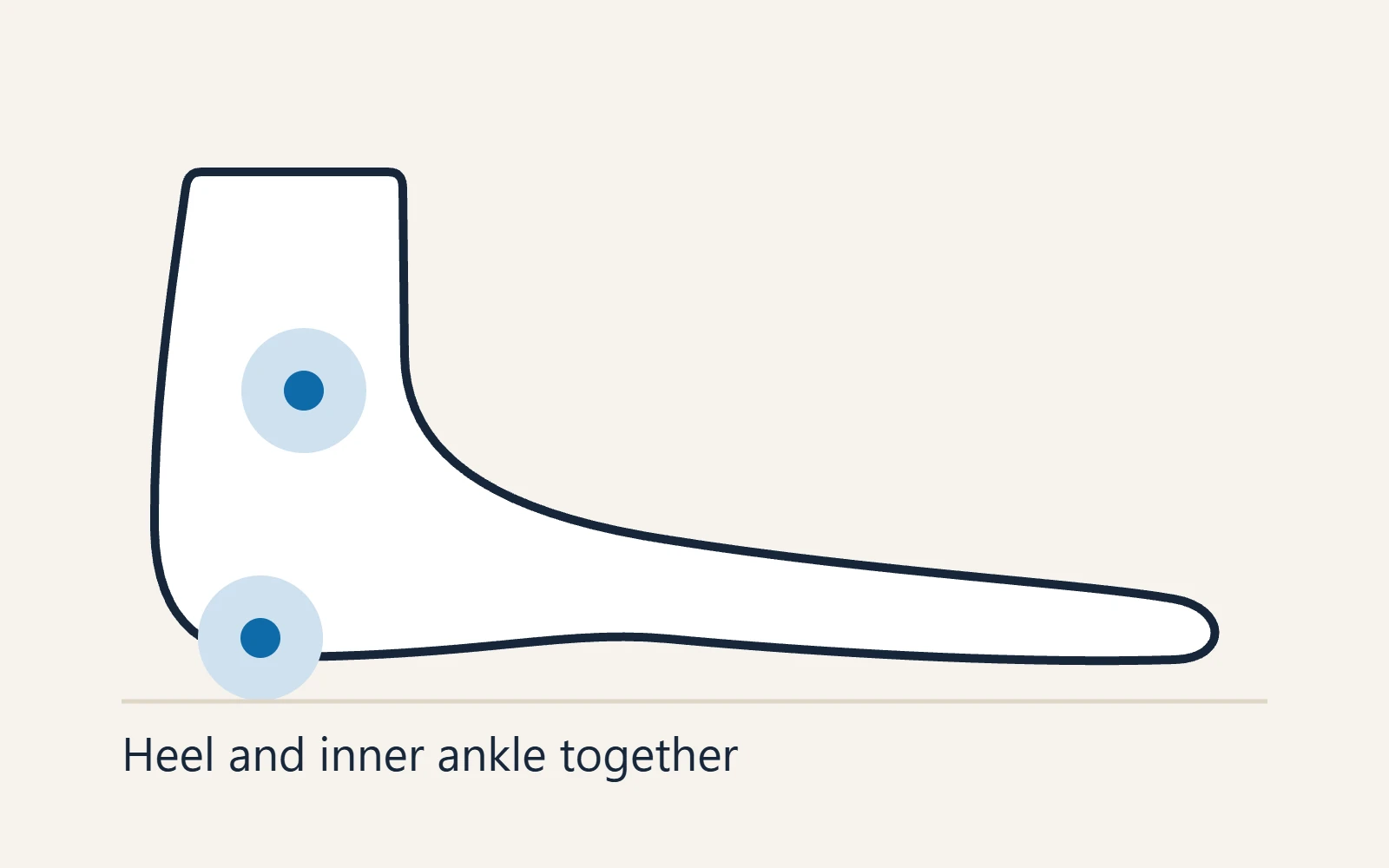
Heel pain symptoms
Can plantar fasciitis cause ankle, calf, knee or side of foot pain?
Plantar fasciitis itself hurts under the heel and sometimes along the arch. It does not spread to the ankle or the knee, but the way you walk on a sore heel can make them ache, and a few other conditions are easily mistaken for it.
The short answer is: indirectly, yes. Plantar fasciitis changes how you stand and walk, and the ankle, the calf, the outer edge of the foot and the knee pick up the extra work. The same foot mechanics that overload the fascia, a stiff ankle or a flattening arch, can also strain the ankle directly. And sometimes the ankle pain is the clue that the heel pain was never plantar fasciitis at all.
On this page
Where plantar fasciitis hurts
Plantar fasciitis hurts on the underside of the heel, usually towards the inner side, at a spot you can often cover with a fingertip. It can spread a little forward along the arch. It is typically sharpest on the first steps after sleep or sitting, and eases as you walk. Pain that is mainly in the ankle, or burning and tingling that runs into the sole, has a different explanation, covered below.
Can plantar fasciitis cause ankle pain?
Not directly, but there are three common links:
- You walk differently. To keep weight off the sore spot, most people roll onto the outside of the foot or push off early. Weeks of that strain the ankle and the tendons around it, which ache in their own right.
- Shared foot mechanics. A stiff ankle is one of the strongest risk factors for plantar fasciitis: in one study, people whose ankle could not bend upwards past neutral were far more likely to have it. Flat feet and an unstable ankle are also linked with it. The same mechanics that overload the fascia can make the ankle sore.
- A neighbouring problem. Pain on the inner ankle with a collapsing arch can come from the tendon that supports the arch. Pain on the outer side of the ankle with a feeling of giving way can come from the joint just below the ankle. Both deserve their own assessment.
Does plantar fasciitis cause ankle swelling?
Not usually. Plantar fasciitis rarely causes visible swelling: the fascia thickens, and the underside of the heel can feel a little puffy, but the ankle does not swell from it. A swollen ankle has a cause of its own, and the pattern points to it:
- After a twist, or with an ankle that gives way: a sprain or ankle instability.
- Along the inner ankle, with the arch slowly flattening: the tendon that holds up the arch, which needs its own assessment.
- A hot, red, painful joint: gout, another inflammatory arthritis or an infection, especially with a fever. Get it seen promptly.
- Both ankles, worse by the evening: fluid collecting in the lower legs, from long periods of standing or sitting, pregnancy, some medicines, or vein, heart, kidney or liver problems. Mention it to your doctor, and get emergency help if you are also short of breath or have chest pain.
- One leg swollen, warm and tender: a possible blood clot. Get it checked the same day.
Side of foot pain
The outside of the foot is where most people shift their weight to spare a painful heel, so aching along the outer edge is common. It usually settles as the heel improves and you walk normally again. A sharp spot on the outer foot that hurts more and more with walking is different, because a bone stress injury there needs checking.
The inside of the foot and arch can hurt from the fascia itself, which runs the length of the arch. Burning, tingling or numbness on the inner side of the heel or sole is different: that suggests a nerve, including tarsal tunnel syndrome behind the inner ankle or Baxter’s nerve under the heel.
Calf pain
A tight calf and plantar fasciitis often go together. The calf pulls on the heel through the Achilles tendon, and a calf tight enough to stop the ankle bending upwards is one of the main risk factors for plantar fasciitis. That tightness can ache in its own right, especially after a long day on your feet.
Guarding the heel adds to it. Many people with a sore heel shift their weight forwards onto the ball of the foot, which makes the calf work harder with every step, so it can feel tired, tight or crampy. Calf stretches with the knee straight and bent, done most days, help the calf and the heel together.
Calf pain that does not fit this pattern needs its own check: a swollen, warm, tender calf, which could be a blood clot and should be seen the same day; cramping in the calf that comes on with walking and goes away after a few minutes of rest, a sign of narrowed leg arteries (peripheral artery disease); or a sudden pop, or a feeling of being kicked in the back of the leg, which can be a calf tear or an Achilles rupture.
Knee, hip and back pain
Plantar fasciitis does not cause knee disease. A limp, though, changes how load travels up the leg, and months of limping can leave the knee, the hip or the lower back aching on either side. The fix is to treat the heel well enough that you stop limping, rather than to treat each joint separately. If the knee is swollen, locking or giving way, it has its own problem and needs its own assessment.
When it is something else
| If you notice | Think about |
|---|---|
| Heel and inner ankle pain with burning, tingling or numbness | Tarsal tunnel syndrome |
| Pain at the back of the heel and above it, rather than underneath | Achilles tendonitis or another back-of-heel cause |
| Both heels, other joints stiff or swollen, long morning stiffness | Inflammatory heel pain |
| Heel pain that builds through the day and hurts when squeezed | Heel stress fracture |
| A swollen ankle after a twist, or an ankle that keeps giving way | An ankle sprain or instability, which needs its own assessment |
| A swollen, warm, tender calf | A possible blood clot: get it checked the same day |
| Calf cramps that come on with walking and ease after a few minutes of rest | Narrowed leg arteries (peripheral artery disease): see your doctor |
What helps
- Treat the heel so you stop limping. Supportive shoes indoors and out, an insert with arch support, and the plantar fascia stretch and strengthening exercises. The treatment plan has the full sequence.
- Work on ankle mobility. Calf stretches with the knee straight and bent, most days. A stiff ankle loads both the fascia and the joints above it.
- Reduce the load while you limp. If you cannot walk without limping, shorten the walks until you can. A limp repeated for miles is what spreads the ache.
- Get the ankle checked if it swells, gives way, or hurts more than the heel.

If it starts under the heel, start there. Dr. Tom’s free 14-day plan from The Heel Pain Playbook opens with a 60-second safety check and a pain map, then the five moves for the heel and calf, with photos and a tracker. Get the free 14-day plan.
Common questions
Can plantar fasciitis cause ankle pain?
Indirectly. Plantar fasciitis stays in the heel and arch, but limping on it strains the ankle, and the same stiff ankle or flattening arch that overloads the fascia can make the ankle ache too. Burning or tingling around the inner ankle points to a nerve instead, and swelling or giving way points to an ankle problem of its own.
Can plantar fasciitis cause pain on the side of the foot?
Yes, usually on the outside, because people shift their weight onto the outer edge to spare the heel. It should ease as the heel improves. A sharp, worsening spot on the outer foot, or burning on the inner side, should be checked.
Can plantar fasciitis cause knee pain?
Not directly. Limping for weeks changes how the knee is loaded, so it can ache. Treat the heel so you walk normally again. A swollen, locking or unstable knee has its own cause.
Can plantar fasciitis spread up the leg?
No. The plantar fascia runs from the heel to the toes and the problem stays there. Pain higher up comes from compensation, from a shared cause such as a tight calf, or from a separate problem.
Why do my heel and ankle both hurt?
Most often because the heel is being guarded and the ankle is working harder, or because a stiff ankle and a flattening arch are loading both. If there is burning or tingling, a nerve such as the one in the tarsal tunnel is a possibility. If both heels and other joints hurt, inflammatory arthritis is worth ruling out.
Can plantar fasciitis cause calf pain?
It can be part of the same picture. A tight calf is one of the main risk factors for plantar fasciitis, and shifting your weight forwards to spare the heel makes the calf work harder, so it can ache or cramp. Calf stretches help both. A swollen, warm, tender calf, or calf pain that comes on with walking and eases with rest, needs to be checked.
Can plantar fasciitis cause ankle swelling?
Not usually. The underside of the heel can feel a little puffy, but a swollen ankle has another cause: a sprain, a tendon or joint problem, gout, or fluid collecting in the lower legs. Swelling in one leg that is warm and tender should be checked the same day for a blood clot.
Does an ankle brace help plantar fasciitis?
Not much on its own. Most braces sold for plantar fasciitis are ankle sleeves or wraps that add compression, and they do little to take load off the fascia. The better-studied options are an insert with arch support and, if the first steps of the morning are the worst, a night splint, although the evidence for both is mixed. A lace-up ankle brace is for an ankle that sprains or gives way, which is a separate problem.
Related heel pain guides
- Plantar fasciitis — how to recognise it, and how to be sure that is what you have.
- Tarsal tunnel syndrome — burning and tingling from behind the inner ankle.
- Plantar fasciitis treatment — the plan that gets you walking normally again.
- Heel pain causes by location — working out what you have from where it hurts.
- Back of heel pain — if the pain is behind the heel rather than under it.
- Plantar fasciitis night splint — for when the first steps of the morning are the worst.
- When to worry about heel pain — the signs that need a same-day check.
- Tu P. Heel Pain: Diagnosis and Management. American Family Physician, 2018.
- Allam AE, Chang KV. Plantar Heel Pain. StatPearls, NCBI Bookshelf.
- Riddle DL, Pulisic M, Pidcoe P, Johnson RE. Risk factors for plantar fasciitis: a matched case-control study. Journal of Bone and Joint Surgery, 2003.
- Adler L, Bergman R, Kaiser K. Tarsal Tunnel Syndrome. StatPearls, NCBI Bookshelf.
- Koc TA, et al. Heel Pain – Plantar Fasciitis: Revision 2023. Clinical Practice Guidelines, Journal of Orthopaedic & Sports Physical Therapy.
- Trojian T, Tucker AK. Plantar Fasciitis. American Family Physician, 2019.
- MedlinePlus Medical Encyclopedia. Foot, leg, and ankle swelling. US National Library of Medicine.
- MedlinePlus Medical Encyclopedia. Peripheral artery disease – legs. US National Library of Medicine.
Heel and ankle pain in Michigan?
When the heel and the ankle both hurt, an examination sorts out which is driving which. Dr. Biernacki sees heel pain in Howell and Bloomfield Township.
This page is education, not a diagnosis. Read our editorial policy for how it was written and what it will not claim.