Coding reference
Plantar Fasciitis ICD-10 Code: M67.A0- (Formerly M72.2) and the Heel Codes Around It
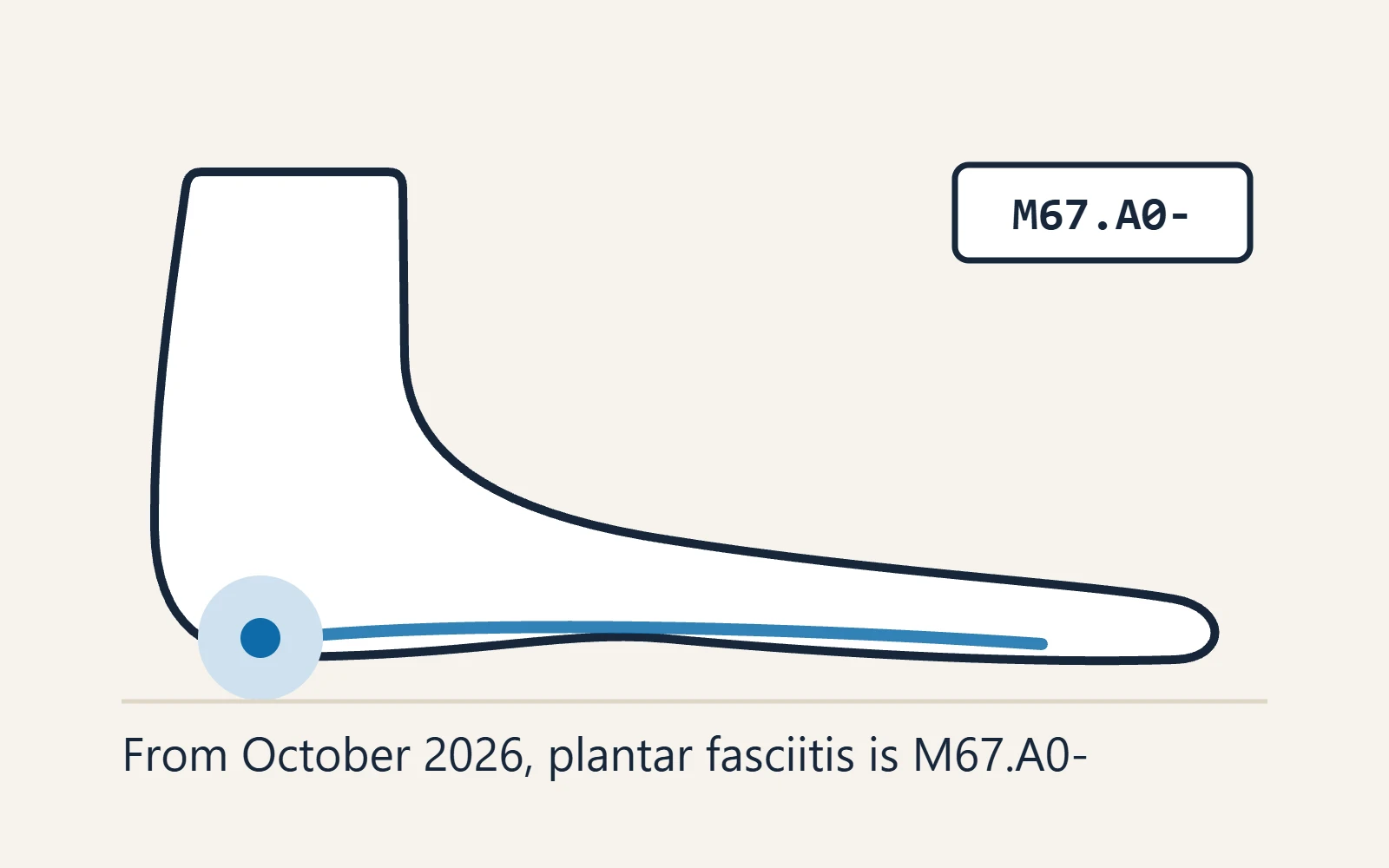
From 1 October 2026, plantar fasciitis has its own ICD-10-CM codes, one for each foot, and M72.2 covers plantar fibromatosis alone. Here are the new codes, the old one and the heel codes around them, checked against the official FY2027 files.
The ICD-10-CM code for plantar fasciitis is M67.A01 for the right foot, M67.A02 for the left foot and M67.A09 when the side is not documented, for services from 1 October 2026. M72.2, which held plantar fasciitis until 30 September 2026, now covers plantar fascial fibromatosis (Ledderhose disease) only and can no longer be reported on its own.
There is no bilateral code: both feet are reported as M67.A01 plus M67.A02. Heel pain without a diagnosis is coded as foot pain (M79.671, M79.672 or M79.673), because ICD-10-CM has no heel pain code. Visits up to 30 September 2026 keep M72.2, because the date of service decides the code set. Found one of these codes on your own paperwork? Skip to what it means for you.
On this page
The plantar fasciitis codes
| Code | Official title (FY2027) | Use it when |
|---|---|---|
| M67.A01 | Plantar fasciitis, right foot | The right foot is affected |
| M67.A02 | Plantar fasciitis, left foot | The left foot is affected |
| M67.A01 and M67.A02 | Both codes, reported together | Both feet are affected; there is no bilateral code |
| M67.A09 | Plantar fasciitis, unspecified foot | The record cannot establish the side and the provider cannot clarify it |
M67.A (Plantar fasciitis) and M67.A0 (Plantar fasciitis, foot) are headings, not reportable codes, and a code short of its full number of characters is invalid (Official Guidelines, Sections I.A.3 and I.B.2). The trailing dash in M67.A0- means exactly that: more characters are needed (I.B.1). The inclusion term “Plantar fasciitis NOS” sits under M67.A09.
When both feet are affected and there is no bilateral code, code each side. The unspecified side should rarely be used: laterality may be taken from another clinician’s note, and conflicting notes are queried (I.B.13). Once one foot has settled, code only the other: conditions that no longer exist are not coded (IV.J).
What happened to M72.2
Until 30 September 2026, plantar fasciitis had no code of its own. It was an inclusion term under M72.2, Plantar fascial fibromatosis, a code with no laterality. The FY2027 addenda separated the two conditions:
- A new subcategory, M67.A Plantar fasciitis, under M67, Other disorders of synovium and tendon, with the codes M67.A01, M67.A02 and M67.A09.
- M72.2 lost the inclusion term “Plantar fasciitis” and gained “Ledderhose disease”.
- M72.2 became a heading over M72.20, M72.21 and M72.22: plantar fascial fibromatosis of the unspecified, right and left foot.
- The Excludes1 note under M72.8 now sends plantar fasciitis to M67.A0-, and so does the index entry “Fasciitis, plantar (foot)”.
The NCHS conversion table lists M72.2 as the previous code for all six new codes, but only the M67.A0- codes describe plantar fasciitis.
The easy mistake is adding a sixth character to M72.2 for plantar fasciitis. M72.21 and M72.22 are valid codes, but for plantar fascial fibromatosis, a different condition.
The date of service decides. HIPAA requires the code set valid when the care is furnished (45 CFR 162.1000), and NCHS applies FY2027 codes to services from 1 October 2026 through 30 September 2027. A visit on 30 September 2026 is M72.2 even if coded in October; from 1 October it is M67.A0-.
Plantar fasciitis or plantar fibromatosis?
The difference used to live only in the note; now it decides the code. The two present differently:
| Plantar fasciitis (M67.A0-) | Plantar fibromatosis, Ledderhose disease (M72.2-) | |
|---|---|---|
| Where | Plantar medial heel, where the fascia attaches to the heel bone | Within the fascia along the arch, usually its medial or central band |
| What the patient notices | Pain on the first steps after rest, and after long periods on the feet | A slow-growing lump in the arch, often painless at first and more painful as it enlarges |
| Key exam finding | Tenderness at the proximal insertion of the fascia, the medial calcaneal tubercle | One or more nodules within the fascia |
The 2023 JOSPT clinical practice guideline lists a proximal plantar fibroma among the alternatives to consider when the picture does not fit or is not resolving. Fibromatosis is diagnosed mainly clinically, with ultrasound or MRI to confirm.
Use the words the index recognises. “Plantar fasciitis” leads to M67.A0-. Plain “fasciitis” leads to M72.9 (Fasciitis NOS), while “plantar fascia syndrome” and “contracture of plantar fascia” lead to M72.2-, the fibromatosis codes. “Plantar fasciopathy” and “fasciosis” are not indexed, so a note using them should also say plantar fasciitis. A patient with both conditions gets both codes: no Excludes note separates them, and coexisting conditions that affect care are coded (IV.J).
Heel pain before a diagnosis
ICD-10-CM has no heel pain code. The index entry for “heel” says only see condition, and pain in the foot leads to M79.67, Pain in foot and toes:
- M79.671 Pain in right foot
- M79.672 Pain in left foot
- M79.673 Pain in unspecified foot
Symptom codes are acceptable while the provider has not established a definitive diagnosis (I.B.4). In outpatient care, a diagnosis written as probable, suspected or rule out is not coded; the symptom is (IV.H). Once plantar fasciitis is confirmed, the pain code goes, because symptoms routinely associated with a disease are not coded separately (I.B.5). M25.57-, Pain in ankle and joints of foot, is a different subcategory, for joint pain.
The heel codes around it
Titles exactly as in the FY2027 code file. Of the ICD-10-CM codes below, the FY2027 update changed only plantar fibromatosis.
| Condition | Codes and official titles | Worth knowing |
|---|---|---|
| Plantar fibromatosis (Ledderhose disease) | M72.21 Plantar fascial fibromatosis, right foot M72.22 Plantar fascial fibromatosis, left foot M72.20 Plantar fascial fibromatosis, unspecified foot |
M72.2, shared with plantar fasciitis, until 30 September 2026 |
| Heel spur | M77.31 Calcaneal spur, right foot M77.32 Calcaneal spur, left foot M77.30 Calcaneal spur, unspecified foot |
A separate diagnosis, and often an incidental X-ray finding (which one hurts) |
| Achilles tendonitis | M76.61 Achilles tendinitis, right leg M76.62 Achilles tendinitis, left leg M76.60 Achilles tendinitis, unspecified leg |
Side is by leg, not foot. Achilles bursitis is an inclusion term; neither “tendinopathy” nor the insertional form has its own index entry |
| Calcaneal bursitis and other foot enthesopathy | M77.51 Other enthesopathy of right foot and ankle M77.52 Other enthesopathy of left foot and ankle M77.50 Other enthesopathy of unspecified foot and ankle |
The index sends “bursitis, calcaneal” here |
| Tarsal tunnel syndrome | G57.51 Tarsal tunnel syndrome, right lower limb G57.52 Tarsal tunnel syndrome, left lower limb G57.53 Tarsal tunnel syndrome, bilateral lower limbs G57.50 Tarsal tunnel syndrome, unspecified lower limb |
Has a bilateral code; entrapment of the posterior tibial nerve indexes here |
| Baxter’s nerve and other plantar nerve lesions | G57.61 Lesion of plantar nerve, right lower limb G57.62 Lesion of plantar nerve, left lower limb G57.63 Lesion of plantar nerve, bilateral lower limbs G57.60 Lesion of plantar nerve, unspecified lower limb |
The index does not name Baxter’s nerve, the first branch of the lateral plantar nerve; “neuropathy, plantar nerves” leads here. Morton’s metatarsalgia is an inclusion term |
| Sever’s disease (calcaneal apophysitis) | M92.61 Juvenile osteochondrosis of tarsus, right ankle M92.62 Juvenile osteochondrosis of tarsus, left ankle M92.60 Juvenile osteochondrosis of tarsus, unspecified ankle |
Inclusion term: Osteochondrosis (juvenile) of calcaneum [Sever]. The index prints calcaneal apophysitis as M92.6 with no dash, but a sixth character is still required |
| Calcaneal stress fracture | M84.374- Stress fracture, right foot M84.375- Stress fracture, left foot M84.376- Stress fracture, unspecified foot |
Needs a seventh character (below). A traumatic heel bone fracture is S92.0-, Fracture of calcaneus, which M84.3 excludes |
| Plantar fasciitis in ICD-9-CM | 728.71 Plantar fascial fibromatosis | Historical: ICD-10 replaced ICD-9 for services from 1 October 2015. “Plantar fasciitis (traumatic)” was listed under it |
Stress fracture seventh characters. Every M84.3 code takes one: A (initial encounter for fracture), D (subsequent encounter for fracture with routine healing), G (delayed healing), K (nonunion), P (malunion) or S (sequela). A right calcaneal stress fracture in active treatment is M84.374A; routine healing follow-up is M84.374D. The guidelines tie A to active treatment, not to the first visit (I.C.13.c, written for pathological fractures), and an external cause code is also requested.
Documentation that supports the code
A code is only as specific as the note behind it; the clinical items follow the 2023 JOSPT guideline’s diagnostic criteria.
- The diagnosis named: “plantar fasciitis”, not only “heel pain” or “fasciitis”.
- The side: right, left or both, ideally in the assessment itself.
- Onset, duration and trigger, such as a recent increase in walking, running or standing.
- Location: plantar medial heel, at the proximal insertion of the fascia.
- Pain pattern: worst on the first steps after inactivity, and worse after prolonged weight-bearing.
- Exam findings: tenderness at the medial calcaneal tubercle, the windlass test and ankle dorsiflexion, plus anything pointing elsewhere: pain on squeezing the heel bone, tarsal tunnel nerve signs, a thin heel pad, a nodule in the arch.
- Imaging, if done, and its interpretation; it is usually unnecessary when the clinical criteria are met, until conservative treatment fails.
- Treatments tried and the response.
Common coding mistakes
- Reporting M72.2 for a visit on or after 1 October 2026. It is now a heading, and headings cannot be reported (I.A.3, I.B.2).
- Fixing that with a sixth character. M72.20 to M72.22 are plantar fibromatosis; plantar fasciitis is M67.A0-.
- Re-coding older visits. Services up to 30 September 2026 keep M72.2, which had no laterality, so bilateral disease was reported once (I.B.12).
- One code for both feet. Report M67.A01 and M67.A02 (I.B.13).
- Defaulting to M67.A09. The unspecified side is meant to be rare, and another clinician’s note can supply it (I.B.13).
- Adding a foot pain code to the diagnosis. Heel pain is part of plantar fasciitis (I.B.5).
- Coding “probable” or “rule out” plantar fasciitis in the office. Outpatient coding takes the symptom instead (IV.H).
If you found this code on your paperwork
ICD-10-CM codes record diagnoses and reasons for visits. A code names the condition and, where it can, the side; it is not a severity grade or a forecast.
- M67.A01, M67.A02 or M67.A09: plantar fasciitis in the right, the left or an unspecified foot.
- M72.2, before 1 October 2026: plantar fasciitis was filed here, under the official title Plantar fascial fibromatosis. That title does not mean you have a growth; the visit note says what was meant.
- M72.20, M72.21 or M72.22, from 1 October 2026: plantar fibromatosis (Ledderhose disease), benign lumps in the tissue of the arch, a different condition.
- M79.671, M79.672 or M79.673: foot pain, recorded before a firm diagnosis.
A change from M72.2 to M67.A01 or M67.A02 means the code book changed, not your diagnosis. If a code looks wrong, such as the wrong foot, ask the office to check it against the visit note.
Plantar fasciitis is pain where the thick band of tissue under the foot attaches to the heel bone, usually worst on the first steps after rest; despite the name, the tissue changes range from inflammatory to degenerative. With non-surgical treatment, about 80% of people improve within 12 months. See plantar fasciitis and plantar fasciitis treatment.

The code names it; a plan treats it. The free 14-day plan from Dr. Tom’s Heel Pain Playbook starts with what to do before you stand up, then builds from there, with a tracker for your first-step pain. Get the free 14-day plan.
Be seen rather than relying on home treatment if any of these apply.
The same day: heel pain after a fall or a sudden pop, a heel you cannot put weight on, or a hot, red, swollen heel with fever.
Promptly: numbness, burning or tingling in the foot; pain at rest or at night; a lump in the arch that is growing or becoming painful.
At a routine appointment: heel pain no better after three months of consistent treatment, when it is worth looking for another cause.
Common questions
What is the ICD-10 code for plantar fasciitis?
M67.A01 (right foot), M67.A02 (left foot) or M67.A09 (unspecified foot) for services from 1 October 2026. For services up to 30 September 2026 it was M72.2, which did not record the side.
Is M72.2 still a valid code?
Not on its own for services from 1 October 2026: it is now the heading over M72.20, M72.21 and M72.22 (plantar fascial fibromatosis) and no longer includes plantar fasciitis. For visits up to 30 September 2026, M72.2 remains correct.
What is the ICD-10 code for bilateral plantar fasciitis?
There is no bilateral code. Report M67.A01 and M67.A02 together, as the guidelines direct when no bilateral code exists. Before 1 October 2026, bilateral plantar fasciitis was M72.2, reported once.
What is the ICD-10 code for heel pain?
There is no heel-specific code. Until a diagnosis is established, heel pain is coded as foot pain: M79.671 (right), M79.672 (left) or M79.673 (unspecified). Once the cause is known, the cause is coded instead.
What is the ICD-10 code for a heel spur?
M77.31 (Calcaneal spur, right foot), M77.32 (left foot) or M77.30 (unspecified foot). It can be reported with plantar fasciitis when the provider documents both, but a spur on an X-ray is often incidental, so it is not the diagnosis by itself. See plantar fasciitis vs heel spurs.
Related heel pain guides
Diabetic foot coding has its own sister references: diabetic foot ICD-10 codes and diabetic neuropathy ICD-10 codes.
- Plantar fasciitis: why the first step hurts
- Plantar fasciitis treatment
- Heel pain causes, by location
- Heel spurs
- Plantar fasciitis vs heel spurs
- Achilles tendonitis
- Tarsal tunnel syndrome
- Baxter’s nerve entrapment
- Sever’s disease
- Heel stress fracture
Heel pain that needs a firm diagnosis?
The right code follows the right diagnosis, and plantar heel pain covers several different conditions. Dr. Tom Biernacki sees these at Balance Foot & Ankle.
Howell — 4330 E Grand River Ave, Howell, MI 48843
Bloomfield Township — 43494 Woodward Ave #208, Bloomfield Township, MI 48302
Monday to Thursday, 9:00am–4:30pm; Friday, 9:00am–2:30pm · (810) 206-1402
Further reading
- National Center for Health Statistics, CDC. ICD-10-CM FY2027 release, effective October 1, 2026 (code descriptions, tabular list, index, addenda, conversion table), and the FY2026 release. ICD-10-CM files; FY2027 folder.
- Centers for Medicare & Medicaid Services and National Center for Health Statistics. ICD-10-CM Official Guidelines for Coding and Reporting, FY 2027 (October 1, 2026 – September 30, 2027). PDF.
- Centers for Medicare & Medicaid Services. ICD-10: 2027 ICD-10-CM files, effective dates and the 2015 transition from ICD-9. cms.gov.
- 45 CFR 162.1000, General requirements (code sets valid at the time the health care is furnished). eCFR.
- ICD-9-CM: CMS Version 32 code titles (effective October 1, 2014) and the NCHS ICD-9-CM Tabular List, FY2012 edition. cms.gov; ftp.cdc.gov.
- Koc TA Jr, Bise CG, Neville C, Carreira D, Martin RL, McDonough CM. Heel Pain – Plantar Fasciitis: Revision 2023. Journal of Orthopaedic & Sports Physical Therapy. 2023;53(12):CPG1–CPG39. doi:10.2519/jospt.2023.0303
- Trojian T, Tucker AK. Plantar Fasciitis. American Family Physician. 2019;99(12):744–750. aafp.org
- Young JR, Sternbach S, Willinger M, Hutchinson ID, Rosenbaum AJ. The etiology, evaluation, and management of plantar fibromatosis. Orthopedic Research and Reviews. 2019;11:1–7. doi:10.2147/ORR.S154289
- Bojovic M, Dimitrijevic S, Olory BCR, et al. Overview of nerve entrapment syndromes in the foot and ankle. International Orthopaedics. 2025;49(4):853–862. doi:10.1007/s00264-025-06469-5
This page is education, not a diagnosis or advice on coding a specific claim. See our editorial policy. Codes are from the FY2027 ICD-10-CM release; ICD-10-CM is updated every October and sometimes in April, so check the current release if you are reading this later.