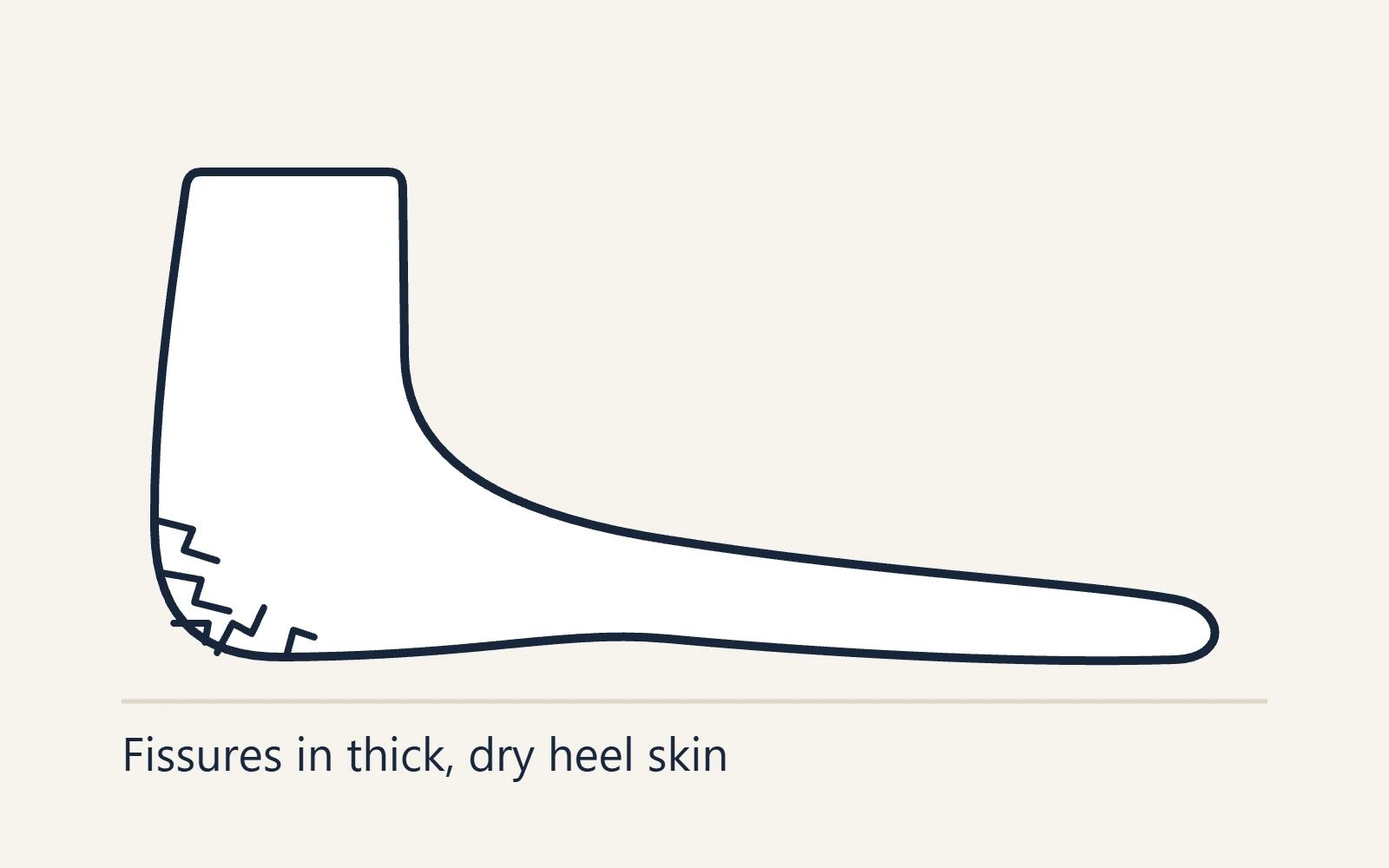
Heel skin
Cracked Heels: Why They Split and How to Heal Them
Heel cracks open where dry, thickened skin meets a fat pad that spreads sideways each time you stand. A daily routine closes most within weeks; the ones that keep returning often have a cause moisturiser cannot reach.
Cracked heels, or heel fissures, are splits in dry, thickened skin around the rim of the heel. To get rid of them, gently file the hard edge, use a cream that both moisturises and breaks down thick skin (urea is the best studied), seal it in overnight, and wear shoes with a closed back that hold the heel pad in.
Expect some change within a week. If not, or if the cracks keep reopening, look for the reason, from open-backed shoes to a fungal infection that passes for dry skin. With diabetes, numb feet or poor circulation, read the diabetes section first: parts of this routine are not safe for those feet.
On this page
What heel fissures are
Heel fissures start as dry, hard skin, a callus, around the rim of the heel, often yellow or brown. Each time you stand, the fat pad under the heel bone is squashed and bulges sideways; the stiff rim of callus cannot stretch to follow, so it splits. Small surface cracks come first, then deepen with continued pressure until standing and walking hurt, and the deepest ones bleed.
An open crack can become infected, occasionally spreading as cellulitis, and on a foot made numb by diabetes it can progress to an ulcer unnoticed.
Is it the skin that hurts, or the heel? Cracks hurt at the split, mostly on standing. Pain with intact skin, such as a stabbing pain under the heel on your first steps or a deep bruised ache, is a different problem. Start with heel pain causes by location or the heel pain quiz.
What causes dry, cracked heels
Cracks need both dry skin and load on the heel. The question is which contributors you can change.
| Contributor | What it does | What helps |
|---|---|---|
| Cold, dry winter air; long hot showers | Dries the skin | Short, warm showers; moisturiser straight after |
| Open-backed shoes, sandals, bare feet | Nothing holds the heel pad in, so it spreads | A closed back, indoors too |
| Long hours standing, or higher body weight | More pressure on the pad and the heel rim | Cushioned shoes and a heel cup |
| Age | Dry skin becomes more common and more severe | Moisturising as daily maintenance |
| Diabetes | Nerve damage can stop the feet sweating; numbness hides a deepening crack | Read the diabetes section first |
| Underactive thyroid | A recognised cause of dry skin and cracked heels | Tell your doctor if dryness is new and widespread |
| Eczema, psoriasis, thickened-sole conditions | Inflame, thicken or crack the sole | Treating the condition itself |
| Fungal infection | Moccasin-type athlete’s foot scales the sole and can crack | Antifungal treatment |
When it is not just dry skin
Moccasin-type athlete’s foot, the second most common form of the infection, looks nothing like the itchy, peeling skin between the toes most people picture. It is chronic, thickened, scaly skin with some redness across the heels and soles and up the sides of the foot, where a moccasin would sit. It often causes no symptoms, it can crack, and it is stubborn. Clues that point to fungus:
- Scale running up the sides of the foot, not just around the heel rim.
- Thick or discoloured toenails; nail infection often travels with it.
- Peeling or soggy skin between the toes.
- One scaly hand: the classic pattern is both feet and one hand.
Moisturiser will not clear it, it can spread to the nails, and broken skin lets bacteria in; cellulitis is the commonest such complication. Looking is not a reliable test, so get a skin scraping. Treatment is an antifungal, helped by a keratolytic such as urea that thins the scale so it gets in, with tablets for extensive or stubborn cases or nail involvement.
Eczema, psoriasis and rarer conditions that thicken the soles crack heels too. Red, itchy or inflamed skin often needs anti-inflammatory treatment as well as moisturiser, but keep steroid creams, including over-the-counter hydrocortisone, off scaly feet until fungus is ruled out: steroids can disguise it.
How to get rid of cracked heels
This routine tackles the dryness, the thick rim and the spreading pad together. Give it two to four weeks, daily.
- Keep showers short and warm. Five to ten minutes, with a gentle, fragrance-free cleanser. Long hot showers dry the skin out.
- File the thick rim gently. Straight after the shower or a short soak, a few light strokes of a pumice stone or foot file over the hard edge only, stopping before the skin looks pink. Never a blade, razor or scissors. With diabetes, numbness or poor circulation, skip this step and leave callus to a podiatrist.
- Moisturise within five minutes, on damp skin. Use urea at 10–25%, or a lactic acid or ammonium lactate cream, two or three times a day while the cracks are open; salicylic acid creams also work, but not on diabetic or numb feet. If it stings in a split, apply it around the crack.
- Seal it in at night. A thin layer of plain petroleum jelly over the cream, then cotton socks. The cream draws water in; the jelly stops it escaping.
- Cover open cracks by day. A liquid bandage over a split protects it, eases the pain and helps it heal.
- Close the back of the shoe. Open-heeled shoes such as flip-flops and slingbacks leave the heel pad free to spread; worn-down or badly fitting shoes are on the same avoid list. Choose a firm, closed heel counter with some cushioning (our shoe guide has the squeeze test), and wear shoes rather than bare feet at home.
- Add a heel cup if you stand all day. It spreads the heel’s load and supports it; our kit guide covers what to look for.
- Keep going once they close, with a daily plain moisturiser or 10% urea, a moisturising strength. What split the skin is still there.
The best cream for cracked heels
The best cream for cracked heels is defined by its ingredients, not its name: a humectant to pull water into the skin, a keratolytic to loosen thick skin, and an occlusive to hold the water in. Check the percentage on the label.
| Ingredient | Strength | Notes |
|---|---|---|
| Urea | 10% to maintain; 10–25% for cracked heels; 30–40% for very thick callus | Moisturises at low strengths, breaks down thick skin at higher ones. The most studied. Stronger versions irritate more often. |
| Lactic acid or ammonium lactate | 10% lactic acid; 12% ammonium lactate | Hydrate and loosen scale. In foot trials, 12% ammonium lactate beat no treatment and performed similarly to most creams it was compared with. |
| Salicylic acid | Usually combined with urea | Strips scale; little evidence on its own. Avoid with diabetes, numbness or poor circulation. |
| Petroleum jelly, dimethicone, lanolin | Any | Occlusives: a film that stops water escaping. Greasy, so best at night. |
The evidence is modest overall and firmer in diabetes. A systematic review of 22 foot-moisturiser studies found urea the most researched ingredient (in 14) but rated the studies poor to moderate and could not rank ingredients. A 2026 meta-analysis of 12 randomised trials in people with diabetes found urea creams reduced foot dryness more than plain base creams at four weeks, with high-certainty evidence, though it could not say which strength is best.
Deep cracked heels and bleeding
A crack deep enough to bleed has gone through the callus into living skin. Keep it clean and covered while it closes: wash it daily with a gentle cleanser, pat it dry, use a liquid bandage by day and petroleum jelly at night, and wear closed-back, cushioned shoes. Keep softening the hard edge around it.
What not to do
Do not cut, shave or pull at the edges. Blades, razors and scissors at home risk taking too much skin and causing an infection.
Do not file a crack that is bleeding. Work on the callus around it once it has closed.
Do not use acid corn or callus removers if you have diabetes, numbness or poor circulation.
Do not seal over a crack that is red, hot, swollen or oozing. Have it seen the same day.
How long it takes
You should see some improvement within a week; DermNet NZ advises seeing a podiatrist if a week of self-treatment has made no difference. Closing takes longer. In a randomised trial of 167 people with diabetes and a deep open heel crack, 24.7% of those using a urea-based cream still had a deep open crack after two weeks, against 42.7% on placebo; after four weeks the figures were 6.4% and 24.1%. Complete healing by four weeks was less common, 46.3% against 33.3%, a difference that was not statistically significant.
So two to four weeks is the honest timescale for most cracks to close, longer for the skin to look normal, and daily maintenance after that.
Cracked heels and diabetes
Diabetes raises the stakes. Its nerve damage can switch off sweating in the feet, so the skin dries, and can take away the pain that would warn you a crack is deepening. International diabetic foot guidelines count a fissure on an at-risk foot as a pre-ulcerative lesion, a strong predictor of an ulcer, to be treated promptly by a trained professional.
- Moisturise daily, but leave callus to a podiatrist: no pumice, file, blade or acid remover at home.
- Wash your feet daily, but do not soak them.
- Do not walk barefoot, in socks alone or in thin slippers, even indoors.
- If a crack opens or bleeds, call a podiatrist that day.
The diabetic version is on our sister site: dry and cracked feet in diabetes, and choosing a diabetic foot cream.
When to be seen, and what a podiatrist does
Same day if a crack looks infected: spreading redness, warmth, swelling, pus or a bad smell, increasing pain, or a fever.
Within the week for any open or bleeding crack if you have diabetes, numb feet or poor circulation. Call the day you find it.
Book an appointment if a week of the routine has changed nothing, the cracks are still open after two to three weeks, or they keep coming back.
Also book if it looks like fungus (scale up the sides of the foot, thick nails, peeling between the toes) or like eczema or psoriasis (red, itchy, inflamed skin). Both need more than moisturiser.
A podiatrist can safely pare away the thick rim of callus, confirm fungus with a scraping and treat it, prescribe stronger urea or salicylic acid preparations, hold a deep split closed with tissue glue or strapping, and spread the load with footwear changes, insoles, heel pads or heel cups.
Common questions
What is the fastest way to heal cracked heels?
The whole routine, daily: gentle filing, a 10–25% urea cream two or three times a day, petroleum jelly and socks at night, a liquid bandage over open splits, and closed-back shoes. In a urea cream trial, most deep open cracks were no longer deep and open by four weeks. If a week changes nothing, have it looked at.
What is the best cream for cracked heels?
Urea at 10–25% is the standard recommendation and the best studied; 10% lactic acid or 12% ammonium lactate are alternatives. Avoid salicylic acid with diabetes or numb feet. Choose by ingredient and percentage, not brand, and seal it in with petroleum jelly at night.
Why do my heels keep cracking even though I moisturise?
Often because moisturiser treats only one cause. Plain lotion does not break down a thick rim of callus, and open-backed shoes, bare feet and standing keep splaying the pad. Scale up the sides of the foot, or thick nails, suggest fungus, which moisturiser will not clear.
Why do cracked heels bleed, and what should I do?
The crack has reached the living skin under the callus. Wash it, pat it dry, cover it with a liquid bandage by day and petroleum jelly at night, and stop filing until it closes. With diabetes, numbness or poor circulation, call a podiatrist that day; if it turns red, hot or swollen, or oozes, be seen the same day.
Are cracked heels a sign of diabetes?
Not on their own: cracked heels are common in people without diabetes. Diabetes can dry the feet by damaging the nerves that control sweating, so new, stubborn dryness in someone at risk is worth raising with a doctor; a blood test answers the question.
Related heel pain guides
- Heel pain causes by location
- Heel pain quiz
- Bruised heel
- Heel fat pad atrophy
- When to worry about heel pain
- Best shoes for plantar fasciitis
- Shoes, inserts and kit for heel pain
Cracked heels that keep splitting?
Cracks that keep reopening despite a proper routine, or a crack on a diabetic foot, need the callus, the footwear and possible fungus looked at together. Dr. Tom Biernacki sees these at Balance Foot & Ankle.
Howell — 4330 E Grand River Ave, Howell, MI 48843
Bloomfield Township — 43494 Woodward Ave #208, Bloomfield Township, MI 48302
Monday to Thursday, 9:00am–4:30pm; Friday, 9:00am–2:30pm · (810) 206-1402
Further reading
- American Academy of Dermatology. How to care for dry, cracked heels. News release, 1 February 2022.
- Ngan V. Cracked heel. DermNet NZ, 2006; page updated 2024.
- Parker J, Scharfbillig R, Jones S. Moisturisers for the treatment of foot xerosis: a systematic review. J Foot Ankle Res. 2017;10:9. doi:10.1186/s13047-017-0190-9
- Piquero-Casals J, Morgado-Carrasco D, Granger C, et al. Urea in dermatology: a review of its emollient, moisturizing, keratolytic, skin barrier enhancing and antimicrobial properties. Dermatol Ther (Heidelb). 2021;11(6):1905–1915. doi:10.1007/s13555-021-00611-y
- Gin H, Rorive M, Gautier S, et al. Treatment by a moisturizer of xerosis and cracks of the feet in men and women with diabetes: a randomized, double-blind, placebo-controlled study. Diabet Med. 2017;34(9):1309–1317. doi:10.1111/dme.13402
- Borgström K, Björklund S, Gudmundsson P, et al. Moisturizer formulations for diabetic foot xerosis: a systematic review and meta-analysis of randomized controlled trials. Front Clin Diabetes Healthc. 2026;7:1922860. doi:10.3389/fcdhc.2026.1922860
- Leung AK, Barankin B, Lam JM, et al. Tinea pedis: an updated review. Drugs Context. 2023;12:2023-5-1. doi:10.7573/dic.2023-5-1
- Pop-Busui R, Boulton AJ, Feldman EL, et al. Diabetic neuropathy: a position statement by the American Diabetes Association. Diabetes Care. 2017;40(1):136–154. doi:10.2337/dc16-2042
- Bus SA, Sacco ICN, Monteiro-Soares M, et al. Guidelines on the prevention of foot ulcers in persons with diabetes (IWGDF 2023 update). Diabetes Metab Res Rev. 2024;40(3):e3651. doi:10.1002/dmrr.3651
This page is education, not a diagnosis. See our editorial policy, and if you have diabetes, numb feet or poor circulation, have any open crack examined rather than treating it yourself.