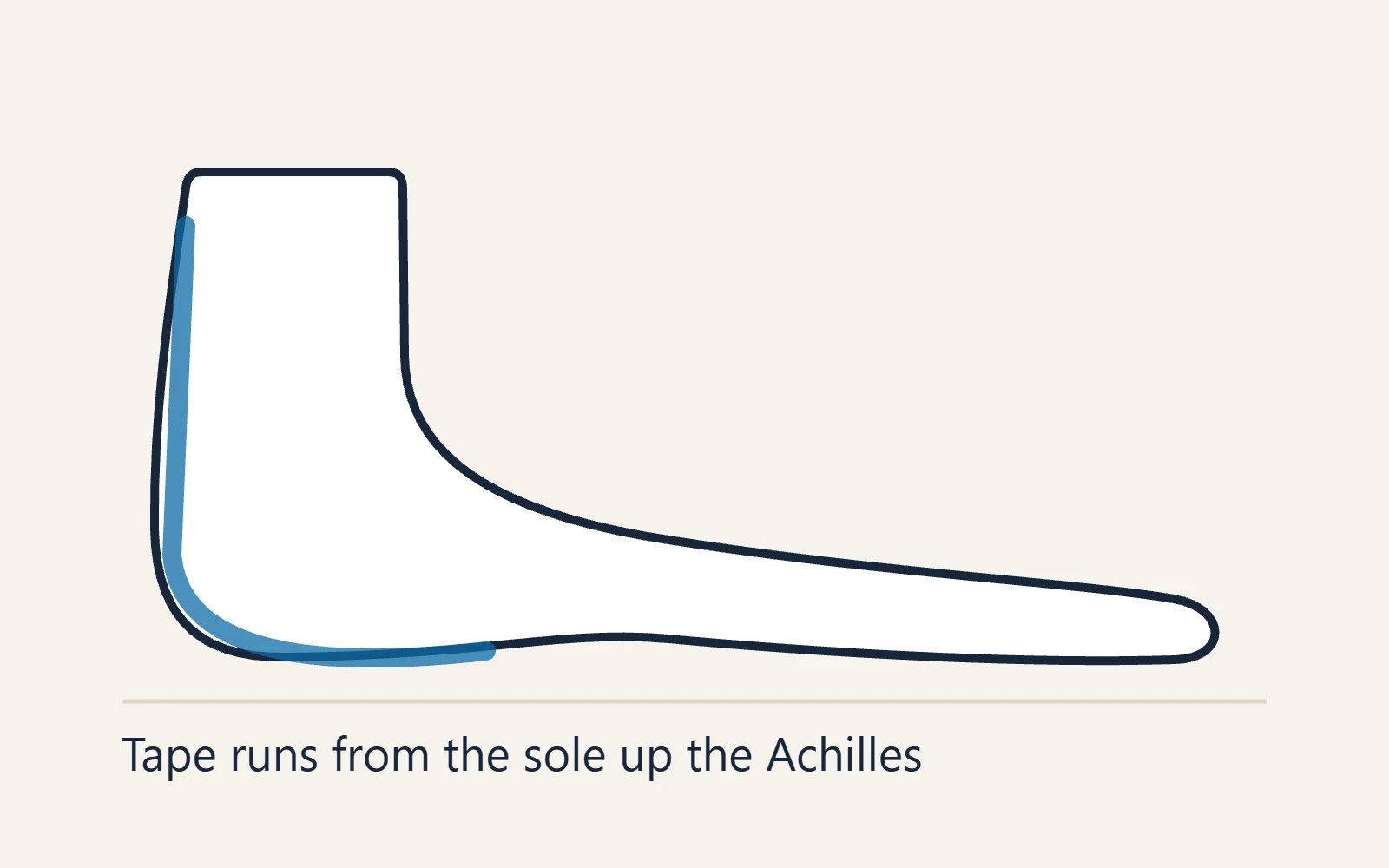
Achilles treatment
KT tape for Achilles tendonitis: how to apply it, and what to expect from it
Kinesiology tape is quick to put on and comfortable to wear, and some people feel steadier with it. It does not treat the tendon, and the evidence for pain relief is thin. Here is how to apply it well and where it fits.
Taping the Achilles is popular because it is cheap, visible and feels like doing something. Used for the right job, as a comfort measure while the exercises do the real work, it is reasonable. Used as the treatment, it disappoints. This page covers the KT method step by step, the athletic trainer’s tape job for game day, what to realistically expect, and the simpler options that often help more.
On this page
Does KT tape work for Achilles tendonitis?
Kinesiology tape is elastic. It stretches with the skin, so unlike rigid athletic tape it cannot hold the ankle in a position or take meaningful load off the tendon. The ideas behind it are sensory: extra input from the skin that may change how the area feels, and a reminder to move carefully.
The research on the Achilles is not encouraging. In a controlled study of 24 people with Achilles tendinopathy, kinesiology tape applied along the tendon made no difference to pain or to how far they could hop, and the authors concluded their results did not support it. That is one small study, and some people do feel more comfortable taped. The fair summary: if it makes you more comfortable while you do your exercises, use it. Do not expect it to heal anything.
Tape is not a test here, the way it is under the foot. For plantar fasciitis, rigid arch tape predicts whether an insert will help. There is no equivalent for the Achilles, so a good or bad response to KT tape tells you little about what to do next.
What you need
- Kinesiology tape, 5 cm wide. A pre-cut roll is easier.
- Scissors, to round the corners of each strip. Rounded corners peel less.
- Clean, dry skin with no lotion. Trim thick hair on the back of the leg, or the tape will lift and removal will hurt.
How to apply KT tape for Achilles tendonitis
Lie face down with your feet over the end of the bed, or kneel on a chair, so the back of the ankle is easy to reach. Having someone else apply it helps.
- Measure the long strip. From the bottom of the heel, up the back of the heel and along the tendon to the middle of the calf. Cut it and round the corners.
- Flex the foot. Pull the toes gently towards the shin so the tendon is on a mild stretch. Tape applied with the foot pointed pulls when you walk.
- Anchor under the heel. Peel back the first 5 cm of backing and press it onto the bottom of the heel with no stretch at all.
- Run it up the tendon with light stretch. Peel the backing as you go and lay the tape up the back of the heel and along the Achilles with about a quarter of its available stretch. Lay the last 5 cm on the calf with no stretch.
- Add a short strip across the sore spot if you want one. Tear the backing in the middle of a 15 cm strip, stretch the centre by about half, and lay it across the tendon over the most tender point. Lay the two ends around the sides of the ankle with no stretch.
- Rub it in. Rub the whole length firmly for a few seconds; the adhesive grips better warm. Put it on at least half an hour before exercise or a shower.
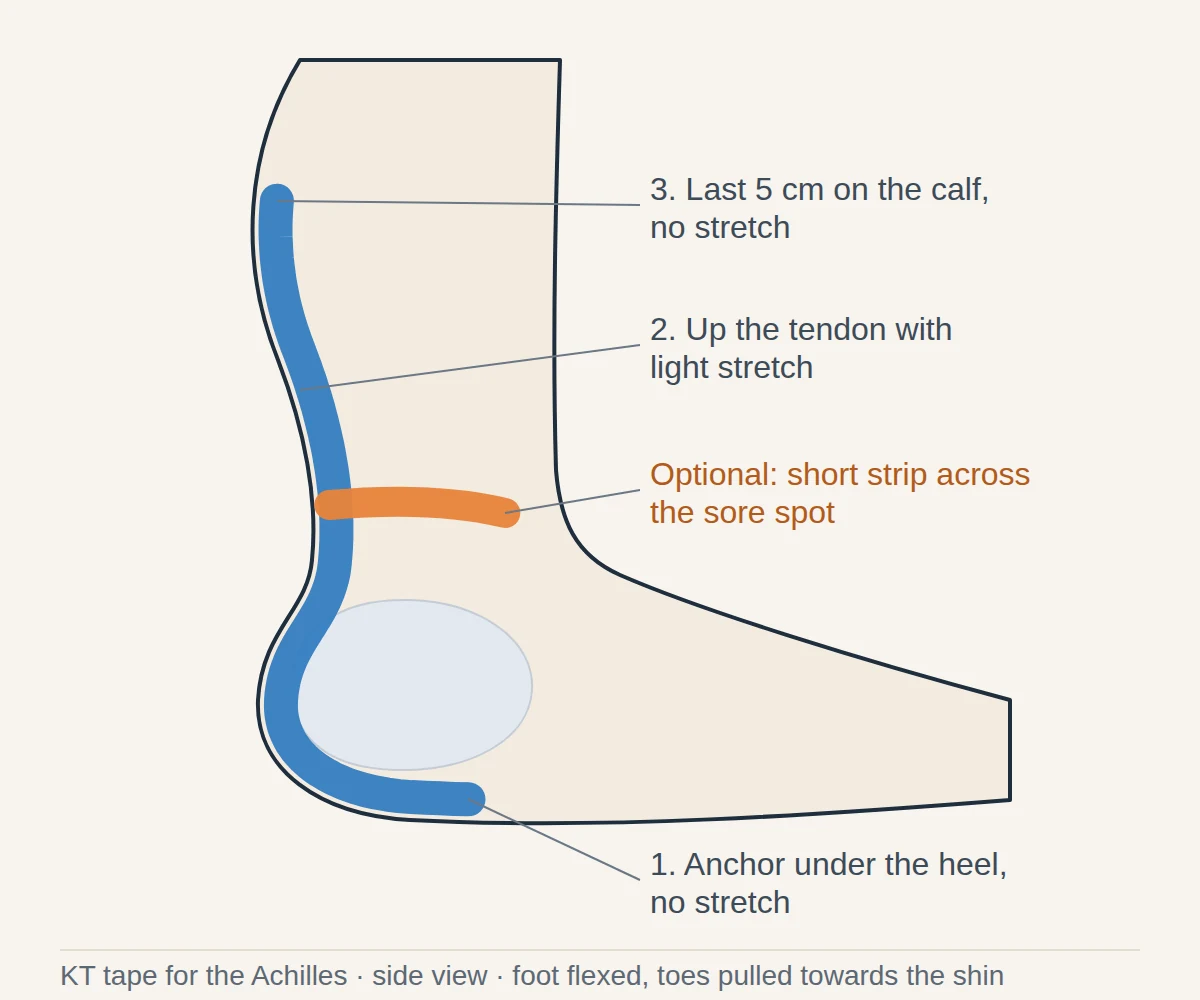
The tape should feel supportive and unnoticeable within a few minutes. Tingling, a pulling sensation, or skin wrinkling hard under the tape when you stand means it went on too tight. Take it off and reapply with less stretch.
How long to leave it on
Kinesiology tape is made to stay on for several days, and three to five days is typical. Take it off sooner if it starts lifting, or if the skin underneath itches, burns or reddens. Remove it slowly, in the direction the hair grows, after soaking it in the shower or softening it with baby oil. Give the skin a day off between applications.
Achilles tape job: taping with athletic tape
An athletic trainer’s Achilles tape job is a different technique from KT tape. It uses wider, much stronger athletic tape, anchored around the midfoot and the upper calf, and it goes on with the foot relaxed and slightly pointed. The strips then stop the ankle bending up as far, which takes some of the strain off the tendon for a game or a race. In the UK and Australia it is called Achilles strapping. This is the method taught in athletic therapy training:
- Position. Lie face down with the lower leg over the end of the bed and the foot relaxed and slightly pointed. That is the angle the tape will hold.
- Protect the skin. Clean, dry skin and a light spray of tape adherent. Put a small lubricated pad over the back of the heel and another over the front of the ankle, where tape rubs, then a layer of pre-wrap from the calf to the midfoot.
- Anchors. With 7.5 cm (3 inch) heavy elastic athletic tape, put two anchors around the midfoot and three around the upper calf. Snug, not tight: the calf swells as it works.
- Support strips. Run three strips from the foot anchors to the top of the calf anchors: one from the top of the foot around the outer side and over the heel, one from the inner side of the foot under the heel, and one from the sole straight over the back of the heel. All three run up the back of the leg.
- Close it. Finish with closing strips around the foot and the calf over the ends of the support strips, so nothing peels.
- Check it. The toes should stay warm, pink and normal to touch, and the foot should stop short of bending all the way up. Numbness, tingling, throbbing or cold toes mean it is too tight: take it off.
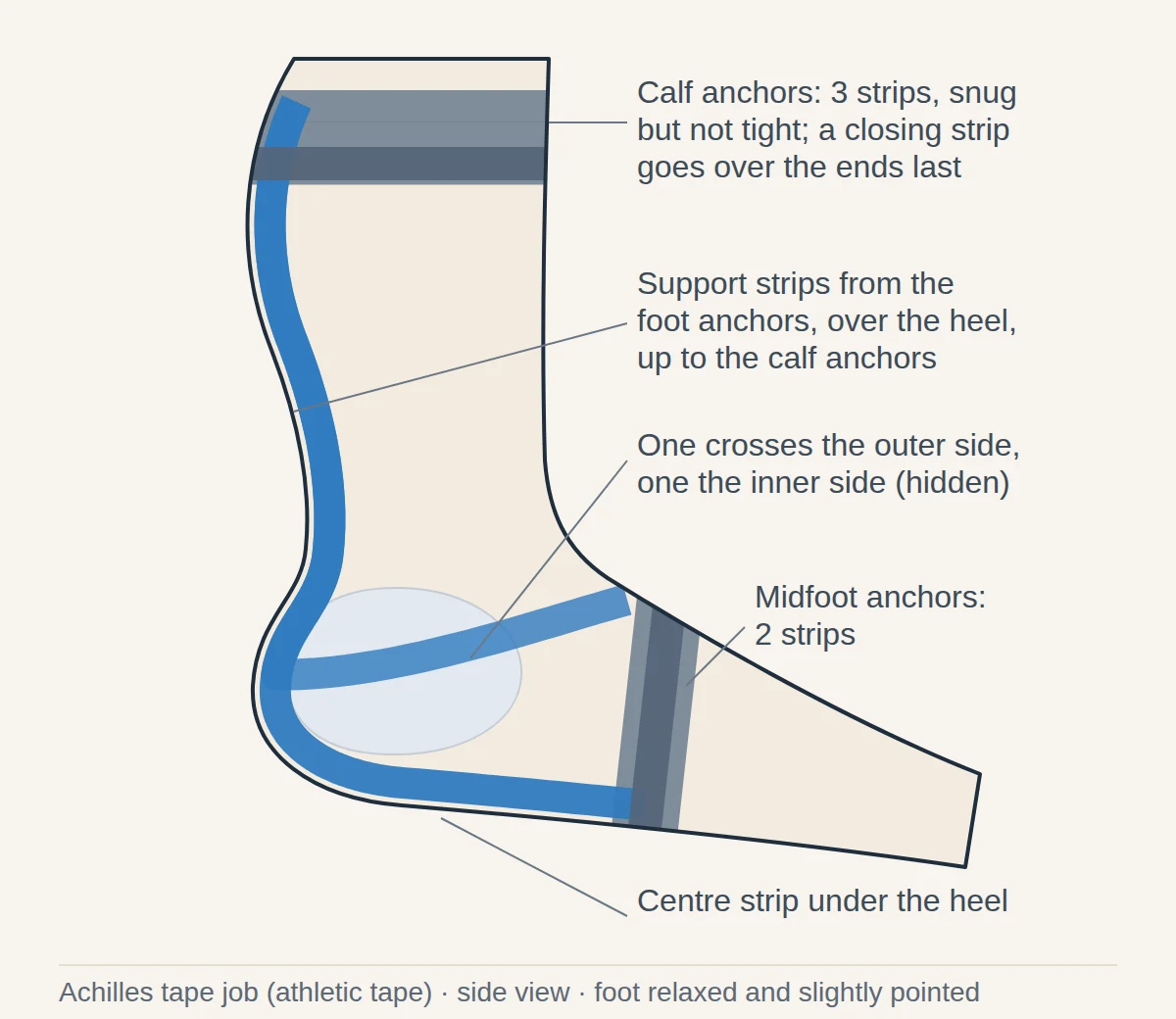
It holds the ankle slightly pointed, which is a less stable position. Athletic trainers put a standard ankle taping over it before sport to protect against a sprain. It is for a game or a race, not for walking around in all week, and it does not replace the exercises.
Who should not tape
Do not tape a suspected Achilles rupture. A pop or snap, a feeling of being kicked in the back of the leg, or being unable to rise onto tiptoe on that side needs same-day assessment. Tape can make a serious injury feel manageable when it is not.
Avoid taping without medical advice if you have diabetes, neuropathy or reduced feeling in the feet, poor circulation, fragile skin, an adhesive allergy, or broken or infected skin where the tape would go.
Heel lifts
If the goal is to take load off the tendon, a small heel lift does it more reliably than elastic tape. Raising the heel slightly reduces the pull on the tendon, and for pain right at the heel bone it also eases the compression at the insertion. Put one in both shoes, so you do not create a leg-length difference.
The athletic tape job above unloads the tendon for a few hours of sport. A heel lift does a similar job all day, in ordinary shoes, with nothing to reapply.
What actually treats it
The treatment for Achilles tendonitis with the best evidence is progressive loading exercise, done for about twelve weeks, with the programme chosen to match where it hurts. The Achilles tendonitis exercises page has both versions and a printable sheet. Alongside that: reduce the activity that spiked it without stopping altogether, use a heel lift for insertional pain, and wear shoes that do not press on the back of the heel. Tape, if you like it, sits on top of that plan.
Common questions
Does KT tape help Achilles tendonitis?
It may make the area feel more comfortable for some people, but it does not treat the tendon, and a controlled study of kinesiology tape over painful Achilles tendons found no change in pain or hopping. Use it as a comfort measure alongside loading exercises, not in place of them.
Can I run with KT tape on my Achilles?
Yes, if running is otherwise within the pain rules: discomfort that stays modest during the run, settles by the next morning, and is not creeping up week to week. The tape does not make running safer for an irritated tendon; how much you run decides that.
How long can I leave KT tape on my Achilles?
Usually three to five days. Take it off sooner if it lifts, gets itchy or the skin reddens, and give the skin a day off before reapplying.
Should the foot be flexed or pointed when taping the Achilles?
Flexed, with the toes pulled gently towards the shin, so the tendon is on a light stretch while you apply the tape. Tape applied with the foot pointed will pull and pinch when you walk.
Is rigid tape better than KT tape for the Achilles?
They do different jobs. Rigid tape can limit ankle movement and unload the tendon for a short event, but it restricts you and needs to be applied well. Kinesiology tape lets you move freely but does not hold anything. For everyday unloading, a heel lift in both shoes is simpler than either.
Can I tape a torn Achilles?
No. A suspected rupture needs same-day assessment, not tape. The signs are a pop or snap, a feeling of being struck in the back of the leg, sudden weakness pushing off, and being unable to rise onto tiptoe on that leg.
Can I wrap my Achilles instead of taping it?
An elastic wrap or ankle sleeve adds compression and a reminder to go easy, but it does not take load off the tendon, which is what actually settles it. A small heel lift in both shoes does that more reliably than either a wrap or tape.
What is an Achilles tape job?
It is the athletic trainer’s way of taping the Achilles: anchors of elastic athletic tape around the midfoot and upper calf, three support strips over the heel, then closing strips, all put on with the foot slightly pointed so the tape limits how far the ankle bends up. It unloads the tendon for a game or a race. KT tape is a different thing: it moves with you and does not hold the ankle at all. The steps are in the athletic tape section above.
Can KT tape help heel bursitis?
There is no good evidence that it does. Bursitis at the back of the heel is aggravated by pressure, from the back of the shoe and from the tendon pressing on the bursa as the ankle bends up, and tape over the sore spot changes neither; on a tender bump the tape edge can rub. Taking the pressure off works better: a shoe with a softer or lower back, a small heel lift, and easing off whatever flared it. The heel bursitis guide covers the rest.
Related heel pain guides
- Achilles tendonitis exercises and stretches — the treatment that does the work, with a printable sheet.
- Achilles tendonitis — midportion or insertional, and why it matters.
- KT tape and low-Dye taping for plantar fasciitis — taping under the foot, where tape does have a clear job.
- Back of heel pain — the other causes at the back of the heel.
- Heel pain after running — what to change in training while the tendon recovers.
- Firth BL, Dingley P, Davies ER, Lewis JS, Alexander CM. The effect of kinesiotape on function, pain, and motoneuronal excitability in healthy people and people with Achilles tendinopathy. Clinical Journal of Sport Medicine, 2010.
- Chimenti RL, Neville C, Houck J, et al. Achilles Pain, Stiffness, and Muscle Power Deficits: Midportion Achilles Tendinopathy Revision – 2024. Clinical Practice Guidelines, Journal of Orthopaedic & Sports Physical Therapy.
- Medina Pabón MA, Bergman R, Naqvi U. Achilles Tendinopathy. StatPearls, NCBI Bookshelf.
- American Academy of Orthopaedic Surgeons, OrthoInfo. Achilles Tendinitis.
- Elliott J, Bahniuk B, Scribbans T. Achilles tendon support technique. Athletic Therapy Skills: Support Techniques. University of Manitoba, 2025.
Achilles pain in Michigan?
If tape, rest and stretching have not moved your Achilles pain, the programme usually needs changing rather than adding to. Dr. Biernacki can confirm which Achilles problem you have and what to do about it, in Howell or Bloomfield Township.
This page is education, not a diagnosis. Do not tape a suspected rupture, or a foot with reduced feeling, poor circulation or broken skin. Read our editorial policy for how it was written and what it will not claim.