Heel pain causes
Back of heel pain: what is causing it, and how to tell the causes apart
Pain at the back of the heel has a short list of causes, and they sit millimetres apart. Where exactly it hurts, what makes it worse, and your age narrow it down quickly.
Most back-of-heel pain comes from the Achilles tendon or the structures packed around its attachment: two small bursae and the upper corner of the heel bone. In children it is usually a growth plate. Occasionally it is a bone stress injury or a tendon rupture, and those two need different handling from the start. This page sorts them out and sends you to the guide for each.
On this page
Where exactly does it hurt?
Take a minute with your fingers before reading anything else. Three quick checks do most of the sorting:
- Press along the tendon from the heel upwards. Sore in the cord 2–6 cm above the bone points to midportion Achilles tendonitis. Sore right at the bone where the tendon attaches points to insertional Achilles tendonitis.
- Squeeze the soft hollows either side of the tendon, just above the heel bone. Pain there points to the deep (retrocalcaneal) bursa.
- Squeeze the heel bone from both sides, below the tendon. Pain there, especially if it has built up with activity, raises the question of a stress fracture.
Then look at the back of the heel. A firm bump with thickened or reddened skin where the shoe rubs is a Haglund’s prominence and usually a superficial bursitis over it.
The causes at a glance
| Cause | Typical person | Where and how it hurts | Read next |
|---|---|---|---|
| Insertional Achilles tendonitis | Adults, active or not, often middle-aged and over | On the bone where the tendon attaches; stiff in the morning; worse uphill and when stretching off a step | Achilles tendonitis |
| Midportion Achilles tendonitis | Runners and people who increased activity | A tender, thickened segment in the cord above the heel; warms up then aches afterwards | Achilles exercises |
| Retrocalcaneal bursitis | Often alongside insertional tendon pain | Squeezing either side of the tendon just above the bone; hates the ankle bending upwards | Heel bursitis |
| Haglund’s deformity with superficial bursitis | Adults whose shoes have stiff heel counters | A bump on the back of the heel that hurts in some shoes and not others | Haglund’s deformity |
| Sever’s disease | Active children, roughly 8 to 14 | Back and sides of the heel after sport; better by morning; nothing happened to it | Sever’s disease |
| Calcaneal stress fracture | Runners, recruits, anyone who stepped up their activity; lower bone density | Deep ache that builds with activity instead of warming up; sore when the heel is squeezed from both sides | Heel stress fracture |
| Achilles rupture | Often middle-aged recreational athletes, sometimes after fluoroquinolone antibiotics | Sudden pop or kick in the back of the leg, then weakness pushing off | Sudden heel pain |
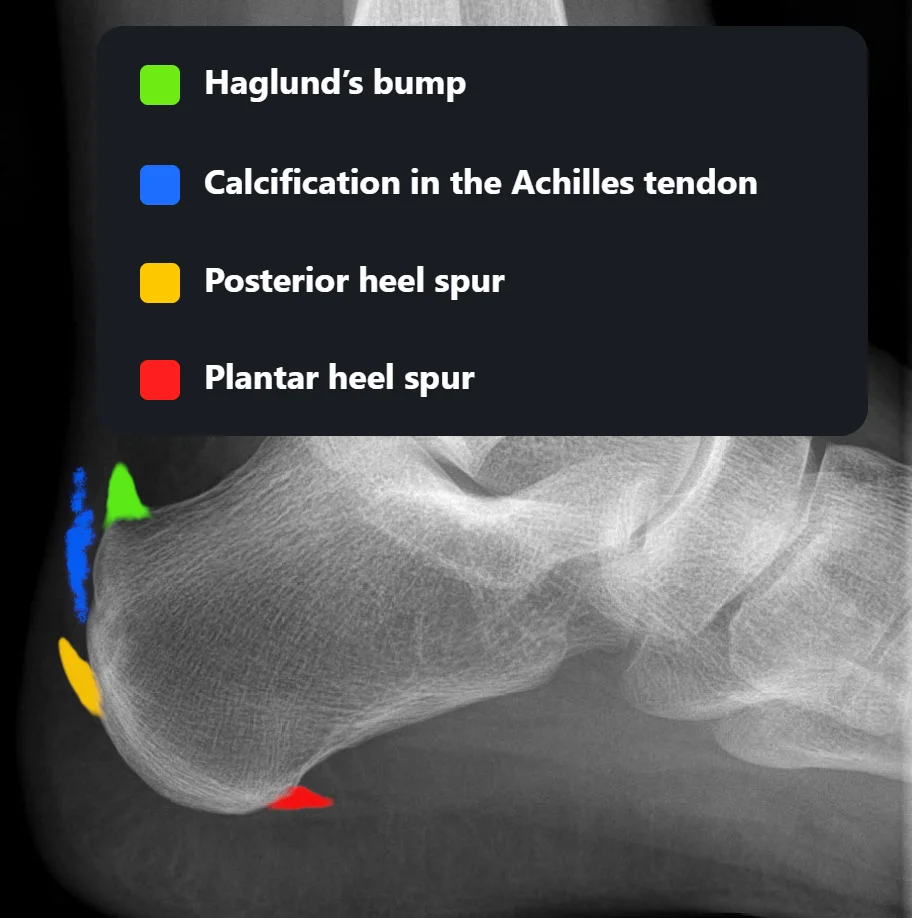
Achilles tendonitis
The most common cause. What matters most is which part of the tendon is sore, because the treatment differs. Pain in the cord responds to loading exercises that drop the heel below a step. Pain right at the bone is often made worse by exactly that exercise, because it presses the tendon into the heel bone, and needs floor-level loading and a heel lift instead. Both types are stiff first thing in the morning and warm up with movement, then ache afterwards. The Achilles tendonitis page explains the difference; the exercise page has both programmes.
Bursitis and Haglund’s deformity
Two small fluid-filled cushions sit either side of the Achilles attachment. The deep one, between the tendon and the bone, is squeezed when the ankle bends upwards. The superficial one, just under the skin, is irritated by the back of a shoe. Both are often driven by a prominent upper corner of the heel bone, the Haglund’s bump or “pump bump”, which is why the bump, the bursa and the tendon insertion frequently flare together.
The clue is footwear. Pain that is bad in one stiff-backed pair and absent in a soft trainer or backless slipper is compression, and changing the shoe is most of the treatment. See heel bursitis and Haglund’s deformity.
Sever’s disease in children
In an active child between roughly eight and fourteen, heel pain after sport with no injury is almost always Sever’s disease: irritation of the growth plate at the back of the heel bone where the Achilles pulls. It is sore after activity, better by the next morning, and it ends when the growth plate closes. It is managed by adjusting the load rather than stopping sport altogether. See Sever’s disease.
Heel stress fracture
A bone stress injury in the heel bone behaves differently from the tendon problems above: it gets worse as you keep going rather than warming up, it can ache at night, and squeezing the heel from both sides hurts. It usually follows a jump in activity, and it is the one heel problem you should not push through. See heel stress fracture.
Less common causes
- Inflammatory arthritis. Pain at the back of both heels in a younger adult, with morning back stiffness that improves with movement, can be inflammation where tendons attach to bone. That needs a medical work-up, not new shoes. See inflammatory heel pain.
- Nerve irritation. Burning or tingling rather than aching, sometimes along the outside of the heel, suggests a nerve. See heel nerve pain.
- Pain deep behind the ankle when the foot is pointed hard, typical in dancers and in kicking sports, can come from the back of the ankle joint rather than the heel. It needs an examination to sort out.
- Infection. A hot, red, swollen heel with fever, or a break in the skin over the back of the heel in someone with diabetes, needs prompt attention.
What helps in the meantime
While you work out which problem you have, these are safe for almost all of the causes above, except a suspected rupture or fracture:
- Take the pressure off the back of the heel. Soft-backed or open-backed shoes, or shoes whose heel counter sits away from the sore spot.
- A small heel lift in both shoes, around 6 to 12 mm. It reduces the pull on the tendon and the compression at the insertion.
- Skip stretches that drop the heel below a step until you know it is a midportion problem. For pain at the bone they make things worse.
- Cut back hills, speed work and jumping for a few weeks rather than stopping all activity.
- Ice for flares, ten minutes at a time, as symptom relief.
When to be seen quickly
Same day: a pop or snap at the back of the ankle, a feeling of being kicked in the calf, sudden weakness pushing off, or being unable to rise onto tiptoe on that leg. That is an Achilles rupture until proven otherwise.
Within days: heel pain that builds with activity and hurts when the heel is squeezed (possible stress fracture); a hot, red, swollen heel, especially with fever; broken skin over the back of the heel if you have diabetes or neuropathy; or both heels at once in a younger adult with back stiffness.
For a wider list of red flags, see when to worry about heel pain.
Common questions
What causes pain in the back of the heel?
Most often the Achilles tendon, either in the cord above the heel or at its attachment to the bone. Next come the bursae beside the tendon and a Haglund’s bump pressed on by shoes. In children aged roughly 8 to 14 it is usually Sever’s disease. Less often it is a stress fracture, an Achilles rupture, inflammatory arthritis or a nerve.
Why does the back of my heel hurt when I walk?
Walking loads the Achilles with every push-off, and the ankle bends upwards through each step, which squeezes the bursa and the tendon insertion against the heel bone. Shoes with stiff heel counters add pressure from behind. Hills and stairs increase both. That is why a heel lift and softer-backed shoes often ease walking pain quickly.
Is back of heel pain Achilles tendonitis?
Often, but not always. Pain in the cord above the heel, or right where it attaches, is usually the tendon. Pain when you squeeze either side of the tendon suggests a bursitis, pain from a bump where the shoe rubs suggests Haglund’s deformity, and pain when the heel bone is squeezed from both sides raises the question of a stress fracture.
Should I stretch if the back of my heel hurts?
Not by dropping your heel off a step until you know what it is. That stretch helps a sore Achilles cord but aggravates pain at the bone, a deep bursitis and a Haglund’s bump. Gentle calf stretches with the heel on the floor are safe for most causes.
Why does the back of my heel hurt in the morning?
Tendon problems stiffen overnight, so the first steps load a tendon that has been resting shortened. Morning stiffness that eases as you move is typical of both types of Achilles tendonitis. Morning stiffness in both heels together with a stiff lower back is worth mentioning to a doctor, because it can be inflammatory.
When should I see a doctor for back of heel pain?
The same day for a pop, sudden weakness or being unable to stand on tiptoe. Within days for pain that builds with activity and hurts when the heel is squeezed, or a hot, red, swollen heel. Otherwise, if two to three months of shoe changes, a heel lift and the right exercises have not helped.
Related heel pain guides
- Achilles tendonitis — midportion or insertional, and why the treatment differs.
- Achilles tendonitis exercises and stretches — both programmes, with a printable sheet.
- Heel bursitis — which of the two bursae is inflamed.
- Haglund’s deformity — the bump at the back of the heel, and why shoes matter most.
- Sever’s disease — heel pain in active children.
- Heel stress fracture — the one not to push through.
- Heel pain causes by location — if the pain is underneath or to the side instead.
- Tu P. Heel Pain: Diagnosis and Management. American Family Physician, 2018.
- Medina Pabón MA, Bergman R, Naqvi U. Achilles Tendinopathy. StatPearls, NCBI Bookshelf.
- Williams CH, Jamal Z, Sternard BT. Bursitis. StatPearls, NCBI Bookshelf.
- American Academy of Orthopaedic Surgeons, OrthoInfo. Achilles Tendinitis.
- American Academy of Orthopaedic Surgeons, OrthoInfo. Sever’s Disease (Heel Pain).
- Bergman R, Kaiser K. Stress Reaction and Fractures. StatPearls, NCBI Bookshelf.
- Shamrock AG, Dreyer MA, Varacallo MA. Achilles Tendon Rupture. StatPearls, NCBI Bookshelf.
Back-of-heel pain in Michigan?
Telling the tendon, the bursae and the bone apart takes a few minutes of examination, and it changes what you should be doing. Dr. Biernacki sees back-of-heel pain in Howell and Bloomfield Township.
This page is education, not a diagnosis. Read our editorial policy for how it was written and what it will not claim.