Heel pain causes
Tarsal tunnel syndrome: when the heel and sole burn rather than ache
Heel pain that burns, tingles or goes numb is behaving like a nerve, not like a fascia. When the nerve involved is the tibial nerve, compressed as it passes behind the inner ankle, the diagnosis is tarsal tunnel syndrome — and it is treated nothing like plantar fasciitis.
Most heel pain is mechanical: a tissue is being loaded beyond what it tolerates, and it aches or stabs in proportion to use. Nerve pain does not follow that rule. It burns, tingles, feels electric, or produces numbness in a patch of skin. It often carries on when you are off your feet, and it can be worse in bed than on a walk.
That distinction matters because the treatments do not overlap. Months of stretching and insoles aimed at a fascia will not help a compressed nerve, and this is one of the conditions most often treated as plantar fasciitis for a year before anyone reconsiders.
On this page
Where the tarsal tunnel is
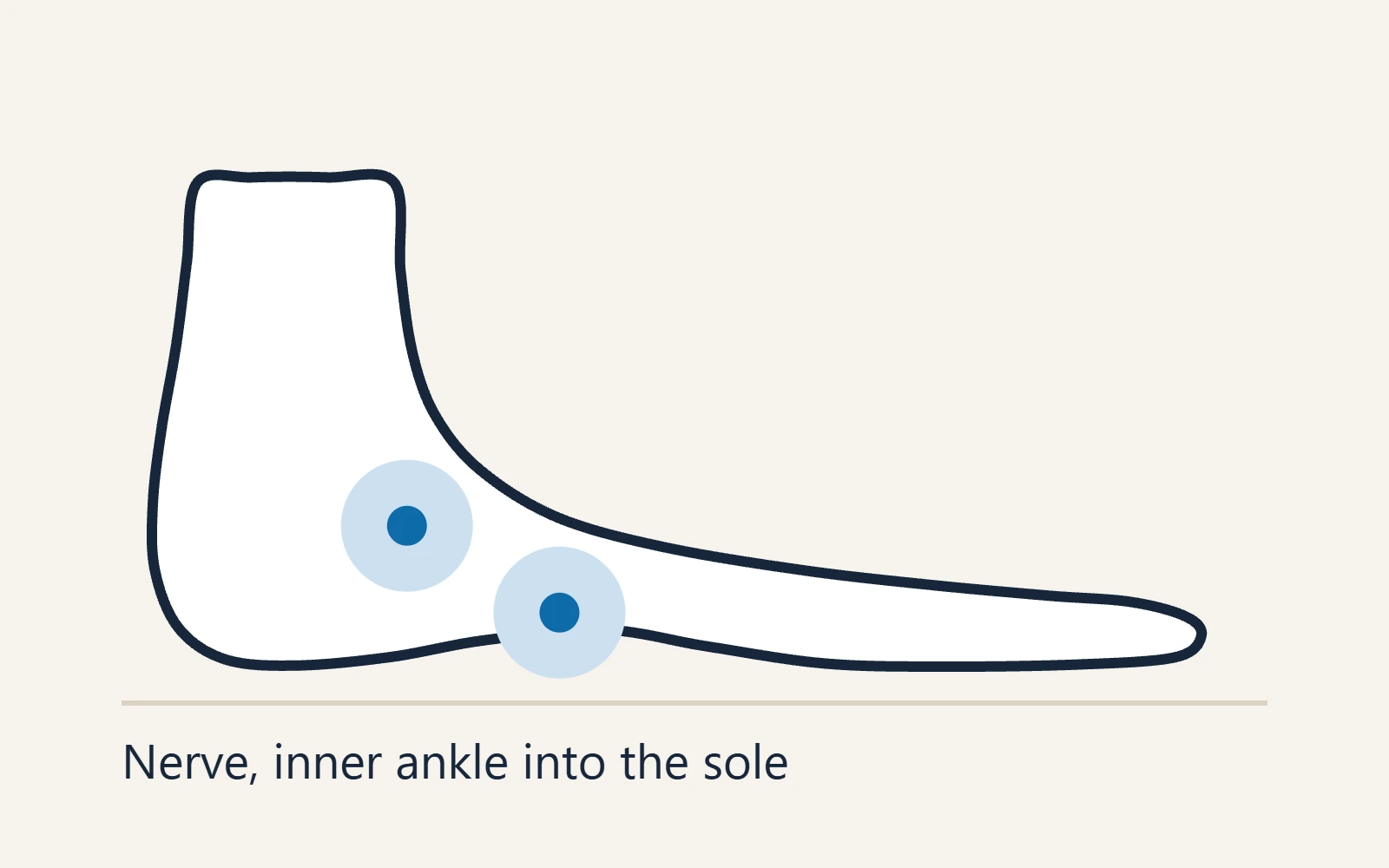
Run your finger down behind the bony bump on the inside of your ankle. The tarsal tunnel is the space just behind and below it, roofed over by a tough fibrous band called the flexor retinaculum. Through that confined space pass the tibial nerve, the posterior tibial artery and veins, and three tendons on their way into the foot.
Inside or just beyond the tunnel, the tibial nerve divides into the medial and lateral plantar nerves, which supply sensation to the sole, and a medial calcaneal branch, which supplies the skin over the inner heel. Which branches are affected determines where the symptoms land, which is why presentations vary so much.
What it feels like
The typical description is burning or tingling across the sole and the inner heel, sometimes with patches of numbness, often worse towards the end of the day and frequently intrusive at night. Many people can reproduce an electric or shooting sensation by pressing behind the inner ankle. Some notice symptoms travelling upwards towards the calf rather than only down into the foot.
What it usually does not do is produce the classic sharp spike on the first two or three steps out of bed that then eases within minutes. That pattern belongs to the fascia.
How it differs from the conditions it is mistaken for
| Tarsal tunnel syndrome | Plantar fasciitis | Baxter’s nerve entrapment | |
|---|---|---|---|
| Quality of pain | Burning, tingling, electric, numb | Sharp, stabbing, then aching | Burning, often with a deep ache |
| Where | Inner ankle, spreading across the sole and inner heel | A fingertip-sized spot at the inner front of the underside of the heel | Inner and under-surface of the heel, sometimes towards the outer sole |
| First steps of the day | No characteristic spike | The defining feature | Variable; often aching rather than sharp |
| At rest and at night | Frequently symptomatic | Usually quiet | Can be symptomatic |
| Tapping behind the inner ankle | Often produces tingling or an electric sensation | No effect | Usually no effect — the tender point is lower and more lateral |
| Numbness | Can be present | Absent | Rare — this branch is largely motor to one muscle |
| Where the compression is | Tibial nerve under the flexor retinaculum | Not a nerve problem | First branch of the lateral plantar nerve, deeper in the foot |
The nerve conditions are close cousins and are covered in more detail under burning heel pain and Baxter’s nerve. It is also entirely possible to have both a compressed nerve and a degenerative fascia at the same time, which is part of why these cases take longer to sort out.
What causes it
- Something occupying space in the tunnel. A ganglion cyst, enlarged veins, an accessory muscle, a nerve sheath tumour or scar tissue. This is the group that responds best to treatment, because there is a specific thing to remove.
- Previous injury. An ankle fracture, a severe sprain or surgery in the area, with scarring or altered bony anatomy narrowing the tunnel.
- A significantly flat or inward-rolling hindfoot. Marked heel valgus puts the tibial nerve under sustained traction as it passes the ankle.
- Swelling and systemic conditions. Pregnancy, rheumatoid arthritis, hypothyroidism and fluid retention all reduce the available space.
- Diabetes, which both makes nerves more vulnerable to compression and produces a generalised neuropathy that can look very similar.
- No identifiable cause at all, which is common and makes the treatment decisions harder.
One distinction is worth making early. Tarsal tunnel syndrome is usually one-sided and follows the territory of a specific nerve. A generalised peripheral neuropathy is typically both feet, symmetrical, and in a stocking distribution that starts at the toes. Bilateral symmetrical burning in both soles is far more likely to be a systemic neuropathy than two tarsal tunnels, and it needs blood tests rather than foot surgery.
How it is diagnosed
Examination does most of the work. Tapping over the nerve behind the inner ankle to see whether it produces tingling along its course — Tinel’s sign — is the most useful single test. Holding the ankle dorsiflexed and everted with the toes extended narrows the tunnel and often reproduces symptoms within a minute. Sensation is mapped across the sole and heel, and the arch position is assessed standing, because hindfoot valgus is a treatable contributor.
MRI is the imaging of choice, and its main job is to find a space-occupying lesion, because that finding changes the plan decisively. Nerve conduction studies and electromyography can support the diagnosis and help exclude a more proximal or generalised nerve problem, but they are neither perfectly sensitive nor perfectly specific here — a normal study does not rule the condition out.
What actually works
- Treat a specific cause if there is one. A ganglion, an accessory muscle or a mass is the best possible finding, because removing it addresses the problem directly rather than managing it.
- Control the hindfoot. Where marked heel valgus is placing the nerve under traction, an orthosis that reduces that position often reduces symptoms. This overlaps with the insole principles but the goal is different — reducing nerve traction rather than fascial tension.
- Reduce the aggravating load. Relative rest, and a period in a boot or a brace where symptoms are severe, gives an irritated nerve the chance to settle.
- Address systemic contributors. Thyroid function, glucose control, inflammatory arthritis and fluid retention all affect the tunnel, and treating them is part of treating the nerve.
- Medication aimed at nerve pain. Agents such as gabapentin, pregabalin, duloxetine or amitriptyline manage neuropathic symptoms while the underlying cause is dealt with. They modify the symptom rather than the compression.
- A corticosteroid injection around the nerve, which can reduce swelling within the tunnel and is also diagnostically informative when it produces clear temporary relief.
- Nerve gliding exercises and physiotherapy, which help some people and are low risk, though the evidence base is modest.
- Surgical decompression, releasing the flexor retinaculum to open the tunnel. Results are considerably better when a discrete compressing lesion is found and removed than when the cause is unclear, which is why the workup matters more here than in most foot conditions.
Seek assessment promptly for any of these.
Progressive numbness, weakness, or visible wasting of the muscles of the sole.
Symptoms in both feet, symmetrical, starting at the toes — this points at a generalised neuropathy and needs medical investigation.
A lump behind the inner ankle, particularly one that is growing.
Diabetes with any new numbness or burning, because sensation loss changes the risk to the foot entirely.
Symptoms following an ankle fracture or ankle surgery.
Back pain or symptoms extending above the knee, which raise the possibility that the problem is in the spine rather than the ankle.
Outlook
Where a specific compressing structure is identified and dealt with, outcomes are good. Where no cause can be found, results are more variable and expectations should be set accordingly — useful improvement is common, complete resolution less reliable. Either way, the important step is getting the diagnosis named, because burning heel pain treated as plantar fasciitis will not improve no matter how diligently the stretching is done. If your heel burns, tingles or goes numb rather than stabbing on the first step, say so explicitly at your appointment.
Watch
Dr. Biernacki runs through the symptoms, the examination tests and the treatment options for tarsal tunnel syndrome.
Common questions
How do I know if my heel pain is a nerve rather than plantar fasciitis?
By the quality of the pain and its timing. Nerve pain burns, tingles, feels electric or produces numbness, often carries on at rest and can be worse at night. Plantar fasciitis is a sharp, localised stab on the first steps after rest that eases within minutes and is quiet when you are off your feet. If tapping behind your inner ankle produces tingling in the sole, that points firmly at the nerve.
Can tarsal tunnel syndrome go away on its own?
Milder cases linked to a temporary cause — pregnancy-related swelling, a period of overload, a treatable thyroid problem — can settle once that cause resolves. Where the tunnel is narrowed by scar tissue, a cyst or bony change, it tends not to resolve spontaneously, and the useful question becomes what is taking up the space.
Is tarsal tunnel syndrome the same as Baxter’s nerve entrapment?
No, though they are related and often confused. Tarsal tunnel syndrome is compression of the tibial nerve behind the inner ankle and can cause numbness across the sole. Baxter’s nerve entrapment involves the first branch of the lateral plantar nerve deeper within the foot, is largely a motor nerve, and typically causes burning heel pain without numbness.
Do I need a nerve conduction study?
Sometimes, but a normal result does not exclude the diagnosis and an abnormal one does not confirm it in isolation. These studies are most valuable for excluding a generalised neuropathy or a more proximal nerve problem, particularly when symptoms are in both feet. MRI is often more decisive, because finding a space-occupying lesion changes the treatment plan.
Will surgery fix it?
It depends heavily on why the nerve is compressed. When a discrete lesion such as a ganglion or an accessory muscle is found and removed, outcomes after decompression are generally good. When no cause is identifiable, results are less predictable and a thorough non-surgical trial is worth completing first. The quality of the workup before surgery is the main determinant of satisfaction afterwards.
Why is it worse at night?
Compressed nerves commonly become more symptomatic at rest, and there are a few contributing reasons: the reduced distraction of daytime activity, fluid redistribution when lying flat, and sustained ankle positions held for hours. Night-time symptoms are a useful clue, because mechanical heel pain from the fascia is usually quiet once you are off your feet.
- Baxter’s nerve: the hidden culprit of chronic heel pain. PubMed.
- Baxter’s Nerve Entrapment. Physiopedia.
- Yi TI, et al. Clinical Characteristics of the Causes of Plantar Heel Pain. Annals of Rehabilitation Medicine.
- American Academy of Orthopaedic Surgeons, OrthoInfo. Heel Pain.
- Schwartz R, et al. Plantar Heel Pain. StatPearls, NCBI Bookshelf.
- Kiel J, Kaiser K. Tarsal Tunnel Syndrome. StatPearls, NCBI Bookshelf.
- Ahmad M, Tsang K, Mackenney PJ, Adedapo AO. Tarsal tunnel syndrome: A literature review. Foot and Ankle Surgery, 2012.
Related heel pain guides
- Burning and nerve pain in the heel
- Plantar fasciitis
- Heel fat pad atrophy
- Heel pain in the morning
- Insoles and orthotics for plantar fasciitis
- Heel pain: how to work out what you have
Heel pain in Michigan?
Dr. Biernacki sees heel pain at Balance Foot & Ankle in Howell and Bloomfield Township. Burning, tingling or numb heel pain needs a nerve examination rather than more fascia treatment, and the sooner that distinction is made the better.
This page is education, not a diagnosis. Read our editorial policy for how it was written and what it will not claim.