Heel pain causes
Inflammatory heel pain: when both heels hurt and the problem is not mechanical
Heel pain in both heels in a younger adult, with morning stiffness that lasts far longer than it should and eases once you get moving, is a different category of problem. This is the one where the right referral is to a rheumatologist, not to another pair of insoles.
Nearly everything else on this site is a mechanical problem: a tissue is being overloaded, and the answer is to change the load. This page covers the exception. In a small but important group, heel pain is the first visible sign of an inflammatory arthritis, and the mechanical treatments will only ever partly work because they are aimed at the wrong mechanism.
It matters that this gets recognised, because the conditions behind it are treatable, and because people in this group commonly spend a year or two being treated for plantar fasciitis before anyone asks about their back, their skin or their eyes.
On this page
What enthesitis is
An enthesis is the point where a tendon or ligament anchors into bone. It is a sophisticated transition zone, and in certain inflammatory diseases the immune system targets these zones specifically. That is enthesitis.
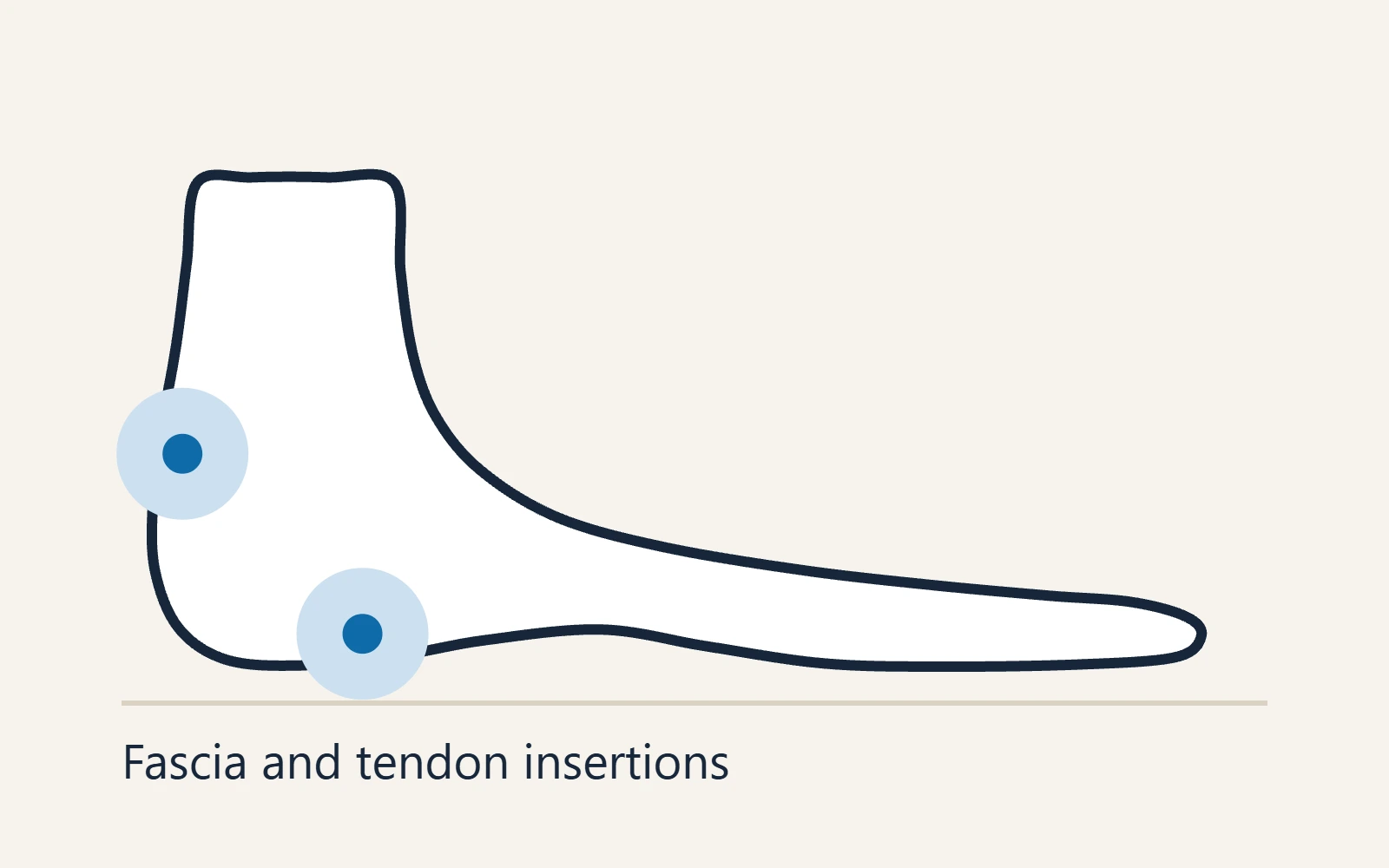
Two of the most commonly affected entheses in the entire body happen to be in the heel: where the plantar fascia attaches underneath, and where the Achilles tendon attaches at the back. So the heel is often where these diseases announce themselves first — sometimes years before a diagnosis is made.
The single most useful distinction on this page: mechanical heel pain gets worse with use and better with rest. Inflammatory heel pain gets better with use and worse with rest. If your heels hurt most after sitting still and loosen up once you are moving, that is the wrong way round for a mechanical problem.
Mechanical versus inflammatory
| Inflammatory | Mechanical | |
|---|---|---|
| How many heels | Frequently both, though it can start in one | Usually one |
| Typical age | Often twenties to forties | Commonly forties and upward |
| Morning stiffness | Lasts well over half an hour, sometimes hours | Sharp for the first steps, settled within minutes |
| Effect of activity | Improves as you move | Improves briefly, then worsens with prolonged load |
| Effect of rest | Worsens; sitting through a film is uncomfortable | Relieves it |
| Night pain | Common, particularly the second half of the night | Unusual |
| Elsewhere in the body | Back, other joints, skin, nails, eyes or gut often involved | Confined to the foot |
| Response to orthotics and stretching | Partial at best, and it stalls | Usually the mainstay of recovery |
The questions that actually sort it
If heel pain is inflammatory, the answer is rarely in the foot. It is in the rest of the history, and these are the questions worth asking yourself before an appointment.
- Does your lower back ache in the second half of the night, and is it better after you get up and move rather than after you rest? Inflammatory back pain behaves in the same inverted way as inflammatory heel pain.
- Do you have psoriasis anywhere, including hidden sites such as the scalp, behind the ears, the navel or the natal cleft? Have your nails pitted, ridged or lifted from the nail bed?
- Has a whole finger or toe ever swollen up like a sausage, rather than just one knuckle?
- Have you had a painful red eye that needed drops from an eye specialist?
- Do you have ongoing bowel symptoms — persistent diarrhoea, blood or mucus, unexplained weight loss?
- Did this start a few weeks after a gut or urinary infection? That pattern can trigger reactive arthritis.
- Is there a family history of psoriasis, ankylosing spondylitis, or inflammatory bowel disease?
A yes to several of these, alongside heel pain in both heels with prolonged morning stiffness, is worth putting in front of a doctor rather than a foot specialist.
What tends to be behind it
Enthesitis at the heel is most associated with a family of conditions collectively called spondyloarthritis. That includes axial spondyloarthritis and ankylosing spondylitis, psoriatic arthritis, reactive arthritis, and arthritis associated with inflammatory bowel disease. They share the tendency to attack entheses rather than joint linings, which is why the heel is such a frequent starting point.
These are not rare conditions, and delays to diagnosis are notoriously long — frequently measured in years. Heel pain that behaves inflammatorily is one of the more useful early signals available.
How it is investigated
- The history, principally. The inverted pattern and the associated features carry more weight than any single test.
- Blood tests. Inflammatory markers may be raised, but a normal result does not exclude anything — they are frequently normal in isolated enthesitis. Testing for HLA-B27 adds information but is neither a diagnosis on its own nor a requirement for one.
- Ultrasound. Can show a thickened enthesis with increased blood flow, which is a more specific finding than thickening alone.
- MRI. Can show inflammation within the bone at the attachment, and is also how the sacroiliac joints are assessed when axial disease is suspected.
What treatment looks like
- Get the diagnosis made by the right specialist. This is rheumatology territory. Foot care is genuinely useful alongside it, but it is supportive rather than definitive, and pursuing it alone is how years get lost.
- Anti-inflammatory medication is usually first line, and the response can be striking in a way that it rarely is for mechanical heel pain. A dramatic response is itself informative.
- Targeted modern treatments work where they are indicated. Where enthesitis is part of a broader spondyloarthritis, biologic therapies aimed at the relevant immune pathways are effective. The conventional tablets used for rheumatoid arthritis are generally disappointing for enthesitis specifically, which is a distinction worth knowing.
- Keep moving. Unlike most mechanical heel problems, where load has to be reduced, exercise tends to help inflammatory disease. Structured activity is part of treatment, not a risk to be managed.
- Use footwear and orthoses as support, not as the plan. Cushioning, a heel lift and a shoe that does not press on a tender Achilles insertion all make daily life easier. They will not control the disease.
One specific caution
Steroid injection around an inflamed Achilles insertion carries a risk of tendon rupture and is approached with real caution in this setting. If an injection is being proposed for back-of-heel pain in someone with suspected inflammatory disease, it is a reasonable thing to ask about directly.
When to be seen
Arrange a medical opinion — not just a podiatry opinion — if you have heel pain in both heels, morning stiffness lasting more than about thirty minutes, heel or back pain that wakes you in the night and eases when you get up, psoriasis or pitted nails alongside heel pain, a whole finger or toe that has swollen, a history of painful red eye, ongoing bowel symptoms, or heel pain that began shortly after a gut or urinary infection.
Heel pain that has not responded to three months of proper mechanical treatment is always worth re-examining. Where the pattern above is present, the question is not which orthotic to try next.
Common questions
Can plantar fasciitis affect both heels at once?
It can, and in people who stand all day on hard floors it is not unusual. So two sore heels is not proof of anything by itself. It becomes significant when it appears alongside the other features — a younger patient, prolonged morning stiffness, pain that eases with movement and returns with rest, and involvement elsewhere in the body.
My inflammatory blood tests were normal. Does that rule this out?
No. Inflammatory markers are commonly normal when enthesitis is the main or only feature, and a normal result is regularly misread as proof that nothing inflammatory is happening. The pattern of symptoms carries more diagnostic weight than the blood test does.
Why does my heel feel better once I start walking?
That is the hallmark of inflammatory rather than mechanical pain. Inflammation and the stiffness that accompanies it build during rest and disperse with movement. A mechanically overloaded tissue does the reverse — it tolerates the first few minutes and protests as load accumulates.
Do I still need orthotics and stretching?
They remain worth using, because a heel with enthesitis is still being loaded every day and easing that load makes you more comfortable. What they will not do is control the underlying disease. Think of them as sensible support running alongside proper medical treatment, rather than as the treatment itself.
Which doctor should I see?
Start with your family doctor, with the specific features written down — both heels, how long the morning stiffness lasts, what happens on rest versus movement, any skin, nail, eye, bowel or back involvement, and the family history. That list is what prompts a rheumatology referral. A foot and ankle specialist can help with the heel and can recognise the pattern, but the diagnosis and treatment belong with rheumatology.
- Enthesopathies. StatPearls, NCBI Bookshelf.
- Seronegative Spondyloarthropathy. StatPearls, NCBI Bookshelf.
- Ankylosing Spondylitis. StatPearls, NCBI Bookshelf.
- Schwartz R, et al. Plantar Heel Pain. StatPearls, NCBI Bookshelf.
Related heel pain guides
- Heel pain in the morning
- Plantar fasciitis
- Heel pain: how to work out what you have
- Achilles tendonitis
- Heel spurs
- Heel pain care in Michigan
- When to worry about heel pain
Heel pain in Michigan?
Dr. Biernacki sees heel pain at Balance Foot & Ankle in Howell and Bloomfield Township, and part of that examination is recognising the heels that are not a mechanical problem at all. Where the pattern points to inflammatory disease, the useful thing a foot specialist can do is say so early and point you to the right referral.
Not sure this is your problem? Start with working out what you have. This page is general education, not medical advice, and it cannot diagnose your heel.